

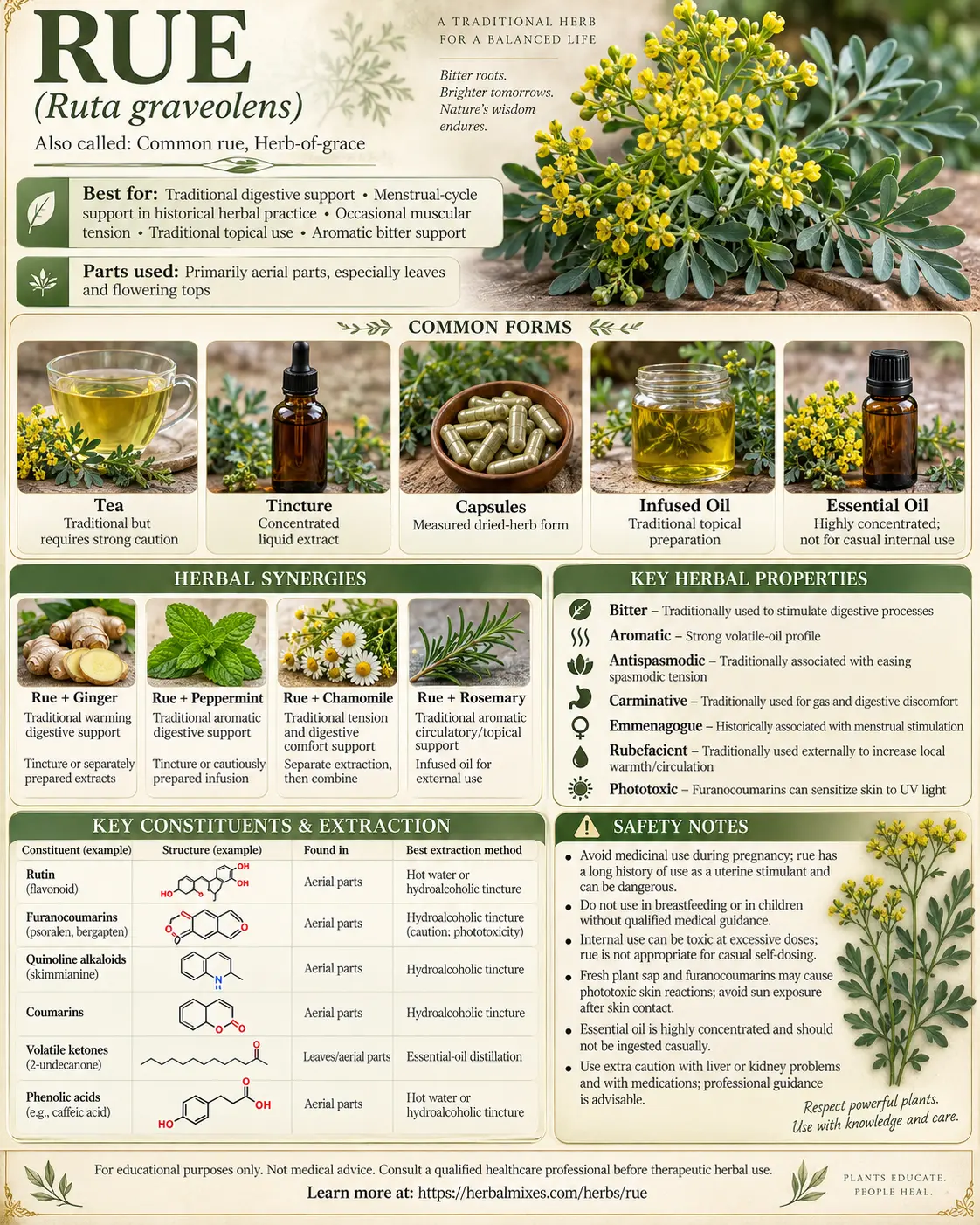
What Rue Is Good For
Historical digestive support — Rue has traditionally been used as a bitter aromatic herb for indigestion, gas, abdominal discomfort, and sluggish digestion. Modern controlled human evidence supporting these uses is very limited.
Traditional menstrual use — Rue has a long history as an emmenagogue, meaning an herb used to stimulate menstrual flow. Because this activity overlaps with historical abortifacient use and reproductive toxicity, it is primarily a safety concern rather than a recommended home treatment.
Antispasmodic activity — Extracts and isolated rue constituents demonstrate smooth-muscle and antispasmodic effects experimentally. Clinical evidence in humans remains insufficient.
Inflammatory support — Flavonoids, alkaloids, coumarins, and other rue constituents show anti-inflammatory effects in laboratory and animal research. These findings remain predominantly preclinical.
Antimicrobial activity — Rue extracts show antibacterial, antifungal, antiviral, and antiparasitic activity experimentally, but these findings do not establish rue as a treatment for infection.
Because safer herbs can address most of these goals, rue is better regarded as a historically important, practitioner-level herb than an everyday medicinal plant.
Available Herbal Products
Buying Guides for Available Rue Products
Because of rue’s toxicity and reproductive risks, these products are listed primarily for botanical reference and practitioner-guided use, not as routine self-care recommendations.
Rue Tincture – Dried Ruta graveolens herb extracted in alcohol, glycerin, and water. Currently listed in stock, with explicit warnings against pregnancy and nursing and regarding photosensitivity. Seller: HawaiiPharm – View Rue Tincture →
Rue Alcohol-Free Extract – Dried-herb glycerite using vegetable glycerin and water. Currently listed in stock; avoiding alcohol does not remove the herb’s inherent safety concerns. Seller: HawaiiPharm – View Rue Alcohol-Free Extract →
Organic Rue Dried Herb – Loose Ruta graveolens aerial herb suitable for botanical, ceremonial, or practitioner-directed preparations. Currently available for purchase. Seller: Gaia Garden Herbals – View Organic Rue Dried Herb →
Rue Cut & Sifted – Single-ingredient dried leaf and small stem pieces, currently available and described for herbal crafts, sachets, incense, and formulations. Seller: Southwest Herb – View Rue Cut & Sifted →
For digestive, menstrual-comfort, or calming purposes, herbs such as ginger, fennel, chamomile, lemon balm, or cramp bark generally provide safer alternatives.
Herbal Synergies
Because rue has a relatively narrow safety margin, these pairings are best understood as historical relationships or safer-substitution strategies, not DIY recommendations for concentrated rue formulas.
Rue + Fennel
Best for: Historical gas and digestive cramping
Rue was traditionally used as an aromatic digestive stimulant, while fennel provides well-established carminative and antispasmodic activity with a much wider safety margin.
Best extraction: For routine use, prefer fennel seed infusion rather than concentrated rue.
Rue + Ginger
Best for: Sluggish digestion and abdominal discomfort
Ginger provides warming digestive stimulation, nausea support, and carminative action without rue’s significant reproductive and phototoxicity concerns.
Best extraction: Ginger tea, tincture, or powder is generally the preferable option.
Rue + Chamomile
Best for: Digestive tension and mild cramping
Chamomile contributes gentle antispasmodic, carminative, and calming activity.
Best extraction: Covered chamomile infusion is preferable for everyday self-care.
Rue + Lemon Balm
Best for: Nervous digestion and abdominal tension
Lemon balm combines mild antispasmodic action with calming nervine activity and has a much more favorable routine safety profile.
Best extraction: Covered hot infusion or tincture.
Rue + Cramp Bark
Best for: Menstrual cramping
Rue’s historical menstrual-stimulating reputation makes it problematic for unsupervised use, while cramp bark provides a more appropriate traditional antispasmodic option.
Best extraction: Cramp-bark decoction or tincture rather than rue-containing DIY formulas.
Key Herbal Properties
Bitter digestive — traditional — Rue has historically been used to stimulate digestion and relieve gas.
Antispasmodic — experimental — Extracts influence smooth-muscle contraction in experimental models.
Emmenagogue — traditional — Rue has been used to stimulate menstruation; this is closely tied to its pregnancy contraindication.
Anti-inflammatory — preclinical — Flavonoids, alkaloids, and coumarins influence inflammatory pathways experimentally.
Antimicrobial — preclinical — Laboratory studies report antibacterial, antifungal, antiviral, and antiparasitic activity.
Phototoxic — Furanocoumarins can cause severe skin reactions when rue-exposed skin is subsequently exposed to UVA light.
Reproductively active / toxic — Traditional and experimental evidence makes concentrated rue inappropriate during pregnancy.






Active Compounds
Rue contains a chemically potent mixture of flavonoids, furanocoumarins, quinoline and quinolone alkaloids, acridone alkaloids, volatile oils, coumarins, and phenolic compounds.
Rutin
Found mainly in: Leaves and aerial parts
The flavonoid rutin takes its name from Ruta. It contributes antioxidant and vascular-related activity and is one of the best-known compounds associated with rue.
Best extraction: Hot water or hydroalcoholic extraction.
Quercetin
Found mainly in: Leaves
Quercetin and related flavonoids contribute antioxidant and inflammatory-modulating properties.
Best extraction: Hot water or diluted alcohol.
Bergapten
Found mainly in: Leaves and aerial tissues
Bergapten, also known as 5-methoxypsoralen, is a furanocoumarin capable of increasing skin sensitivity to UVA radiation.
Best extraction: Alcohol-rich extraction; it can also be present on fresh plant surfaces.
Xanthotoxin
Found mainly in: Leaves and aerial parts
Xanthotoxin, or 8-methoxypsoralen, is another photosensitizing furanocoumarin isolated from rue.
Best extraction: Hydroalcoholic or solvent extraction.
Psoralen-Type Furanocoumarins
Found mainly in: Leaves and stems
These compounds can form DNA photoadducts after UVA exposure and are responsible for rue’s characteristic phytophotodermatitis risk.
Best extraction: Alcohol-containing preparations extract them efficiently—which is one reason concentrated extracts deserve caution.
Graveoline
Found mainly in: Leaves and other aerial tissues
Graveoline is a quinolone alkaloid isolated from rue and investigated for several biological activities.
Best extraction: Alcohol-rich extraction.
Skimmianine
Found mainly in: Aerial parts and roots
Skimmianine is a furoquinoline alkaloid reported from Ruta graveolens and studied experimentally for pharmacological activity.
Best extraction: Hydroalcoholic extraction.
Volatile Oil
Found mainly in: Fresh aerial parts
Rue essential oil contains potent volatile ketones and other aromatic compounds.
Best extraction: Steam distillation.
Concentrating this fraction significantly increases toxicity risk; rue essential oil should not be casually swallowed.
FAQ
What is rue best used for?
Historically, rue was used for digestion, menstrual stimulation, spasms, and pain.
Today, its toxicity and phototoxicity mean safer herbs are generally preferable for those purposes.
Is rue safe to drink as tea?
Rue tea is less concentrated than essential oil, but that does not make it a good everyday tea.
Internal rue can cause significant adverse effects, especially at excessive doses, and concentrated use is inappropriate during pregnancy.
Why can rue burn the skin in sunlight?
Rue contains psoralen-type furanocoumarins.
When plant juice contacts the skin and the area is subsequently exposed to UVA radiation, a severe phototoxic reaction called phytophotodermatitis can develop, with redness, blistering, and later pigmentation.
Can rue bring on a menstrual period?
Rue was historically used as an emmenagogue, but it should not be used as a home method to induce menstruation.
A missed period may indicate pregnancy or another condition that requires evaluation, and rue has a history of serious toxicity when used for abortion.
Can rue essential oil be taken internally?
It should not be casually ingested.
Essential oil concentrates rue’s most potent volatile compounds and can produce serious toxic effects at inappropriate doses.
Safety & Precautions
Rue is a high-caution medicinal herb.
Do not use rue during pregnancy. Its traditional emmenagogue and abortifacient use, combined with experimental reproductive effects, makes concentrated internal use inappropriate.
It should also be avoided during breastfeeding because adequate safety data are lacking and the plant contains potent biologically active compounds.
Do not give medicinal rue preparations to children.
Fresh rue can cause significant phytophotodermatitis. Skin exposed to rue sap and then sunlight may develop redness, burning, swelling, blisters, and prolonged dark pigmentation.
Wear gloves when harvesting or handling large amounts of fresh rue and wash exposed skin before sun exposure.
Rue should not be used as a homemade insect repellent applied to the skin because the combination of plant exposure and sunlight can cause severe phototoxic reactions.
Internal poisoning can involve nausea, vomiting, severe abdominal pain, dizziness, weakness, neurological symptoms, liver or kidney injury, and reproductive toxicity, depending on the preparation and amount.
Avoid swallowing rue essential oil.
People with liver disease, kidney disease, gastrointestinal disease, seizure disorders, or significant medication use should avoid experimenting with rue.
The presence of furanocoumarins also creates theoretical potential for interactions involving drug-metabolizing enzymes, although clinically reliable interaction data are limited.
Do not use rue to attempt to induce menstruation, miscarriage, or labor.
If a significant amount of rue or rue essential oil has been swallowed and symptoms develop, seek urgent medical advice. In the United States, Poison Control can be reached at 1-800-222-1222.
Given the availability of safer alternatives, routine internal medicinal use of rue is generally difficult to justify without qualified professional supervision.
References
- Kew Plants of the World Online — Ruta graveolens L.
- PubMed — Traditional Uses, Phytochemistry, Pharmacology and Toxicology of Ruta graveolens: 2024 Critical Review
- PubMed — Exploring the Genus Ruta: Traditional Uses, Pharmacology and Safety Concerns
- PubMed — Genus Ruta: Biological and Pharmacological Properties
- PubMed — Rue-Associated Phytophototoxicity
- PubMed — Phytotoxins from the Leaves of Ruta graveolens
- HawaiiPharm — Rue Tincture
- HawaiiPharm — Rue Alcohol-Free Extract
- Gaia Garden Herbals — Organic Rue Dried Herb
- Southwest Herb — Rue Cut & Sifted
Disclaimer
Disclaimer: This article is for educational purposes only and is not intended to diagnose, treat, cure, or prevent any disease. Herbal products can cause side effects and interact with medications. Consult a qualified healthcare professional before using herbs therapeutically, especially if you are pregnant, breastfeeding, taking prescription medications, or managing a medical condition.