

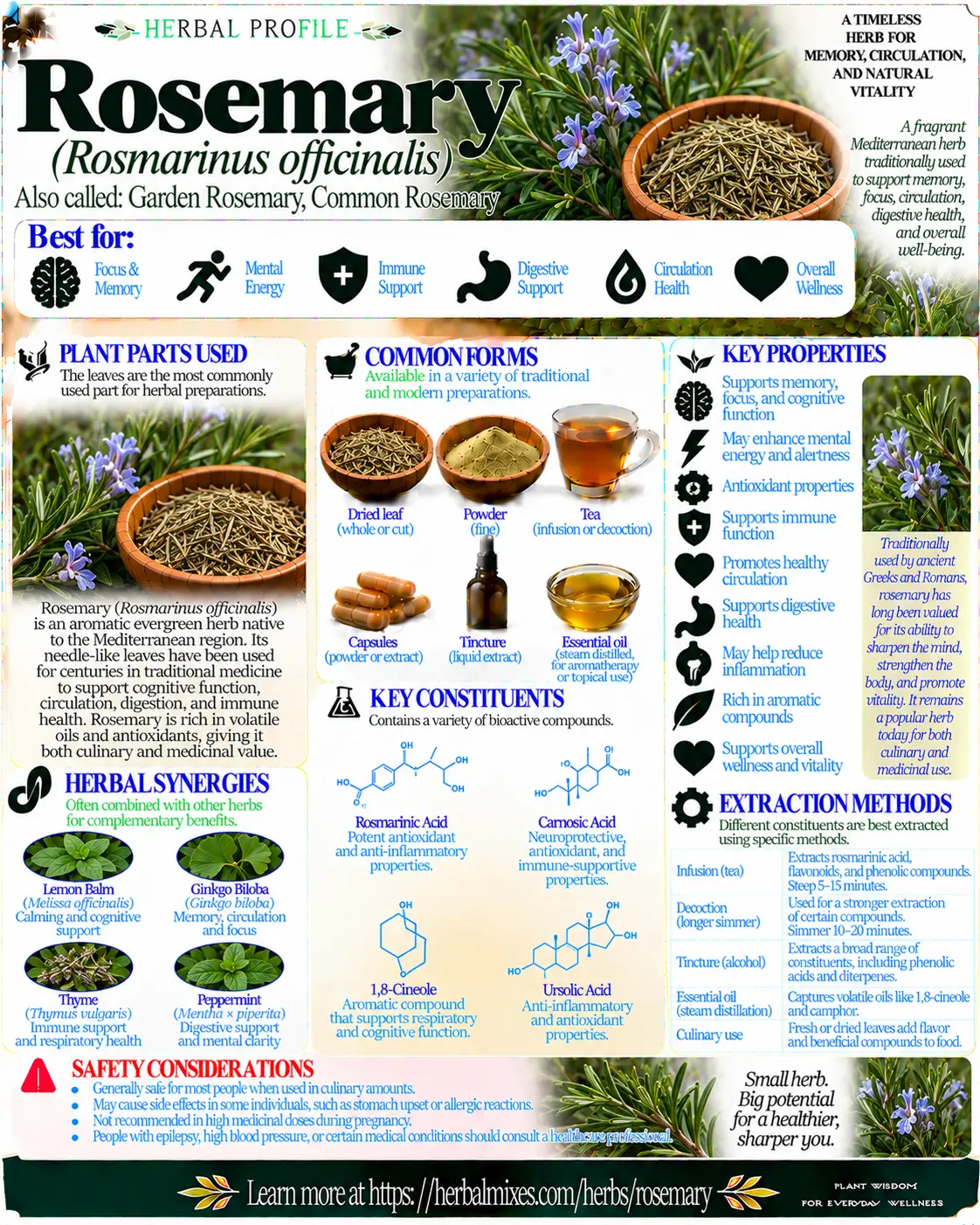
What Rosemary Is Good For
Memory & focus — Rosemary has a longstanding reputation for supporting memory and mental alertness. Small randomized trials have reported improvements in aspects of memory and cognitive performance, although results vary by dose and preparation.
Mental fatigue — Its aromatic volatile oils, particularly 1,8-cineole, contribute to rosemary’s stimulating sensory profile. Rosemary is often used when mental work feels sluggish or concentration declines.
Digestive support — Rosemary leaf is traditionally used for indigestion, bloating, and mild gastrointestinal discomfort. The European Medicines Agency recognizes rosemary leaf within the therapeutic area of gastrointestinal disorders.
Circulatory support — EMA also recognizes traditional rosemary use in circulatory complaints. Rosemary is commonly used as a warming aromatic herb in topical and internal formulas intended to support peripheral circulation.
Scalp & hair support — A randomized comparative trial involving 100 people with androgenetic alopecia found that both rosemary oil and 2% minoxidil significantly increased hair count after six months, with no significant difference between groups. This was only one trial, so rosemary oil should not be considered proven equivalent to standard hair-loss treatment.
Antioxidant protection — Rosemary is especially rich in carnosic acid, carnosol, and rosmarinic acid, compounds extensively studied for antioxidant and inflammatory-modulating activity.
Available Herbal Products
Buying Guides for Available Rosemary Products
Rosemary Liquid Herbal Extract – Fresh leafy-tip tincture. Made from Regenerative Organic Certified Salvia rosmarinus at a 1:1.75 fresh-herb ratio and currently available directly from the manufacturer. Seller: Herb Pharm – View Herb Pharm Rosemary →
Organic Rosemary Leaf Cut & Sifted – Loose dried leaf. An organic Rosmarinus officinalis product currently listed in stock and well suited to tea, culinary use, and herbal blends. Seller: Starwest Botanicals – View Organic Rosemary Leaf →
Organic Rosemary Leaf Powder – Finely ground leaf. A currently in-stock whole-herb powder suitable for capsules, culinary preparations, or custom formulas. Seller: Starwest Botanicals – View Organic Rosemary Leaf Powder →
Rosemary Leaf 350 mg – Whole-leaf vegan capsules. Provides 700 mg rosemary leaf per two-capsule serving and is currently listed in stock. Seller: Nature’s Way / iHerb – View Nature’s Way Rosemary Leaf →
For everyday digestive and antioxidant use, leaf tea, food, or tincture is usually more appropriate than essential oil. For scalp applications, choose a properly formulated topical rosemary product rather than applying undiluted essential oil.
Herbal Synergies
Rosemary pairs especially well with ginkgo, peppermint, ginger, sage, and nettle depending on whether the goal is cognition, digestion, circulation, or scalp support.
Rosemary + Ginkgo
Best for: Memory, focus, and cognitive support
Rosemary contributes aromatic stimulation and antioxidant diterpenes, while ginkgo has better-developed clinical research related to cerebral circulation and cognitive function.
Best extraction: Rosemary tincture or tea combined with standardized ginkgo extract.
Rosemary + Peppermint
Best for: Mental alertness and digestive sluggishness
Both are aromatic mint-family herbs. Rosemary contributes warming stimulation while peppermint adds cooling carminative and antispasmodic activity.
Best extraction: Covered hot infusion or hydroalcoholic tincture.
Rosemary + Ginger
Best for: Sluggish digestion and cold circulation
Rosemary provides aromatic bitter and circulatory support, while ginger contributes warming carminative and gastric-motility effects.
Best extraction: Rosemary tea or tincture combined with ginger tea or powder.
Rosemary + Sage
Best for: Memory and antioxidant support
Rosemary and sage share several polyphenols and volatile compounds and have complementary traditional reputations for cognition.
Best extraction: Covered hot infusion or tincture.
Rosemary + Nettle
Best for: Scalp and hair-support formulas
Rosemary is often used topically to support scalp circulation, while nettle adds mineral-rich traditional scalp and hair support.
Best extraction: Rosemary diluted topical oil or rinse combined with nettle infusion.
Key Herbal Properties
Nootropic supportive — Small human trials suggest possible benefits for memory and cognitive performance.
Carminative — Rosemary’s aromatic compounds help explain its traditional use for bloating and digestive discomfort.
Digestive stimulant — Its bitter and volatile constituents can stimulate digestive activity.
Circulatory stimulant — traditional — Rosemary has longstanding use as a warming herb for peripheral circulation.
Antioxidant — Carnosic acid, carnosol, and rosmarinic acid are among rosemary’s most important antioxidant compounds.
Anti-inflammatory — experimental — Rosemary diterpenes and polyphenols influence inflammatory pathways in laboratory and animal studies.
Antimicrobial — experimental — Rosemary essential oil demonstrates antibacterial and antifungal activity in vitro.
Topical scalp supportive — Limited clinical evidence suggests rosemary oil may support hair growth in androgenetic alopecia.







Active Compounds
Rosemary contains two major phytochemical fractions: volatile essential-oil compounds such as 1,8-cineole and camphor, and nonvolatile polyphenols and diterpenes such as rosmarinic acid, carnosic acid, and carnosol.
Carnosic Acid
Found mainly in: Leaves
Carnosic acid is one of rosemary’s signature antioxidant diterpenes.
It has been extensively studied for antioxidant, inflammatory-modulating, neuroprotective, and cellular effects.
Best extraction: Alcohol-rich or lipid-compatible extraction. Carnosic acid is relatively lipophilic and is not extracted as efficiently by plain water.
Carnosol
Found mainly in: Leaves
Carnosol is closely related to carnosic acid and can form through oxidation during processing and storage.
It contributes strongly to rosemary’s antioxidant activity.
Best extraction: Hydroalcoholic or lipid-compatible extraction.
Rosmarinic Acid
Found mainly in: Leaves
Rosmarinic acid is a characteristic mint-family polyphenol with antioxidant and inflammatory-modulating activity.
Best extraction: Hot water or hydroalcoholic extraction.
1,8-Cineole
Found mainly in: Essential oil
Also called eucalyptol, 1,8-cineole contributes rosemary’s sharp aromatic character and has been investigated for respiratory, cognitive, and antimicrobial activity.
Best extraction: Steam distillation or alcohol-rich tincture.
Camphor
Found mainly in: Essential oil
Camphor contributes the penetrating, warming aroma of rosemary oil.
It is pharmacologically active and becomes much more important from a safety perspective in concentrated essential oil.
Best extraction: Steam distillation.
Alpha-Pinene
Found mainly in: Essential oil
Alpha-pinene contributes pine-like aroma and experimental antioxidant and antimicrobial activity.
Best extraction: Steam distillation.
Borneol
Found mainly in: Essential oil
Borneol is a monoterpene alcohol contributing to rosemary’s aroma and sensory activity.
Best extraction: Steam distillation or hydroalcoholic tincture.
Ursolic Acid
Found mainly in: Leaves
Ursolic acid is a pentacyclic triterpene associated with experimental anti-inflammatory and metabolic activity.
Best extraction: Alcohol-rich or lipid-compatible extraction.
FAQ
What is rosemary best used for?
Rosemary is especially useful for digestive support, mental alertness, memory support, circulation, antioxidant protection, and topical scalp care.
Its strongest traditional recognition is for digestive and circulatory complaints, while cognitive and hair-growth uses have emerging clinical evidence.
Does rosemary really improve memory?
Possibly.
A small randomized study in older adults found that a low dose of rosemary powder improved some measures of memory speed, while a much higher dose impaired performance. Another trial in university students found improvements in memory-related measures after one month.
Does rosemary oil really help hair growth?
There is limited but interesting evidence.
One six-month randomized trial found significant increases in hair count with both rosemary oil and 2% minoxidil, with no significant difference between the two groups.
More independent trials are needed before rosemary oil can be considered equivalent to established treatments.
Is rosemary tea the same as rosemary essential oil?
No.
Tea extracts rosmarinic acid, flavonoids, tannins, and small amounts of volatile compounds.
Essential oil is highly concentrated in volatile compounds such as 1,8-cineole, camphor, and alpha-pinene and requires much greater safety caution.
Is rosemary stimulating?
It can be mildly stimulating.
Its aroma is often associated with alertness and mental clarity, so sensitive people may prefer not to use concentrated rosemary products close to bedtime.
Safety & Precautions
Rosemary used normally as a culinary herb is generally safe for most adults.
Concentrated extracts and especially essential oil require more caution.
Do not swallow undiluted rosemary essential oil. High exposure to concentrated camphor- and cineole-rich preparations can cause nausea, vomiting, neurological symptoms, or seizures.
Essential oil should be diluted appropriately before topical use.
Avoid contact with the eyes, mucous membranes, and broken skin, and perform a patch test if you have sensitive skin.
People with epilepsy or seizure disorders should use highly concentrated rosemary essential-oil products cautiously because camphor and related volatile constituents may lower seizure threshold at high exposure.
EMA’s rosemary monographs describe several medicinal preparations for adults and adolescents but do not support indiscriminate use of concentrated essential oil in young children.
Pregnancy requires caution with concentrated medicinal preparations. Ordinary culinary rosemary is very different from high-dose extracts or essential oil.
Avoid using rosemary essential oil internally during pregnancy.
Safety during breastfeeding is also insufficiently established for concentrated preparations.
Rosemary may theoretically influence blood pressure, blood sugar, and platelet function, so concentrated supplements deserve caution alongside antihypertensive, diabetes, anticoagulant, or antiplatelet medication.
Human interaction data remain limited.
Topical rosemary oil can cause contact dermatitis, redness, burning, or scalp irritation.
Do not use rosemary as a substitute for medical evaluation of sudden memory decline, persistent digestive symptoms, severe circulatory problems, or unexplained hair loss.
Hair loss can result from thyroid disease, iron deficiency, autoimmune disease, medication effects, nutritional deficiency, hormonal changes, or scarring disorders, some of which require specific treatment.
Anyone who is pregnant, breastfeeding, taking anticoagulants or neurological medication, or managing epilepsy, diabetes, or cardiovascular disease should discuss concentrated rosemary preparations with an appropriate healthcare professional.
References
- European Medicines Agency — Rosemary Leaf
- PubMed — Short-Term Effects of Rosemary on Cognitive Function in Older Adults
- PubMed — Rosemary and Memory, Anxiety, Depression, and Sleep in University Students
- PubMed — Rosemary Oil vs. Minoxidil 2% for Androgenetic Alopecia
- PubMed — Rosmarinus officinalis: Updated Phytochemistry and Biological Activity Review
- PubMed — Rosemary and Its Topical Applications
- PubMed — Rosemary and Nervous-System Disorders: Updated Review
- Herb Pharm — Rosemary Liquid Herbal Extract
- Starwest Botanicals — Organic Rosemary Leaf
- Starwest Botanicals — Organic Rosemary Leaf Powder
- Nature’s Way / iHerb — Rosemary Leaf Capsules
Disclaimer
Disclaimer: This article is for educational purposes only and is not intended to diagnose, treat, cure, or prevent any disease. Herbal products can cause side effects and interact with medications. Consult a qualified healthcare professional before using herbs therapeutically, especially if you are pregnant, breastfeeding, taking prescription medications, or managing a medical condition.