

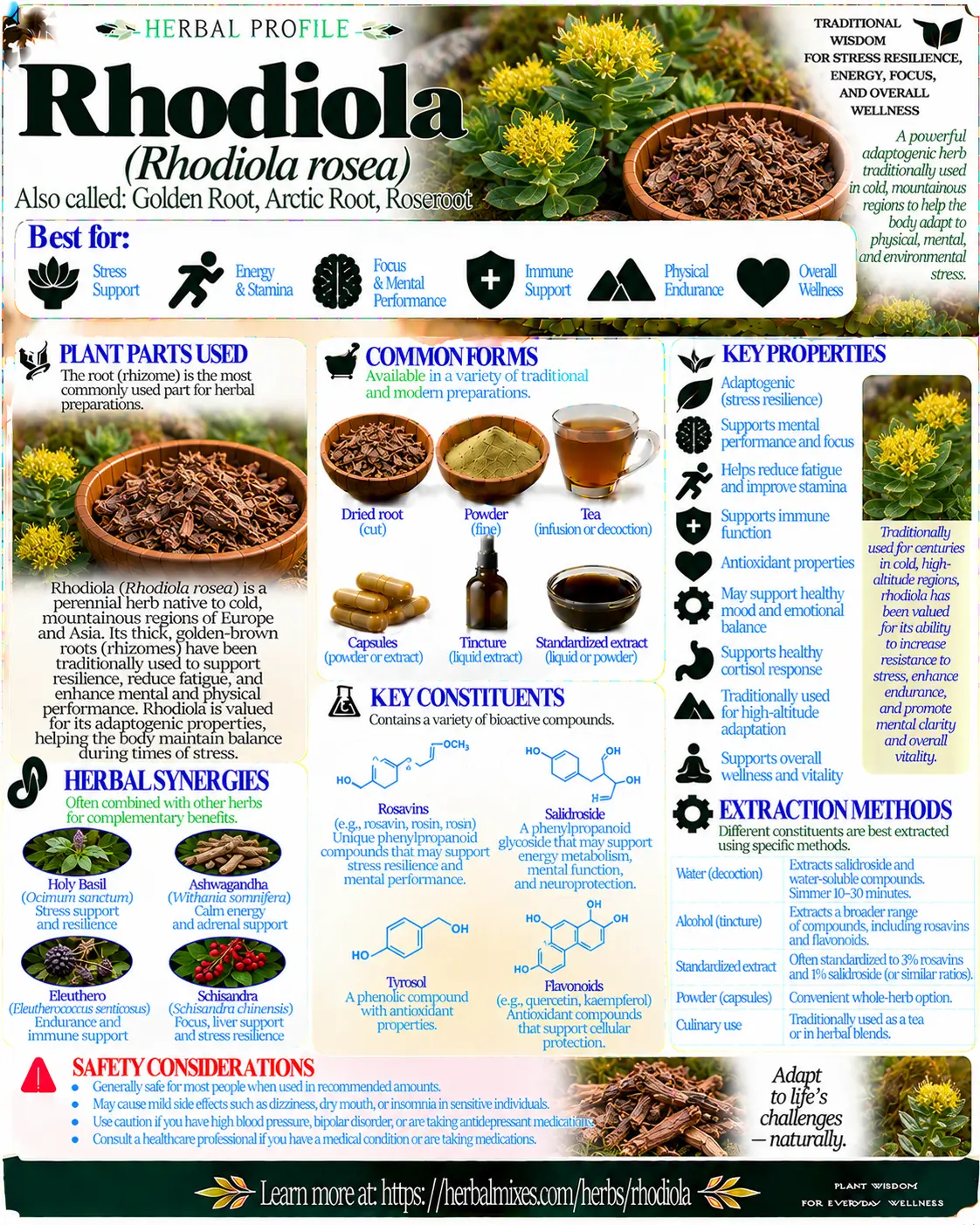
What Rhodiola Is Good For
Stress resilience — Rhodiola is widely used as an adaptogenic herb to support performance during physical or mental stress. NCCIH notes that it has a long history of use for fatigue, endurance, work performance, mood, and cognition, although the overall quality of human evidence remains limited.
Mental fatigue — Several small clinical studies suggest standardized rhodiola extracts may help reduce mental fatigue, particularly during demanding work, study, shift work, or prolonged stress.
Low energy and burnout-related symptoms — Rhodiola is often used when fatigue is accompanied by emotional exhaustion or reduced concentration. Some trials report improvement, but many studies are small or lack strong placebo controls, so the evidence should be considered promising rather than definitive.
Focus under stress — Rhodiola may help preserve attention, reaction speed, and cognitive performance during stressful or fatiguing situations, although effects vary between studies.
Physical endurance — Research has examined rhodiola for exercise performance and perceived exertion. Some trials suggest modest benefits, while others do not, so it should not be viewed as a reliable performance enhancer.
Available Herbal Products
Buying Guides for Available Rhodiola Products
Rhodiola 500 mg – Standardized root extract. Provides 500 mg of Rhodiola rosea root extract standardized to at least 3% rosavins and 1% salidroside and is currently available directly from the manufacturer. Seller: NOW Foods – View NOW Rhodiola 500 mg →
Rhodiola Liquid Herbal Extract – Certified-organic dried-root tincture. A convenient liquid preparation made specifically from Rhodiola rosea root and currently available directly from the manufacturer. Seller: Herb Pharm – View Herb Pharm Rhodiola →
Rhodiola Rosea Liquid Phyto-Caps – Concentrated root extract. A currently available Gaia Herbs preparation sold through iHerb and designed for adaptogenic stress and energy support. Seller: Gaia Herbs / iHerb – View Gaia Herbs Rhodiola Rosea →
Rhodiola Extract 250 mg – Standardized capsule extract. A widely available Rhodiola rosea supplement currently listed through iHerb. Seller: Life Extension / iHerb – View Rhodiola Extract →
For standardized products, the classic benchmark is approximately 3% rosavins and 1% salidroside. Products that list only “rhodiola” without specifying Rhodiola rosea or marker compounds are harder to compare with published research.
Herbal Synergies
Rhodiola pairs especially well with ashwagandha, schisandra, holy basil, ginseng, and oat straw depending on whether the goal is energy, stress resilience, mental performance, or nervous-system recovery.
Rhodiola + Ashwagandha
Best for: Stress with fatigue and poor recovery
Rhodiola tends to feel more activating, while ashwagandha is often more calming and restorative.
Best extraction: Standardized extracts or separate tinctures.
Rhodiola + Schisandra
Best for: Mental endurance and stress adaptation
Both are classic adaptogenic herbs. Rhodiola emphasizes mental and physical performance, while schisandra adds lignan-rich stress and liver support.
Best extraction: Hydroalcoholic tinctures or standardized extracts.
Rhodiola + Holy Basil
Best for: Daytime stress with mental fatigue
Rhodiola provides stimulating adaptogenic support, while holy basil adds a more calming aromatic effect.
Best extraction: Rhodiola extract combined with holy-basil tea or tincture.
Rhodiola + Panax Ginseng
Best for: Significant fatigue and reduced stamina
Both can be stimulating adaptogens, making the combination better suited to people who tolerate activating herbs well.
Best extraction: Standardized root extracts.
Avoid taking this combination late in the day if it interferes with sleep.
Rhodiola + Oat Straw
Best for: Burnout-like fatigue with nervous-system depletion
Rhodiola contributes adaptogenic stimulation, while oat straw adds gentle nutritive and nervine support.
Best extraction: Rhodiola tincture or capsule alongside a long oat-straw infusion.
Key Herbal Properties
Adaptogenic — Rhodiola is used to improve resilience during physical and psychological stress.
Antifatigue — Human studies suggest possible reductions in fatigue, though evidence quality varies.
Nootropic supportive — Some studies suggest improvements in attention, concentration, and mental performance during stress.
Mildly stimulating — Rhodiola can feel energizing and may increase alertness.
Antioxidant — Rosavins, salidroside, tyrosol, and other phenolics contribute antioxidant activity.
Neuroprotective — experimental — Salidroside and related constituents demonstrate neuroprotective effects in laboratory and animal studies.
Mood supportive — preliminary — Small clinical studies have examined rhodiola for mild depressive symptoms, but evidence is insufficient to recommend it as a replacement for antidepressant treatment.




Active Compounds
Rhodiola root contains phenylpropanoids, phenylethanol derivatives, flavonoids, proanthocyanidins, monoterpenes, phenolic acids, and other polyphenols.
The most important quality markers are rosavins and salidroside.
Rosavin
Found mainly in: Root and rhizome of Rhodiola rosea
Rosavin is one of the signature phenylpropanoid glycosides used to distinguish R. rosea from many other Rhodiola species.
Best extraction: Hydroalcoholic extraction. Rosavin is polar enough for water-alcohol mixtures and is routinely concentrated in standardized extracts.
Rosarin
Found mainly in: Root and rhizome
Rosarin belongs to the same rosavin family and contributes to the characteristic phytochemical profile of Rhodiola rosea.
Best extraction: Hydroalcoholic tincture or standardized extract.
Rosin
Found mainly in: Root and rhizome
Rosin is another cinnamyl-alcohol-derived glycoside grouped with rosavin and rosarin.
Best extraction: Hydroalcoholic extraction.
Salidroside
Found mainly in: Root and rhizome
Salidroside, also called rhodioloside, is one of rhodiola’s most extensively studied compounds.
Experimental research associates it with antioxidant, neuroprotective, metabolic, and stress-response effects.
Best extraction: Water or hydroalcoholic extraction because salidroside is relatively polar.
Tyrosol
Found mainly in: Root
Tyrosol is a phenolic compound related to salidroside and contributes to antioxidant activity.
Best extraction: Water or alcohol-water mixtures.
Proanthocyanidins
Found mainly in: Root
These polyphenolic compounds contribute antioxidant and astringent activity.
Best extraction: Water or hydroalcoholic preparations.
Flavonoids
Found mainly in: Root and aerial tissues
Rhodiola contains several flavonoids that complement its phenylpropanoid profile.
Best extraction: Hot water or diluted alcohol.
-
FAQ
What is rhodiola best used for?
Rhodiola is most commonly used for stress-related fatigue, low energy, mental exhaustion, and maintaining performance during demanding periods.
NCCIH notes that there still is not enough reliable evidence to conclude that rhodiola is effective for any specific health condition.
Is rhodiola stimulating?
It can be.
Some people experience increased alertness or energy, while others find it simply reduces fatigue. Sensitive people may experience jitteriness, irritability, or insomnia.
What do 3% rosavins and 1% salidroside mean?
These are common standardization markers used in many clinical-style Rhodiola rosea extracts.
NOW Foods, for example, currently sells an extract standardized to at least 3% total rosavins and 1% salidroside.
Should rhodiola be taken in the morning or evening?
Morning or early afternoon is generally preferable because it can be stimulating.
People who experience insomnia should avoid taking it close to bedtime.
How long has rhodiola been studied for safety?
NCCIH states that rhodiola is possibly safe for up to about 12 weeks. Longer-term safety is less certain.
Safety & Precautions
Rhodiola is generally well tolerated for short-term use, but possible adverse effects include insomnia, agitation, headache, dizziness, dry mouth, and gastrointestinal discomfort.
Because it can feel stimulating, begin conservatively if you are sensitive to caffeine or other activating supplements.
NCCIH considers rhodiola possibly safe for up to 12 weeks, but long-term safety has not been well established.
Use caution with antidepressants, stimulants, ADHD medications, and other drugs affecting serotonin, norepinephrine, or dopamine because pharmacodynamic interactions are theoretically possible.
People with bipolar disorder or a history of mania or hypomania should be especially cautious. Stimulating herbs may aggravate mood elevation or agitation in susceptible individuals.
Stop use if you develop unusual racing thoughts, marked agitation, severe insomnia, or mood elevation.
NOW Foods currently advises that its standardized rhodiola extract is not recommended during pregnancy or nursing.
Reliable pregnancy and breastfeeding safety data remain inadequate for concentrated rhodiola extracts.
People taking medications for blood pressure or blood sugar should also use caution because experimental and limited clinical research suggests rhodiola may influence both.
Do not use rhodiola to self-treat persistent fatigue without investigating possible causes such as anemia, thyroid disease, sleep apnea, depression, infection, diabetes, medication effects, or cardiovascular disease.
Seek medical evaluation when fatigue is severe, unexplained, progressively worsening, associated with weight loss, shortness of breath, chest pain, neurological symptoms, or persists despite adequate sleep.
Anyone who is pregnant, breastfeeding, taking psychiatric or stimulant medications, or managing bipolar disorder, diabetes, or cardiovascular disease should discuss therapeutic rhodiola use with an appropriate healthcare professional.
References
- Kew Plants of the World Online — Rhodiola rosea L.
- NCCIH — Rhodiola: Usefulness and Safety
- PubMed — Rhodiola and Stress-Related Fatigue: Clinical Review
- PubMed — Rhodiola Rosea: Systematic Review of Clinical Trials
- NOW Foods — Rhodiola 500 mg
- Herb Pharm — Rhodiola Liquid Herbal Extract
- Gaia Herbs / iHerb — Rhodiola Rosea
- iHerb — Rhodiola Supplements
Disclaimer
Disclaimer: This article is for educational purposes only and is not intended to diagnose, treat, cure, or prevent any disease. Herbal products can cause side effects and interact with medications. Consult a qualified healthcare professional before using herbs therapeutically, especially if you are pregnant, breastfeeding, taking prescription medications, or managing a medical condition.