

What Red Raspberry Leaf Is Good For
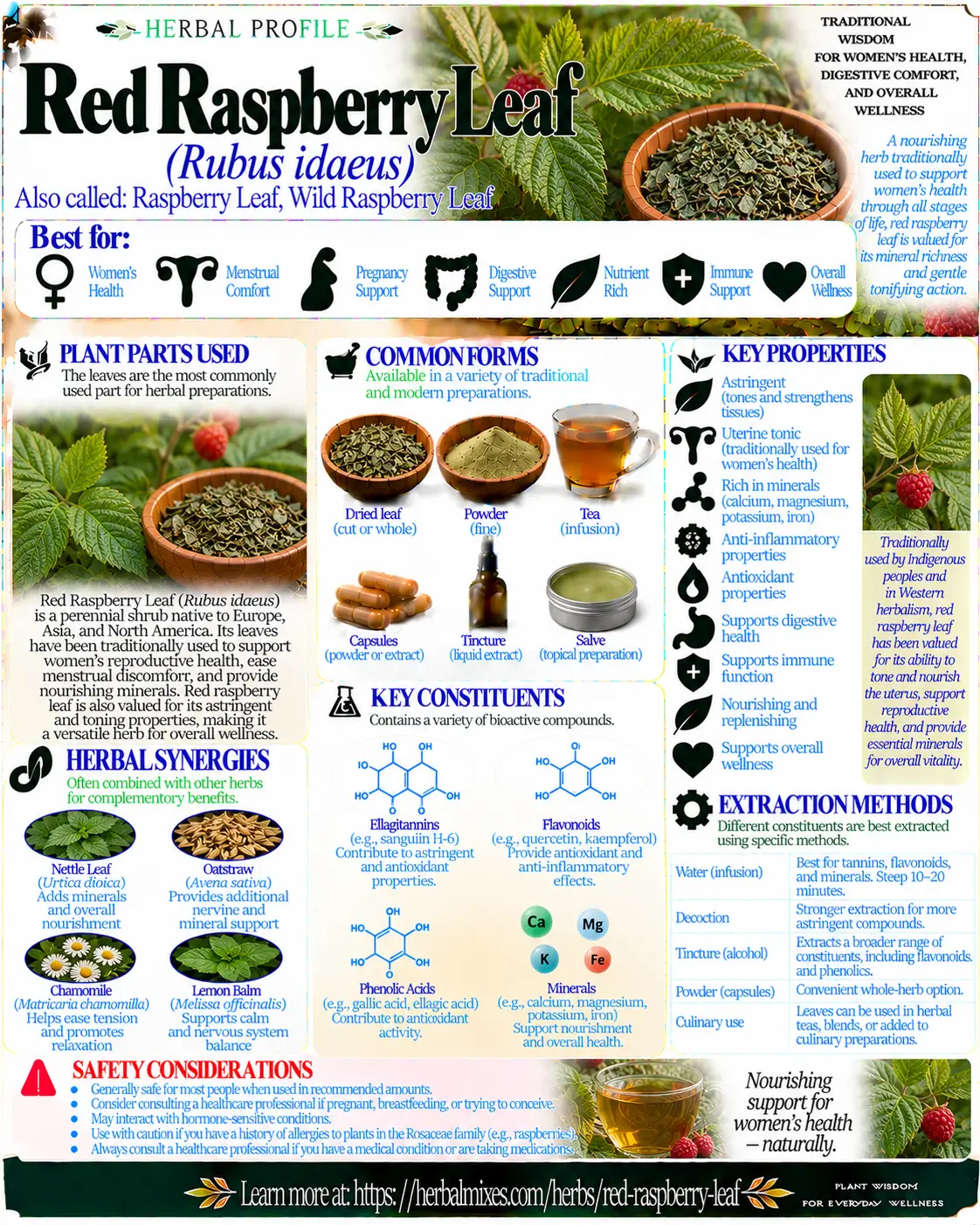
Menstrual comfort — Raspberry leaf is traditionally used for menstrual cramping and pelvic tension. Its tannins provide astringency, while experimental research suggests the leaf can influence smooth-muscle activity, although strong clinical trials for menstrual pain are lacking.
Traditional uterine support — Raspberry leaf is widely described in herbal medicine as a uterine tonic, particularly during the later stages of pregnancy. However, this traditional reputation is considerably stronger than the modern clinical evidence.
Late-pregnancy use — The herb is often taken with the intention of preparing for labor. A randomized trial involving 192 low-risk first-time mothers used 2.4 g/day from 32 weeks until labor and found no shortening of the first stage of labor and no major maternal or infant adverse effects.
Digestive astringency — The leaf is rich in tannins and other polyphenols, giving tea its slightly drying, black-tea-like character. This supports its traditional use for mild loose stool and irritated digestive tissues.
Nutritive herbal tea — Raspberry leaf contains minerals and a diverse range of polyphenols, including ellagitannins, flavonoids, and phenolic acids. A recent chemical analysis detected dozens of polyphenolic compounds in raspberry-leaf samples and confirmed that tea preparation extracts many of them.
Available Herbal Products
Buying Guides for Available Red Raspberry Leaf Products
Organic Raspberry Leaf Powder – Finely ground Rubus idaeus leaf suitable for capsules, smoothies, or herbal formulations. Currently listed in stock. Seller: Starwest Botanicals – View Organic Raspberry Leaf Powder →
Organic Raspberry Leaf Tea Bags – Single-herb caffeine-free tea made from organic Rubus idaeus leaf and currently listed in stock. Seller: Starwest Botanicals – View Organic Raspberry Leaf Tea Bags →
Organic Red Raspberry Leaf – Loose cut-and-sifted leaf for tea and herbal blending, currently available through iHerb. Seller: Frontier Co-op / iHerb – View Frontier Organic Red Raspberry Leaf →
Raspberry Leaf 320 mg – Whole-leaf vegan capsules for people who prefer measured servings instead of tea. Currently available through iHerb. Seller: Nature’s Way / iHerb – View Nature’s Way Raspberry Leaf →
Red Raspberry 400 mg – Whole Rubus idaeus leaf in vegan capsules and currently available. Seller: Solaray / iHerb – View Solaray Red Raspberry →
Traditional Medicinals Raspberry Leaf Tea is a well-known product, but the manufacturer currently lists it out of stock, so it is not included above as an available recommendation.
Herbal Synergies
Red raspberry leaf pairs especially well with cramp bark, nettle, ginger, chamomile, and oat straw depending on whether the goal is menstrual comfort, nutritive support, digestive tension, or pregnancy-oriented herbal formulas.
Red Raspberry Leaf + Cramp Bark
Best for: Menstrual cramping and pelvic tension
Raspberry leaf provides traditional uterine-tonic and astringent activity, while cramp bark contributes more directly antispasmodic smooth-muscle support.
Best extraction: Raspberry-leaf infusion combined with cramp-bark decoction or tincture.
Red Raspberry Leaf + Nettle
Best for: Nutritive support and traditional pregnancy formulas
Both are mineral-rich leafy herbs commonly included in nutritive teas.
Nettle contributes additional minerals and traditional urinary support, while raspberry leaf provides tannins and reproductive-system associations.
Best extraction: Long hot-water infusion.
Red Raspberry Leaf + Ginger
Best for: Menstrual discomfort with digestive upset
Raspberry leaf contributes traditional uterine support, while ginger provides warming antispasmodic, digestive, and nausea-supportive activity.
Best extraction: Raspberry-leaf infusion combined with fresh ginger tea.
Red Raspberry Leaf + Chamomile
Best for: Menstrual tension with nervousness
Raspberry leaf provides mild astringent and traditional uterine support, while chamomile contributes relaxing antispasmodic and nervine effects.
Best extraction: Covered hot infusion.
Red Raspberry Leaf + Oat Straw
Best for: Nutritive and nervous-system support
Raspberry leaf contributes tannins and polyphenols, while oat straw adds gentle nutritive and traditional nervous-system support.
Best extraction: Long hot-water infusion.
Key Herbal Properties
Astringent — Raspberry leaf is rich in tannins and ellagitannins that tighten and tone tissues.
Uterine tonic — traditional — Its most famous traditional use is supporting uterine tone, particularly in pregnancy and menstrual formulas.
Antispasmodic — traditional / experimental — Raspberry leaf has historically been used for menstrual and digestive cramping, although experimental studies show complex rather than uniformly relaxing effects on smooth muscle.
Nutritive — The leaf supplies minerals and numerous polyphenolic compounds.
Antioxidant — Ellagitannins, flavonoids, and phenolic acids provide substantial antioxidant activity.
Anti-inflammatory — experimental — Raspberry polyphenols influence inflammatory pathways in laboratory studies.
Antidiarrheal — traditional — Its tannin-rich astringency helps explain traditional use for mild loose stool.




Active Compounds
Raspberry leaf contains a broad mixture of ellagitannins, flavonoids, phenolic acids, tannins, minerals, and other polyphenols. Modern analytical work has identified more than 50 polyphenolic compounds in leaf samples.
Sanguiin H-6
Found mainly in: Leaves and fruit
Sanguiin H-6 is a major raspberry ellagitannin and an important contributor to the plant’s antioxidant and astringent properties.
Ellagitannins are among the dominant polyphenols associated with red raspberry.
Best extraction: Hot water or hydroalcoholic extraction.
Lambertianin C
Found mainly in: Leaves and fruit
Lambertianin C is another large ellagitannin characteristic of raspberry.
It contributes to antioxidant and tannin-related tissue effects.
Best extraction: Hot-water infusion or hydroalcoholic extract.
Ellagic Acid
Found mainly in: Released from ellagitannins during processing and digestion
Ellagic acid is produced through breakdown of raspberry ellagitannins and is widely studied for antioxidant and cellular effects.
Best extraction: Hydroalcoholic preparations provide broad recovery, while tea also delivers precursor ellagitannins.
Quercetin Glycosides
Found mainly in: Leaves
Raspberry leaf contains quercetin-related flavonoids that contribute antioxidant and inflammatory-modulating activity.
Best extraction: Hot water or diluted alcohol.
Kaempferol Glycosides
Found mainly in: Leaves
Kaempferol derivatives form another important part of the leaf’s flavonoid profile.
Best extraction: Water or hydroalcoholic extraction.
Catechins
Found mainly in: Leaves
Catechin-related polyphenols contribute additional antioxidant and astringent qualities.
Best extraction: Hot-water infusion.
Phenolic Acids
Found mainly in: Leaves
Raspberry leaf contains several phenolic acids, complementing its ellagitannin and flavonoid profile.
Best extraction: Hot water or hydroalcoholic tincture.
“Fragarine”
Found mainly in: Historically attributed to raspberry leaf
Older herbal literature frequently credits a compound called fragarine with raspberry leaf’s uterine-toning effects.
However, modern reviews have not established fragarine as a clearly characterized major active compound responsible for the herb’s effects. It is therefore better treated as a historical phytochemical claim rather than a confirmed mechanism.
FAQ
What is red raspberry leaf best used for?
It is best known for menstrual comfort, traditional uterine support, nutritive tea, and mild digestive astringency.
Its famous use for preparing for labor remains traditional rather than strongly proven clinically.
Does raspberry leaf make labor easier or shorter?
The evidence does not clearly show that it does.
A systematic review found the pregnancy evidence weak, and the main randomized trial did not significantly shorten the first stage of labor.
When can raspberry leaf be taken during pregnancy?
There is no universally established evidence-based starting week.
The best-known randomized trial began supplementation at 32 weeks, but NIH notes that evidence supporting pregnancy use is very limited and safety has not been adequately established.
Is raspberry leaf tea the same as raspberry fruit?
No.
The medicinal tea is made from the leaves of Rubus idaeus, not the berries. The leaf is much more tannin-rich and has a different phytochemical profile.
Is tea or capsules better?
For traditional use, tea is the classic preparation and extracts tannins, ellagitannins, flavonoids, and other water-soluble compounds effectively.
Capsules mainly provide convenience and a more easily measured quantity of whole leaf.
Safety & Precautions
Red raspberry leaf has a long history of use during pregnancy, but traditional use should not be confused with proven pregnancy safety.
The NIH Office of Dietary Supplements states that raspberry leaf is promoted for strengthening the uterus and facilitating labor, but the evidence supporting these claims is very limited and pregnancy safety has not been well studied.
A 2021 systematic review included 13 studies—only six involving humans—and concluded that the evidence supporting pregnancy use is weak. Experimental studies showed raspberry leaf can affect uterine and other smooth muscle, but the direction and clinical importance of these effects remain uncertain.
The main randomized trial involved 192 low-risk first-time mothers taking 2.4 g/day from 32 weeks onward. No major adverse maternal or infant effects were observed, but raspberry leaf did not shorten the first stage of labor.
A 2024 observational study found some apparently favorable labor outcomes among users, but the researchers specifically warned that the findings cannot establish either effectiveness or safety because the study was small and nonrandomized.
Because of this uncertainty, anyone who is pregnant should discuss raspberry-leaf use with their obstetrician or midwife, particularly before using concentrated extracts or beginning use early in pregnancy.
Extra caution is appropriate with a history of preterm labor, cervical insufficiency, placenta previa, unexplained pregnancy bleeding, high-risk multiple pregnancy, previous complicated delivery, or planned cesarean birth.
Safety during breastfeeding appears less concerning than pregnancy, but concentrated medicinal use has not been extensively studied.
The leaf’s high tannin content may cause nausea, stomach irritation, or constipation in sensitive people, particularly with very strong tea.
Tannin-rich preparations can theoretically reduce absorption of iron and some medications if taken simultaneously. People taking iron supplements may prefer to separate strong raspberry-leaf tea from iron by a couple of hours.
Do not use raspberry leaf to attempt to induce labor without obstetric supervision.
Seek urgent maternity care for contractions before term, vaginal bleeding, leaking fluid, severe abdominal pain, decreased fetal movement, severe headache, visual changes, or other concerning pregnancy symptoms.
Anyone pregnant, breastfeeding, taking regular medication, or managing a high-risk pregnancy should discuss therapeutic raspberry-leaf use with an appropriate healthcare professional.
References
- NIH Office of Dietary Supplements — Dietary Supplements and Pregnancy
- PubMed — Biophysical Effects, Safety and Efficacy of Raspberry Leaf in Pregnancy: Systematic Review
- PubMed — Raspberry Leaf in Pregnancy: Safety and Efficacy in Labor
- PubMed — Raspberry Leaf Use in Pregnancy: 2024 Prospective Observational Study
- PubMed — Raspberry Leaf: Should It Be Recommended to Pregnant Women?
- PubMed — Raspberry Leaf and Cervical Ripening/Labor Review
- PubMed — Polyphenol Composition of Raspberry Leaf
- PubMed — Red Raspberry Ellagitannins: 2026 Review
- Starwest Botanicals — Organic Raspberry Leaf Powder
- Starwest Botanicals — Organic Raspberry Leaf Tea Bags
- Frontier Co-op / iHerb — Red Raspberry Leaf
- Solaray / iHerb — Red Raspberry 400 mg
Disclaimer
Disclaimer: This article is for educational purposes only and is not intended to diagnose, treat, cure, or prevent any disease. Herbal products can cause side effects and interact with medications. Consult a qualified healthcare professional before using herbs therapeutically, especially if you are pregnant, breastfeeding, taking prescription medications, or managing a medical condition.