

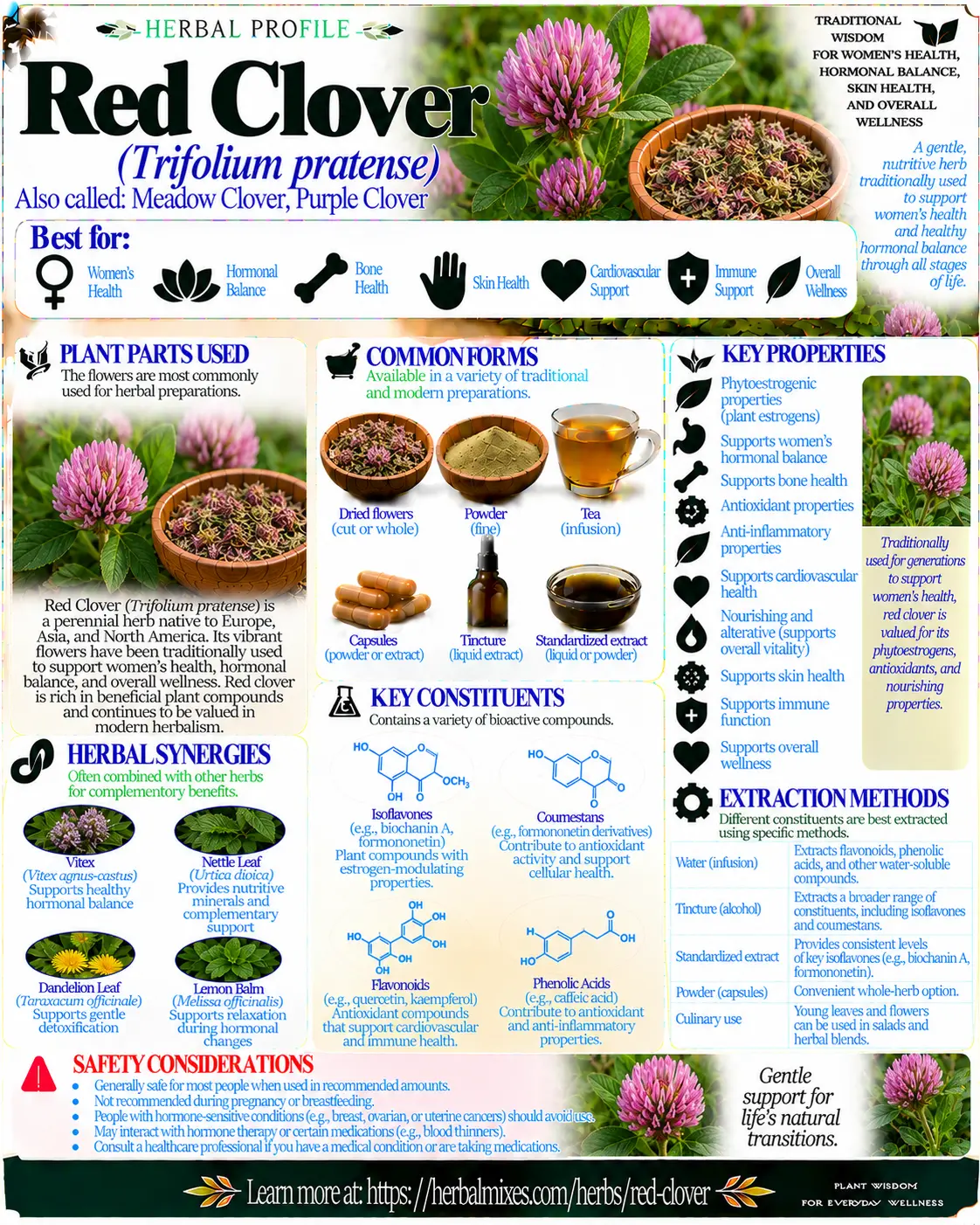
What Red Clover Is Good For
Menopausal hot flashes — Red clover contains isoflavones that can interact with estrogen receptors. Clinical findings are mixed: NCCIH considers the overall evidence inconclusive, although some trials and meta-analyses of standardized extracts have reported reductions in hot-flash frequency.
Night sweats and menopausal symptoms — Standardized red-clover isoflavone products are widely used for vasomotor symptoms. Benefits appear to depend heavily on the specific extract, dose, and study design, so ordinary red-clover tea should not be assumed equivalent to standardized clinical extracts.
Bone-health support — Red-clover isoflavones have been studied for postmenopausal bone density and bone turnover. Results are inconsistent, and red clover should not replace established osteoporosis prevention or treatment.
Cardiovascular support — Some studies suggest modest improvements in cholesterol or vascular markers in postmenopausal women, but results remain conflicting. NCCIH considers the evidence insufficient for firm conclusions.
General phytoestrogen support — Red clover is one of the richer herbal sources of biochanin A, formononetin, genistein, and daidzein, making it useful when the therapeutic goal is specifically isoflavone exposure.
Available Herbal Products
Buying Guides for Available Red Clover Products
Red Clover Liquid Herbal Extract – Flowering-aerial-parts tincture. Made from certified-organic Trifolium pratense and currently available directly from the manufacturer. Seller: Herb Pharm – View Herb Pharm Red Clover →
Red Clover 375 mg – Whole-flower-top capsules. Provides 750 mg of red-clover flower tops per two-capsule serving and is currently available. Seller: NOW Foods – View NOW Red Clover →
Promensil Menopause – Standardized red-clover isoflavone extract. Provides 80 mg total isoflavones from a 25:1 Trifolium pratense aerial-parts extract and is the type of standardized formulation most similar to products studied clinically for hot flashes. Seller: iHerb – View Promensil Menopause →
Promensil Peri Menopause – Standardized red-clover extract blend. Provides 40 mg red-clover isoflavones plus passionflower and is currently available. Seller: iHerb – View Promensil Peri Menopause →
Nature’s Way also makes a whole-herb Red Clover Blossom product, but the current manufacturer listing shows it as backordered, so it is not included above as an available recommendation.
For menopause-related goals, a standardized isoflavone extract is more comparable with clinical research than ordinary red-clover tea or whole-herb capsules.
Herbal Synergies
Red clover pairs especially well with black cohosh, sage, flaxseed, hawthorn, and oat straw depending on whether the goal is menopausal comfort, phytoestrogen support, cardiovascular wellness, or nervous-system support.
Red Clover + Black Cohosh
Best for: Hot flashes and broader menopausal symptoms
Red clover contributes phytoestrogenic isoflavones, while black cohosh works through different neuroendocrine mechanisms and does not appear to act simply as a direct estrogen replacement.
Best extraction: Standardized extracts rather than tea when targeting menopausal symptoms.
Red Clover + Sage
Best for: Hot flashes and night sweats
Red clover provides isoflavones, while sage has traditional and emerging clinical use for excessive sweating and hot flashes.
Best extraction: Standardized red-clover extract combined with sage tincture or extract.
Red Clover + Flaxseed
Best for: Phytoestrogen and cardiovascular support
Red clover contributes isoflavones, while flaxseed provides lignans, soluble fiber, and alpha-linolenic acid.
Best extraction: Red-clover extract or infusion combined with freshly ground flaxseed.
Red Clover + Hawthorn
Best for: Midlife cardiovascular support
Red clover contributes isoflavones and potential lipid effects, while hawthorn adds flavonoids and procyanidins associated with vascular and cardiac support.
Best extraction: Red-clover tincture or standardized extract combined with hawthorn tincture or extract.
Red Clover + Oat Straw
Best for: Menopausal stress and nervous tension
Red clover provides hormonal-transition support, while oat straw adds gentle nutritive and nervine activity.
Best extraction: Red-clover tincture or infusion combined with a long oat-straw infusion.
Herbal Properties
Key Herbal Properties
Phytoestrogenic — Red clover is rich in isoflavones that can bind estrogen receptors, generally with weaker activity than endogenous estrogen.
Menopause supportive — Standardized extracts have shown benefit in some hot-flash trials, though the overall evidence remains mixed.
Antioxidant — Isoflavones and other phenolic compounds contribute antioxidant activity.
Cardiovascular supportive — Some clinical research suggests possible effects on lipids and vascular function, but findings are inconsistent.
Bone supportive — Isoflavones have been investigated for bone turnover and postmenopausal bone density.
Anti-inflammatory — experimental — Biochanin A, formononetin, and related compounds influence inflammatory signaling in laboratory and animal studies.
Antiproliferative — experimental — Red-clover isoflavones show cellular effects in preclinical cancer research, but this does not make red clover a cancer treatment.


Active Compounds
Red clover is best known for its isoflavones, especially biochanin A and formononetin, along with smaller amounts of genistein, daidzein, flavonoids, coumarin-related compounds, phenolic acids, and other constituents.
Biochanin A
Found mainly in: Flowering aerial parts
Biochanin A is one of red clover’s major isoflavones.
It is a methylated precursor that can be metabolized in the body to genistein.
Best extraction: Hydroalcoholic extraction or standardized extract. It is less efficiently extracted into plain water than into alcohol-water mixtures.
Formononetin
Found mainly in: Flowering tops and leaves
Formononetin is another major red-clover isoflavone and can be metabolized to daidzein.
Best extraction: Hydroalcoholic tincture or standardized extract.
Genistein
Found mainly in: Present directly and also formed metabolically from biochanin A
Genistein is a well-studied phytoestrogen with preferential activity at estrogen receptor beta compared with estrogen receptor alpha.
Best extraction: Hydroalcoholic or standardized isoflavone preparations.
Daidzein
Found mainly in: Present directly and derived metabolically from formononetin
Daidzein is another important isoflavone.
Some people metabolize daidzein to equol, a compound with stronger estrogen-receptor activity, while others do not.
Best extraction: Hydroalcoholic or standardized extract.
Pratensein
Found mainly in: Flowering aerial parts
Pratensein is another red-clover isoflavone occurring in smaller amounts.
Best extraction: Hydroalcoholic extraction.
Flavonoids
Found mainly in: Flowers and leaves
Red clover contains additional flavonoids that complement its isoflavone-rich profile and contribute antioxidant activity.
Best extraction: Hot water or diluted alcohol.
Coumarin-Related Compounds
Found mainly in: Aerial parts
Red clover contains naturally occurring coumarin-related constituents.
These are different from prescription anticoagulants such as warfarin, but they contribute to the reason concentrated use warrants caution in people taking blood-thinning medications.
Best extraction: Hydroalcoholic preparations.
FAQ
What is red clover best used for?
Red clover is best known for menopausal hot flashes and other midlife symptoms, especially when a standardized isoflavone extract is used.
The evidence is mixed, so it is better viewed as a possible supportive option rather than a guaranteed treatment.
Does red clover increase estrogen?
Not exactly.
Its isoflavones act as phytoestrogens, meaning they can interact with estrogen receptors. Their effects are weaker and more selective than the body’s own estrogen.
Is red clover effective for hot flashes?
Possibly.
NCCIH considers the evidence inconsistent overall, while some meta-analyses of specific standardized extracts have reported meaningful reductions in hot-flash frequency.
Is red clover tea as effective as standardized extract?
Probably not for menopause-specific goals.
Tea extracts many water-soluble constituents, but most clinical trials use standardized isoflavone products, which provide a much more defined dose.
How long does red clover take to work?
Clinical menopause products are generally studied over several weeks to months, not as immediate-relief remedies.
Some commercial standardized products advise allowing roughly 6–8 weeks before judging response.
Safety & Precautions
Red clover extracts have generally been well tolerated in clinical studies, including studies lasting up to several years, according to NCCIH.
The biggest concern is its phytoestrogen activity.
People with a history of estrogen-sensitive breast cancer, endometrial cancer, ovarian cancer, uterine fibroids, endometriosis, or other hormone-sensitive conditions should discuss concentrated red-clover extracts with their oncology or gynecology team before use.
NCCIH specifically notes concern about possible effects on hormone-sensitive tissues.
Avoid medicinal red-clover supplements during pregnancy and breastfeeding. NCCIH states that they may be unsafe in these settings.
Nature’s Way also advises against use when attempting to become pregnant.
Use caution with anticoagulant and antiplatelet medications, particularly warfarin, apixaban, rivaroxaban, clopidogrel, and aspirin, because theoretical or additive bleeding effects are possible.
People scheduled for surgery should inform their surgical team about red-clover supplementation.
Because isoflavones can have hormonal activity, use caution when taking hormone replacement therapy, oral contraceptives, tamoxifen, aromatase inhibitors, or other endocrine therapies.
Do not use red clover as an alternative to proven treatment for osteoporosis, cardiovascular disease, cancer, or severe menopausal symptoms.
Hot flashes, night sweats, vaginal bleeding after menopause, unexplained weight loss, or new breast symptoms deserve appropriate medical evaluation.
Anyone who is pregnant, breastfeeding, trying to conceive, taking blood thinners, using hormone therapy, or managing a hormone-sensitive condition should discuss therapeutic red-clover use with an appropriate healthcare professional.
References
- Kew Plants of the World Online — Trifolium pratense L.
- NCCIH — Red Clover: Usefulness and Safety
- NCCIH — Menopausal Symptoms and Complementary Health Approaches
- PubMed — Red Clover Isoflavones for Menopausal Hot Flushes: Meta-Analysis
- PubMed — Red Clover for Hot Flushes: Systematic Review
- PubMed — Updated Red Clover Hot-Flash Systematic Review
- Herb Pharm — Red Clover Liquid Herbal Extract
- NOW Foods — Red Clover 375 mg
- Promensil / iHerb — Menopause Red Clover Extract
- Promensil / iHerb — Peri Menopause Red Clover Extract
Disclaimer
Disclaimer: This article is for educational purposes only and is not intended to diagnose, treat, cure, or prevent any disease. Herbal products can cause side effects and interact with medications. Consult a qualified healthcare professional before using herbs therapeutically, especially if you are pregnant, breastfeeding, taking prescription medications, or managing a medical condition.