

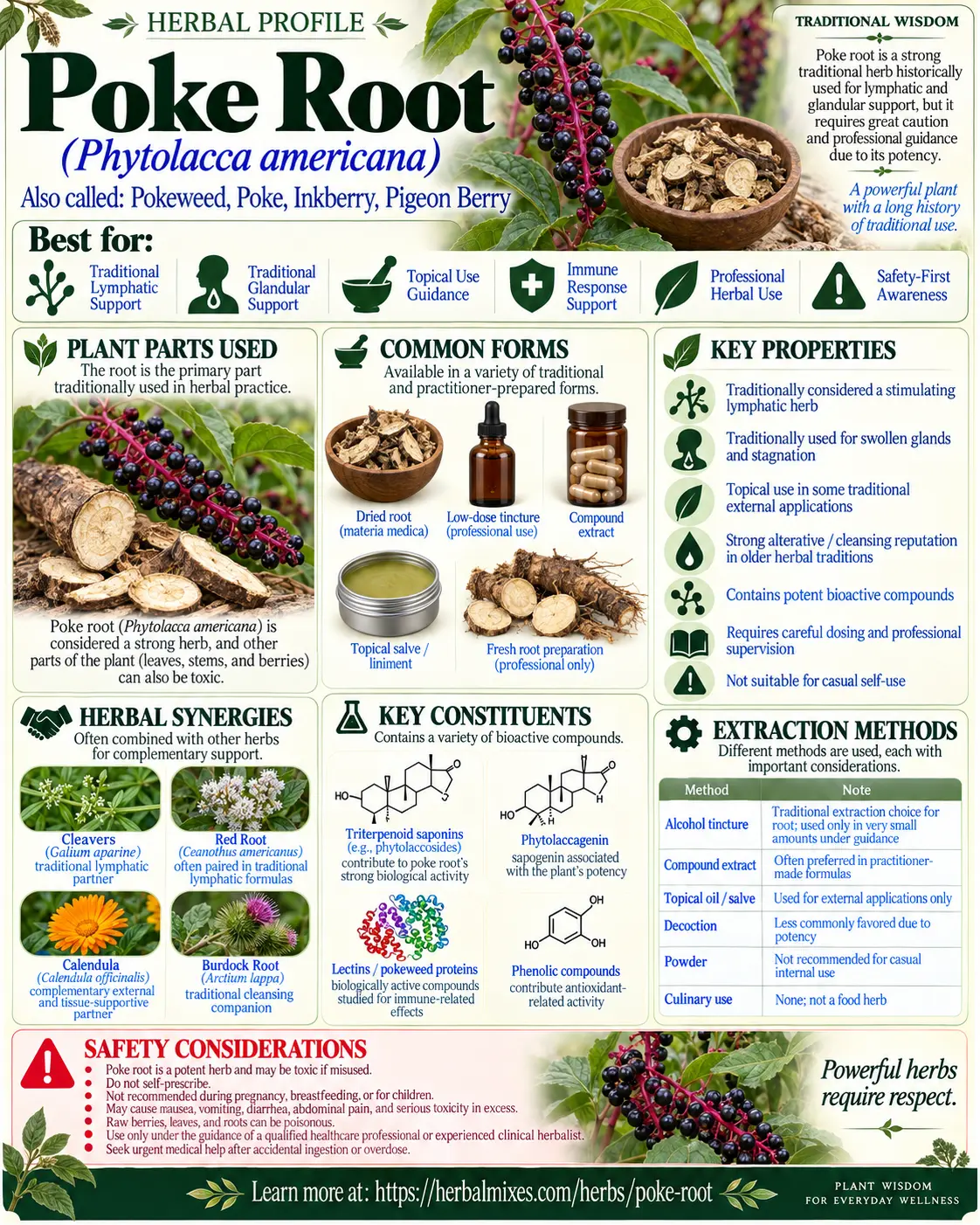
What Poke Root Is Good For
Historical lymphatic support — Poke root has a longstanding reputation in Western herbalism as a powerful lymphatic herb, particularly for swollen or congested lymph tissues. Modern clinical trials supporting this use are lacking, and toxicity sharply limits its suitability for self-care.
Traditional inflammatory support — Historical herbal practice used very small quantities of poke root for inflammatory or glandular complaints. Its triterpene saponins have anti-inflammatory activity experimentally, but this does not establish a safe or effective human therapeutic dose. (PubMed)
Traditional topical use — Ethnobotanical sources document external use of pokeweed root preparations for skin ulcers, sores, and eczema. Modern evidence is limited, and topical exposure can itself cause irritation. (PubMed Central)
Immune-system research — Pokeweed contains biologically active lectins known as pokeweed mitogens, which have been extensively used in laboratory immunology research because they stimulate lymphocytes. This is a research application—not evidence that poke root should be taken as an “immune booster.”
Botanical and pharmacological study — Pokeweed is important scientifically because of its saponins, lectins, antiviral proteins, and other potent compounds, but pharmacological potency and toxicity are closely linked.
Available Herbal Products
Buying Guides for Available Poke Root Products
Because poke root can cause serious poisoning, I would not recommend routine consumer purchase of oral poke-root products for general wellness.
A few professional or combination products still contain Phytolacca americana:
Herbal Detox Liquid Herbal Extract – Multi-herb tincture containing fresh poke root alongside Oregon grape, stillingia, wild indigo, and prickly ash. This is a concentrated formula and should be used cautiously rather than as an everyday “detox.” Seller: Herb Pharm – View Herb Pharm Herbal Detox →
Poke Root Professional Extract – Fresh-root concentrated tincture. Herb Pharm has produced a 1:1 Phytolacca americana root extract labeled for use only under the direction of an expert healthcare practitioner. Availability may vary, and this is not an appropriate routine self-care product.
For lymphatic or inflammatory support, safer herbs such as cleavers, calendula, violet leaf, echinacea, or red root are generally much more appropriate for home herbalism.
Herbal Synergies
Because poke root has a narrow safety margin, the following combinations reflect historical or practitioner-level herbalism rather than DIY recommendations.
Poke Root + Cleavers
Best for: Historical lymphatic congestion
Poke root provides very strong traditional lymphatic activity, while cleavers offers much gentler lymphatic and urinary support.
For self-care, cleavers alone is usually the safer choice.
Best extraction: Cleavers tea or tincture. Poke root should not be added casually to home formulations.
Poke Root + Calendula
Best for: Traditional lymphatic and skin support
Calendula contributes gentle lymphatic, vulnerary, and inflammatory-supportive properties without poke root’s significant toxicity.
Best extraction: Calendula tea, tincture, or topical preparation is preferable for routine use.
Poke Root + Echinacea
Best for: Historical glandular and immune-system formulas
Echinacea has a better-established safety profile for short-term immune-supportive herbal use.
Best extraction: Echinacea tincture or tea. Poke root should only be considered in expert-supervised formulations.
Poke Root + Red Root
Best for: Practitioner-guided lymphatic formulas
Both have traditional lymphatic associations, but red root (Ceanothus americanus) has a much wider safety margin.
Best extraction: Red root tincture or decoction is usually the better home-herbal option.
Poke Root + Violet Leaf
Best for: Gentle lymphatic and tissue support
Violet leaf is soothing and traditionally lymphatic, making it a much gentler alternative when poke root’s intensity is unnecessary.
Best extraction: Violet leaf infusion or tincture.
Key Herbal Properties
Lymphatic — traditional — Poke root is historically regarded as one of the strongest lymphatic herbs, but this use lacks modern controlled clinical evidence.
Anti-inflammatory — preclinical — Triterpene saponins including phytolaccosides and esculentoside-related compounds show inflammatory-modulating activity experimentally.
Immunologically active — Pokeweed lectins strongly affect lymphocyte activity and are used as laboratory mitogens.
Emetic — Pokeweed can cause intense nausea and vomiting. This is a toxic effect, not a desirable medicinal property.
Cathartic — Significant exposure can cause severe diarrhea and abdominal cramping.
Cytotoxic — Several pokeweed proteins and saponins have strong cellular effects experimentally, which helps explain both research interest and toxicity.




Active Compounds
Poke root contains triterpenoid saponins, lectins, ribosome-inactivating proteins, phytosterols, and other highly active compounds. Roots are among the most toxic portions of the plant.
Phytolaccoside A
Found mainly in: Root
Phytolaccoside A is one of several triterpenoid saponins identified in Phytolacca americana.
These compounds contribute both pharmacological activity and gastrointestinal toxicity.
Best extraction: Water and alcohol-water mixtures can extract saponins. Because extraction can concentrate toxic constituents, this is not a suitable DIY target.
Phytolaccoside B
Found mainly in: Root
Phytolaccoside B is another oleanane-type triterpene saponin isolated from poke root.
Best extraction: Hydroalcoholic or aqueous extraction, but concentrated preparations increase toxicity risk.
Phytolaccoside E
Found mainly in: Root
Also known in related literature as esculentoside A, this saponin belongs to a group investigated for anti-inflammatory and cellular activity.
Best extraction: Water or alcohol-water preparations.
Phytolaccasaponins N1–N5
Found mainly in: Root
Five structurally characterized triterpene saponins named phytolaccasaponins N1 through N5 were isolated from P. americana roots along with several previously known saponins. (PubMed)
Best extraction: Specialized solvent extraction. These compounds are research constituents rather than appropriate home-extraction targets.
Esculentosides
Found mainly in: Root
Pokeweed species contain multiple esculentosides, a family of oleanene-type saponins investigated for anti-inflammatory, antifungal, and cytotoxic effects.
Best extraction: Polar solvent extraction.
Pokeweed Mitogens
Found mainly in: Roots and other tissues
Pokeweed contains several lectins capable of strongly stimulating immune cells in laboratory systems.
At least several distinct pokeweed lectins have been characterized, including root-derived mitogenic lectins.
Best extraction: Specialized laboratory protein extraction—not home herbal preparation.
Pokeweed Antiviral Proteins
Found mainly in: Leaves, seeds, and other tissues
Pokeweed produces ribosome-inactivating proteins that have been studied for antiviral and anticancer applications in laboratory settings.
These proteins are highly biologically active and are another reason experimental findings should not be translated into casual medicinal use.
Best extraction: Specialized laboratory purification only.
Alpha-Spinasterol
Found mainly in: Root
Alpha-spinasterol is a phytosterol identified in P. americana roots.
Best extraction: Alcohol-rich or lipid-compatible extraction.
FAQ
What is poke root best used for?
Historically, poke root was used as a powerful lymphatic and glandular herb.
Today, because of its toxicity and lack of modern clinical evidence, it is better regarded as a practitioner-level or historical herb rather than a routine home remedy.
Is poke root poisonous?
Yes.
Pokeweed contains toxic saponins and other active compounds. Root ingestion can cause severe vomiting, diarrhea, abdominal pain, weakness, cardiovascular effects, neurological symptoms, and potentially life-threatening poisoning.
Can poke root be used for swollen lymph nodes?
Traditional herbalists used it for that purpose, but swollen lymph nodes can result from infection, autoimmune disease, medication reactions, or cancer.
Because poke root itself is toxic, persistent or unexplained lymph-node swelling should be medically evaluated instead of self-treated with poke root.
Are pokeberries or poke leaves safe?
All parts of pokeweed contain toxic constituents, with root generally considered among the most hazardous.
Young poke leaves have historically been eaten after repeated boiling and discarding of the cooking water, but poisoning still occurs from improper preparation. They should not be treated as an ordinary edible green.
Is poke root tincture safer than raw root?
A tincture allows very small measured amounts, but it can also efficiently extract toxic constituents.
That makes it more predictable—not inherently safe. Concentrated poke-root tincture should only be used under expert supervision.
Safety & Precautions
Poke root is a toxic herb and should not be used casually.
Most pokeweed poisonings produce pronounced gastrointestinal symptoms including nausea, repeated vomiting, severe diarrhea, abdominal cramping, and sometimes bloody vomiting. Symptoms can begin within approximately 30 minutes to several hours after ingestion.
More severe poisoning may involve weakness, dizziness, low blood pressure, abnormal heart rate, confusion, seizures, respiratory problems, or other systemic effects.
The triterpenoid phytolaccosides and related saponins are major contributors to pokeweed toxicity.
The root is especially hazardous and has been mistaken for edible or medicinal roots, resulting in accidental poisoning.
Do not use poke root during pregnancy or breastfeeding.
Do not give poke root internally to children.
People with cardiovascular, gastrointestinal, kidney, liver, neurological, or immune disorders should not experiment with poke root.
Poke root should never be used to self-treat cancer, mastitis, swollen lymph nodes, severe inflammation, infection, or autoimmune disease.
Avoid applying strong fresh-root preparations directly to skin because local irritation and absorption are possible.
Commercial products containing poke root may specify extremely small doses. This does not establish a generally safe self-treatment range because sensitivity, preparation strength, and phytochemical concentration can vary.
If poke root, pokeweed root, or an unknown quantity of pokeweed has been swallowed and symptoms develop, seek prompt medical advice.
For significant ingestion or symptoms such as persistent vomiting, severe diarrhea, fainting, confusion, seizures, breathing problems, or abnormal heartbeat, seek urgent medical care.
In the United States, Poison Control can be reached at 1-800-222-1222.
For ordinary lymphatic support, considerably safer herbs such as cleavers, calendula, violet leaf, or appropriately selected echinacea preparations are preferable.
References
- Kew Plants of the World Online — Phytolacca americana L.
- PubMed — Bioactive Triterpene Saponins from the Roots of Phytolacca americana
- PubMed Central — Phytochemistry of Cherokee Aromatic Medicinal Plants
- PubMed Central — Phytolacca americana: Chemistry and Bioactivity Review
- ScienceDirect — Identification of Phytolaccosides in Pokeweed Intoxication
- Oxford Academic — Mitogenic Lectins from Pokeweed Roots
- ScienceDirect — Esculentosides: Biological Activity and Molecular Targets
- Herb Pharm — Herbal Detox Liquid Herbal Extract
Disclaimer
Disclaimer: This article is for educational purposes only and is not intended to diagnose, treat, cure, or prevent any disease. Herbal products can cause side effects and interact with medications. Consult a qualified healthcare professional before using herbs therapeutically, especially if you are pregnant, breastfeeding, taking prescription medications, or managing a medical condition.