

What Peppermint Is Good For
Bloating & gas — Peppermint is one of the most useful aromatic carminative herbs for gas, bloating, and digestive spasms. Menthol-rich volatile oil helps relax gastrointestinal smooth muscle.
IBS-related abdominal discomfort — Enteric-coated peppermint oil has substantially better clinical evidence than peppermint tea. NCCIH reports that short-term studies suggest it can improve overall IBS symptoms, abdominal pain, bloating, and gas in some adults.
Indigestion — Peppermint leaf has long-standing traditional use for digestive discomfort and flatulence. The European Medicines Agency recognizes peppermint leaf within the therapeutic area of gastrointestinal disorders.
Nausea support — Small studies suggest peppermint extract or inhaled peppermint oil may reduce nausea in some situations, including treatment-related nausea, although the evidence is not strong enough for all causes of nausea.
Mild tension headache — EMA recognizes properly formulated peppermint oil applied to the forehead and temples for relief of mild headache. This is a topical essential-oil application, not the same as drinking peppermint tea.
Respiratory comfort — Peppermint oil creates a strong cooling sensation through menthol-sensitive receptors and is traditionally used in inhaled or topical cold preparations. It may make breathing feel easier without actually functioning as a decongestant that physically opens blocked airways.
Available Herbal Products
Buying Guides for Available Peppermint Products
Peppermint Spirits – Tincture plus peppermint essential oil. A concentrated certified-organic Mentha × piperita liquid formula for occasional indigestion, gas, and nausea; currently available directly from the manufacturer. Seller: Herb Pharm – View Herb Pharm Peppermint Spirits →
Peppermint Gels – Enteric-coated softgels. Contains peppermint oil with ginger and fennel oils and is formulated to release in the intestines rather than the stomach; currently available directly from the manufacturer. Seller: NOW Foods – View NOW Peppermint Gels →
Organic Peppermint Leaf Cut & Sifted – Dried loose leaf. A currently in-stock U.S.-grown Mentha piperita product ideal for digestive tea, culinary use, and custom herbal blends. Seller: Starwest Botanicals – View Starwest Organic Peppermint Leaf →
Organic Peppermint Leaf Tea Bags – Single-herb tea. A convenient caffeine-free Mentha piperita tea currently in stock and well suited to everyday digestive use. Seller: Starwest Botanicals – View Starwest Organic Peppermint Tea →
For IBS-type symptoms, enteric-coated peppermint oil is the form most closely supported by clinical research. For everyday bloating or post-meal digestive discomfort, peppermint leaf tea is usually the gentler choice.
Herbal Synergies
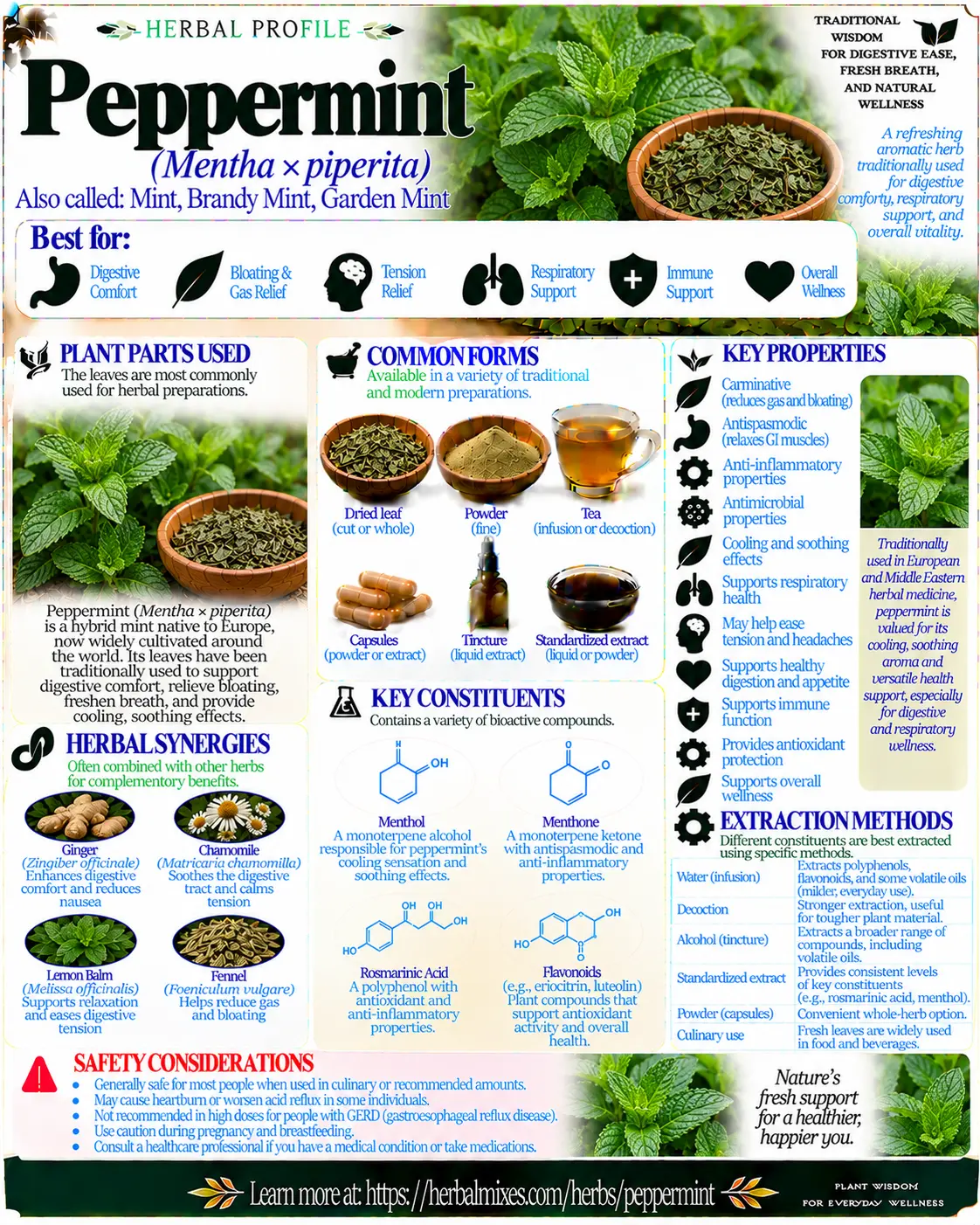
Peppermint pairs especially well with fennel, ginger, chamomile, lemon balm, and marshmallow root depending on whether the goal is gas, nausea, nervous digestion, or digestive irritation.
Peppermint + Fennel
Best for: Gas, bloating, and abdominal cramping
Peppermint contributes menthol-rich antispasmodic activity, while fennel adds anethole-rich carminative support.
This is one of the most practical combinations for post-meal bloating.
Best extraction: Covered hot infusion. Both herbs contain volatile oils that can be lost during prolonged uncovered boiling.
Peppermint + Ginger
Best for: Nausea, bloating, and sluggish digestion
Peppermint helps relax digestive spasms, while ginger supports gastric motility and nausea control.
Best extraction: Covered peppermint infusion combined with fresh ginger tea, powder, or tincture.
Peppermint + Chamomile
Best for: Nervous digestion and abdominal tension
Peppermint provides cooling carminative activity, while chamomile adds soothing antispasmodic and calming effects.
Best extraction: Covered hot infusion.
Peppermint + Lemon Balm
Best for: Bloating associated with stress
Both are mint-family aromatics, but lemon balm contributes additional gentle nervine activity.
Best extraction: Covered hot infusion or tincture to preserve volatile compounds.
Peppermint + Marshmallow Root
Best for: Digestive discomfort with irritation or dryness
Peppermint contributes carminative activity, while marshmallow root adds mucilage that soothes irritated tissues.
Best extraction: Prepare peppermint as a covered hot infusion and marshmallow separately as a cold infusion, then combine.
Key Herbal Properties
Carminative — Peppermint helps reduce gas and bloating through aromatic digestive activity.
Antispasmodic — Peppermint oil can relax gastrointestinal smooth muscle, partly through effects on calcium-dependent contraction.
Digestive supportive — Peppermint leaf has longstanding traditional use for indigestion and abdominal discomfort.
Antiemetic supportive — Peppermint aroma and extracts have shown modest nausea-reducing effects in some human studies.
Analgesic topical — Menthol-rich peppermint oil activates cold-sensitive receptors and can reduce mild headache discomfort when correctly formulated and applied topically.
Antimicrobial — Peppermint essential oil demonstrates antibacterial and antifungal activity experimentally, though this does not make it a substitute for treatment of infection.
Antioxidant — Rosmarinic acid and flavonoids contribute antioxidant activity.







Active Compounds
Peppermint contains two very different phytochemical fractions: volatile essential-oil compounds such as menthol and menthone, and water-soluble polyphenols such as rosmarinic acid and flavonoids.
Menthol
Found mainly in: Essential oil of leaves and flowering aerial parts
Menthol is peppermint’s signature cooling compound.
It activates TRPM8 cold-sensitive receptors, producing the familiar cooling sensation, and contributes to antispasmodic and topical analgesic activity.
Best extraction: Steam distillation or alcohol-rich extraction. A covered tea captures smaller amounts.
Menthone
Found mainly in: Essential oil
Menthone is another major volatile ketone contributing to peppermint’s characteristic aroma and pharmacological profile.
Best extraction: Steam distillation or hydroalcoholic tincture.
Menthyl Acetate
Found mainly in: Essential oil
Menthyl acetate contributes sweet, cooling aromatic notes and complements menthol and menthone.
Best extraction: Steam distillation.
1,8-Cineole
Found mainly in: Essential oil
1,8-Cineole, or eucalyptol, occurs in smaller amounts and contributes to peppermint’s aromatic respiratory profile.
Best extraction: Essential-oil distillation or hydroalcoholic extraction.
Rosmarinic Acid
Found mainly in: Leaves
Rosmarinic acid is a major mint-family polyphenol with antioxidant and inflammatory-modulating activity.
Unlike menthol, it extracts readily into ordinary tea.
Best extraction: Hot water or hydroalcoholic tincture.
Eriocitrin
Found mainly in: Leaves
Eriocitrin is a flavonoid glycoside found in peppermint and contributes antioxidant activity.
Best extraction: Hot-water infusion or diluted alcohol.
Luteolin Derivatives
Found mainly in: Leaves
Luteolin-related flavonoids contribute to peppermint’s antioxidant and inflammatory-modulating chemistry.
Best extraction: Hot water or hydroalcoholic extraction.
Hesperidin
Found mainly in: Leaves
Hesperidin is another flavonoid glycoside contributing to the broader polyphenol profile.
Best extraction: Hot-water infusion or diluted alcohol.
FAQ
What is peppermint best used for?
Peppermint is best supported for bloating, gas, abdominal spasms, indigestion, and short-term IBS symptom relief.
Enteric-coated peppermint oil has better clinical evidence for IBS than ordinary peppermint tea.
Does peppermint oil really help IBS?
It can.
NCCIH reports that reviews of clinical trials suggest enteric-coated peppermint oil may modestly improve overall IBS symptoms and abdominal pain over the short term, although evidence quality is not perfect and some trials have shown no significant difference from placebo.
Why does peppermint sometimes cause heartburn?
Peppermint may relax the lower esophageal sphincter, allowing stomach contents to reflux upward.
This is why peppermint can help intestinal spasms yet worsen GERD in some people.
Is peppermint tea the same as peppermint oil capsules?
No.
Tea contains small amounts of volatile oil plus substantial water-soluble polyphenols such as rosmarinic acid.
Essential-oil capsules deliver a much more concentrated dose of menthol and related volatile compounds.
Is peppermint useful for headaches?
Topically, yes for some mild headaches.
EMA recognizes certain peppermint-oil preparations applied to the forehead and temples for mild headache relief. Essential oil must be properly formulated and kept away from the eyes.
Safety & Precautions
Peppermint leaf tea is generally well tolerated, but concentrated peppermint essential oil requires more caution.
The most common problem is heartburn or reflux. Peppermint can decrease lower-esophageal-sphincter pressure, so people with GERD or hiatal hernia may find that peppermint tea or oil worsens symptoms.
NCCIH specifically notes that peppermint oil may cause reflux, heartburn, indigestion, belching, or perianal burning, particularly with oral preparations.
Enteric-coated capsules can reduce stomach exposure and may lessen some reflux-related adverse effects.
Use caution in people with significant gastrointestinal inflammation or ulcers.
Do not swallow ordinary pure aromatherapy peppermint essential oil unless it is specifically formulated and labeled for internal use.
Essential oil should be properly diluted before topical use and kept away from the eyes, mucous membranes, and damaged skin.
Peppermint oil or menthol-containing preparations should not be applied around the nose or face of infants and very young children, because concentrated menthol can trigger serious respiratory reactions.
EMA places age restrictions on several peppermint-oil uses; oral preparations for intestinal symptoms should not be used in children under 8 years, and some inhaled or topical respiratory applications have stricter pediatric limitations.
Safety during pregnancy and breastfeeding is better established for normal culinary peppermint than for concentrated medicinal essential-oil products. Use concentrated products conservatively and according to professional guidance.
Peppermint does not replace evaluation of persistent abdominal pain, unexplained weight loss, bloody stool, persistent vomiting, severe constipation, or significant bowel changes.
Anyone with severe GERD, hiatal hernia, gastrointestinal disease, pregnancy, breastfeeding, or regular prescription medication use should discuss concentrated peppermint-oil products with an appropriate healthcare professional.
References
- NCCIH — Peppermint Oil: Usefulness and Safety
- NCCIH — Irritable Bowel Syndrome and Complementary Health Approaches
- European Medicines Agency — Peppermint Leaf
- European Medicines Agency — Peppermint Oil
- Herb Pharm — Peppermint Spirits
- NOW Foods — Peppermint Gels
- Starwest Botanicals — Organic Peppermint Leaf
- Starwest Botanicals — Organic Peppermint Tea Bags
Disclaimer
Disclaimer: This article is for educational purposes only and is not intended to diagnose, treat, cure, or prevent any disease. Herbal products can cause side effects and interact with medications. Consult a qualified healthcare professional before using herbs therapeutically, especially if you are pregnant, breastfeeding, taking prescription medications, or managing a medical condition.