

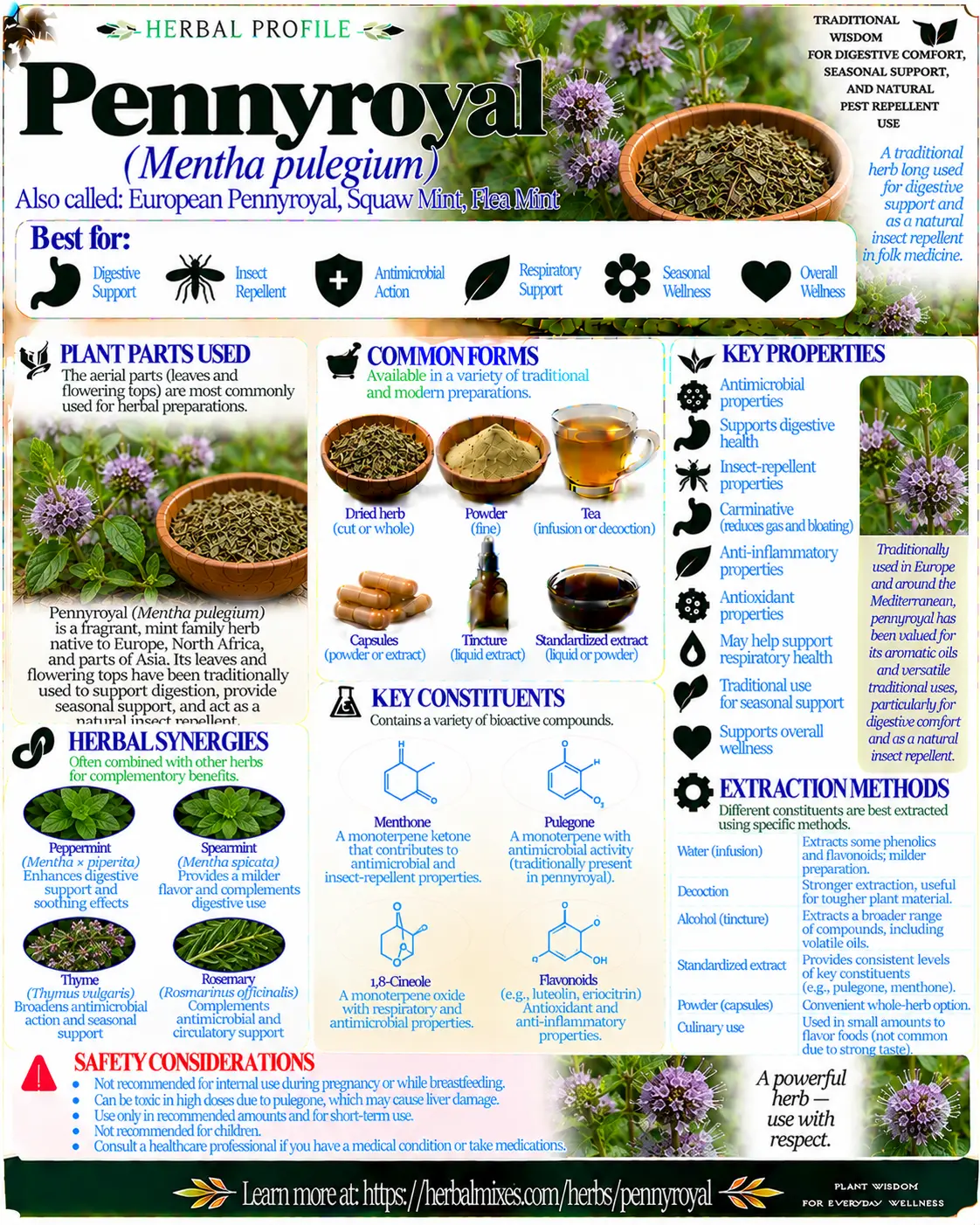
What Pennyroyal Is Good For
Historical digestive support — Pennyroyal was traditionally used as an aromatic mint for gas, digestive discomfort, and sluggish digestion. However, because safer carminative herbs such as peppermint, spearmint, fennel, and ginger are readily available, pennyroyal is rarely a sensible first choice for internal use.
Traditional menstrual use — Pennyroyal historically developed a reputation as an emmenagogue, meaning an herb used to stimulate menstruation. This is also closely connected with its historical use as an abortifacient and is a major safety concern rather than a recommended therapeutic application.
Insect-repellent use — Fresh and dried pennyroyal has traditionally been used to discourage insects. Modern research also examines Mentha pulegium volatile compounds for agricultural and pest-control applications.
Antimicrobial activity — Pennyroyal extracts and essential oil demonstrate antibacterial and antifungal activity in laboratory studies. This is experimental evidence and does not justify internal essential-oil use.
Antioxidant activity — Leaf extracts contain flavonoids and phenolic compounds with measurable antioxidant activity, but there is little reason to choose pennyroyal over safer antioxidant herbs.
Available Herbal Products
Buying Guides for Available Pennyroyal Products
Because pennyroyal has a narrower safety margin than most herbs in this series, concentrated internal-use products are not recommended here as routine wellness purchases.
In particular, pennyroyal essential oil should not be purchased for oral use. LiverTox classifies pennyroyal oil as a likely cause of clinically apparent liver injury and documents severe poisoning and deaths following ingestion.
If purchasing pennyroyal for botanical, horticultural, or carefully controlled external purposes, verify whether the species is:
European Pennyroyal — Mentha pulegium
or
American Pennyroyal — Hedeoma pulegioides
They are botanically different plants but can both contain substantial amounts of pulegone.
For digestive or calming purposes, safer alternatives include peppermint, spearmint, lemon balm, fennel, chamomile, or ginger.
Herbal Synergies
Because of pennyroyal’s toxicity concerns, these combinations are best understood as historical herbal relationships rather than recommendations for routine internal formulas.
Pennyroyal + Peppermint
Best for: Historical digestive use
Both are aromatic mints, but peppermint provides a much better-established and safer option for gas, bloating, and digestive spasms.
Best extraction: Choose peppermint tea rather than concentrated pennyroyal preparations.
Pennyroyal + Fennel
Best for: Historical gas and bloating support
Fennel provides reliable carminative and antispasmodic activity without pennyroyal’s significant pulegone-related toxicity concerns.
Best extraction: Fennel seed infusion is the preferred approach.
Pennyroyal + Ginger
Best for: Historical sluggish digestion
Ginger provides warming digestive, carminative, and nausea-supportive activity and has a substantially better safety profile.
Best extraction: Ginger tea, powder, or standardized extract.
Pennyroyal + Lemon Balm
Best for: Digestive tension with nervousness
Lemon balm provides aromatic digestive and calming support without the major hepatotoxicity associated with concentrated pennyroyal oil.
Best extraction: Covered lemon-balm infusion or tincture.
Pennyroyal + Chamomile
Best for: Digestive cramping and nervous tension
Chamomile combines carminative, antispasmodic, and calming actions and is generally a much more appropriate routine herbal option.
Best extraction: Covered hot infusion.
Key Herbal Properties
Carminative — traditional — Pennyroyal has historically been used for gas and digestive discomfort because of its strongly aromatic volatile oil.
Emmenagogue — traditional — Historical use includes stimulating menstrual flow. This action is an important reason for its pregnancy contraindication.
Antimicrobial — experimental — Essential-oil and solvent extracts inhibit various bacteria and fungi in laboratory studies.
Antioxidant — experimental — Methanolic leaf extracts contain phenolic compounds and demonstrate antioxidant activity.
Antispasmodic — traditional / experimental — Traditional digestive use and laboratory findings suggest smooth-muscle effects, but strong clinical evidence is lacking.
Insect repellent — Pennyroyal’s volatile compounds have longstanding traditional and modern agricultural applications as insect-repellent substances.
Hepatotoxic at concentrated exposure — Pulegone-rich essential oil can produce severe liver injury and is one of pennyroyal’s most clinically important pharmacological characteristics.




Active Compounds
Mentha pulegium contains volatile monoterpenes, flavonoids, phenolic acids, tannins, and other secondary metabolites. Essential-oil chemistry varies considerably, but pulegone is often a major constituent.
Pulegone
Found mainly in: Essential oil of leaves and flowering aerial parts
Pulegone is the most important constituent from a safety perspective.
The liver metabolizes pulegone through CYP enzymes, particularly CYP1A2 and CYP2E1, producing reactive metabolites including menthofuran. These metabolites can deplete glutathione and cause severe liver-cell injury.
Best extraction: Steam distillation strongly concentrates pulegone—which is precisely why pennyroyal essential oil poses much greater danger than ordinary dilute herbal preparations.
Menthofuran
Found mainly in: Essential oil and formed metabolically from pulegone
Menthofuran is a toxic metabolite produced from pulegone in the body and plays a major role in pennyroyal-induced liver injury.
Best extraction: It occurs in volatile-oil fractions; concentrating the oil increases toxicological concern rather than therapeutic value.
Isomenthone
Found mainly in: Essential oil
Isomenthone is another monoterpene ketone commonly found in Mentha pulegium essential oil.
Best extraction: Steam distillation or alcohol-rich extraction.
Piperitone
Found mainly in: Essential oil
Piperitone contributes to the mint-like volatile profile and varies among pennyroyal chemotypes.
Best extraction: Steam distillation.
Eriocitrin
Found mainly in: Leaves
Eriocitrin is a citrus-like flavonoid glycoside identified in pennyroyal leaves and contributes antioxidant activity.
Best extraction: Hot water or hydroalcoholic extraction.
Hesperidin
Found mainly in: Leaves
Hesperidin contributes to pennyroyal’s flavonoid and antioxidant profile.
Best extraction: Hot water or diluted alcohol.
Luteolin
Found mainly in: Leaves and aerial parts
Luteolin is a flavonoid associated with antioxidant and inflammatory-modulating activity.
Best extraction: Hydroalcoholic extraction; glycosides also extract into hot water.
Rosmarinic Acid
Found mainly in: Leaves
Rosmarinic acid is a common mint-family polyphenol with antioxidant activity.
Best extraction: Hot water or hydroalcoholic tincture.
-
FAQ
What is pennyroyal best used for?
Today, pennyroyal is better regarded as a historically important but potentially dangerous aromatic herb rather than a routine medicinal plant.
Safer herbs can usually provide the digestive, menstrual-comfort, or respiratory effects for which pennyroyal was traditionally used.
Is pennyroyal essential oil safe to swallow?
No.
Pennyroyal oil is highly toxic when ingested and has caused acute liver failure, neurological injury, multiorgan failure, and death.
It should never be swallowed as a home remedy.
Is pennyroyal tea safe?
Tea is far less concentrated than essential oil, but that does not make it an ideal routine remedy.
A modern review notes that even pennyroyal tea is not recommended because of liver-toxicity concerns, particularly when safer alternatives exist.
Can pennyroyal bring on a period?
It was historically used for this purpose, but trying to induce menstruation with pennyroyal is unsafe.
Missed periods can result from pregnancy, hormonal disorders, stress, medication effects, or other conditions requiring evaluation.
Is American pennyroyal the same as European pennyroyal?
No.
European pennyroyal is Mentha pulegium, while American pennyroyal is Hedeoma pulegioides.
Both belong to the mint family and may contain toxic pulegone, so the safety warning applies to both.
Safety & Precautions
Pennyroyal essential oil should never be taken internally.
The NIH LiverTox database documents pennyroyal oil as a cause of acute hepatic necrosis, liver failure, multiorgan injury, and death.
Pulegone is converted in the liver to toxic metabolites including menthofuran, which deplete cellular glutathione and can cause extensive liver-cell destruction.
Published poisoning reports describe moderate-to-severe toxicity after ingestion of concentrated pennyroyal oil, including fatal cases.
Pregnancy is an absolute major concern. Pennyroyal has historically been used as an abortifacient, and experimental studies confirm reproductive toxicity.
Do not use pennyroyal internally during pregnancy or attempt to use it to induce menstruation, miscarriage, or labor.
Pennyroyal should also be avoided during breastfeeding.
Do not give pennyroyal to infants or children. Two infants developed severe liver and neurological injury after receiving mint tea contaminated with or made from pennyroyal; one infant died.
People with liver disease, kidney disease, seizure disorders, or heavy alcohol use should be particularly careful to avoid pennyroyal exposure.
Do not combine concentrated pennyroyal with medications or substances that can stress the liver.
Possible poisoning symptoms include nausea, vomiting, abdominal pain, dizziness, agitation, seizures, confusion, jaundice, dark urine, bleeding abnormalities, and loss of consciousness.
Pennyroyal poisoning is a medical emergency.
If pennyroyal essential oil has been swallowed, do not wait for symptoms to appear. In the United States, contact Poison Control at 1-800-222-1222 and seek urgent medical guidance.
Medical reports indicate that N-acetylcysteine may be used in pennyroyal poisoning because of similarities between pulegone toxicity and acetaminophen-related glutathione depletion, but this is hospital treatment—not a home remedy.
Given the availability of safer alternatives, routine internal medicinal use of pennyroyal is difficult to justify.
References
- Kew Plants of the World Online — Mentha pulegium L.
- PubMed — Mentha pulegium: Medicinal Properties, Phytochemistry and Toxicology
- NCBI LiverTox — Pennyroyal Oil
- PubMed — Pennyroyal Toxicity: Human Cases and Toxic Metabolites
- PubMed — Multiple Organ Failure After Pennyroyal Exposure in Infants
- PubMed — Mentha pulegium Extracts: Phytochemical Composition and Biological Activities
- PubMed — Mentha pulegium Bioactive Compounds and Modern Applications
Disclaimer
Disclaimer: This article is for educational purposes only and is not intended to diagnose, treat, cure, or prevent any disease. Herbal products can cause side effects and interact with medications. Consult a qualified healthcare professional before using herbs therapeutically, especially if you are pregnant, breastfeeding, taking prescription medications, or managing a medical condition.