

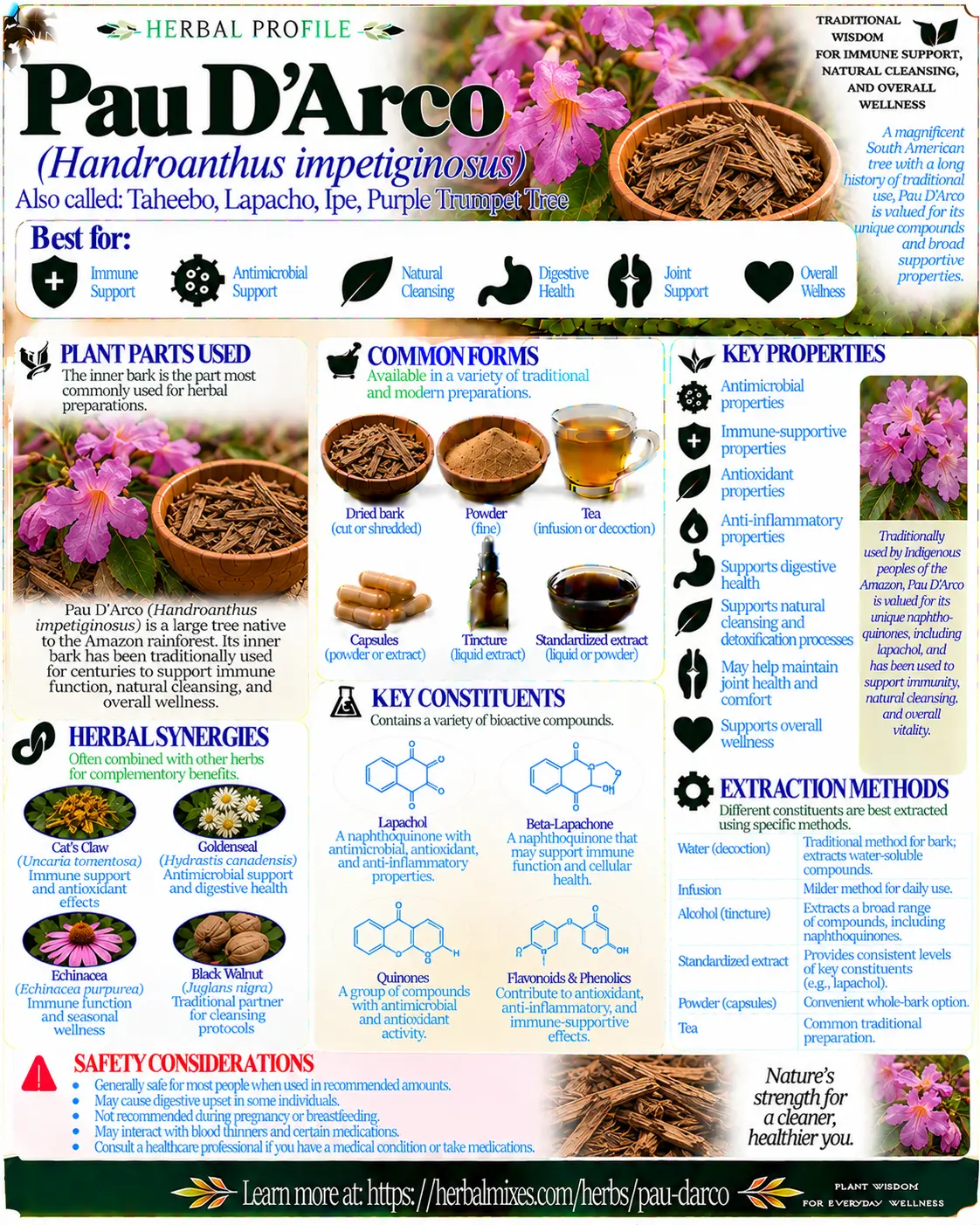
What Pau d’Arco Is Good For
Traditional immune support — Pau d’Arco has a long history of use in South American herbal medicine and is commonly included in immune-support formulas. However, modern human evidence is limited, so it should not be presented as a proven immune stimulant.
Microbial balance — Its naphthoquinones, especially lapachol and beta-lapachone, show antibacterial, antifungal, and antiparasitic activity in laboratory research. These effects have not been adequately demonstrated in human infection trials.
Inflammatory balance — Pau d’Arco extracts and isolated naphthoquinones influence inflammatory pathways experimentally. Most evidence remains preclinical.
Digestive support — Traditional preparations have been used for digestive complaints and intestinal wellness. Strong clinical evidence for specific gastrointestinal conditions is lacking.
Antioxidant support — Phenolic compounds, flavonoids, and naphthoquinones contribute antioxidant activity.
Despite widespread claims online, Pau d’Arco has not been proven to treat cancer or serious infections in humans.
Available Herbal Products
Buying Guides for Available Pau d’Arco Products
Pau d’Arco 500 mg – Inner-bark capsules. Provides 500 mg of Pau d’Arco inner bark per capsule and is currently available directly from the manufacturer. Seller: NOW Foods – View NOW Pau d’Arco →
Pau d’Arco Extract – Liquid herbal extract. A concentrated liquid option currently available for people who prefer drops rather than capsules. Seller: NOW Foods – View NOW Pau d’Arco Extract →
Pau d’Arco Extract Alcohol-Free – Concentrated inner-bark liquid extract. Uses a cold extraction process followed by alcohol removal and is currently listed in stock. Seller: Nature’s Answer – View Nature’s Answer Pau d’Arco →
Pau d’Arco Bark Cut & Sifted – Loose inner bark. A Brazilian Handroanthus/Tabebuia impetiginosa product suitable for tea or tincture and currently available. Seller: Frontier Co-op – View Frontier Co-op Pau d’Arco Bark →
Nature’s Way also sells Pau d’Arco inner-bark capsules, but the manufacturer currently lists the 100-capsule size as backordered, so it is not included above as a primary available recommendation.
Because “Pau d’Arco” can refer commercially to bark from several related species, look for a label that clearly identifies the botanical species and specifically states inner bark.
Herbal Synergies
Pau d’Arco pairs especially well with oregano, garlic, ginger, turmeric, and astragalus depending on whether the goal is digestive, microbial, inflammatory, or general immune support.
Pau d’Arco + Oregano
Best for: Traditional microbial and digestive support
Pau d’Arco contributes naphthoquinones such as lapachol, while oregano adds carvacrol and thymol.
Both have strong laboratory antimicrobial activity, but this combination should not replace appropriate treatment for diagnosed infection.
Best extraction: Pau d’Arco decoction or tincture combined with oregano tea or a properly formulated extract.
Pau d’Arco + Garlic
Best for: Microbial balance and cardiovascular support
Pau d’Arco provides naphthoquinones, while garlic contributes sulfur compounds such as allicin-derived metabolites.
Best extraction: Pau d’Arco tea or tincture combined with freshly crushed garlic or a standardized garlic preparation.
Pau d’Arco + Ginger
Best for: Digestive support with warming balance
Pau d’Arco can be intensely bitter, while ginger adds warming carminative activity and may make digestive formulas easier to tolerate.
Best extraction: Pau d’Arco decoction with ginger root.
Pau d’Arco + Turmeric
Best for: Antioxidant and inflammatory balance
Pau d’Arco contributes naphthoquinones and phenolics, while turmeric supplies curcuminoids acting through complementary inflammatory pathways.
Best extraction: Pau d’Arco tincture or decoction combined with turmeric powder or formulated curcumin extract.
Pau d’Arco + Astragalus
Best for: General immune and resilience support
Pau d’Arco contributes traditional microbial-supportive chemistry, while astragalus offers polysaccharide-rich adaptogenic and immune-modulating support.
Best extraction: Decoction. Both are tough plant materials well suited to longer water extraction.
Key Herbal Properties
Antimicrobial — Lapachol, beta-lapachone, and related compounds show antibacterial, antifungal, and antiparasitic effects experimentally.
Anti-inflammatory — Pau d’Arco constituents influence inflammatory signaling in laboratory and animal models.
Antioxidant — Naphthoquinones and phenolic compounds contribute antioxidant activity.
Antifungal — Laboratory studies demonstrate activity against several fungal organisms, but clinical effectiveness in people remains unproven.
Antiparasitic — Beta-lapachone and related compounds have demonstrated activity against organisms such as Trypanosoma in experimental models.
Cytotoxic / antiproliferative — Several Pau d’Arco compounds inhibit cancer-cell growth in laboratory studies. This is preclinical evidence and does not establish Pau d’Arco as a cancer treatment.
Bitter tonic — Its intensely bitter inner bark has traditionally been used in digestive and tonic preparations.




Active Compounds
Pau d’Arco inner bark contains naphthoquinones, furanonaphthoquinones, anthraquinones, flavonoids, phenolic compounds, and other secondary metabolites. The best-known constituents are lapachol and beta-lapachone.
Lapachol
Found mainly in: Inner bark and wood
Lapachol is one of the best-known naphthoquinones associated with Pau d’Arco.
It demonstrates antimicrobial, antiparasitic, and cytotoxic effects experimentally but also has important toxicity concerns, including interference with vitamin-K-related clotting pathways.
Best extraction: Hydroalcoholic or other solvent-based extraction. Lapachol has poor water solubility, so ordinary tea may extract substantially less than alcohol-rich preparations.
Beta-Lapachone
Found mainly in: Bark and heartwood; related chemically to lapachol
Beta-lapachone is an ortho-naphthoquinone extensively investigated for antimicrobial and anticancer mechanisms.
It can generate oxidative stress selectively in certain cells through NQO1-related pathways, which is why it has attracted pharmaceutical research interest.
Best extraction: Alcohol-rich or specialized extraction. It is poorly water soluble.
Alpha-Lapachone
Found mainly in: Bark and wood
Alpha-lapachone is another naturally occurring naphthoquinone related to beta-lapachone.
Its biological activity has been explored experimentally, but it is less extensively studied.
Best extraction: Hydroalcoholic or specialized solvent extraction.
Dehydro-Alpha-Lapachone
Found mainly in: Bark
This related naphthoquinone contributes to the broader chemical profile of Handroanthus species.
Best extraction: Alcohol-rich extraction.
Quercetin
Found mainly in: Bark
Quercetin and related flavonoids contribute antioxidant and inflammatory-modulating activity.
Best extraction: Hot water or hydroalcoholic tincture.
Phenolic Compounds
Found mainly in: Inner bark
Various phenolics complement the stronger naphthoquinone chemistry and contribute antioxidant activity.
Best extraction: Water or diluted alcohol.
Furanonaphthoquinones
Found mainly in: Bark and wood
Pau d’Arco contains several furanonaphthoquinones, a group of compounds investigated for antimicrobial and cytotoxic activity.
Best extraction: Hydroalcoholic or specialized solvent extraction.
-
FAQ
What is Pau d’Arco best used for?
Pau d’Arco is best described as a traditional immune, digestive, and microbial-balance herb.
Its strongest modern research is laboratory-based rather than clinical, so claims should remain conservative.
Does Pau d’Arco kill Candida?
Pau d’Arco compounds show antifungal activity in laboratory studies, including against some Candida species.
That does not prove that Pau d’Arco supplements can safely or reliably treat vaginal, oral, or systemic candidiasis in humans.
Does Pau d’Arco treat cancer?
No proven cancer benefit has been established.
Lapachol and beta-lapachone have substantial anticancer laboratory research, but clinical studies have not shown Pau d’Arco to be an effective cancer treatment. Memorial Sloan Kettering specifically notes that its anticancer effects have not been demonstrated in humans.
Is tea or tincture better?
Tea is the traditional preparation, but lapachol and beta-lapachone are poorly water soluble, so a simple tea does not efficiently extract all of the bark’s naphthoquinones.
Hydroalcoholic extracts provide broader extraction but may also produce higher exposure to compounds responsible for adverse effects.
Can Pau d’Arco be taken every day?
Long-term safety has not been established well enough to recommend indefinite high-dose use.
Because of bleeding, reproductive, and gastrointestinal concerns, it is better suited to conservative, short-term use when chosen at all.
Safety & Precautions
Pau d’Arco deserves more caution than an ordinary herbal tea because its naphthoquinones can have meaningful pharmacological and toxic effects.
The most important interaction concern involves blood clotting.
Lapachol can interfere with vitamin-K-dependent pathways, and Memorial Sloan Kettering warns that Pau d’Arco may increase bleeding risk when combined with anticoagulant or antiplatelet medication.
Use particular caution with warfarin, apixaban, rivaroxaban, dabigatran, clopidogrel, aspirin, and similar medicines.
Stop use before surgery according to the instructions of the healthcare professional managing your medications and procedure.
Possible adverse effects include nausea, vomiting, gastrointestinal irritation, and urine discoloration.
High or prolonged lapachol exposure has caused anemia in animal studies.
Avoid during pregnancy. Experimental studies have reported fetotoxic, reproductive, and chromosomal effects from lapachol exposure.
Because safety during breastfeeding has not been established, concentrated preparations should also be avoided unless specifically recommended by a qualified clinician.
NOW Foods labels its current Pau d’Arco capsules for adults only and specifically advises against use during pregnancy or nursing.
Do not use Pau d’Arco as a substitute for evidence-based treatment of cancer, bacterial infection, fungal infection, parasitic infection, HIV, or other serious disease.
Human data are too limited to establish reliable treatment doses, and product potency can vary considerably by species, plant part, and extraction method.
Pau d’Arco is derived from the inner bark, and botanical identity matters. Kew currently accepts Handroanthus impetiginosus, while many older products and research papers use the synonymous names Tabebuia impetiginosa or Tabebuia avellanedae.
Anyone taking blood thinners, preparing for surgery, pregnant, breastfeeding, managing anemia, or taking prescription medications should discuss therapeutic Pau d’Arco use with an appropriate healthcare professional.
References
- Kew Plants of the World Online — Handroanthus impetiginosus
- Memorial Sloan Kettering Cancer Center — Pau d’Arco
- PubMed — Red Lapacho (Tabebuia impetiginosa): Ethnopharmacology and Evidence Review
- PubMed — Beta-Lapachone: Natural Occurrence, Biological Activities and Toxicity
- PubMed — Beta-Lapachone: Mechanisms and Therapeutic Potential
- PubMed — Anticancer Potential and Toxicity of Handroanthus: Systematic Review
- NOW Foods — Pau d’Arco 500 mg
- Nature’s Answer — Pau d’Arco Alcohol-Free Extract
- Frontier Co-op — Pau d’Arco Bark
- iHerb — Pau d’Arco Products
Disclaimer
Disclaimer: This article is for educational purposes only and is not intended to diagnose, treat, cure, or prevent any disease. Herbal products can cause side effects and interact with medications. Consult a qualified healthcare professional before using herbs therapeutically, especially if you are pregnant, breastfeeding, taking prescription medications, or managing a medical condition.