

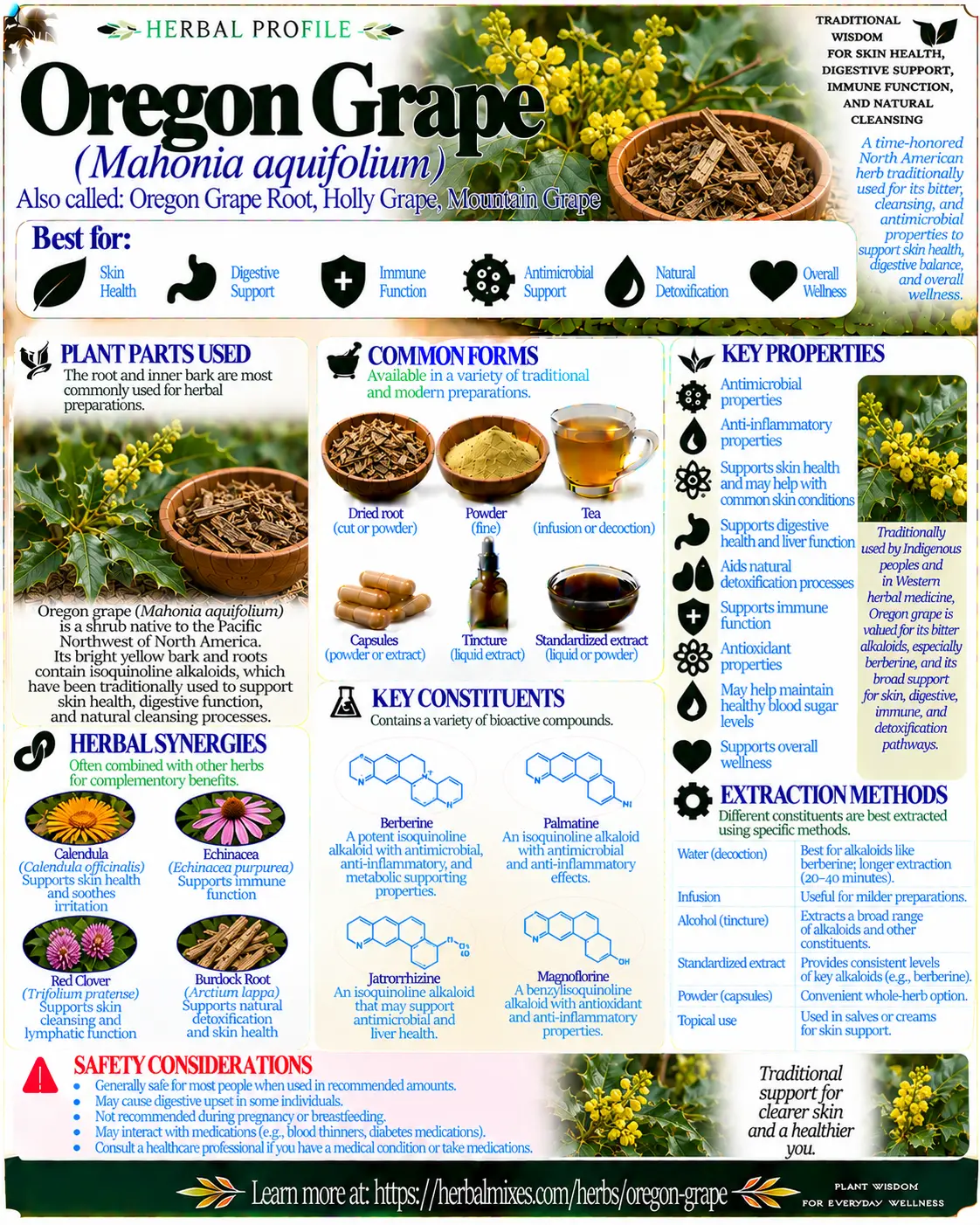
What Oregon Grape Is Good For
Sluggish digestion — Oregon grape root is a strongly bitter herb traditionally used to stimulate digestion, especially when appetite is poor or digestion feels slow and heavy. Its yellow color comes largely from isoquinoline alkaloids such as berberine.
Bitter digestive support — Small amounts before meals are traditionally used as a digestive bitter. This use is more consistent with the whole herb than treating Oregon grape as simply another high-dose berberine supplement.
Skin support — Topical extracts of Mahonia aquifolium have been studied for mild-to-moderate psoriasis. Randomized trials have reported some improvement, although evidence is limited and topical Oregon grape should not replace established psoriasis treatment. (PubMed)
Microbial balance — Berberine and related alkaloids show broad antibacterial and antifungal activity in laboratory research. This does not mean Oregon grape root can replace antibiotics or antifungal medication for clinically significant infections.
Metabolic wellness — Berberine has substantial research for glucose and lipid metabolism, but most clinical trials use purified or standardized berberine, not whole Oregon grape root. The two should not be assumed equivalent.
Available Herbal Products
Buying Guides for Available Oregon Grape Products
Oregon Grape Liquid Herbal Extract – Wildcrafted root tincture. Made from Berberis aquifolium root at a 1:5 herb-to-menstruum ratio using alcohol and water; currently available directly from the manufacturer. Seller: Herb Pharm – View Herb Pharm Oregon Grape →
Oregon Grape Root Extract Wildcrafted – Concentrated liquid extract. Made from Mahonia aquifolium root using water and organic alcohol at a 1:1 herb strength and currently listed in stock. Seller: Starwest Botanicals – View Starwest Oregon Grape Root Extract →
Oregon Grape Root Powder Wildcrafted – Whole powdered root. A single-herb Mahonia aquifolium product currently in stock and suitable for capsules or formulated bitters. Seller: Starwest Botanicals – View Starwest Oregon Grape Root Powder →
Oregon Grape Root Cut & Sifted Wildcrafted – Loose dried root. Currently in stock and suitable for decoction or homemade tincture. Seller: Starwest Botanicals – View Starwest Oregon Grape Root →
Mountain Rose Herbs also carries Oregon grape root, root powder, and liquid extract, but its dried root and powder were listed as out of stock when checked, so they are not included above as current buying options.
Herbal Synergies
Oregon grape pairs especially well with gentian, dandelion root, burdock root, ginger, and chamomile depending on whether the goal is bitter digestive stimulation, skin support, or balancing its strong bitterness.
Oregon Grape + Gentian
Best for: Sluggish digestion and poor appetite
Both herbs are strongly bitter and help stimulate digestive secretions before meals.
Because the combination is intense, relatively small amounts are usually appropriate.
Best extraction: Hydroalcoholic tincture. Alcohol-water mixtures efficiently extract Oregon grape alkaloids and gentian bitter glycosides.
Oregon Grape + Dandelion Root
Best for: Heavy digestion and bitter liver support
Oregon grape contributes berberine-rich bitterness, while dandelion root adds gentler digestive and hepatobiliary support.
Best extraction: Decoction or combined tincture.
Oregon Grape + Burdock Root
Best for: Traditional skin and digestive support
Oregon grape contributes antimicrobial and bitter alkaloids, while burdock adds inulin-rich, nutritive, and traditional skin-supportive qualities.
Best extraction: Decoction or tincture. Burdock also benefits from water extraction because of its polysaccharides.
Oregon Grape + Ginger
Best for: Sluggish digestion with bloating or nausea
Oregon grape provides bitter stimulation, while ginger adds warming carminative and motility support.
Best extraction: Oregon grape tincture combined with ginger tea or tincture.
Oregon Grape + Chamomile
Best for: Bitter digestive support with stomach tension
Oregon grape stimulates digestive function, while chamomile contributes gentler antispasmodic and calming activity.
Best extraction: Oregon grape tincture combined with covered chamomile infusion.
Key Herbal Properties
Bitter tonic — Oregon grape root is intensely bitter and traditionally used to stimulate appetite and digestive secretions.
Antimicrobial — Berberine and related alkaloids demonstrate substantial antibacterial and antifungal activity experimentally.
Anti-inflammatory — Berberine, berbamine, and related alkaloids influence inflammatory signaling, and topical Mahonia aquifolium extracts have been studied clinically in psoriasis.
Antioxidant — Alkaloids and polyphenols contribute antioxidant activity.
Metabolic supportive — Berberine may influence glucose and lipid metabolism, but evidence for isolated berberine should not automatically be transferred to ordinary Oregon grape preparations.
Cholagogue / digestive supportive — Oregon grape is traditionally used in bitter digestive formulas associated with bile and digestive stimulation.
Astringent — Root bark also contains compounds contributing mild tissue-tightening activity.







Active Compounds
Oregon grape root contains a characteristic mixture of benzylisoquinoline alkaloids, particularly berberine-related compounds, along with tannins and other secondary metabolites.
Berberine
Found mainly in: Root and root bark
Berberine is the best-known yellow isoquinoline alkaloid in Oregon grape and is responsible for much of the root’s characteristic color.
It has been extensively studied for glucose regulation, lipid metabolism, antimicrobial activity, and inflammatory pathways. Oral bioavailability is very low—generally reported at less than 1%—because of poor absorption, intestinal metabolism, and P-glycoprotein efflux. (PubMed)
Best extraction: Hydroalcoholic tincture or decoction. As an alkaloid salt in the plant, berberine can be recovered into both alcohol-water and acidic aqueous preparations.
Palmatine
Found mainly in: Root and root bark
Palmatine is another protoberberine alkaloid found in Oregon grape and related Berberis species.
It contributes to the plant’s antimicrobial and antioxidant chemistry.
Best extraction: Hydroalcoholic tincture or decoction.
Jatrorrhizine
Found mainly in: Root
Jatrorrhizine is a yellow protoberberine alkaloid structurally related to berberine.
Its pharmacology overlaps partly with other berberine-type alkaloids, although human evidence is much more limited.
Best extraction: Hydroalcoholic or aqueous-acid extraction.
Columbamine
Found mainly in: Root and bark
Columbamine is another isoquinoline alkaloid found in Berberis species and contributes to the broader yellow-alkaloid fraction.
Best extraction: Hydroalcoholic tincture.
Berbamine
Found mainly in: Root and stem tissues
Berbamine is a bisbenzylisoquinoline alkaloid investigated experimentally for inflammatory, immune, and cellular effects.
These findings remain largely preclinical.
Best extraction: Hydroalcoholic extraction.
Oxyacanthine
Found mainly in: Root and bark
Oxyacanthine is another bisbenzylisoquinoline alkaloid associated with Berberis species.
Its specific contribution to traditional Oregon grape effects in humans is not well established.
Best extraction: Alcohol-water mixtures.
Tannins
Found mainly in: Bark and root tissues
Tannins contribute mild astringency and complement Oregon grape’s intensely bitter alkaloid profile.
Best extraction: Hot water or diluted alcohol.
FAQ
What is Oregon grape best used for?
Oregon grape is best suited to short-term bitter digestive support, especially sluggish digestion or poor appetite.
Its topical extracts also have some clinical evidence for mild-to-moderate psoriasis, while most metabolic claims come from research on isolated berberine rather than the whole herb.
Is Oregon grape the same as goldenseal?
No.
They are different plants, but both contain berberine and related isoquinoline alkaloids, which is why Oregon grape has sometimes been used as an alternative in herbal formulas.
Is Oregon grape the same as berberine?
No.
Berberine is one constituent of Oregon grape root. Whole Oregon grape contains several additional alkaloids and other compounds, and the amount of berberine is much less standardized than in purified berberine supplements.
Why are both Mahonia aquifolium and Berberis aquifolium used?
Modern Kew taxonomy accepts Berberis aquifolium as the current botanical name and treats Mahonia aquifolium as a synonym.
Many herbal products and older research papers still use the name Mahonia aquifolium.
Is tincture or decoction better?
Both are suitable.
A decoction extracts water-soluble alkaloid salts and is traditional for woody roots, while a hydroalcoholic tincture provides a concentrated, convenient, broad-spectrum preparation.
Safety & Precautions
Oregon grape requires more caution than ordinary food herbs because it contains significant berberine-type alkaloids.
Do not use berberine-containing Oregon grape medicinally during pregnancy. NCCIH states that berberine should not be used during pregnancy or breastfeeding because exposure can interfere with bilirubin metabolism in infants. (NCCIH)
Do not give berberine-containing products to infants. Berberine exposure has been associated with elevated bilirubin and a risk of severe neurological injury in newborns. (NCCIH)
Common adverse effects associated with berberine-containing supplements include nausea, abdominal discomfort, diarrhea, bloating, and constipation.
Oregon grape may interact with prescription medications because berberine can affect CYP3A4, CYP2D6, CYP2C9, and P-glycoprotein-related drug handling. (PubMed)
Particular caution is warranted with drugs having narrow therapeutic ranges and with medications such as cyclosporine, tacrolimus, digoxin, anticoagulants, diabetes medicines, and other extensively metabolized prescriptions.
Berberine may lower blood glucose, so combining concentrated Oregon grape products with insulin, metformin, sulfonylureas, or other glucose-lowering therapies may increase the risk of excessive glucose reduction.
Do not assume that ordinary Oregon grape root delivers the same dose or effect as a standardized berberine supplement.
Because Oregon grape is a strong bitter, concentrated preparations may aggravate gastritis, reflux, nausea, or digestive irritation in sensitive individuals.
Topical Oregon grape preparations can cause burning, itching, or allergic reactions. In one psoriasis trial, several participants experienced local reactions. (PubMed)
Oregon grape should not replace medical treatment for persistent diarrhea, serious infection, diabetes, liver disease, psoriasis, or other chronic skin disease.
Anyone who is pregnant, breastfeeding, taking prescription medications, using diabetes treatment, or managing a significant chronic illness should discuss therapeutic Oregon grape use with an appropriate healthcare professional.
References
- Kew Plants of the World Online — Berberis aquifolium Pursh
- Kew — Mahonia aquifolium Synonym Record
- PubMed — Mahonia aquifolium in Psoriasis: Double-Blind Placebo-Controlled Study
- PubMed — Mahonia aquifolium in Psoriasis Vulgaris
- NCCIH — Berberine Safety and Diabetes Research
- PubMed — Berberine Pharmacology and Bioavailability Review
- PubMed — Berberine and Cytochrome P450 Drug Interactions
- Herb Pharm — Oregon Grape Liquid Herbal Extract
- Starwest Botanicals — Oregon Grape Root Extract
- Starwest Botanicals — Oregon Grape Root Powder
- Starwest Botanicals — Oregon Grape Root Cut & Sifted
Disclaimer
Disclaimer: This article is for educational purposes only and is not intended to diagnose, treat, cure, or prevent any disease. Herbal products can cause side effects and interact with medications. Consult a qualified healthcare professional before using herbs therapeutically, especially if you are pregnant, breastfeeding, taking prescription medications, or managing a medical condition.