

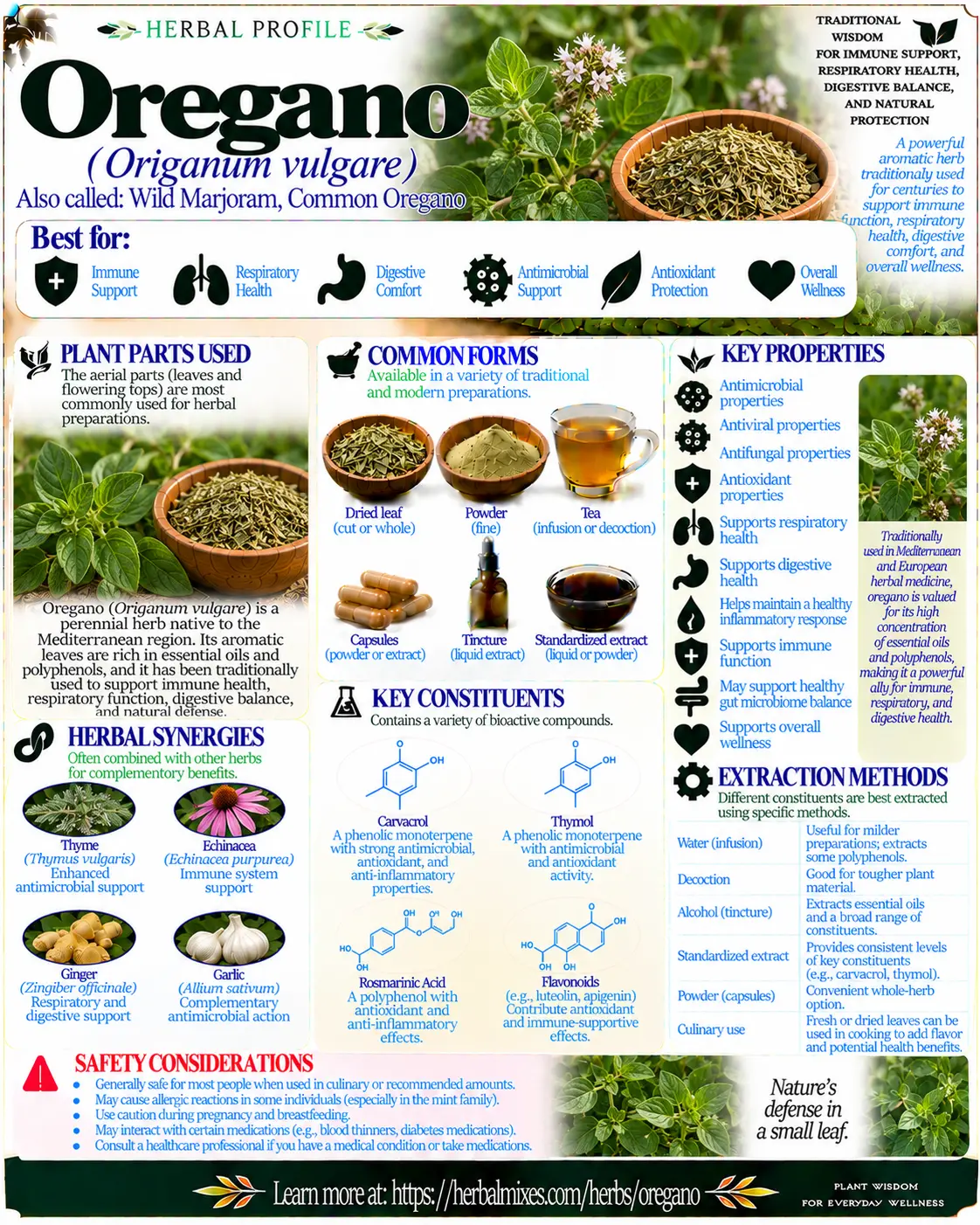
What Oregano Is Good For
Digestive support — Oregano is a classic aromatic digestive herb. Its volatile oils and bitter-aromatic compounds make it useful for sluggish digestion, post-meal heaviness, and digestive discomfort.
Bloating & gas — Oregano’s carvacrol- and thymol-rich volatile oil gives it strong carminative activity, making it particularly suitable for gas and bloating associated with slow digestion.
Respiratory comfort — Oregano has longstanding traditional use in respiratory formulas. A small randomized trial using a multi-herb essential-oil spray containing an oregano species found short-term improvement in upper-respiratory symptoms, but this does not prove that O. vulgare alone treats respiratory infections.
Antioxidant support — Oregano contains rosmarinic acid, flavonoids, and volatile phenols that contribute substantial antioxidant activity.
Microbial balance — Oregano oil—especially its constituents carvacrol and thymol—has strong antibacterial and antifungal activity in laboratory studies. Human clinical evidence remains much more limited than the extensive laboratory research.
Short-term immune support — Concentrated oregano oil products are commonly used for short-term seasonal support. This use is largely based on traditional practice and antimicrobial laboratory research rather than evidence that oregano prevents colds or flu.
Available Herbal Products
Buying Guides for Available Oregano Products
Oil of Oregano – Supercritical CO₂ oregano leaf extract capsules. Provides oregano-derived carvacrol and thymol in a concentrated form and is currently available directly from the manufacturer. Gaia recommends short-term use of 2–4 weeks. Seller: Gaia Herbs – View Gaia Herbs Oil of Oregano →
Oregano Oil Softgels – Enteric-coated essential-oil softgels. Contains Origanum vulgare oil standardized to at least 55% carvacrol, combined with ginger and fennel oils, and is currently available. Seller: NOW Foods – View NOW Oregano Oil Softgels →
Wild Oregano Oil – Diluted liquid oregano oil. Provides Mediterranean Origanum vulgare oil standardized to 70% carvacrol in a liquid form and is currently listed in stock. Seller: California Natural / iHerb – View California Natural Wild Oregano Oil →
Oil of Oregano 180 mg – Softgels. Provides steam-distilled Origanum vulgare leaf oil standardized to at least 80% carvacrol and diluted with extra-virgin olive oil. Seller: Natural Factors / iHerb – View Natural Factors Oil of Oregano →
When buying concentrated oregano oil, look for a clearly identified Origanum vulgare product with a stated carvacrol content. Independent testing published by NOW Foods in 2026 found major potency discrepancies among many oregano-oil supplements sold online, including some products with almost no detectable carvacrol.
Herbal Synergies
Oregano pairs especially well with thyme, ginger, fennel, garlic, and marshmallow depending on whether the goal is respiratory support, digestion, microbial balance, or soothing irritated tissues.
Oregano + Thyme
Best for: Productive cough and respiratory congestion
Both herbs contain aromatic monoterpenes and phenolic compounds, especially carvacrol and thymol, giving the combination strong traditional expectorant and antimicrobial characteristics.
Best extraction: Covered hot infusion or properly formulated tincture. Covering the tea helps retain volatile oils.
Oregano + Ginger
Best for: Bloating, sluggish digestion, and nausea
Oregano contributes aromatic carminative activity, while ginger adds warming motility and nausea support.
Best extraction: Covered oregano infusion combined with ginger tea or tincture.
Oregano + Fennel
Best for: Gas and post-meal bloating
Oregano provides stronger pungent aromatics, while fennel contributes gentler antispasmodic and carminative activity.
Best extraction: Covered hot infusion. Both herbs contain volatile compounds that are lost during prolonged uncovered boiling.
Oregano + Garlic
Best for: Culinary microbial and cardiovascular support
Oregano contributes carvacrol and thymol, while garlic supplies sulfur compounds such as allicin-derived metabolites.
Best extraction: Fresh culinary use is especially logical. Oregano can be added near the end of cooking, while freshly crushed garlic benefits from resting briefly before heating.
Oregano + Marshmallow Root
Best for: Respiratory irritation with dryness
Oregano provides aromatic respiratory activity, while marshmallow root adds soothing mucilage.
Best extraction: Prepare oregano separately as a covered hot infusion and marshmallow as a cold infusion, then combine.
Herbal Properties
Carminative — Oregano’s aromatic volatile oils support digestion and help reduce gas and bloating.
Antimicrobial — Carvacrol and thymol strongly disrupt microbial membranes in laboratory studies. Oregano has demonstrated activity against numerous bacteria and fungi, but laboratory potency does not equal proven clinical treatment.
Antioxidant — Rosmarinic acid, flavonoids, carvacrol, thymol, and other phenolics contribute strong antioxidant activity.
Anti-inflammatory — Oregano constituents influence inflammatory signaling experimentally.
Expectorant — Its aromatic nature supports traditional use in respiratory formulas for mucus and congestion.
Antispasmodic — Oregano extracts and volatile compounds can affect smooth-muscle activity experimentally, supporting its traditional digestive use.
Digestive stimulant — Its pungent aromatic profile can stimulate appetite and digestive activity.
Herbal Constituents
Oregano contains both volatile essential-oil compounds and nonvolatile polyphenols. The relative amounts vary significantly by subspecies, growing region, harvest timing, and extraction method.
Carvacrol
Found mainly in: Essential oil of leaves and flowering tops
Carvacrol is one of oregano’s signature volatile phenols and often the primary marker used to standardize oregano-oil supplements.
It shows strong antibacterial and antifungal activity experimentally by disrupting microbial cell membranes.
Best extraction: Steam distillation or supercritical CO₂ extraction. Carvacrol is lipophilic and volatile, so it is much more concentrated in essential oil than in ordinary tea.
Thymol
Found mainly in: Essential oil
Thymol is closely related to carvacrol and contributes additional antimicrobial, antioxidant, and aromatic activity.
The ratio of thymol to carvacrol varies widely among oregano chemotypes.
Best extraction: Steam-distilled essential oil, CO₂ extract, or alcohol-rich tincture.
Rosmarinic Acid
Found mainly in: Leaves and flowering aerial parts
Rosmarinic acid is an important water-soluble polyphenol found throughout the mint family.
It contributes antioxidant and inflammatory-modulating activity without requiring essential-oil extraction.
Best extraction: Hot water or hydroalcoholic tincture.
Caffeic Acid
Found mainly in: Aerial parts
Caffeic acid contributes to oregano’s antioxidant polyphenol fraction and is chemically related to rosmarinic acid.
Best extraction: Hot water or diluted alcohol.
Luteolin
Found mainly in: Leaves and aerial tissues
Luteolin and its glycosides contribute antioxidant and inflammatory-modulating activity.
Best extraction: Hot-water infusion or hydroalcoholic extract.
Apigenin
Found mainly in: Leaves
Apigenin is another flavonoid found in oregano and contributes to its broader antioxidant profile.
Best extraction: Hydroalcoholic extraction; glycosides also extract into hot water.
p-Cymene
Found mainly in: Essential oil
p-Cymene is a volatile monoterpene often present alongside carvacrol and thymol.
It contributes aroma and may influence the overall antimicrobial behavior of the essential-oil mixture.
Best extraction: Steam distillation.
Gamma-Terpinene
Found mainly in: Essential oil
Gamma-terpinene is an aromatic monoterpene and biochemical precursor associated with carvacrol formation in oregano.
Best extraction: Steam distillation or other volatile-oil extraction.
Key Herbal Properties
Carminative — Oregano’s aromatic volatile oils support digestion and help reduce gas and bloating.
Antimicrobial — Carvacrol and thymol strongly disrupt microbial membranes in laboratory studies. Oregano has demonstrated activity against numerous bacteria and fungi, but laboratory potency does not equal proven clinical treatment.
Antioxidant — Rosmarinic acid, flavonoids, carvacrol, thymol, and other phenolics contribute strong antioxidant activity.
Anti-inflammatory — Oregano constituents influence inflammatory signaling experimentally.
Expectorant — Its aromatic nature supports traditional use in respiratory formulas for mucus and congestion.
Antispasmodic — Oregano extracts and volatile compounds can affect smooth-muscle activity experimentally, supporting its traditional digestive use.
Digestive stimulant — Its pungent aromatic profile can stimulate appetite and digestive activity.






Active Compounds
Oregano contains both volatile essential-oil compounds and nonvolatile polyphenols. The relative amounts vary significantly by subspecies, growing region, harvest timing, and extraction method.
Carvacrol
Found mainly in: Essential oil of leaves and flowering tops
Carvacrol is one of oregano’s signature volatile phenols and often the primary marker used to standardize oregano-oil supplements.
It shows strong antibacterial and antifungal activity experimentally by disrupting microbial cell membranes.
Best extraction: Steam distillation or supercritical CO₂ extraction. Carvacrol is lipophilic and volatile, so it is much more concentrated in essential oil than in ordinary tea.
Thymol
Found mainly in: Essential oil
Thymol is closely related to carvacrol and contributes additional antimicrobial, antioxidant, and aromatic activity.
The ratio of thymol to carvacrol varies widely among oregano chemotypes.
Best extraction: Steam-distilled essential oil, CO₂ extract, or alcohol-rich tincture.
Rosmarinic Acid
Found mainly in: Leaves and flowering aerial parts
Rosmarinic acid is an important water-soluble polyphenol found throughout the mint family.
It contributes antioxidant and inflammatory-modulating activity without requiring essential-oil extraction.
Best extraction: Hot water or hydroalcoholic tincture.
Caffeic Acid
Found mainly in: Aerial parts
Caffeic acid contributes to oregano’s antioxidant polyphenol fraction and is chemically related to rosmarinic acid.
Best extraction: Hot water or diluted alcohol.
Luteolin
Found mainly in: Leaves and aerial tissues
Luteolin and its glycosides contribute antioxidant and inflammatory-modulating activity.
Best extraction: Hot-water infusion or hydroalcoholic extract.
Apigenin
Found mainly in: Leaves
Apigenin is another flavonoid found in oregano and contributes to its broader antioxidant profile.
Best extraction: Hydroalcoholic extraction; glycosides also extract into hot water.
p-Cymene
Found mainly in: Essential oil
p-Cymene is a volatile monoterpene often present alongside carvacrol and thymol.
It contributes aroma and may influence the overall antimicrobial behavior of the essential-oil mixture.
Best extraction: Steam distillation.
Gamma-Terpinene
Found mainly in: Essential oil
Gamma-terpinene is an aromatic monoterpene and biochemical precursor associated with carvacrol formation in oregano.
Best extraction: Steam distillation or other volatile-oil extraction.
FAQ
What is oregano best used for?
Oregano is best suited to digestive support, bloating, culinary antioxidant support, and short-term respiratory or immune formulas.
Its strong antimicrobial reputation is largely supported by laboratory studies rather than large clinical trials.
Is oregano oil the same as oregano tea?
No.
Tea extracts water-soluble compounds such as rosmarinic acid and smaller amounts of volatile oil.
Oregano essential oil is dramatically more concentrated in carvacrol, thymol, and other volatile constituents and therefore requires much more careful use.
What does carvacrol do?
Carvacrol is a volatile phenolic compound that can disrupt bacterial and fungal membranes in laboratory experiments.
This makes it an important quality marker in oregano-oil products, but it does not mean concentrated oregano oil should replace antibiotics or antifungal medication when those treatments are medically indicated.
Is a higher carvacrol percentage always better?
No.
Higher concentration means greater potency but also potentially greater irritation. Product quality, actual milligrams per dose, correct dilution, and appropriate duration matter more than simply choosing the highest percentage.
Can oregano oil be taken every day?
Culinary oregano can be eaten regularly, but concentrated essential-oil supplements are better viewed as short-term products.
Gaia Herbs, for example, recommends a maximum use period of 2–4 weeks for its concentrated Oil of Oregano product.
Safety & Precautions
Culinary oregano is generally very well tolerated. Concentrated oregano oil is substantially different and requires greater caution.
Essential oil can irritate the mouth, throat, esophagus, stomach, skin, and eyes if used improperly.
Do not swallow undiluted pure oregano essential oil unless a specific commercial product has been formulated and labeled for internal use. Pure aromatherapy essential oils and dietary oregano-oil supplements are not interchangeable.
NOW’s pure oregano essential oil is specifically marketed for aromatherapy, with other uses requiring dilution in a carrier oil.
Gaia Herbs advises using its concentrated oregano-oil capsules for only 2–4 weeks and recommends avoiding them during pregnancy and lactation.
NOW Foods likewise states that its oregano-oil softgels are not recommended during pregnancy or nursing.
Possible adverse effects from concentrated products include burning sensation, reflux, nausea, abdominal irritation, or diarrhea.
People allergic to oregano or other members of the Lamiaceae family, such as basil, mint, sage, marjoram, thyme, or lavender, may be more likely to react.
Laboratory research suggests oregano constituents may influence platelet aggregation, blood glucose, and drug-metabolizing pathways, but clinically important human interactions are not well characterized. People taking anticoagulants, diabetes medication, or multiple prescription drugs should use concentrated oregano extracts cautiously.
Because concentrated essential oils can irritate tissues, use particular caution with gastritis, peptic ulcers, severe reflux, or sensitive gastrointestinal conditions.
Do not use oregano oil as a substitute for antibiotics or other medical treatment for pneumonia, urinary infection, strep throat, serious gastrointestinal infection, fungal infection, or sepsis.
Seek medical attention for persistent fever, breathing difficulty, chest pain, severe abdominal pain, dehydration, bloody stool, or symptoms that are significant or worsening.
Anyone who is pregnant, breastfeeding, taking prescription medication, or managing a chronic medical condition should discuss concentrated oregano-oil use with an appropriate healthcare professional.
References
- Kew Plants of the World Online — Origanum vulgare L.
- PubMed — Phytochemistry and Antimicrobial Properties of Origanum vulgare
- PubMed — Oregano Extract and Gastrointestinal Health Review
- PubMed — Oregano Antioxidant Extract Formulations
- PubMed — Aromatic Essential Oils for Upper Respiratory Symptoms
- PubMed — Emulsified Oregano Oil in Enteric Parasites: Small Clinical Study
- Gaia Herbs — Oil of Oregano
- NOW Foods — Oregano Oil Softgels
- NOW Foods — Pure Oregano Essential Oil
- NOW Foods — 2026 Oregano Oil Supplement Testing
- California Natural / iHerb — Wild Oregano Oil
- Natural Factors / iHerb — Oil of Oregano
Disclaimer
Disclaimer: This article is for educational purposes only and is not intended to diagnose, treat, cure, or prevent any disease. Herbal products can cause side effects and interact with medications. Consult a qualified healthcare professional before using herbs therapeutically, especially if you are pregnant, breastfeeding, taking prescription medications, or managing a medical condition.