

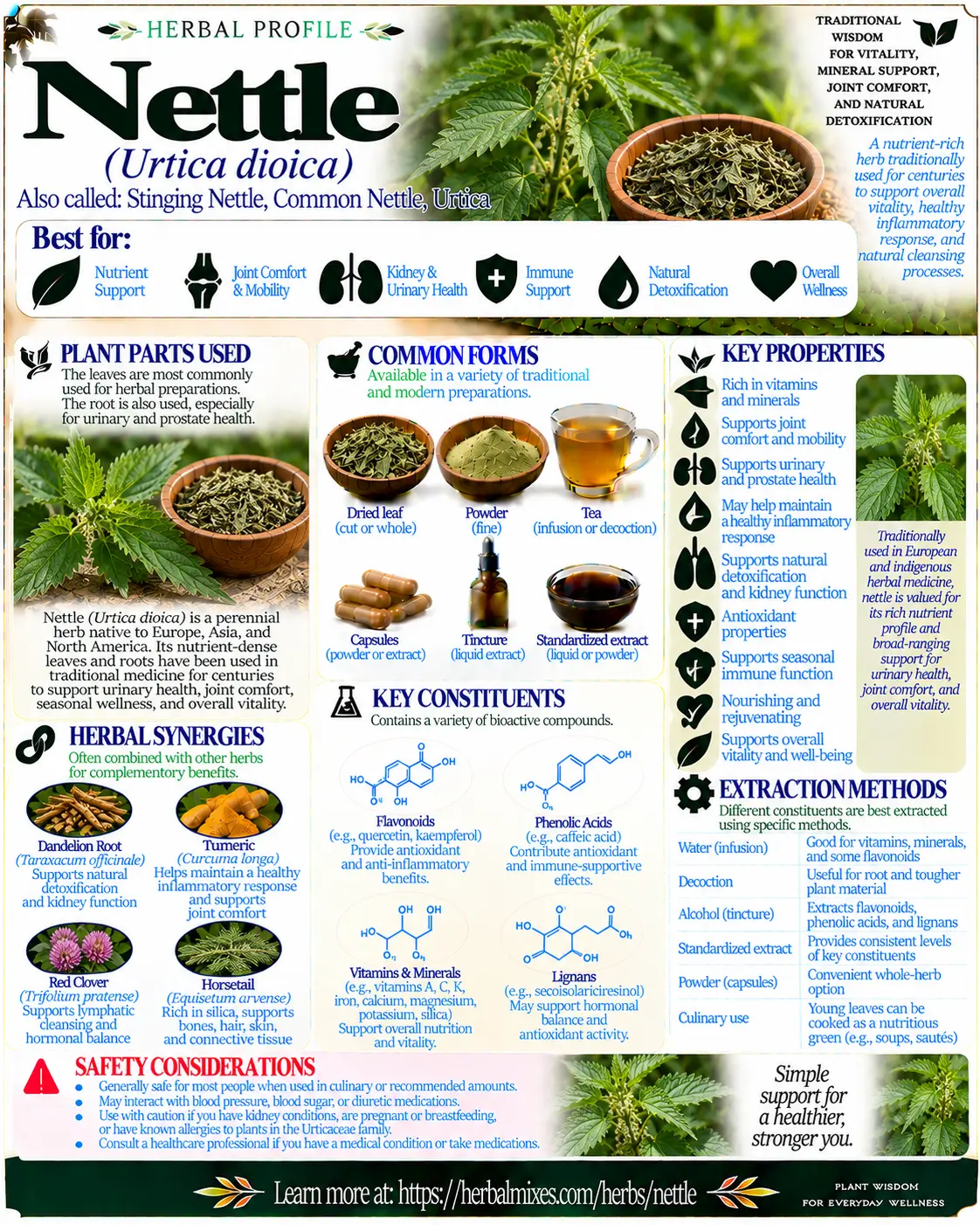
What Nettle Is Good For
Mineral-rich nourishment — Nettle leaf is widely used as a nutrient-dense green herb. The leaves contain minerals, carotenoids, vitamins, protein, fiber, chlorophyll, and polyphenols, making long infusions and whole-leaf powders especially popular for everyday nourishment.
Urinary tract support — Nettle leaf and aerial herb have traditional European use for increasing urine flow as supportive therapy in minor urinary complaints. EMA currently recognizes nettle leaf and herb within the therapeutic area of urinary tract disorders.
Seasonal allergy support — Freeze-dried nettle has been studied for allergic rhinitis. One randomized trial found slightly better symptom ratings than placebo, while another trial showed improvement in both nettle and placebo groups, so the evidence remains limited rather than conclusive.
Joint comfort — Nettle aerial herb has traditional use for minor articular pain, and EMA includes nettle herb within the therapeutic area of pain and inflammation.
Mild fluid retention — Because nettle leaf is traditionally mildly diuretic, it is sometimes used when gentle urinary flushing is desired. It is not appropriate when fluid restriction has been medically recommended.
Prostate support — Nettle root is different from nettle leaf. Root preparations have been studied for lower urinary tract symptoms associated with benign prostatic hyperplasia. A randomized 12-week trial reported improvement in symptom scores, but nettle root should not be used to self-diagnose or replace evaluation of prostate symptoms.
Available Herbal Products
Buying Guides for Available Nettle Products
Stinging Nettle Blend – Fresh aerial-parts and seed tincture. A certified-organic Urtica dioica liquid extract combining fresh aerial parts with dried seed and currently available directly from the manufacturer. Seller: Herb Pharm – View Herb Pharm Stinging Nettle Blend →
Stinging Nettle Alcohol-Free – Aerial-parts glycerite. An alcohol-free certified-organic Urtica dioica extract made with vegetable glycerin and water. Seller: Herb Pharm – View Herb Pharm Stinging Nettle Alcohol-Free →
Organic Nettle Leaf Cut & Sifted – Dried loose leaf. Currently in stock and ideal for tea, long nourishing infusions, soups, broths, and custom herbal blends. Seller: Starwest Botanicals – View Organic Nettle Leaf →
Organic Nettle Leaf Tea Bags – Single-herb tea bags. A convenient caffeine-free Urtica dioica preparation currently in stock for everyday infusion. Seller: Starwest Botanicals – View Organic Nettle Leaf Tea →
Organic Nettle Root Cut & Sifted – Dried root. Currently in stock and intended for root-specific preparations rather than general leaf nutrition. Seller: Starwest Botanicals – View Organic Nettle Root →
The most important buying distinction is leaf versus root. Leaf is typically chosen for nourishing infusions, urinary flushing, and general wellness, while root is more specifically associated with lower urinary tract and prostate support.
Herbal Synergies
Nettle pairs especially well with dandelion leaf, goldenrod, quercetin-rich herbs, turmeric, and saw palmetto depending on whether the goal is urinary support, seasonal allergies, joint comfort, or prostate health.
Nettle + Dandelion Leaf
Best for: Mild fluid retention and urinary flushing
Nettle leaf contributes traditional diuretic and mineral-rich qualities, while dandelion leaf adds complementary urinary and potassium-rich nutritional support.
Best extraction: Hot infusion. Both leaves release minerals, flavonoids, and other polar constituents efficiently into water.
Nettle + Goldenrod
Best for: Everyday urinary tract support
Nettle contributes gentle urinary flushing, while goldenrod adds more specific traditional urinary and anti-inflammatory actions.
Best extraction: Hot infusion or tincture.
Nettle + Quercetin-Rich Herbs
Best for: Seasonal allergy support
Nettle contains flavonoids including quercetin derivatives, while herbs such as elderflower or hibiscus add additional polyphenols.
This is best considered supportive rather than a replacement for antihistamines or allergy evaluation.
Best extraction: Hot infusion or standardized extracts, depending on the formulation.
Nettle + Turmeric
Best for: Joint and musculoskeletal comfort
Nettle contributes traditional anti-inflammatory and joint-supportive use, while turmeric adds curcuminoids acting through different inflammatory pathways.
Best extraction: Nettle infusion or extract combined with turmeric powder or a formulated curcumin extract.
Nettle Root + Saw Palmetto
Best for: Lower urinary tract symptoms associated with prostate enlargement
Nettle root contributes sterols, lignans, polysaccharides, and other root-specific compounds, while saw palmetto provides fatty acids and phytosterols used in prostate formulas.
Herb Pharm currently combines nettle root with saw palmetto in its Prostate Health formula.
Best extraction: Hydroalcoholic or standardized extracts rather than leaf tea.
Key Herbal Properties
Nutritive — Nettle leaf provides minerals, carotenoids, vitamins, fiber, protein, and polyphenols and is also consumed as a food.
Diuretic — Nettle leaf and herb are traditionally used to increase urine flow and support urinary flushing.
Anti-inflammatory — Polyphenols, sterols, flavonoids, and other nettle constituents influence inflammatory pathways experimentally.
Antioxidant — Quercetin, rutin, kaempferol, chlorogenic acid, carotenoids, and related compounds contribute antioxidant activity.
Antihistamine-related — Nettle extracts have been investigated for allergic rhinitis, but human evidence remains limited and inconsistent.
Urinary supportive — Both leaf and root have urinary applications, but they are used for different purposes.
Prostate supportive — Root preparations may improve some lower urinary tract symptoms associated with benign prostate enlargement.
Metabolic supportive — Experimental research suggests effects on glucose and cardiovascular pathways, but nettle should not be treated as a proven therapy for diabetes or hypertension.




Active Compounds
Nettle contains a broad range of flavonoids, phenolic acids, carotenoids, sterols, lignans, fatty acids, lectins, vitamins, and minerals. The relative abundance varies substantially between leaf, root, seed, and stem.
Quercetin and Quercetin Glycosides
Found mainly in: Leaves and aerial parts
Quercetin and related glycosides contribute antioxidant and inflammatory-modulating activity and are among nettle’s best-characterized flavonoids.
Best extraction: Hot-water infusion or hydroalcoholic extract. Glycosylated forms are sufficiently polar for effective aqueous extraction.
Rutin
Found mainly in: Leaves
Rutin, or quercetin-3-O-rutinoside, is another important nettle flavonoid associated with antioxidant and vascular-supportive activity.
Best extraction: Hot water or diluted alcohol.
Chlorogenic Acid
Found mainly in: Leaves and aerial parts
Chlorogenic acid, including caffeoylquinic-acid derivatives, contributes significantly to nettle’s polyphenol profile and antioxidant activity.
Best extraction: Hot water or hydroalcoholic extraction.
Kaempferol Derivatives
Found mainly in: Leaves
Kaempferol-related flavonoids contribute to nettle’s antioxidant and inflammatory-modulating chemistry.
Best extraction: Hot infusion or hydroalcoholic tincture.
Beta-Sitosterol
Found mainly in: Root and other tissues
Beta-sitosterol is one of nettle’s important plant sterols and is particularly relevant to root-focused prostate preparations.
Best extraction: Alcohol-rich or specialized extracts. Sterols have poor water solubility.
Lignans
Found mainly in: Root
Nettle root contains several lignans that have been investigated for interactions with sex-hormone-binding globulin and other pathways potentially relevant to prostate physiology. The actual clinical mechanism remains uncertain.
Best extraction: Hydroalcoholic or specialized root extract.
Urtica dioica Agglutinin
Found mainly in: Root
Urtica dioica agglutinin (UDA) is a small lectin isolated from nettle root and investigated experimentally for immunological and antiviral activity. These laboratory findings do not establish ordinary nettle products as antiviral medicines.
Best extraction: Specialized aqueous or laboratory protein extraction rather than ordinary home tea.
Carotenoids
Found mainly in: Leaves
Nettle leaves contain carotenoids including beta-carotene and lutein, contributing nutritional and antioxidant value.
Best extraction: Whole leaf consumed with some dietary fat. Carotenoids are fat soluble and are not efficiently concentrated by plain tea.
FAQ
What is nettle best used for?
Nettle leaf is best suited to nutritional support, urinary flushing, and traditional joint support, while nettle root is more specifically used for lower urinary tract symptoms associated with benign prostate enlargement.
Does nettle really help seasonal allergies?
Possibly, but the evidence is weak.
An early randomized study found freeze-dried nettle slightly better than placebo, while a later study found symptom improvement in both groups and concluded that larger trials were needed.
Is nettle leaf the same as nettle root?
No.
Leaf is rich in minerals, carotenoids, flavonoids, and phenolic acids and is typically used as tea or food. Root contains a different profile of sterols, lignans, polysaccharides, and lectins and is mainly used in prostate formulas.
Why doesn’t dried nettle sting?
Fresh nettle leaves have microscopic stinging hairs, or trichomes, that inject irritating chemicals when touched.
Drying, cooking, or properly processing the leaves disables the sting, which is why dried nettle can safely be prepared as tea or food. Starwest specifically notes that dried or cooked nettle loses its sting.
Is tea or tincture better?
For minerals and everyday nourishment, tea or a long infusion is usually better because minerals and many polyphenols extract readily into water.
Tinctures are more concentrated and convenient and capture a broader range of constituents, while root-specific prostate preparations are often better suited to specialized extracts.
Safety & Precautions
Dried or cooked nettle leaf is generally well tolerated, but fresh nettle can cause immediate burning, itching, redness, or raised welts when its stinging hairs contact the skin.
Nettle’s urinary-flushing activity means it should not be used to force diuresis when a person has been medically advised to restrict fluids, such as in some cases of severe heart or kidney disease.
Because nettle may affect blood glucose or blood pressure, people taking diabetes or antihypertensive medications should be cautious with concentrated extracts. Experimental and clinical evidence suggests possible metabolic and cardiovascular effects, although the magnitude of clinically important interactions remains uncertain.
Nettle may also have an additive effect with diuretic medicines, potentially increasing urine output or altering fluid balance.
Nettle pollen can cause allergy, although research suggests it is generally less allergenic than closely related pellitory pollen.
Safety during pregnancy and breastfeeding has not been adequately established for concentrated medicinal preparations. Starwest Botanicals advises pregnant or lactating users to take herbal products under physician guidance.
For prostate symptoms, do not rely on nettle root without appropriate evaluation. Difficulty urinating, weak stream, blood in the urine, painful urination, recurrent nighttime urination, or urinary retention can have causes that require medical diagnosis.
Seek urgent care for complete inability to urinate, severe lower abdominal pain, blood in the urine with clots, high fever with urinary symptoms, or signs of a serious allergic reaction.
Anyone with kidney or heart disease, diabetes, blood-pressure problems, pregnancy, breastfeeding, or prescription medications should discuss regular therapeutic nettle use with an appropriate healthcare professional.
References
- European Medicines Agency — Nettle Herb
- European Medicines Agency — Nettle Leaf
- European Medicines Agency — Nettle Root
- PubMed — Nutritional and Pharmacological Importance of Stinging Nettle
- PubMed — Chemical Constituents of Stinging Nettle: Polyphenolic Review
- PubMed — Nettle Root Extract in Benign Prostatic Hyperplasia
- PubMed — Freeze-Dried Nettle for Allergic Rhinitis
- Herb Pharm — Stinging Nettle Blend
- Starwest Botanicals — Organic Nettle Leaf
- Starwest Botanicals — Organic Nettle Root
Disclaimer
Disclaimer: This article is for educational purposes only and is not intended to diagnose, treat, cure, or prevent any disease. Herbal products can cause side effects and interact with medications. Consult a qualified healthcare professional before using herbs therapeutically, especially if you are pregnant, breastfeeding, taking prescription medications, or managing a medical condition.