

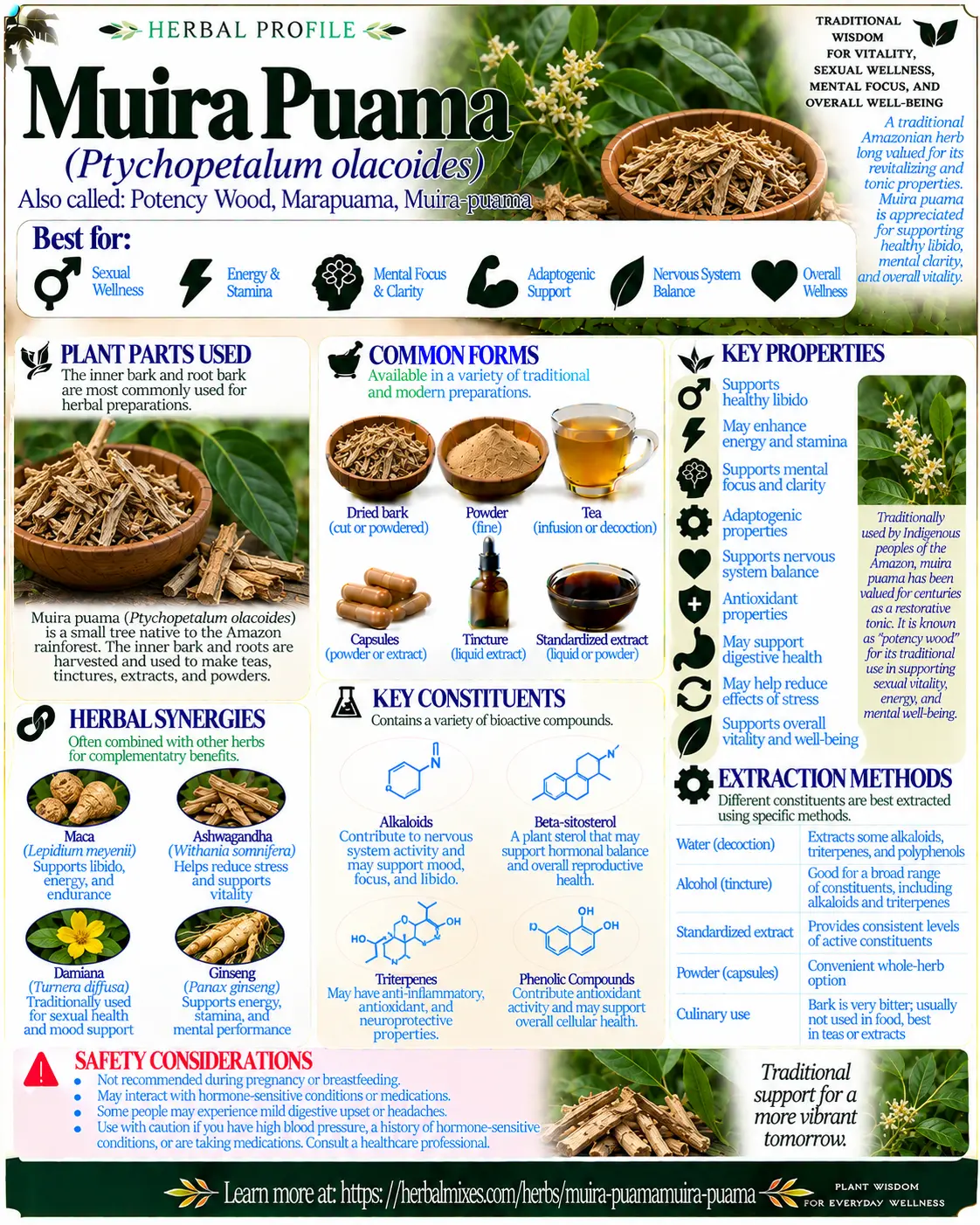
What Muira Puama Is Good For
Libido support — Muira puama is best known as a traditional Amazonian aphrodisiac and sexual tonic. It appears in supplements for libido and sexual performance, but high-quality clinical trials of Ptychopetalum olacoides alone are lacking.
Sexual wellness — Muira puama has been studied mostly as part of multi-herb formulas rather than as a single ingredient. This makes it difficult to determine how much benefit comes specifically from muira puama.
Energy & vitality — Traditional use includes physical vitality, stamina, and recovery from fatigue. Modern evidence for these effects remains mostly preclinical or based on traditional use rather than strong human trials.
Mental stamina — P. olacoides has traditionally been described as a nerve tonic. Animal research has found memory-enhancing and acetylcholinesterase-inhibiting effects, but comparable human cognitive trials have not established efficacy.
Healthy cognitive aging — Experimental research has investigated muira puama for memory retrieval, neuroprotection, and nerve-growth-related pathways. These findings are interesting but should not be interpreted as evidence that muira puama prevents or treats dementia.
Available Herbal Products
Buying Guides for Available Muira Puama Products
Wildcrafted Muira Puama Powder – Powdered root and bark. A clearly identified Ptychopetalum olacoides product from Brazil, currently listed in stock and suitable for capsules, beverages, or traditional preparations. Seller: Starwest Botanicals – View Starwest Muira Puama Powder →
Wildcrafted Muira Puama Cut & Sifted – Loose root/bark herb. A Ptychopetalum olacoides preparation currently in stock and suitable for tea, decoction, or homemade tincture. Seller: Starwest Botanicals – View Starwest Muira Puama Cut & Sifted →
Full Spectrum Muira Puama 400 mg – Whole-herb capsules. A convenient capsule format currently available through iHerb. Seller: Swanson / iHerb – View Swanson Full Spectrum Muira Puama →
True Herbs Muira Puama 300 mg – Capsules. A measured capsule option currently available through iHerb for people who prefer to avoid powders or tinctures. Seller: Solaray / iHerb – View Solaray Muira Puama →
A botanical-identity detail matters when shopping for muira puama. Starwest identifies its products as Ptychopetalum olacoides, while Herb Pharm currently sells a “Muira Puama” extract made from Croton echioides rather than P. olacoides. These plants should not automatically be treated as chemically interchangeable.
Herbal Synergies
Muira puama pairs especially well with maca, damiana, ginseng, schisandra, and ginger depending on whether the goal is libido, stamina, sexual wellness, or general vitality.
Muira Puama + Maca
Best for: Libido, stamina, and sexual wellness
Muira puama contributes traditional nerve-tonic and aphrodisiac activity, while maca adds food-based energy and human research suggesting possible support for sexual desire.
Best extraction: Muira puama tincture or decoction combined with maca powder or gelatinized maca capsules. Maca is well suited to whole-food use, while muira puama is traditionally extracted.
Muira Puama + Damiana
Best for: Libido with nervous tension
Both herbs have longstanding traditional reputations as aphrodisiacs, but damiana adds more aromatic nervine and mood-supportive qualities.
Best extraction: Hydroalcoholic tincture. Alcohol captures aromatic and less-polar constituents from both herbs more broadly than plain water.
Muira Puama + Asian Ginseng
Best for: Sexual vitality and physical stamina
Muira puama provides traditional reproductive and nerve-tonic support, while Asian ginseng adds better-studied adaptogenic and fatigue-supportive activity.
Best extraction: Muira puama tincture combined with standardized ginseng extract.
Muira Puama + Schisandra
Best for: Mental stamina and stress resilience
Muira puama has traditional CNS-tonic associations, while schisandra contributes lignans used for endurance and adaptation to stress.
Best extraction: Hydroalcoholic tinctures or standardized extracts.
Muira Puama + Ginger
Best for: Vitality with sluggish digestion
Ginger adds warming digestive and circulatory support and can make muira puama formulas more comfortable for people who experience digestive heaviness.
Best extraction: Muira puama tincture or decoction with ginger tea or tincture.
Key Herbal Properties
Aphrodisiac — Muira puama has a strong traditional reputation for increasing sexual desire, although evidence from controlled trials of the single herb remains insufficient.
Nerve tonic — Amazonian traditional use includes nervous-system and age-related complaints, and experimental research has explored cognition and memory.
Nootropic — Ethanol extracts improved memory retrieval in animal studies and demonstrated acetylcholinesterase-inhibitory activity. These results remain preclinical.
Stimulant / tonic — Traditional use emphasizes physical and mental vitality. Some animal research also suggests CNS-stimulating characteristics.
Antioxidant — Phenolic compounds and other constituents contribute antioxidant activity.
Neuroprotective — Experimental studies have reported protective effects in models of cognitive impairment, but human clinical confirmation is lacking.
Acetylcholinesterase inhibitory — P. olacoides ethanol extracts inhibited acetylcholinesterase in cognition-relevant brain regions in animal studies, which may contribute to its experimental memory effects.




Active Compounds
Modern analysis of Ptychopetalum olacoides bark has identified alkaloids, flavonoids, phenolic acids, serotonin derivatives, and clerodane diterpenoids. Alkaloids appear particularly prominent in analyzed bark samples.
Magnoflorine
Found mainly in: Bark
Magnoflorine is an aporphine alkaloid and one of the major compounds identified in quantitative analysis of P. olacoides bark.
Together with menisperine, it accounted for most of the quantified analytes in one detailed chemical study.
Best extraction: Hydroalcoholic extraction. Alkaloids generally extract efficiently in polar alcohol-water mixtures.
Menisperine
Found mainly in: Bark
Menisperine is another major alkaloid identified in muira puama bark and appears to be one of its dominant chemical markers.
Its precise contribution to libido or cognitive effects in humans has not been established.
Best extraction: Hydroalcoholic tincture or standardized extract.
Ptychonolide and Related Clerodane Diterpenoids
Found mainly in: Bark
Muira puama contains several unusual clerodane diterpenoids, including ptychonolide and related compounds.
Some isolated diterpenoids promoted nerve-growth-factor-related neurite outgrowth in cultured cells, but this is experimental evidence rather than proof of neurological benefit in people.
Best extraction: Alcohol-rich or methanol-type laboratory extraction. These relatively lipophilic compounds are not efficiently concentrated by simple tea alone.
Luteolin
Found mainly in: Bark
Luteolin is a flavonoid with antioxidant and inflammatory-modulating activity found in P. olacoides.
Best extraction: Hydroalcoholic extract or hot water, although alcohol generally gives broader flavonoid recovery.
4-Coumaroylserotonin
Found mainly in: Bark
4-Coumaroylserotonin is a serotonin-derived phenolic compound identified in phytochemical analysis of muira puama.
Its specific clinical role in the herb’s traditional effects is unknown.
Best extraction: Hydroalcoholic extraction.
Caffeic Acid
Found mainly in: Bark
Caffeic acid contributes antioxidant activity and occurs alongside several other phenolic acids.
Best extraction: Water or hydroalcoholic extraction.
Ferulic Acid
Found mainly in: Bark
Ferulic acid is another antioxidant phenolic compound identified in muira puama bark.
Best extraction: Hydroalcoholic extract, although some is recoverable in hot water.
Vanillic and Syringic Acids
Found mainly in: Bark
These phenolic acids contribute to the broader antioxidant profile of the plant.
Best extraction: Water or hydroalcoholic extraction.
FAQ
What is muira puama best used for?
Muira puama is primarily used traditionally for libido, sexual vitality, energy, and nervous-system support.
Clinical evidence for Ptychopetalum olacoides alone remains insufficient, so these uses should be described as traditional or preliminary rather than proven.
Does muira puama increase testosterone?
There is no good evidence that muira puama reliably raises testosterone.
Its traditional aphrodisiac reputation should not be interpreted as evidence of hormone enhancement.
Does muira puama improve memory?
Animal studies have shown improved memory retrieval and acetylcholinesterase inhibition after standardized ethanol extracts.
However, these findings have not yet been established in controlled human cognitive trials.
Is tincture or powder better?
A hydroalcoholic tincture is likely to extract a broader range of alkaloids and diterpenoids.
Whole powder retains the complete plant material and may be convenient in capsules, but constituent absorption and concentration are less predictable.
Is every product called muira puama the same plant?
No.
“Muira puama” is a common name applied commercially to more than one South American plant. If you specifically want Ptychopetalum olacoides, check the botanical name on the label.
Safety & Precautions
Clinical safety information for Ptychopetalum olacoides is limited, and there are no high-quality clinical trials establishing a standard therapeutic dose.
One human toxicology study used muira puama as part of a multi-herb formula containing guarana, catuaba, and ginger for 28 days and found no severe adverse reactions or meaningful laboratory abnormalities. Because it was a combination product, this does not establish the safety of high-dose P. olacoides alone.
Possible stimulating effects deserve attention. An animal study found anxiety-like effects after administration of an ethanol extract, suggesting that large or concentrated doses may not be ideal for people prone to anxiety, agitation, or insomnia.
Use cautiously with stimulant medications or supplements, including large amounts of caffeine, until more reliable interaction data are available.
Because experimental studies suggest activity involving acetylcholine, dopamine, beta-adrenergic, and serotonin-related pathways, people taking neurological or psychiatric medications should discuss concentrated use with a healthcare professional.
Safety during pregnancy and breastfeeding has not been adequately established. Avoid concentrated medicinal use unless specifically recommended by a qualified professional.
There is insufficient evidence to establish safety in children, so concentrated products are best reserved for adults.
Muira puama should not be used as a replacement for medical evaluation of erectile dysfunction, persistent loss of libido, infertility, severe fatigue, or cognitive decline, because these symptoms can reflect cardiovascular, endocrine, neurological, psychological, or medication-related causes.
Botanical identification is especially important. Some products marketed as “muira puama” use species such as Croton echioides rather than Ptychopetalum olacoides. Their chemical profiles and evidence bases are not necessarily interchangeable.
Anyone taking prescription medication, managing cardiovascular or psychiatric conditions, pregnant, breastfeeding, or experiencing persistent sexual dysfunction should discuss therapeutic muira puama use with an appropriate healthcare professional.
References
- Kew Plants of the World Online — Ptychopetalum olacoides Benth.
- PubMed — Chemical Constituents of Ptychopetalum olacoides
- PubMed — Ptychopetalum olacoides and Acetylcholinesterase Activity
- PubMed — Memory Retrieval Improvement with Ptychopetalum olacoides
- PubMed — Promnesic Effects of Ptychopetalum olacoides
- PubMed — Clerodane Diterpenoids and NGF-Potentiating Activity
- PubMed — Additional Clerodane Diterpenoids from P. olacoides
- PubMed — Clinical Toxicology Study of Catuama
- Drugs.com — Muira Puama Professional Monograph
- Starwest Botanicals — Wildcrafted Muira Puama Powder
Disclaimer
Disclaimer: This article is for educational purposes only and is not intended to diagnose, treat, cure, or prevent any disease. Herbal products can cause side effects and interact with medications. Consult a qualified healthcare professional before using herbs therapeutically, especially if you are pregnant, breastfeeding, taking prescription medications, or managing a medical condition.