

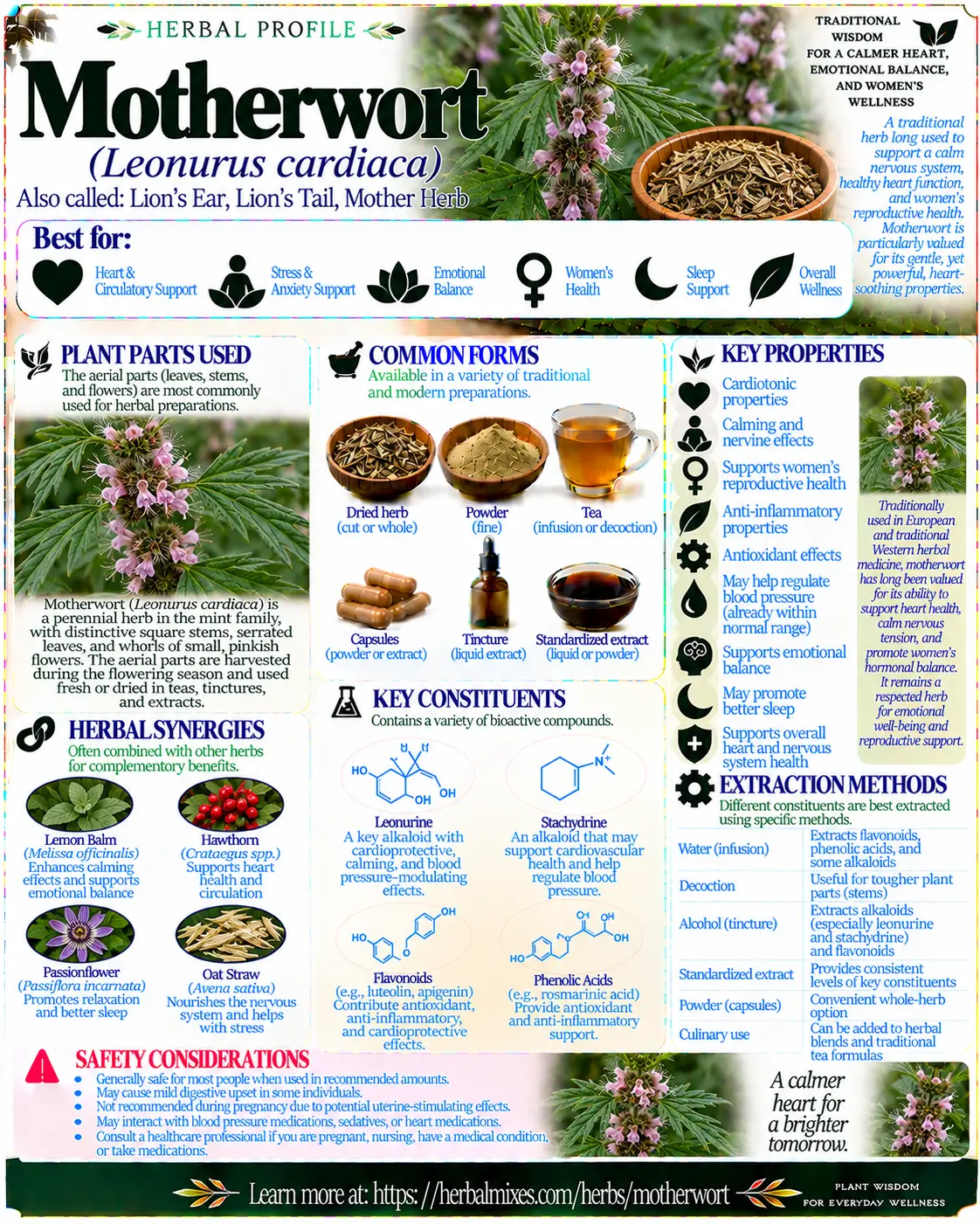
What Motherwort Is Good For
Nervous tension — Motherwort is a traditional nervine used for restlessness and stress, especially when emotional tension is accompanied by a noticeable heartbeat. The European Medicines Agency recognizes traditional use for relief of nervous tension. (EMA)
Stress-related palpitations — Motherwort has a particularly strong traditional association with nervous cardiac symptoms such as palpitations, but only after serious heart conditions have been excluded. EMA specifically includes this indication in its traditional-use monograph. (EMA)
Menstrual support — Motherwort has long been used in women’s herbal practice for menstrual discomfort and cycle support. Modern evidence for this use is limited, and its uterine activity is also why it should be avoided during pregnancy.
Restlessness — Its traditional sedative and calming effects make motherwort useful when physical agitation or emotional tension feels strongly “in the chest.”
Mild cardiovascular tension — Small clinical and preclinical studies suggest mild hypotensive and heart-rate-modulating effects, but current evidence is insufficient to use motherwort as treatment for hypertension or arrhythmia. (PubMed)
Available Herbal Products
Buying Guides for Available Motherwort Products
Motherwort Liquid Herbal Extract – Flowering aerial-parts tincture. A 1:5 certified-organic hydroalcoholic extract made from Leonurus cardiaca grown in Oregon and currently available directly from the manufacturer. Seller: Herb Pharm – View Herb Pharm Motherwort →
Motherwort Alcohol-Free Liquid Extract – Glycerite. Made from dried Leonurus cardiaca herb using glycerin and water and currently listed in stock. A useful option for people who prefer to avoid alcohol. Seller: HawaiiPharm – View HawaiiPharm Motherwort Alcohol-Free →
Motherwort Liquid Extract – Hydroalcoholic tincture. A concentrated dried-herb extract currently listed in stock and available in several bottle sizes. Seller: HawaiiPharm – View HawaiiPharm Motherwort Tincture →
Organic Motherwort Herb – Dried flowering herb. Suitable for tea or homemade tinctures, although Mountain Rose Herbs currently lists this product as out of stock. Seller: Mountain Rose Herbs – View Mountain Rose Herbs Motherwort →
For therapeutic use, tinctures are generally the most practical form because motherwort is intensely bitter and many of its alkaloids, diterpenes, flavonoids, and phenolics extract well into water-alcohol mixtures.
Herbal Synergies
Motherwort pairs especially well with hawthorn, lemon balm, skullcap, cramp bark, and ginger depending on whether the goal is nervous palpitations, stress, menstrual discomfort, or digestive tension.
Motherwort + Hawthorn
Best for: Nervous palpitations with cardiovascular support
Motherwort contributes calming and mild cardiovascular effects, while hawthorn adds more specific circulatory and cardiac support through flavonoids and oligomeric procyanidins.
This is one of the classic combinations when emotional tension is accompanied by awareness of heartbeat.
Best extraction: Tincture or liquid extract. Both herbs contain constituents that extract broadly into hydroalcoholic preparations.
Motherwort + Lemon Balm
Best for: Stress, restlessness, and nervous palpitations
Motherwort helps calm cardiovascular tension, while lemon balm contributes gentle nervine and digestive support.
Best extraction: Tincture or covered hot infusion.
Motherwort + Skullcap
Best for: Restlessness and muscular nervous tension
Motherwort provides the cardiovascular-nervine component, while skullcap contributes a more direct relaxing nervine action.
Best extraction: Hydroalcoholic tincture. This gives a concentrated preparation without requiring a very bitter tea.
Motherwort + Cramp Bark
Best for: Menstrual cramping with nervous tension
Motherwort has traditional menstrual and uterine associations, while cramp bark contributes smooth-muscle-relaxing and antispasmodic activity.
Best extraction: Tincture. Both herbs are well suited to alcohol-water extraction.
Motherwort + Ginger
Best for: Menstrual discomfort with nausea or digestive sluggishness
Motherwort contributes traditional menstrual support, while ginger adds warming, antispasmodic, carminative, and nausea-supportive properties.
Best extraction: Motherwort tincture combined with ginger tea, tincture, or powder.
Key Herbal Properties
Nervine — Motherwort is traditionally used to calm nervous tension and restlessness, particularly when stress feels physically cardiovascular. EMA recognizes this traditional use. (EMA)
Cardiotonic / cardiovascular supportive — Motherwort has a longstanding traditional association with the heart. Modern reviews describe mild negative chronotropic and hypotensive effects, but clinical evidence remains limited. (PubMed)
Mild hypotensive — Some research suggests modest blood-pressure-lowering activity, which may be useful but also creates a medication-interaction concern.
Sedative — Experimental and limited clinical evidence supports mild calming or sedative activity.
Antispasmodic — Motherwort has traditionally been used for smooth-muscle and menstrual tension.
Uterine active — Motherwort has a strong traditional association with uterine activity and menstruation. This property is also an important reason to avoid it during pregnancy.
Anti-inflammatory — Leonurine, stachydrine, diterpenes, and other compounds influence inflammatory signaling experimentally. (PubMed)
Antioxidant — Flavonoids, phenolic acids, and related compounds contribute antioxidant activity.






Active Compounds
Motherwort contains a chemically diverse mixture of nitrogen-containing compounds, labdane diterpenoids, iridoids, flavonoids, phenolic acids, triterpenes, sterols, tannins, and small amounts of volatile oil. (PubMed)
Leonurine
Found mainly in: Flowering aerial parts
Leonurine is one of the best-known alkaloid-like compounds associated with the genus Leonurus. It has been studied extensively for cardiovascular, neuroprotective, antioxidant, and anti-inflammatory effects.
Much of this research is preclinical and often involves other Leonurus species, so isolated leonurine findings should not automatically be treated as proof of whole-herb clinical effects.
Best extraction: Hydroalcoholic extract. Leonurine and related nitrogen-containing compounds extract well in polar water-alcohol mixtures.
Stachydrine
Found mainly in: Aerial parts
Stachydrine, also known as proline betaine, is another characteristic nitrogen-containing constituent found in Leonurus species.
It has been investigated experimentally for cardiovascular, uterine, antioxidant, and anti-inflammatory activity. (PubMed)
Best extraction: Water or hydroalcoholic extract because stachydrine is highly polar.
Leonuride
Found mainly in: Flowering aerial herb
Leonuride is an iridoid glycoside associated with Leonurus cardiaca and contributes to the herb’s characteristic phytochemical profile.
Best extraction: Hot water or diluted alcohol. Glycosides generally extract well into polar solvents.
Labdane Diterpenoids
Found mainly in: Aerial parts
Motherwort contains numerous labdane diterpenoids, a large chemical group within the genus Leonurus. Research has particularly investigated their anti-inflammatory and cardiovascular effects. (PubMed)
Best extraction: Hydroalcoholic tincture. Alcohol improves extraction of the less-polar diterpene fraction.
Hyperoside
Found mainly in: Flowering aerial parts
Hyperoside is a quercetin glycoside and one of the flavonoids used historically as a quality marker for European motherwort herb. A pharmacognosy review notes a European Pharmacopoeia minimum total flavonoid content expressed as hyperoside. (PubMed)
Best extraction: Hot water or hydroalcoholic tincture.
Rutin
Found mainly in: Aerial parts
Rutin is another flavonoid glycoside contributing antioxidant and vascular-supportive activity.
Best extraction: Hot-water infusion or diluted alcohol.
Ursolic Acid
Found mainly in: Aerial tissues
Ursolic acid is a pentacyclic triterpenoid found in motherwort and many other mint-family plants.
It has anti-inflammatory and antioxidant effects experimentally.
Best extraction: Alcohol-rich extract. Ursolic acid is poorly soluble in plain water.
FAQ
What is motherwort best used for?
Motherwort is best known for nervous tension and stress-related palpitations.
EMA specifically recognizes traditional use for nervous tension and nervous cardiac complaints such as noticeable heartbeat, after serious medical causes have been excluded. (EMA)
Does motherwort lower heart rate?
Possibly.
Research reviews describe mild negative chronotropic activity, meaning a potential slowing effect on heart rate, but motherwort is not a substitute for treatment of tachycardia or arrhythmia. (PubMed)
Can motherwort lower blood pressure?
It may.
A small clinical study considered by EMA suggested a possible reduction in blood pressure, but it was short and lacked an appropriate comparison group, so firm conclusions could not be drawn. (EMA)
Is motherwort good for menstruation?
Motherwort has a long traditional association with menstrual and uterine support, and Herb Pharm currently markets its extract for healthy menstrual-cycle support.
However, high-quality clinical evidence is limited, and its uterine activity makes pregnancy an important contraindication.
Is motherwort tea or tincture better?
Both can be used, but tincture is often more practical.
Motherwort tea is extremely bitter, while hydroalcoholic extraction captures alkaloids, flavonoids, diterpenes, and other constituents in a small dose.
Safety & Precautions
Motherwort should be used with more caution than very gentle nervines such as lemon balm or chamomile.
The most important restriction is pregnancy. Because motherwort has traditional uterine-stimulating and emmenagogue activity, it should generally be avoided during pregnancy unless specifically directed by a qualified healthcare professional.
EMA restricts traditional medicinal motherwort use to adults. (EMA)
Safety during breastfeeding has not been adequately established.
Because motherwort may lower heart rate and blood pressure, use caution with beta-blockers, calcium-channel blockers, antiarrhythmic medicines, antihypertensive drugs, or other medications that affect cardiovascular function.
People with low blood pressure, bradycardia, diagnosed arrhythmias, heart block, or other cardiovascular disease should not self-treat with concentrated motherwort.
Experimental research on Leonurus constituents also suggests antiplatelet or anticoagulant activity, so caution is appropriate with warfarin, apixaban, rivaroxaban, clopidogrel, aspirin, or other blood-thinning medicines. (PubMed)
Possible adverse effects include digestive discomfort, dizziness, sedation, changes in blood pressure, or changes in heartbeat.
Palpitations should not automatically be assumed to be “nervous.” They can result from thyroid disease, anemia, electrolyte abnormalities, medication effects, atrial fibrillation, other arrhythmias, or structural heart disease.
Seek urgent medical care for palpitations accompanied by chest pain, fainting, severe shortness of breath, weakness, confusion, or a sustained very fast or irregular heartbeat.
EMA advises medical evaluation if nervous or cardiac symptoms persist longer than four weeks or worsen during use. (EMA)
Anyone who is pregnant, breastfeeding, taking cardiovascular or blood-thinning medication, or managing heart disease should discuss therapeutic motherwort use with an appropriate healthcare professional.
References
- European Medicines Agency — Leonuri cardiacae herba
- Kew Plants of the World Online — Leonurus cardiaca L.
- PubMed — Leonurus cardiaca L. (Motherwort): Review of Phytochemistry and Pharmacology
- PubMed — Phytochemistry and Pharmacology of the Genus Leonurus
- PubMed — Review of Stachydrine Pharmacology
- PubMed — Exploring Stachydrine: Biological Activities and Metabolic Pathways
- Herb Pharm — Motherwort Liquid Herbal Extract
- HawaiiPharm — Motherwort Alcohol-Free Extract
- HawaiiPharm — Motherwort Tincture
- Mountain Rose Herbs — Organic Motherwort
Disclaimer
Disclaimer: This article is for educational purposes only and is not intended to diagnose, treat, cure, or prevent any disease. Herbal products can cause side effects and interact with medications. Consult a qualified healthcare professional before using herbs therapeutically, especially if you are pregnant, breastfeeding, taking prescription medications, or managing a medical condition.