

What Moringa Is Good For
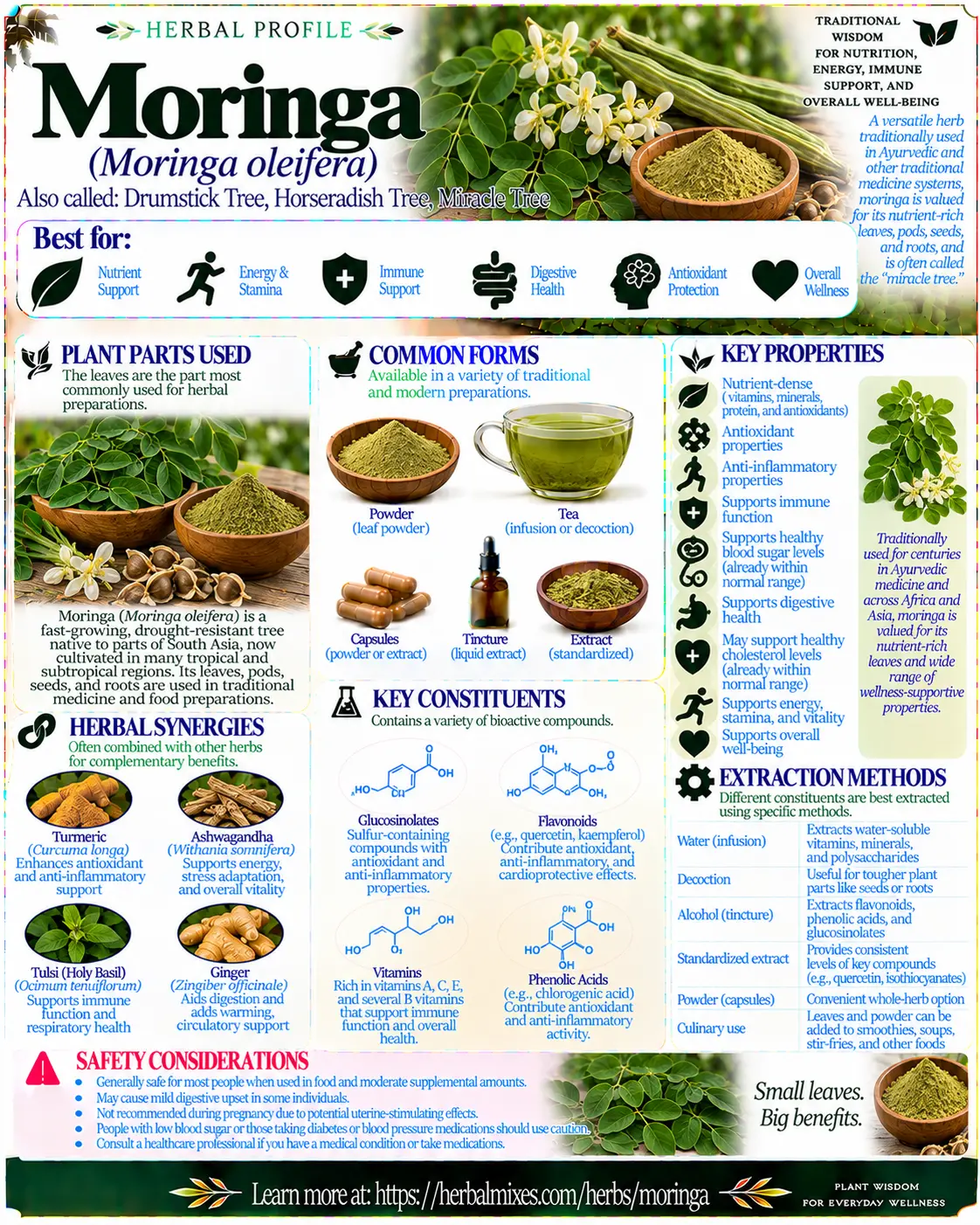
Nutritional support — Moringa leaves are unusually nutrient-dense and are consumed as both food and herbal supplement. They provide protein, fiber, carotenoids, minerals, vitamins, and numerous plant polyphenols, making moringa especially useful as a food-based green supplement rather than simply a medicinal extract.
Antioxidant support — Moringa leaves contain flavonoids, phenolic acids, glucosinolates, and isothiocyanates that contribute antioxidant activity and influence cellular defenses against oxidative stress.
Healthy blood sugar — Human studies have investigated moringa leaf for glucose control. A randomized trial in people with prediabetes found favorable changes in fasting glucose and HbA1c after 12 weeks, but larger reviews show inconsistent results, so moringa should not be treated as a diabetes medication.
Healthy blood pressure — Recent meta-analyses suggest possible modest reductions in blood pressure, but study quality and heterogeneity remain important limitations. Results should therefore be considered promising rather than definitive.
Metabolic wellness — Moringa has been studied for glucose, cholesterol, blood pressure, and metabolic syndrome. A 2025 meta-analysis of randomized trials found no consistent benefit across most cardiometabolic outcomes and rated the overall certainty of evidence very low.
Everyday vitality — Because moringa leaf functions as a nutrient-rich whole food without caffeine, it is often used as a daily green powder or capsule for general nutritional support rather than as an immediate stimulant.
Available Herbal Products
Buying Guides for Available Moringa Products
Organic Moringa Leaf Powder – Whole dried leaf powder. An organic Moringa oleifera powder suitable for smoothies, juice, soups, oatmeal, or other foods and currently listed in stock. Seller: Starwest Botanicals – View Starwest Organic Moringa Leaf Powder →
Moringa Leaf Veg Capsules – Organic whole-leaf capsules. Uses non-GMO organic moringa leaf and provides a convenient measured alternative to green powder. Seller: NOW Foods – View NOW Foods Moringa Leaf →
Organic Moringa Capsules – Whole-leaf capsules. Made from regeneratively grown organic Moringa oleifera leaf with no herbal blends or stimulant ingredients. Seller: Organic India – View Organic India Moringa Capsules →
Organic Moringa Powder – Whole-leaf green powder. A single-ingredient organic moringa leaf powder designed for smoothies, drinks, oatmeal, and everyday food use. Seller: Organic India – View Organic India Moringa Powder →
For general wellness, whole leaf powder is usually the most food-like option. Concentrated extracts may provide higher amounts of selected phytochemicals, but they should not automatically be assumed superior to the whole leaf.
Herbal Synergies
Moringa pairs especially well with turmeric, ginger, cinnamon, hibiscus, and amla depending on whether the goal is antioxidant, metabolic, cardiovascular, or nutritional support.
Moringa + Turmeric
Best for: Antioxidant and inflammatory balance
Moringa contributes glucosinolates, isothiocyanates, quercetin-related flavonoids, and chlorogenic acid, while turmeric contributes curcuminoids.
The combination approaches oxidative and inflammatory signaling through different phytochemical families.
Best extraction: Moringa leaf powder or water-based extract combined with turmeric powder or a formulated curcumin extract. Curcuminoids are poorly water soluble, so turmeric benefits from different preparation methods than moringa.
Moringa + Ginger
Best for: Digestive support and everyday vitality
Moringa provides nutritional and antioxidant support, while ginger adds warming carminative and digestive activity.
This combination works well in food, smoothies, soups, or functional beverages.
Best extraction: Whole powders or tea. Ginger tolerates hot-water extraction well, while moringa leaf can be consumed directly as powder.
Moringa + Cinnamon
Best for: Metabolic and blood-sugar support
Moringa and cinnamon have both been investigated for glucose metabolism through different mechanisms.
Because both may influence blood glucose, people taking diabetes medication should monitor carefully.
Best extraction: Moringa leaf powder combined with cinnamon powder, tea, or standardized extract.
Moringa + Hibiscus
Best for: Cardiovascular and antioxidant support
Moringa contributes polyphenols and isothiocyanates, while hibiscus provides anthocyanins and organic acids associated with cardiovascular support.
Best extraction: Moringa powder or extract combined with hibiscus infusion.
Moringa + Amla
Best for: Nutritional and antioxidant support
Moringa provides carotenoids, minerals, flavonoids, and glucosinolates, while amla contributes vitamin C-related nutrition, tannins, and additional polyphenols.
Best extraction: Whole powders or water-based preparations. This pairing works especially well as a food-based formula.
Herbal Properties
Nutritive — Moringa leaves provide protein, fiber, minerals, carotenoids, vitamins, and numerous phytochemicals.
Antioxidant — Quercetin derivatives, chlorogenic acid, glucosinolates, isothiocyanates, and other polyphenols contribute substantial antioxidant activity.
Anti-inflammatory — Moringa isothiocyanates and polyphenols influence NF-κB, Nrf2, oxidative signaling, and other inflammatory pathways experimentally.
Metabolic supportive — Moringa has been investigated for glucose, lipid, and blood-pressure regulation, although modern clinical evidence remains inconsistent.
Hypoglycemic — Some human and experimental studies suggest glucose-lowering effects. This potential action is clinically important because it may interact with diabetes medication.
Mild hypotensive — Some trials and meta-analyses suggest blood-pressure reductions, although certainty remains low.
Immunomodulatory — Moringa polysaccharides, polyphenols, and isothiocyanates influence immune signaling experimentally, but evidence is insufficient to claim that moringa prevents infections.
Key Herbal Properties
Nutritive — Moringa leaves provide protein, fiber, minerals, carotenoids, vitamins, and numerous phytochemicals.
Antioxidant — Quercetin derivatives, chlorogenic acid, glucosinolates, isothiocyanates, and other polyphenols contribute substantial antioxidant activity.
Anti-inflammatory — Moringa isothiocyanates and polyphenols influence NF-κB, Nrf2, oxidative signaling, and other inflammatory pathways experimentally.
Metabolic supportive — Moringa has been investigated for glucose, lipid, and blood-pressure regulation, although modern clinical evidence remains inconsistent.
Hypoglycemic — Some human and experimental studies suggest glucose-lowering effects. This potential action is clinically important because it may interact with diabetes medication.
Mild hypotensive — Some trials and meta-analyses suggest blood-pressure reductions, although certainty remains low.
Immunomodulatory — Moringa polysaccharides, polyphenols, and isothiocyanates influence immune signaling experimentally, but evidence is insufficient to claim that moringa prevents infections.






Active Compounds
Moringa leaf contains a diverse mixture of glucosinolates, isothiocyanates, flavonoids, phenolic acids, carotenoids, vitamins, minerals, proteins, and polysaccharides. Its phytochemical profile varies substantially depending on plant part, growing conditions, drying, and extraction.
Glucomoringin
Found mainly in: Leaves, seeds, and other tissues
Glucomoringin is one of the characteristic glucosinolates of Moringa oleifera.
When plant tissue is damaged and the enzyme myrosinase is active, glucomoringin can be converted into moringin, a biologically active isothiocyanate.
Best extraction: Water or hydroalcoholic extraction for the intact glucosinolate. Mild processing helps preserve the glucosinolate-myrosinase system better than aggressive heat treatment.
Moringin
Found mainly in: Formed from glucomoringin after enzymatic conversion
Moringin is a characteristic moringa isothiocyanate formed through myrosinase-mediated breakdown of glucomoringin.
Moringa isothiocyanates are structurally unusual because they contain a sugar-related substituent that makes them relatively stable compared with many cruciferous isothiocyanates.
Best extraction: Fresh or gently processed plant material followed by aqueous or hydroalcoholic extraction. Excessive heat can inactivate myrosinase and change isothiocyanate formation.
Quercetin Derivatives
Found mainly in: Leaves
Moringa leaves contain quercetin and quercetin glycosides, which contribute antioxidant and vascular-supportive activity.
Best extraction: Hot water or hydroalcoholic extraction. Glycosylated flavonoids are sufficiently polar for water extraction.
Kaempferol Derivatives
Found mainly in: Leaves
Kaempferol glycosides complement quercetin compounds in moringa’s flavonoid profile.
Best extraction: Water or hydroalcoholic tincture.
Chlorogenic Acid
Found mainly in: Leaves
Chlorogenic acid is a polyphenol associated with antioxidant activity and glucose-metabolism research.
Best extraction: Water or diluted alcohol. It is a relatively polar phenolic acid and extracts effectively into aqueous preparations.
Carotenoids
Found mainly in: Leaves
Moringa leaves contain carotenoids including beta-carotene and lutein, contributing nutritional and antioxidant value.
Best extraction: Whole leaf consumed with food containing some fat. Carotenoids are fat soluble and are poorly extracted into plain tea.
Polyphenols
Found mainly in: Leaves
Moringa contains numerous phenolic acids and flavonoids that contribute its overall antioxidant profile.
Best extraction: Water, hydroalcoholic extract, or direct consumption of whole leaf powder.
Protein and Amino Acids
Found mainly in: Leaves
Dried moringa leaves contain appreciable protein and multiple amino acids, supporting their use as a nutrient-rich food ingredient.
Best extraction: No extraction required. Whole leaf powder or cooked leaves retain this nutritional fraction.
FAQ
What is moringa best used for?
Moringa is best viewed as a nutrient-rich green food with antioxidant and potential metabolic-supportive properties.
Clinical research has explored blood sugar and blood pressure, but the evidence is not strong enough to treat moringa as a replacement for medical therapy.
Does moringa lower blood sugar?
It may.
A randomized 12-week study in people with prediabetes found favorable changes in fasting glucose and HbA1c, and a 2026 meta-analysis also reported glucose-lowering signals. However, a 2025 meta-analysis of randomized trials found no consistent effect across most cardiometabolic outcomes.
The evidence therefore remains mixed.
Does moringa lower blood pressure?
Possibly.
Recent meta-analyses have found reductions in systolic and diastolic blood pressure, but heterogeneity and methodological limitations make the certainty low.
People already taking antihypertensive medication should monitor rather than assuming more is better.
Is moringa powder better than capsules?
Not necessarily.
If both contain the same whole dried leaf, the main difference is convenience. Powder is easier to use as food and generally provides larger serving amounts, while capsules offer more consistent portioning.
Is moringa leaf the same as moringa root?
No.
Moringa supplements for general wellness are typically made from the leaf. Root and bark have different chemistry and substantially greater safety concerns and should not be casually substituted for leaf preparations.
Safety & Precautions
Moringa leaf is widely consumed as food and appears reasonably well tolerated in ordinary dietary amounts, but concentrated supplementation and non-leaf plant parts require greater caution.
A major systematic review concluded that clinical evidence remains limited and that toxicity can occur at sufficiently high doses.
Possible adverse effects include nausea, diarrhea, abdominal discomfort, or other digestive symptoms, particularly when larger amounts of leaf powder are introduced quickly.
Moringa may influence blood glucose. People taking insulin, metformin, sulfonylureas, or other glucose-lowering medication should monitor carefully and discuss concentrated supplementation with their healthcare professional.
Moringa may also influence blood pressure, creating potential additive effects with antihypertensive medicines.
Medicinal use during pregnancy should be avoided unless specifically recommended by a qualified healthcare professional. A review of traditional medicinal plants used during pregnancy identified Moringa oleifera among plants warranting avoidance because of reproductive effects reported in preclinical research.
In particular, moringa root and bark should not be treated as interchangeable with the edible leaf. Commercial leaf-only products are generally the more appropriate form for ordinary nutritional use.
Organic India specifically advises avoiding moringa root and bark and uses only the leaf in its current products.
Safety during breastfeeding has not been adequately established for concentrated supplements, despite traditional use of moringa as a food in some cultures.
People with thyroid, kidney, liver, cardiovascular, or metabolic disease should be conservative with concentrated extracts because human interaction data remain incomplete.
Choose reputable products with clear identification of the plant part. “Moringa” alone is not sufficient information because leaf, seed, bark, and root have different chemical and safety profiles.
Seek professional guidance before regular medicinal use if you are pregnant, breastfeeding, using diabetes or blood-pressure medication, or managing a chronic medical condition.
References
- Kew Plants of the World Online — Moringa oleifera Lam.
- PubMed — Moringa oleifera: Systematic Review of Phytochemistry, Pharmacology and Toxicity
- PubMed — Glucosinolates and Isothiocyanates from Moringa oleifera
- PubMed — Cardiometabolic Outcomes: Meta-Analysis of Randomized Controlled Trials
- PubMed — Moringa and Hyperglycemia/Hypertension: 2026 Systematic Review and Meta-Analysis
- PubMed — Moringa Leaf Supplementation in Prediabetes
- PubMed — Review of the Safety and Efficacy of Moringa oleifera
- NOW Foods — Moringa Leaf Capsules
- Starwest Botanicals — Organic Moringa Leaf Powder
- Organic India — Moringa Capsules
Disclaimer
Disclaimer: This article is for educational purposes only and is not intended to diagnose, treat, cure, or prevent any disease. Herbal products can cause side effects and interact with medications. Consult a qualified healthcare professional before using herbs therapeutically, especially if you are pregnant, breastfeeding, taking prescription medications, or managing a medical condition.