

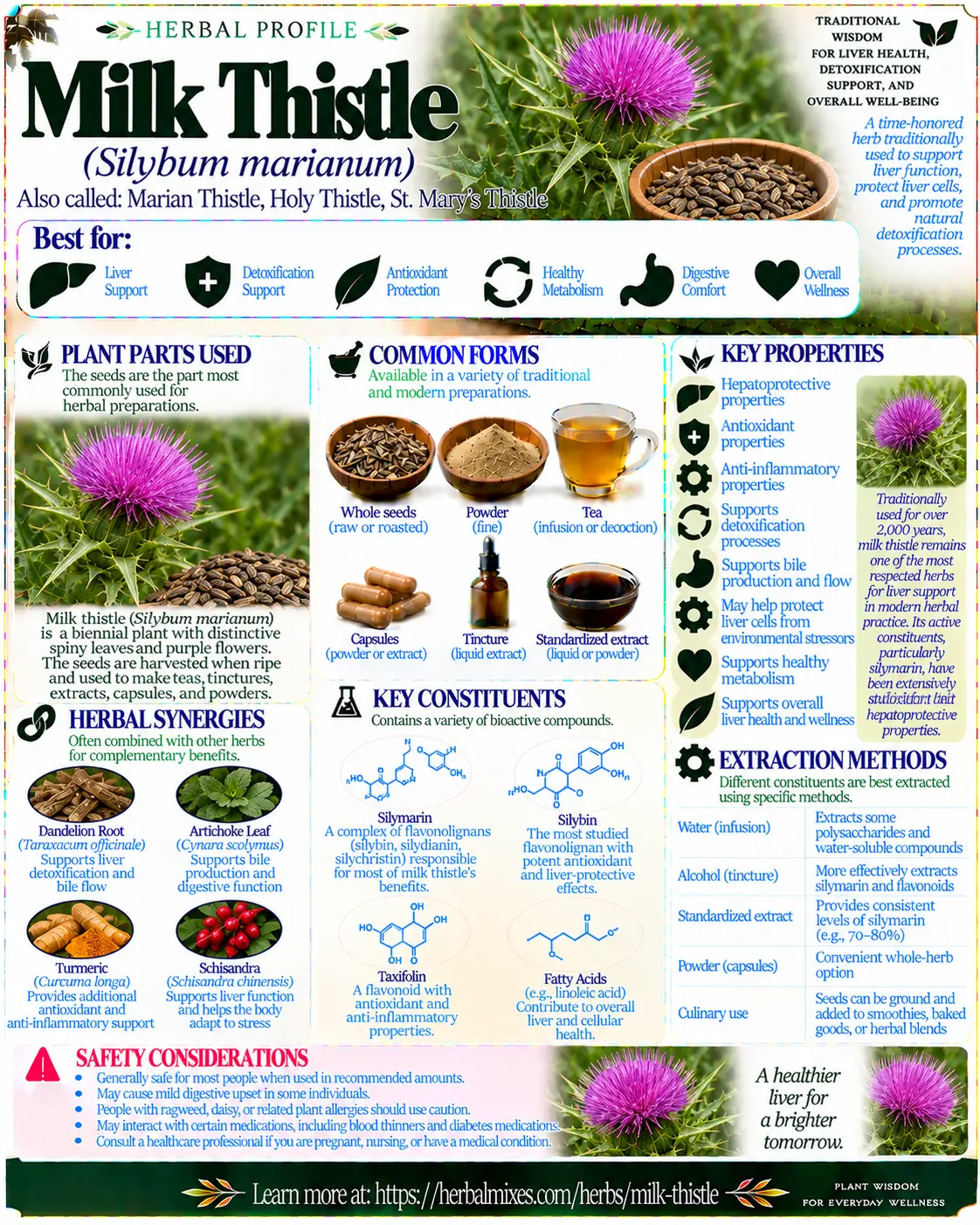
What Milk Thistle Is Good For
Liver support — Milk thistle is best known as a liver-supportive herb. Its flavonolignan complex, silymarin, has antioxidant and cell-protective activity, but clinical trials in alcohol-related liver disease, hepatitis, fatty liver disease, and other liver disorders have produced conflicting or insufficient results.
Antioxidant protection — Silymarin and especially silibinin can influence oxidative-stress pathways and support endogenous antioxidant defenses. This is one of the main biochemical explanations for milk thistle’s reputation as a hepatic protective herb.
Healthy liver function — Standardized milk thistle extracts are commonly used to support normal liver-cell function and detoxification pathways. However, “liver detox” should not be interpreted as evidence that milk thistle removes toxins from the body or reverses liver damage.
Digestive support — The European Medicines Agency recognizes milk thistle fruit for traditional use in symptomatic relief of digestive disorders, such as feelings of fullness and indigestion, after serious medical conditions have been excluded.
Metabolic liver wellness — Milk thistle has been investigated in nonalcoholic fatty liver disease and steatohepatitis, but NCCIH notes that an NCCIH-funded study in NASH did not show benefit from silymarin supplementation.
Available Herbal Products
Buying Guides for Available Milk Thistle Products
Milk Thistle Extract Maximum Strength – Standardized capsules. Provides 750 mg milk thistle extract standardized to 600 mg silymarin per capsule for people looking for a concentrated single-herb preparation. Seller: NOW Foods – View NOW Milk Thistle Extract →
Milk Thistle Extract Extra Strength – Softgels. Provides 450 mg extract with 360 mg silymarin in a softgel format designed to improve solubility of this poorly water-soluble constituent complex. Seller: NOW Foods – View NOW Extra Strength Milk Thistle →
Milk Thistle – Full-spectrum fruit extract capsules. Uses organic Silactive® milk thistle extract and is formulated specifically to improve bioavailability compared with standard extract preparations. Seller: Gaia Herbs – View Gaia Herbs Milk Thistle →
Milk Thistle Gummies – Standardized fruit-extract gummies. Provides 100 mg of silymarins per serving in a convenient chewable format. Seller: Gaia Herbs – View Gaia Herbs Milk Thistle Gummies →
Milk Thistle – Standardized seed-extract capsules. Contains 175 mg milk thistle extract standardized to 80% silymarin, although the manufacturer currently lists the 60-capsule size as backordered. Seller: Nature’s Way – View Nature’s Way Milk Thistle →
For liver-focused use, standardized extracts usually make more sense than plain seed powder because silymarin is poorly water soluble and its concentration in whole seed is much lower and less predictable.
Herbal Synergies
Milk thistle pairs especially well with artichoke, dandelion root, turmeric, schisandra, and ginger depending on whether the goal is liver support, digestion, antioxidant protection, or broader metabolic wellness.
Milk Thistle + Artichoke
Best for: Liver and digestive support
Milk thistle contributes silymarin flavonolignans, while artichoke leaf provides caffeoylquinic acids and bitter compounds traditionally used for bile flow and digestion.
This pairing is common in commercial liver formulas, including NOW Foods’ milk thistle preparations.
Best extraction: Standardized milk thistle extract combined with artichoke tincture or standardized extract. Milk thistle flavonolignans require more than a simple water infusion.
Milk Thistle + Dandelion Root
Best for: Liver support with sluggish digestion
Milk thistle contributes antioxidant hepatic support, while dandelion root adds bitter digestive and traditional hepatobiliary actions.
Best extraction: Standardized milk thistle extract with dandelion decoction, tincture, or extract.
Milk Thistle + Turmeric
Best for: Antioxidant and inflammatory balance
Milk thistle provides silibinin and related flavonolignans, while turmeric contributes curcuminoids that influence oxidative and inflammatory pathways through different mechanisms.
Best extraction: Standardized or enhanced-bioavailability extracts. Both silymarin and curcuminoids have relatively poor oral absorption in ordinary raw preparations.
Milk Thistle + Schisandra
Best for: Liver resilience and stress support
Milk thistle contributes silymarin, while schisandra provides lignans such as schisandrin compounds traditionally associated with liver and adaptogenic support.
Best extraction: Standardized extracts or hydroalcoholic preparations. Both herbs contain important less-polar compounds that are poorly represented by weak tea alone.
Milk Thistle + Ginger
Best for: Digestive comfort with liver-supportive formulas
Milk thistle provides the liver-focused component, while ginger contributes warming carminative, nausea-supportive, and motility-promoting activity.
Best extraction: Milk thistle extract combined with ginger tea, tincture, or powder.
Key Herbal Properties
Hepatoprotective — Silymarin is widely studied for liver-cell protection through antioxidant, membrane-stabilizing, and inflammatory pathways, though clinical benefits in established liver disease remain uncertain.
Antioxidant — Silymarin and silibinin can reduce oxidative stress experimentally and support glutathione-related defenses.
Anti-inflammatory — Milk thistle flavonolignans influence inflammatory signaling pathways in laboratory and animal research.
Digestive supportive — EMA recognizes traditional use of milk thistle fruit for digestive complaints such as fullness and indigestion.
Metabolic supportive — Silymarin has been investigated for glucose and lipid metabolism, but evidence remains insufficient for treating diabetes or metabolic liver disease.
Cell-protective — Silibinin and related flavonolignans have been investigated for membrane stabilization and protection against experimentally induced toxins.






Active Compounds
Milk thistle fruit is best known for silymarin, a mixture of flavonolignans rather than a single compound. Important constituents include silibinin, isosilibinin, silychristin, silydianin, taxifolin, fatty acids, sterols, and other polyphenols.
Silymarin
Found mainly in: Fruit/seed coat
Silymarin is the collective name for the flavonolignan-rich fraction extracted from milk thistle fruits. It includes silibinin, isosilibinin, silychristin, and silydianin.
Commercial milk thistle products are often standardized to approximately 70–80% silymarin, allowing much more consistent dosing than raw seed powder. Nature’s Way, for example, standardizes its extract to 80% silymarin.
Best extraction: Alcohol-rich or specialized pharmaceutical extraction. Silymarin has poor water solubility, so ordinary milk thistle tea is not an efficient way to obtain concentrated flavonolignans.
Silibinin
Found mainly in: Fruit
Silibinin, also called silybin, is the major active component of the silymarin complex and usually represents the largest proportion of standardized extracts.
It has been extensively researched for antioxidant, liver-protective, inflammatory, and metabolic actions.
Best extraction: Standardized extract, phospholipid complex, or other enhanced-bioavailability preparation. Silibinin’s poor aqueous solubility and extensive metabolism limit oral bioavailability.
Isosilibinin
Found mainly in: Fruit
Isosilibinin A and B are closely related flavonolignans that contribute to the broader silymarin profile.
Best extraction: Alcohol or standardized extract rather than simple tea.
Silychristin
Found mainly in: Fruit
Silychristin is another major silymarin flavonolignan and contributes antioxidant activity.
Best extraction: Standardized hydroalcoholic or pharmaceutical extract.
Silydianin
Found mainly in: Fruit
Silydianin occurs in smaller proportions than silibinin but contributes to the complete phytochemical profile of silymarin.
Best extraction: Alcohol-containing or standardized extract.
Taxifolin
Found mainly in: Fruit
Taxifolin is a flavanonol related structurally to the flavonolignans and contributes antioxidant activity.
Best extraction: Hydroalcoholic extraction. It is somewhat more polar than many of the larger flavonolignans.
Fatty Acids
Found mainly in: Seed kernel
Milk thistle seeds contain a substantial oil fraction rich in linoleic and oleic acids.
These nutritional lipids are chemically distinct from silymarin, which is concentrated primarily in the outer fruit tissues.
Best extraction: Whole seed, pressed seed oil, or lipid extraction.
Phytosterols
Found mainly in: Seed
Milk thistle contains plant sterols that contribute to the nutritional profile of the whole seed.
Best extraction: Oil or alcohol-based extraction rather than water.
FAQ
What is milk thistle best used for?
Milk thistle is primarily used for liver support and antioxidant protection.
However, NCCIH emphasizes that clinical trials in hepatitis, alcohol-related liver disease, fatty liver disease, chemotherapy-related liver injury, and other liver conditions have been conflicting or insufficient to establish clear effectiveness.
Is milk thistle scientifically proven to repair the liver?
No.
Laboratory research on silymarin is extensive, but human clinical outcomes are inconsistent. Milk thistle should not be described as a proven treatment for cirrhosis, hepatitis, fatty liver disease, or medication-induced liver damage.
Is milk thistle tea effective?
Tea contains some water-soluble components of the fruit but is not an efficient way to extract silymarin, because the main flavonolignans have poor water solubility.
For silymarin-focused use, standardized extracts are generally more appropriate.
What does “80% silymarin” mean?
It means the manufacturer has concentrated the milk thistle extract so that approximately 80% of the measured extract consists of the silymarin flavonolignan complex.
It does not mean the raw milk thistle seed naturally contains 80% silymarin.
Can milk thistle be taken every day?
Commercial standardized products are commonly intended for daily use, and milk thistle is generally well tolerated orally. NCCIH reports that its most common side effects are digestive symptoms such as bloating, nausea, and gas.
Long-term supplementation should still be discussed with a healthcare professional when liver disease or prescription medication is involved.
Safety & Precautions
Milk thistle appears to be generally well tolerated when taken orally. The most commonly reported adverse effects are gastrointestinal, including bloating, nausea, and gas.
Allergic reactions can occur, especially in people sensitive to plants in the Asteraceae/Compositae family, which includes ragweed, chrysanthemums, daisies, and related plants. Nature’s Way specifically includes this warning on its current product.
Milk thistle extracts may influence drug-metabolizing enzymes and transport proteins in laboratory studies, although the clinical importance of many proposed interactions remains uncertain. People taking multiple prescription medications should discuss concentrated extracts with a pharmacist or clinician.
Because milk thistle may influence blood glucose, people using insulin or glucose-lowering medications should monitor appropriately and seek professional guidance before taking concentrated extracts regularly.
Do not use milk thistle as a substitute for medical treatment of hepatitis, cirrhosis, fatty liver disease, jaundice, medication-induced liver injury, or alcohol-related liver disease.
Safety during pregnancy and breastfeeding has not been adequately established for concentrated extracts. Gaia Herbs currently advises against its milk thistle products during pregnancy, while other manufacturers recommend professional consultation.
Seek medical care for symptoms that may indicate significant liver disease, including yellowing of the skin or eyes, dark urine, pale stools, abdominal swelling, persistent right-upper-abdominal pain, vomiting blood, unusual confusion, or severe unexplained fatigue.
NCCIH has also raised concerns about chemical and microbiological quality differences among commercially sold milk thistle supplements, making reputable sourcing and standardized manufacturing important.
Anyone with diagnosed liver disease, diabetes, pregnancy, breastfeeding, allergies to the daisy family, or prescription medications should discuss therapeutic milk thistle use with an appropriate healthcare professional.
References
- NCCIH — Milk Thistle: Usefulness and Safety. View NCCIH reference →
- European Medicines Agency — Silybi mariani fructus. View EMA reference →
- Nature’s Way — Milk Thistle. View product →
- Nature’s Way — Milk Thistle Ingredient Information. View ingredient profile →
- NOW Foods — Milk Thistle Extract Maximum Strength. View product →
- NOW Foods — Extra Strength Milk Thistle Softgels. View product →
- Gaia Herbs — Milk Thistle. View product →
- Gaia Herbs — Milk Thistle Gummies. View product →
Disclaimer
Disclaimer: This article is for educational purposes only and is not intended to diagnose, treat, cure, or prevent any disease. Herbal products can cause side effects and interact with medications. Consult a qualified healthcare professional before using herbs therapeutically, especially if you are pregnant, breastfeeding, taking prescription medications, or managing a medical condition.