

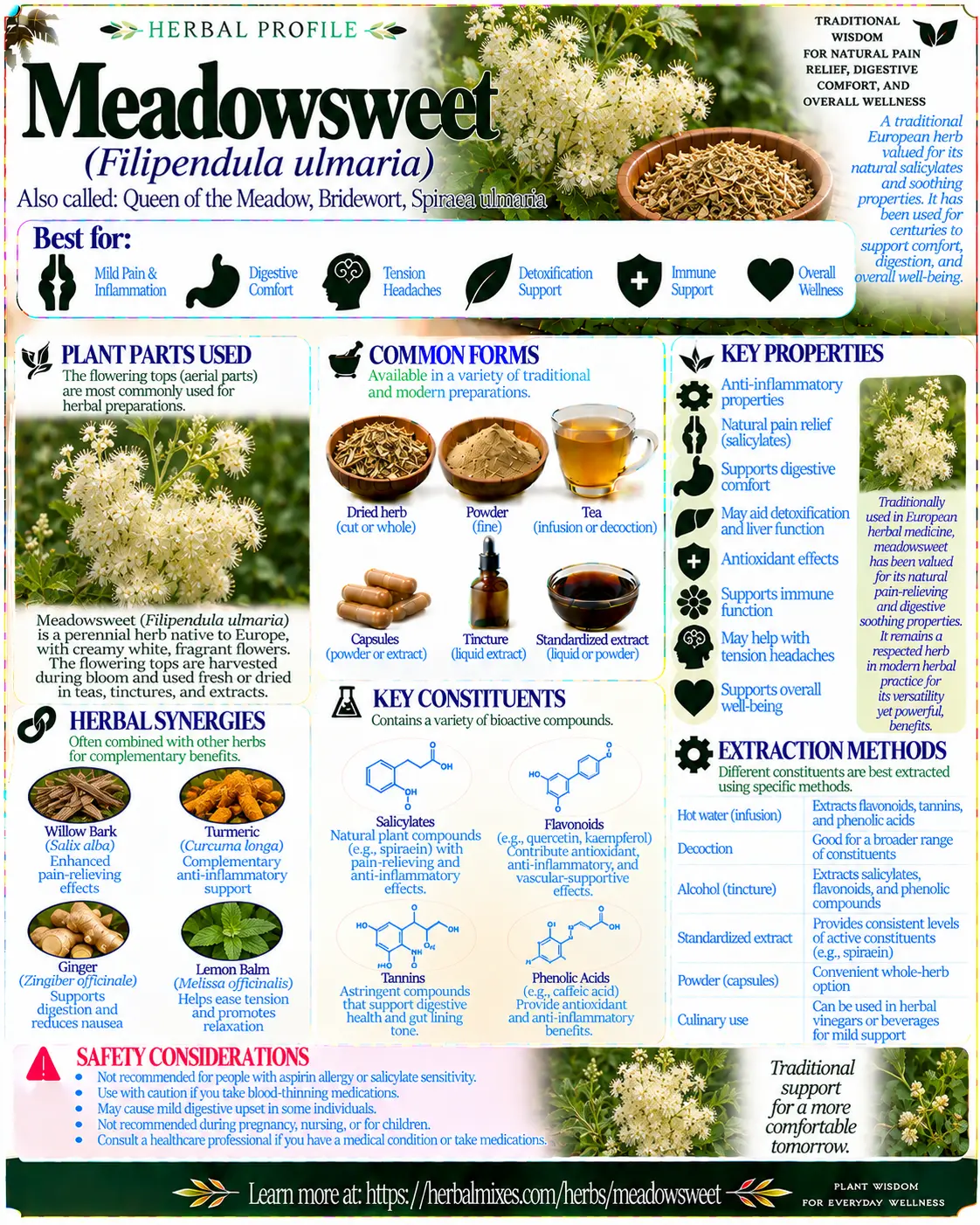
What Meadowsweet Is Good For
Mild joint & muscle discomfort — Meadowsweet contains salicylate-related compounds together with flavonoids and tannins and has a long traditional association with mild pain and inflammatory discomfort. The European Medicines Agency places meadowsweet herb and flower within the therapeutic area of pain and inflammation.
Common cold comfort — EMA recognizes meadowsweet flower as a traditional herbal medicine for supportive treatment of the common cold. Warm tea is particularly appropriate when aches and general discomfort accompany a cold.
Headache support — Meadowsweet is traditionally used for minor aches and headaches, particularly in formulas where salicylate-containing herbs are appropriate. Evidence for treating recurrent or severe headaches specifically remains limited.
Digestive irritation — Despite containing salicylate-related compounds, meadowsweet is traditionally considered relatively soothing to the digestive tract. Its tannins and mucilage-like constituents help explain why herbalists often use it when upper digestive discomfort accompanies inflammation.
Occasional heartburn & sour stomach — Meadowsweet frequently appears in traditional formulas for acidic or irritated digestion. This use is primarily traditional; persistent reflux or recurrent upper abdominal pain should be medically evaluated.
Feverish cold symptoms — Warm meadowsweet infusions have traditionally been used as a gentle diaphoretic, often combined with elderflower or linden during seasonal illness.
Available Herbal Products
Buying Guides for Available Meadowsweet Products
Meadowsweet Liquid Herbal Extract – Flowering aerial-parts tincture. A certified-organic hydroalcoholic extract of Filipendula ulmaria providing a convenient concentrated alternative to tea. Seller: Herb Pharm – View Herb Pharm Meadowsweet →
Organic Meadowsweet Herb – Dried loose herb. Best suited to hot infusions, custom digestive blends, cold-season teas, or homemade tinctures when available. Seller: Mountain Rose Herbs – View Mountain Rose Herbs Meadowsweet →
Healthy Gut – Combination capsules. Includes meadowsweet with chamomile, spearmint, gentian, slippery elm, and other herbs in a digestive-support formula. Seller: Kroeger Herb Co. / iHerb – View Healthy Gut →
Single-herb commercial meadowsweet products are less common than tinctures and bulk dried herb. Traditional Medicinals also uses meadowsweet in several tea formulas, although the meadowsweet-containing products checked were currently listed as out of stock.
Herbal Synergies
Meadowsweet pairs especially well with ginger, turmeric, chamomile, marshmallow root, and elderflower depending on whether the goal is musculoskeletal comfort, digestion, or cold-season support.
Meadowsweet + Ginger
Best for: Musculoskeletal discomfort with sluggish digestion
Meadowsweet contributes salicylate-related compounds, tannins, and flavonoids, while ginger adds warming gingerols and shogaols associated with digestive and inflammatory support.
The combination is especially useful when aches occur alongside a heavy or unsettled stomach.
Best extraction: Hot infusion or tincture. Meadowsweet’s phenolics and tannins extract readily into water, while ginger also performs well in hot-water preparations.
Meadowsweet + Turmeric
Best for: Joint and muscle comfort
Meadowsweet provides salicylate-related and polyphenolic chemistry, while turmeric contributes curcuminoids that act through different inflammatory pathways.
Traditional Medicinals currently uses this combination together with ginger in a joint-support tea formulation.
Best extraction: Meadowsweet tea or tincture paired with turmeric powder or a formulated turmeric extract. Curcuminoids are poorly water soluble, so turmeric requires different extraction considerations from meadowsweet.
Meadowsweet + Chamomile
Best for: Digestive irritation with cramping or nervous tension
Meadowsweet contributes astringent and soothing digestive actions, while chamomile adds carminative, antispasmodic, and gentle nervine effects.
Best extraction: Covered hot infusion. Both herbs work particularly well as tea.
Meadowsweet + Marshmallow Root
Best for: Irritated upper digestive tissues
Meadowsweet provides tannins and phenolics, while marshmallow root adds abundant mucilage that coats and soothes irritated mucous membranes.
Best extraction: Prepare meadowsweet as a hot infusion and marshmallow as a cold infusion, then combine.
Meadowsweet + Elderflower
Best for: Common cold comfort
Both herbs have longstanding traditional use in warm cold-season teas. Elderflower contributes aromatic and diaphoretic support, while meadowsweet adds salicylate-related and astringent properties.
Best extraction: Hot infusion, preferably consumed warm.
Key Herbal Properties
Analgesic / pain supportive — Meadowsweet’s traditional use for mild aches is associated partly with its salicylate chemistry, although it should not be assumed to act exactly like aspirin.
Anti-inflammatory — Salicylate derivatives, flavonoids, tannins, and phenolic compounds influence inflammatory pathways experimentally. EMA categorizes meadowsweet within pain and inflammation.
Astringent — Meadowsweet is rich in tannins, giving it significant tissue-toning and astringent activity. Traditional Medicinals specifically identifies it as an astringent herb.
Diaphoretic — Warm meadowsweet tea is traditionally used to encourage gentle perspiration during colds.
Digestive soothing — Meadowsweet has a longstanding herbal reputation for supporting irritated upper digestive tissues despite its salicylate-related constituents.
Antioxidant — Flavonoids, ellagitannins, and phenolic acids contribute substantial antioxidant activity. Chemical analysis has identified numerous hydrolysable tannins and other polyphenols in meadowsweet.
Diuretic — Meadowsweet also has traditional mild diuretic activity and is classified as such by Traditional Medicinals.






Active Compounds
Meadowsweet contains an unusually rich combination of salicylate derivatives, hydrolysable tannins, flavonoids, phenolic acids, and small amounts of volatile oil. Its chemistry explains both its traditional musculoskeletal applications and its important aspirin/salicylate precautions.
Salicylaldehyde
Found mainly in: Flowers and flowering aerial parts
Salicylaldehyde is one of the characteristic aromatic salicylate-related compounds in meadowsweet and contributes to the plant’s distinctive scent and pharmacological profile.
It can participate in the broader formation and metabolism of salicylate compounds associated with traditional pain-relieving use.
Best extraction: Hydroalcoholic tincture or covered hot infusion. Because aromatic salicylate compounds are partly volatile, prolonged uncovered boiling is unnecessary.
Methyl Salicylate
Found mainly in: Flowers and volatile fraction
Methyl salicylate is related chemically to salicylic acid and is one of several compounds contributing to meadowsweet’s salicylate profile.
The concentration in ordinary herbal preparations is much lower and less predictable than in pharmaceutical salicylate products.
Best extraction: Alcohol tincture or covered infusion. Its volatility and moderate lipophilicity favor alcohol-containing preparations.
Salicin-Related Glycosides
Found mainly in: Aerial herb
Meadowsweet contains several salicylate glycosides and related precursors that may ultimately contribute salicylate metabolites after ingestion.
Best extraction: Hot water or hydroalcoholic tincture. Glycosides are relatively polar and extract effectively into aqueous preparations.
Tellimagrandins
Found mainly in: Flowers and aerial portions
Tellimagrandin I and II are hydrolysable tannins identified in meadowsweet preparations. They contribute strong antioxidant and astringent activity.
Best extraction: Hot water or hydroalcoholic extract. Hydrolysable tannins are highly compatible with polar solvents.
Rugosins
Found mainly in: Flowers
Meadowsweet contains several rugosin ellagitannins, including rugosins A, B, D, and E. These compounds form an important part of its polyphenolic profile.
Best extraction: Hot infusion or hydroalcoholic tincture.
Quercetin Derivatives
Found mainly in: Flowers and leaves
Quercetin-related flavonoids contribute antioxidant and inflammatory-modulating activity.
Best extraction: Hot-water infusion or hydroalcoholic tincture.
Kaempferol Derivatives
Found mainly in: Flowers
Kaempferol glycosides complement the plant’s broader flavonoid profile.
Best extraction: Hot infusion or diluted alcohol.
Phenolic Acids
Found mainly in: Flowers and aerial herb
Meadowsweet contains several phenolic acids that contribute antioxidant activity alongside its tannins and flavonoids.
Best extraction: Hot water or hydroalcoholic extraction.
FAQ
What is meadowsweet best used for?
Meadowsweet is primarily used for mild joint and muscle discomfort, cold-season support, and traditional digestive soothing.
EMA currently lists meadowsweet herb and flower within the therapeutic areas of pain and inflammation and cough/cold. A formal revision of the European monographs was under review in 2026.
Is meadowsweet basically herbal aspirin?
No.
Meadowsweet contains salicylate-related compounds, but it is chemically much more complex than aspirin and also contains tannins, flavonoids, phenolic acids, and other constituents.
Aspirin is purified acetylsalicylic acid; meadowsweet does not provide a predictable aspirin-equivalent dose.
Is meadowsweet tea or tincture better?
For everyday digestive or cold-season use, tea is an excellent preparation because tannins, flavonoid glycosides, and many salicylate-related compounds extract into hot water.
A tincture provides a more concentrated preparation and captures a broader portion of the aromatic fraction.
Can meadowsweet irritate the stomach like aspirin?
Its effects cannot be assumed to match aspirin. Meadowsweet is traditionally used for digestive comfort despite containing salicylate compounds.
However, anyone with active peptic ulcer disease, gastrointestinal bleeding, aspirin intolerance, or significant salicylate sensitivity should avoid self-treatment with meadowsweet.
Can meadowsweet be taken every day?
Occasional short-term tea or properly labeled commercial products are commonly used, but daily concentrated use is not appropriate for everyone because of salicylate exposure and potential medication interactions.
Persistent pain, recurrent heartburn, or prolonged cold symptoms should be medically evaluated rather than managed indefinitely with meadowsweet.
Safety & Precautions
The most important precaution with meadowsweet is its salicylate content.
People with an aspirin or salicylate allergy or sensitivity should avoid meadowsweet. Traditional Medicinals likewise advises consulting a healthcare practitioner before using meadowsweet if you are allergic to aspirin or salicylates.
Use caution with aspirin, warfarin, clopidogrel, apixaban, rivaroxaban, other anticoagulants or antiplatelet drugs, and frequent NSAID use. Evidence defining the magnitude of these interactions is limited, but combining multiple agents that influence bleeding or salicylate exposure deserves professional supervision.
People with active stomach ulcers, gastrointestinal bleeding, bleeding disorders, or a history of serious aspirin reactions should avoid concentrated meadowsweet unless specifically advised otherwise.
Medicinal use during pregnancy and breastfeeding has not been adequately established. Traditional Medicinals specifically recommends professional consultation during pregnancy or breastfeeding.
Because of its salicylate content, avoid giving concentrated medicinal meadowsweet to children or teenagers with viral illnesses such as influenza or chickenpox without explicit medical guidance.
People with aspirin-exacerbated respiratory disease—asthma or nasal symptoms triggered by aspirin or other NSAIDs—should avoid meadowsweet because of possible salicylate sensitivity.
Possible adverse effects include digestive discomfort, nausea, allergic reactions, or worsening of salicylate-sensitive symptoms.
Do not use meadowsweet to mask persistent or severe pain. Seek medical evaluation for sudden severe headache, chest pain, unexplained joint swelling, black or bloody stool, severe abdominal pain, high fever, breathing difficulty, or pain following significant injury.
Anyone taking anticoagulant or antiplatelet medication, using aspirin regularly, pregnant, breastfeeding, or managing gastrointestinal or bleeding disorders should discuss therapeutic meadowsweet use with an appropriate healthcare professional.
References
- European Medicines Agency — Meadowsweet Herb. EMA Filipendulae ulmariae herba →
- European Medicines Agency — Meadowsweet Flower. EMA Filipendulae ulmariae flos →
- EMA — Community Herbal Monograph on Filipendula ulmaria Flower. View EMA monograph →
- PubMed — Hydrolysable Tannins and Polyphenols in Meadowsweet. View PubMed study →
- Traditional Medicinals — Meadowsweet Herb Profile. View Meadowsweet profile →
- Herb Pharm — Meadowsweet Liquid Herbal Extract. View Herb Pharm Meadowsweet →
- Traditional Medicinals — Turmeric & Ginger with Meadowsweet Tea. View product →
- iHerb — Kroeger Herb Co. Healthy Gut. View product →
Disclaimer
Disclaimer: This article is for educational purposes only and is not intended to diagnose, treat, cure, or prevent any disease. Herbal products can cause side effects and interact with medications. Consult a qualified healthcare professional before using herbs therapeutically, especially if you are pregnant, breastfeeding, taking prescription medications, or managing a medical condition.