

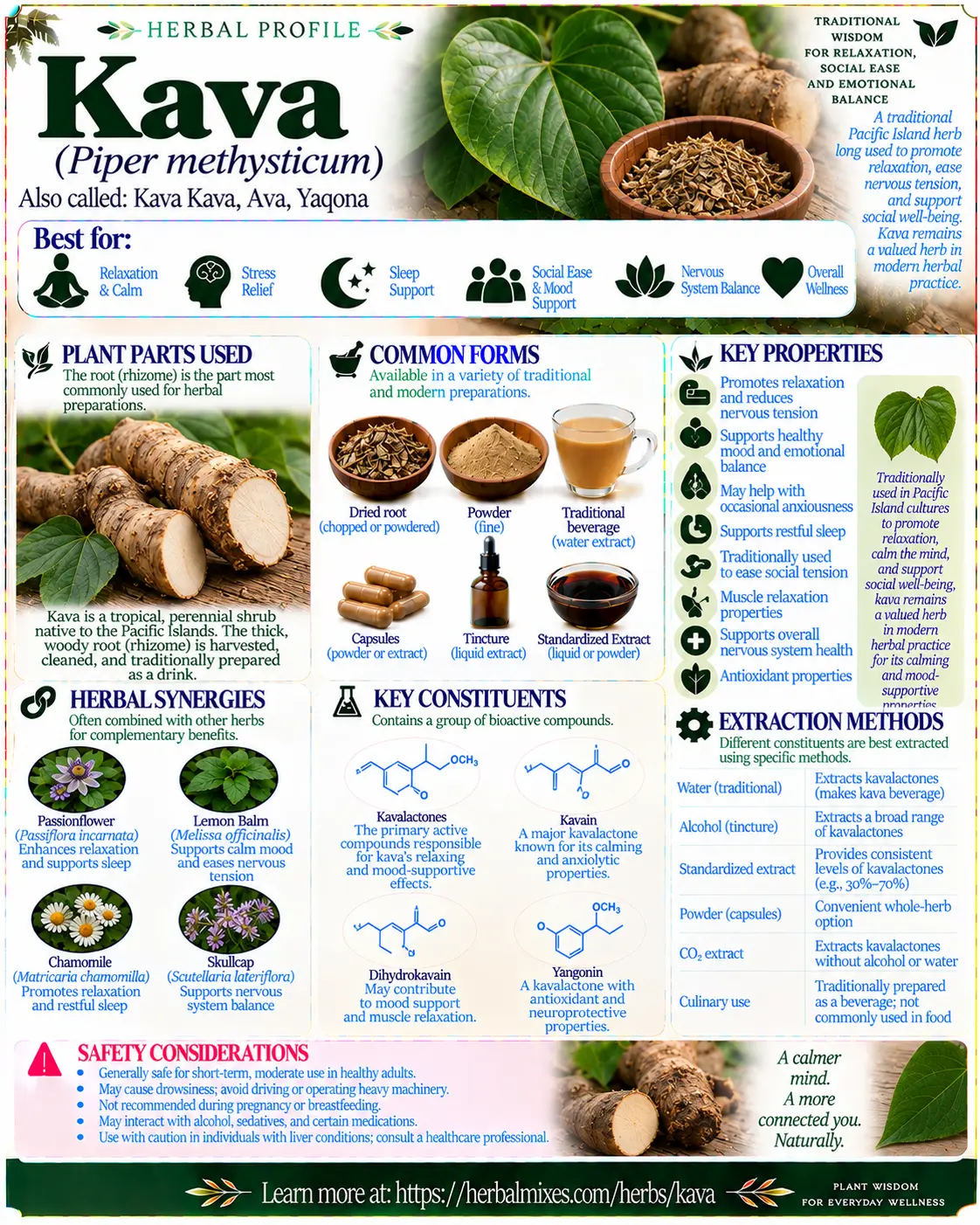
What Kava Is Good For
Occasional anxiety — Kava is best known for its anxiolytic and calming effects. Human studies have found that some standardized kava extracts may reduce anxiety symptoms, although study results and product formulations vary. NCCIH describes anxiety as the condition for which kava has received the most human research. (NCCIH)
Stress & nervous tension — Kava is traditionally used to promote relaxation while allowing the user to remain mentally present. Its principal constituents, the kavalactones, act on several nervous-system pathways associated with relaxation. (PubMed)
Restlessness — Kava may help when nervous tension produces physical restlessness or difficulty settling down. It is generally considered more relaxing than strongly sleep-inducing.
Stress-related sleep difficulty — By reducing nervous tension, kava may indirectly make it easier to unwind before sleep. Evidence for kava specifically as an insomnia treatment is much weaker than the evidence surrounding anxiety.
Muscular tension related to stress — Traditional kava beverages often produce both mental relaxation and a sensation of physical ease. Kavalactones affect multiple neuronal signaling systems, which may help explain this relaxing profile. (PubMed)
Available Herbal Products
Buying Guides for Available Kava Products
Noble Kava Liquid Herbal Extract – Root and rhizome tincture. Made from mature noble-variety Piper methysticum grown in Vanuatu and designed for occasional stress, relaxation, and mild anxiety support. Seller: Herb Pharm – View Herb Pharm Kava →
Kava Root – Concentrated root extract. A noble-kava preparation providing a validated 50 mg of kavalactones per serving and designed for short-term stress and relaxation support. Seller: Gaia Herbs – View Gaia Herbs Kava Root →
Kava Extract Alcohol-Free – Standardized liquid extract. An alcohol-free preparation standardized to 35% kavalactones, useful for people who prefer drops without ethanol. Seller: Nature’s Answer – View Nature’s Answer Kava Extract →
Kava Kava Extract Liquid – Glycerin-containing liquid extract. A convenient liquid preparation for relaxation support that avoids capsules and provides a concentrated alternative to traditional kava beverages. Seller: NOW Foods – View NOW Kava Kava Extract Liquid →
When buying kava, look for products that clearly identify Piper methysticum, specify root and/or rhizome, and preferably use recognized noble cultivars rather than unspecified plant material. Herb Pharm and Gaia Herbs both currently emphasize noble varieties and below-ground plant parts. (Herb Pharm)
Herbal Synergies
Kava pairs especially well with lemon balm, passionflower, lavender, ashwagandha, and ginger depending on whether the goal is anxiety, relaxation, stress resilience, or digestive comfort.
Kava + Lemon Balm
Best for: Nervous tension and difficulty unwinding
Kava provides stronger relaxation through its kavalactones, while lemon balm contributes gentler nervine, carminative, and calming actions.
The pairing may be useful when stress affects both mood and digestion without requiring a strongly sedating formula.
Best extraction: Kava extract combined with lemon balm tincture or covered infusion. Kavalactones are poorly represented in weak water infusions compared with concentrated kava preparations, while lemon balm performs very well in tea.
Kava + Passionflower
Best for: Anxiety with racing thoughts or nighttime restlessness
Kava contributes a more pronounced physical and mental relaxing action, while passionflower is traditionally used to quiet nervous restlessness and mental overactivity.
Best extraction: Tincture or standardized extracts. Both herbs contain constituents that are well represented in hydroalcoholic preparations.
Because both can cause drowsiness, avoid combining them with alcohol, sedative drugs, or before driving.
Kava + Lavender
Best for: Evening relaxation and mild nervous tension
Kava supplies kavalactones associated with anxiety reduction, while lavender contributes aromatic calming constituents such as linalool and linalyl acetate.
Best extraction: Kava standardized extract or tincture plus lavender tea or tincture. A covered lavender infusion helps preserve volatile oils.
Kava + Ashwagandha
Best for: Ongoing stress with fatigue and tension
Kava is better suited to short-term relaxation, while ashwagandha is commonly used as a longer-term adaptogenic restorative.
Their roles therefore complement one another: kava helps with immediate tension while ashwagandha supports broader stress resilience.
Best extraction: Separate standardized extracts or tinctures.
This combination may increase drowsiness in sensitive individuals.
Kava + Ginger
Best for: Relaxation with digestive sensitivity
Kava can occasionally cause stomach upset, while ginger contributes warming, carminative, and nausea-supportive actions.
Best extraction: Kava liquid extract with ginger tea or tincture. Ginger’s aromatic and pungent constituents extract readily into hot water and alcohol.
Key Herbal Properties
Anxiolytic — Kava is most strongly associated with reducing anxiety and nervous tension. Older systematic reviews found standardized extracts superior to placebo in several anxiety trials, although more rigorous contemporary research is still needed. (PubMed)
Nervine relaxant — Kava traditionally promotes mental and physical relaxation without necessarily producing the level of sedation associated with pharmaceutical sleep medications.
Sedative — Larger amounts and concentrated extracts may cause drowsiness and impair coordination, particularly when combined with other central nervous system depressants.
Muscle relaxant — Kavalactones influence neuronal ion channels and neurotransmitter systems involved in muscular and nervous-system activity. This helps explain kava’s traditional reputation for physical relaxation.
Mood supportive — Kava’s relaxing effects may help improve subjective mood when tension and frustration are associated with temporary stress. Herb Pharm currently markets noble kava specifically for peaceful relaxation and positive mood support. (Herb Pharm)
Anti-inflammatory — Kavain and several other kava constituents influence inflammatory signaling experimentally, including NF-κB-related pathways. These findings do not establish kava as a treatment for inflammatory disease. (PubMed)





Active Compounds
Kava’s primary active constituents are kavalactones, especially kavain, dihydrokavain, methysticin, dihydromethysticin, yangonin, and desmethoxyyangonin. The plant also contains flavokavains, including flavokavain A and B. Product quality, cultivar, plant part, and extraction method can significantly change the final chemical profile. (PubMed)
Kavain
Found mainly in: Rhizome and roots
Kavain is one of the six principal kavalactones and among the most important compounds associated with kava’s relaxing and anxiolytic actions.
Modern research suggests kavain affects several neurological pathways, including GABA-related signaling and ion channels, although kava does not act exactly like a benzodiazepine. (PubMed)
Best extraction: Hydroalcoholic or lipophilic extract. Kavain has limited water solubility, so concentrated extracts generally recover it more efficiently than weak tea.
Traditional kneaded-water preparations still extract meaningful kavalactones because of the physical processing and naturally present starches and lipids.
Dihydrokavain
Found mainly in: Rhizome and roots
Dihydrokavain is another major kavalactone associated with relaxing neurological activity. Human pharmacokinetic research found it produced the highest systemic exposure among the major kavalactones measured after standardized oral kava administration. (PubMed)
Best extraction: Hydroalcoholic, acetone-based laboratory extraction, or specialized concentrated extract. It is less efficiently extracted by plain water than by mixed-solvent preparations.
Methysticin
Found mainly in: Rhizome and roots
Methysticin is a psychoactive kavalactone that contributes to kava’s complex nervous-system activity.
Experimental research also suggests methysticin can interact with drug-metabolizing enzyme systems, one reason medication interactions deserve caution. (PubMed)
Best extraction: Hydroalcoholic or lipophilic extract.
Dihydromethysticin
Found mainly in: Root and rhizome
Dihydromethysticin is structurally related to methysticin and contributes to kava’s central nervous system effects.
It is one of the six major kavalactones commonly measured when evaluating kava extracts. (PubMed)
Best extraction: Hydroalcoholic or concentrated extract. Its limited water solubility means extraction is improved by alcohol or other appropriate solvents.
Yangonin
Found mainly in: Rhizome and roots
Yangonin is another important kavalactone. Laboratory studies demonstrate effects on neurological receptor and signaling systems that may contribute to kava’s relaxing profile.
Best extraction: Hydroalcoholic or lipophilic extract.
Desmethoxyyangonin
Found mainly in: Rhizome and roots
Desmethoxyyangonin, sometimes called 5,6-dehydrokavain, is one of the six principal kavalactones used to characterize kava’s chemical profile. (PubMed)
Best extraction: Hydroalcoholic extract. Plain water generally provides less efficient extraction of these relatively lipophilic lactones.
Flavokavains
Found mainly in: Root and rhizome, with concentrations influenced by cultivar and plant material
Kava contains chalcones known as flavokavain A, flavokavain B, and flavokavain C.
These compounds have attracted particular attention in research into possible kava-related liver toxicity, although the causes of rare liver injuries remain debated and likely involve multiple factors including product quality, cultivar, plant part, extraction, individual susceptibility, and drug interactions. (PubMed)
Best extraction: Alcohol and other relatively nonpolar solvents. Traditional aqueous preparations generally extract less of some lipophilic flavokavains than strong organic-solvent extracts.
FAQ
What is kava best used for?
Kava is best known for occasional anxiety, nervous tension, and relaxation.
NCCIH notes that there has been a fair amount of human research on kava for anxiety but relatively little research for most other conditions. (NCCIH)
Does kava make you sleepy?
It can, especially at higher amounts or when combined with other sedating substances.
Many people primarily experience relaxation rather than heavy sedation, but coordination and reaction time can still be impaired. Do not drive or operate machinery after taking kava until you know how it affects you.
Is traditional kava drink better than a tincture or capsule?
They are chemically different preparations.
Traditional Pacific kava is usually made by mechanically working root and rhizome material in water, while modern supplements may use alcohol, glycerin, or concentrated extraction methods.
Standardized extracts provide more predictable kavalactone content, while traditionally prepared beverages more closely reflect customary Pacific use.
What does “noble kava” mean?
“Noble” refers to cultivars traditionally selected for desirable drinking characteristics and a chemical profile considered appropriate for customary consumption.
For supplements, choosing a reputable manufacturer that uses noble varieties and root/rhizome rather than aerial plant parts is a useful quality consideration. Herb Pharm and Gaia Herbs both currently specify noble cultivars in their kava products. (Gaia Herbs)
Can kava be taken every day?
Routine long-term use is not a good default because of unresolved liver-safety concerns and limited long-term clinical data.
Gaia Herbs currently limits its concentrated kava product to a maximum of one month, illustrating the conservative approach appropriate for concentrated supplementation. (Gaia Herbs)
Safety & Precautions
The major safety concern with kava is rare but potentially severe liver injury. Cases have included hepatitis, cirrhosis, liver failure, and the need for liver transplantation. NCCIH continues to recognize this as an important unresolved safety issue. (NCCIH)
The exact cause is uncertain. Potential contributors include cultivar, plant part, extraction method, product contamination or adulteration, flavokavain exposure, individual susceptibility, alcohol use, and medication interactions. EMA completed an assessment but did not adopt an EU herbal monograph for kava. (EMA)
Avoid kava if you currently have or previously had liver disease.
Do not combine kava with alcohol. Gaia Herbs specifically warns against alcohol consumption with its kava extract because of liver and central nervous system concerns. (Gaia Herbs)
Avoid combining kava with benzodiazepines, sleep medications, opioids, sedating antihistamines, barbiturates, or other central nervous system depressants unless specifically approved by a healthcare professional. Additive sedation and impaired coordination are possible.
Kava may interact with drug-metabolizing enzymes and other metabolic pathways. Experimental studies show that individual kavalactones can influence enzyme systems including CYP-related pathways and carboxylesterase 1. (PubMed)
Because of this interaction potential, anyone taking prescription medication should discuss kava with a physician or pharmacist before regular use.
Do not use kava during pregnancy or breastfeeding because adequate safety has not been established.
Concentrated kava supplements are generally inappropriate for children and adolescents. Gaia Herbs currently restricts its product to adults 18 years and older. (Gaia Herbs)
Possible short-term adverse effects include digestive upset, headache, dizziness, drowsiness, impaired coordination, and numbness of the mouth.
Heavy or prolonged kava consumption can cause a reversible dry, scaly skin condition known as kava dermopathy.
Stop using kava and seek medical evaluation if symptoms potentially suggesting liver injury develop, including yellow skin or eyes, dark urine, unusually pale stools, persistent nausea or vomiting, unexplained fatigue, loss of appetite, or upper abdominal pain. (NCCIH)
Do not drive, operate heavy equipment, or perform safety-sensitive work after taking enough kava to affect alertness or coordination.
Anyone with liver disease, a chronic medical condition, regular alcohol use, or prescription medications should discuss kava with an appropriate healthcare professional before use.
References
- NCCIH — Kava: Usefulness and Safety
- European Medicines Agency — Piperis methystici rhizoma
- Kew Plants of the World Online — Piper methysticum G.Forst.
- PubMed — Efficacy of Kava Extract for Treating Anxiety: Systematic Review and Meta-analysis
- PubMed — DARK Classics in Chemical Neuroscience: Kava
- PubMed — Biological Activity and Hepatotoxicity of Kavalactones and Flavokavains
- PubMed — Clinical Pharmacokinetics of Kavalactones
- PubMed — Methysticin and Dihydromethysticin in Kava
- Herb Pharm — Noble Kava Liquid Herbal Extract
- Gaia Herbs — Kava Root
Disclaimer
Disclaimer: This article is for educational purposes only and is not intended to diagnose, treat, cure, or prevent any disease. Herbal products can cause side effects and interact with medications. Consult a qualified healthcare professional before using herbs therapeutically, especially if you are pregnant, breastfeeding, taking prescription medications, or managing a medical condition.