

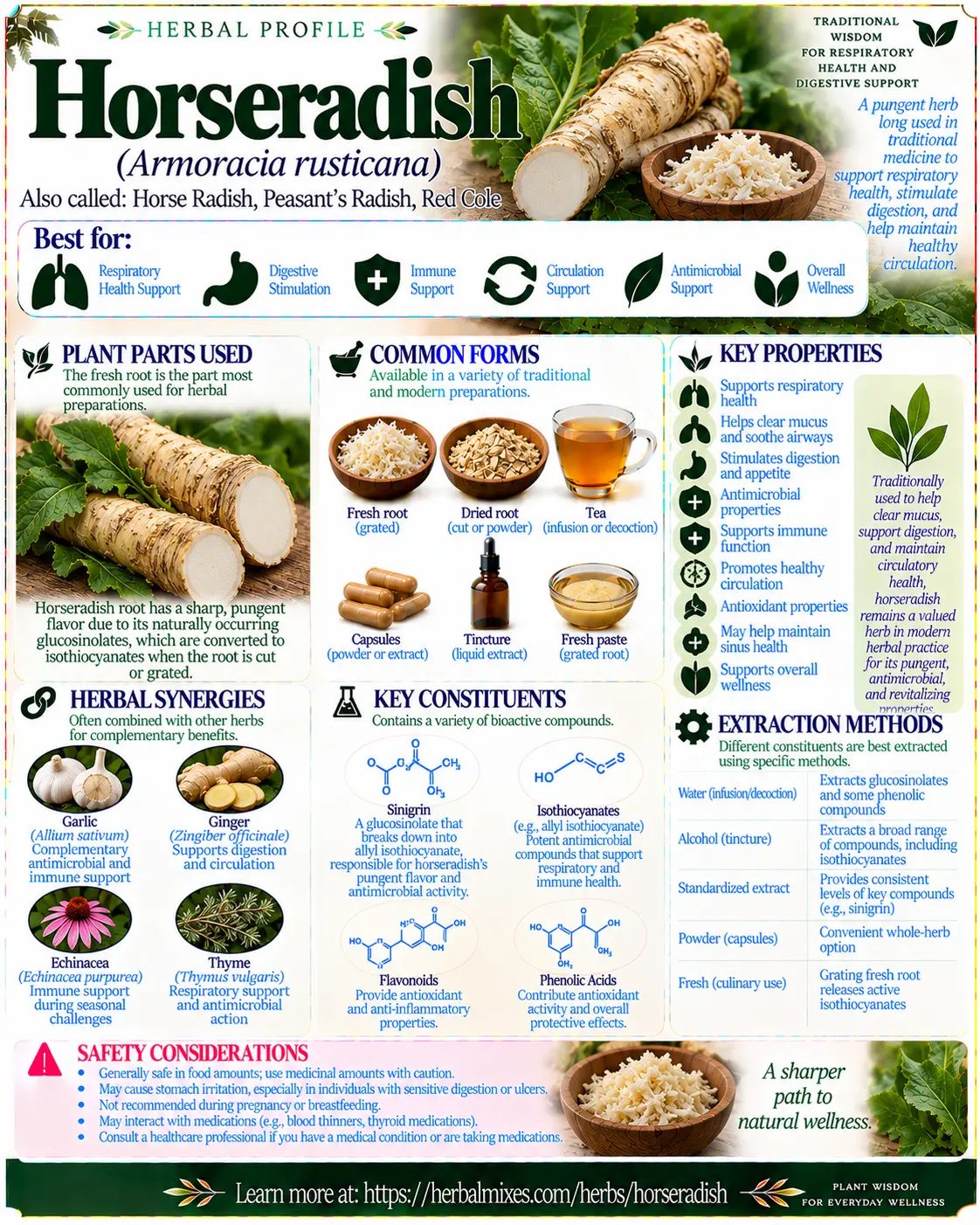
What Horseradish Is Good For
Sinus congestion — Fresh horseradish releases intensely pungent allyl isothiocyanate (AITC) when the root is grated or crushed. Its vapors can temporarily stimulate nasal secretions and create the familiar sensation of opening congested nasal passages.
Thick respiratory mucus — Horseradish is traditionally used in respiratory formulas when mucus feels thick or difficult to clear. Its pungent mustard oils stimulate secretions rather than acting as a soothing demulcent.
Seasonal respiratory support — Isothiocyanates derived from horseradish glucosinolates demonstrate antimicrobial activity in laboratory research. A horseradish-and-nasturtium preparation has also been studied clinically for respiratory and urinary conditions, although those findings apply to the specific combination rather than horseradish alone.
Sluggish digestion — Horseradish’s sharp pungency can stimulate salivation and digestive secretions, making small culinary amounts useful when digestion feels slow or heavy.
Poor appetite — Traditionally, pungent horseradish root is used as a digestive stimulant before or alongside meals when appetite is temporarily reduced.
Warming circulation — Horseradish produces an immediate warming sensation through its volatile isothiocyanates. This helps explain its traditional use in warming digestive and respiratory formulas.
Available Herbal Products
Buying Guides for Available Horseradish Products
Organic Horseradish Root Powder – Powdered root. A versatile single-herb option for culinary preparations, homemade vinegars, respiratory blends, or carefully prepared herbal formulas. Seller: Starwest Botanicals – View Starwest Botanicals Organic Horseradish Root Powder →
Whole Root Horseradish Extract – Liquid tincture. A certified-organic whole-root hydroalcoholic extract providing a concentrated alternative to freshly grated root. Seller: Swanson / Herb Pharm – View Herb Pharm Whole Root Horseradish Extract →
Horseradish Root Powder – Powdered root. A bulk non-irradiated Armoracia rusticana powder useful for food, homemade bitters, vinegar preparations, or custom herbal formulas. Seller: Swanson / Frontier Co-op – View Frontier Co-op Horseradish Root Powder →
Sinus Blend – Combination capsules. Contains horseradish root with peppermint, wood betony, lettuce, and vitamin C for people looking for a ready-made traditional sinus-support formula rather than horseradish alone. Seller: iHerb – View Kroeger Herb Co. Sinus Blend →
Sinus Plus – Combination capsules. Includes horseradish with goldenseal, marshmallow, lobelia, and cayenne in a broader respiratory and mucus-membrane formula. Seller: iHerb – View Christopher’s Original Formulas Sinus Plus →
Herbal Synergies
Horseradish pairs especially well with garlic, thyme, ginger, elderberry, and marshmallow root depending on whether the goal is respiratory congestion, seasonal support, digestion, or mucous-membrane balance.
Horseradish + Garlic
Best for: Seasonal respiratory and antimicrobial support
Horseradish contributes glucosinolate-derived isothiocyanates, while garlic supplies reactive sulfur compounds such as allicin.
Both herbs are strongly pungent, but their chemistry is different enough to make them complementary in food-based or short-term seasonal formulas.
Best extraction: Fresh food, vinegar, or tincture. Crushing both plants before use activates important enzymatic chemistry.
Horseradish + Thyme
Best for: Thick mucus and chest congestion
Horseradish provides stimulating pungency, while thyme contributes aromatic volatile oils such as thymol and carvacrol traditionally associated with respiratory and expectorant support.
Best extraction: Horseradish tincture or vinegar alongside covered thyme infusion. Thyme’s volatile oils are well suited to covered hot-water extraction, while horseradish’s reactive mustard oils require gentler handling.
Horseradish + Ginger
Best for: Sluggish digestion and warming respiratory support
Both herbs are warming, but ginger adds carminative, anti-nausea, and motility-supportive qualities while horseradish provides sharper sinus and secretion-stimulating pungency.
Best extraction: Fresh food, vinegar, or tincture. Both roots can also be incorporated into oxymel-style preparations.
Horseradish + Elderberry
Best for: Seasonal wellness
Horseradish provides pungent respiratory stimulation, while elderberry contributes anthocyanins and is traditionally used in cold-season syrups and immune-support formulas.
Best extraction: Combination preparation. Elderberry works well as syrup or decoction, while horseradish is better added fresh, as tincture, or into vinegar rather than boiled extensively.
Horseradish + Marshmallow Root
Best for: Congestion with irritated throat or mucous membranes
Horseradish can feel intensely stimulating and drying, while marshmallow root contributes soothing mucilage.
The combination helps balance secretion-stimulating pungency with demulcent support.
Best extraction: Separate preparations. Horseradish works best fresh, in tincture, or vinegar; marshmallow root is best prepared as a cold-water infusion.
Key Herbal Properties
Expectorant — Horseradish is traditionally used to encourage respiratory secretions and help loosen thick mucus.
Pungent respiratory stimulant — Its volatile mustard oils rapidly stimulate the nose, throat, and sinuses and can temporarily increase nasal drainage.
Digestive stimulant — The sharp taste encourages salivation and digestive activity, making horseradish useful in small amounts with rich meals.
Antimicrobial — Allyl isothiocyanate demonstrates substantial antibacterial and antifungal activity in laboratory research. This does not mean horseradish can replace antibiotics when treatment is required.
Anti-inflammatory — Sinigrin and AITC influence inflammatory pathways in experimental studies, although human therapeutic significance remains uncertain.
Circulatory stimulant — Horseradish produces a rapid warming sensation and is traditionally classified as stimulating to peripheral circulation.
Rubefacient — Applied externally, mustard oils strongly irritate the skin and increase local redness and warmth. Because burns and blistering are possible, homemade topical horseradish applications require substantial caution.







Active Compounds
Horseradish root is especially rich in glucosinolates, particularly sinigrin, which is converted by the enzyme myrosinase into pungent isothiocyanates when the root is cut, crushed, or grated. Allyl isothiocyanate and phenethyl isothiocyanate are especially important to its characteristic aroma and biological activity.
Sinigrin
Found mainly in: Root
Sinigrin is the major allyl glucosinolate associated with horseradish’s pungency. In intact tissue it remains relatively stable and separated from the enzyme myrosinase.
When the root is damaged, myrosinase converts sinigrin into allyl isothiocyanate and related products.
Best extraction: Fresh crushed root, powder rehydrated shortly before use, or carefully prepared vinegar. Consuming the intact glucosinolate together with active myrosinase preserves the chemistry needed to generate AITC.
Prolonged high heat can inactivate myrosinase and alter the final isothiocyanate profile.
Allyl Isothiocyanate — AITC
Found mainly in: Freshly damaged root after enzymatic conversion of sinigrin
Allyl isothiocyanate produces the powerful nasal heat associated with freshly grated horseradish. It is volatile and has demonstrated antibacterial, antifungal, antioxidant, and anti-inflammatory activity experimentally.
Best extraction: Freshly grated or crushed root, vinegar preparation, or appropriately prepared extract. AITC is volatile and poorly water soluble, so prolonged boiling is a poor method for retaining it.
Myrosinase
Found mainly in: Root tissue
Myrosinase is the plant enzyme that converts glucosinolates such as sinigrin into biologically reactive isothiocyanates after tissue damage.
It is not a medicinal constituent in the usual sense, but it is crucial to horseradish chemistry because without active myrosinase much less fresh AITC is generated.
Best extraction: No conventional extraction required. Crush or grate the root so the enzyme can interact with sinigrin before extensive heating.
Gluconasturtiin
Found mainly in: Root
Gluconasturtiin is another glucosinolate found in horseradish. Its enzymatic breakdown produces phenethyl isothiocyanate (PEITC).
Best extraction: Fresh crushed root or minimally processed preparations that preserve glucosinolate and myrosinase interactions.
Phenethyl Isothiocyanate — PEITC
Found mainly in: Damaged root after conversion of gluconasturtiin
PEITC is another biologically active mustard oil generated from horseradish glucosinolates. It has been investigated for antimicrobial, antioxidant, anti-inflammatory, and cell-signaling effects.
Best extraction: Fresh crushed root or specialized extract. Like AITC, PEITC is relatively lipophilic and poorly represented by prolonged plain-water boiling.
Glucosinolates
Found mainly in: Root
Horseradish contains a broader family of sulfur-containing glucosinolates beyond sinigrin and gluconasturtiin.
These stable precursors act as a storage system from which more reactive isothiocyanates are generated when plant tissue is damaged.
Best extraction: Fresh root, powder, or hydroalcoholic preparation. Preparation technique matters because enzymatic conversion is as important as solvent choice.
Phenolic Compounds
Found mainly in: Root
Horseradish also contains phenolic compounds that complement its sulfur-rich chemistry and contribute antioxidant activity.
Best extraction: Water-alcohol extract or whole-root consumption. Mixed solvents capture a broader range than oil alone.
FAQ
What is horseradish best used for?
Horseradish is best suited to sinus congestion, thick mucus, and sluggish digestion when a strongly stimulating, pungent herb is appropriate.
Its distinctive effects come mainly from isothiocyanates released after the root is grated or crushed.
Why does horseradish clear your nose so quickly?
Crushing horseradish converts sinigrin into volatile allyl isothiocyanate.
AITC rapidly reaches the nose and stimulates sensory nerves and mucous membranes, producing burning, tearing, and increased nasal secretions.
Is fresh horseradish better than cooked horseradish?
For mustard-oil activity, generally yes.
Freshly grated root preserves more myrosinase activity needed to convert sinigrin into AITC. Strong or prolonged heating can inactivate this enzyme and allow volatile isothiocyanates to escape.
Cooked horseradish still has culinary value but is chemically different.
Is horseradish tea or tincture better?
A simple hot tea is usually not the best way to capture horseradish’s most distinctive chemistry because AITC is volatile and poorly water soluble.
Fresh root, vinegar preparations, or carefully manufactured tinctures generally retain the pungent compounds more effectively.
Can horseradish be used every day?
Horseradish is commonly consumed regularly as a culinary condiment in small quantities.
Concentrated medicinal amounts are more irritating and are better suited to short-term or targeted use rather than automatically being taken indefinitely.
Safety & Precautions
Horseradish is highly irritating in concentrated amounts. Excessive fresh root can cause burning of the mouth and throat, stomach irritation, nausea, vomiting, or diarrhea.
People with gastritis, peptic ulcers, severe acid reflux, inflammatory bowel irritation, or highly sensitive digestion may tolerate concentrated horseradish poorly.
Horseradish may irritate the kidneys and urinary tract when consumed in excessive medicinal quantities. People with significant kidney disease should avoid concentrated preparations unless specifically approved by a healthcare professional.
Avoid intentionally inhaling concentrated horseradish vapors at close range. AITC is a powerful irritant to the eyes, nose, lungs, and mucous membranes.
Do not place fresh grated horseradish directly onto the skin for prolonged periods. Mustard oils can cause severe irritation, blistering, or chemical-like burns.
Therapeutic use during pregnancy and breastfeeding has not been adequately established. Concentrated preparations are best avoided unless specifically recommended by a qualified healthcare professional.
Horseradish belongs to the Brassicaceae family. People with known allergies to mustard-family plants should use extra caution.
Because concentrated glucosinolate-rich foods may influence thyroid iodine handling when consumed in exceptionally high quantities, people with significant thyroid disorders should avoid excessive chronic use of raw horseradish. Normal culinary amounts are a different level of exposure.
Experimental research on sinigrin and isothiocyanates is extensive, but most proposed anti-inflammatory, antimicrobial, and anticancer effects come from laboratory studies. These findings should not be interpreted as evidence that horseradish treats infection or cancer.
Seek medical evaluation for sinus or respiratory symptoms accompanied by high fever, severe facial pain, difficulty breathing, chest pain, coughing blood, confusion, or symptoms that persist or worsen.
Anyone with kidney disease, significant gastrointestinal disease, thyroid disease, pregnancy, breastfeeding, or prescription medications should discuss concentrated therapeutic horseradish use with an appropriate healthcare professional.
References
- Kew Plants of the World Online — Armoracia rusticana
- PubMed — Health Benefits, Applications, and Analytical Methods of Allyl Isothiocyanate
- PubMed — Isothiocyanates in Medicine: Allyl, Phenethyl and Benzyl Isothiocyanates
- PubMed — Sinigrin and Its Therapeutic Benefits
- PubMed — Glucosinolates: Sinigrin and Antimicrobial Phytochemistry
- PubMed — Allyl Isothiocyanate Formation in Horseradish Roots
- PubMed — Therapeutic Potential and Safety of Sinigrin
- Starwest Botanicals — Organic Horseradish Root Powder
- Swanson / Herb Pharm — Whole Root Horseradish Extract
- iHerb — Kroeger Herb Co. Sinus Blend
Disclaimer
Disclaimer: This article is for educational purposes only and is not intended to diagnose, treat, cure, or prevent any disease. Herbal products can cause side effects and interact with medications. Consult a qualified healthcare professional before using herbs therapeutically, especially if you are pregnant, breastfeeding, taking prescription medications, or managing a medical condition.