

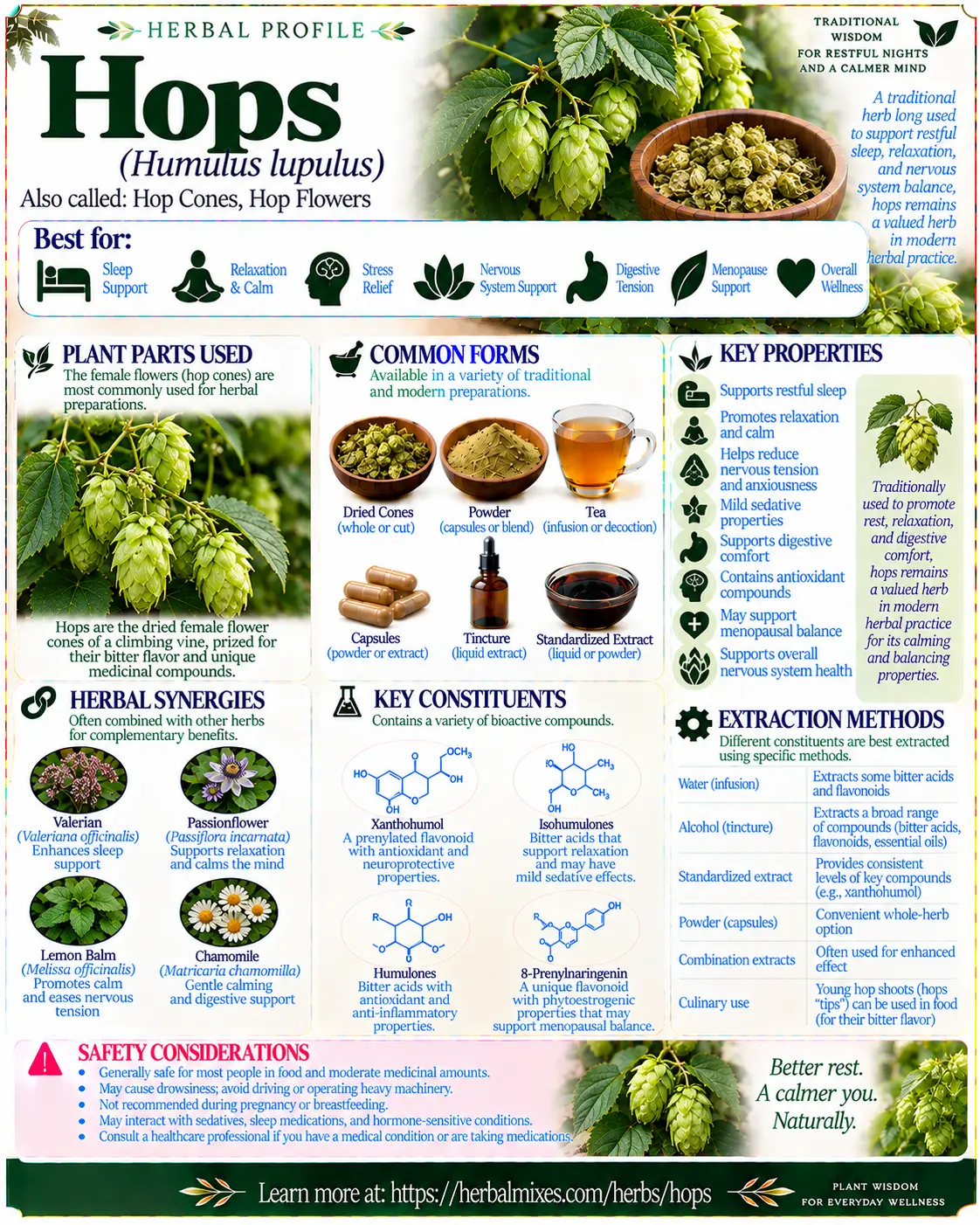
What Hops Is Good For
Sleep support — Hops is traditionally used as a sedative and calming herb, especially for difficulty falling asleep related to nervous tension. The European Medicines Agency recognizes hops flower for relief of mild symptoms of mental stress and to aid sleep based on traditional use. (ema.europa.eu)
Nervous tension — Hops is commonly used when irritability, restlessness, or mental overactivity makes it difficult to relax. Its bitter acids and volatile compounds are thought to contribute to this calming profile.
Restlessness — Hops is often combined with valerian in nighttime formulas because the two herbs offer complementary calming actions. Human studies have evaluated this pairing more often than hops alone.
Digestive bitters — The intensely bitter resins in hops can stimulate appetite and digestive secretions, making small amounts useful in traditional bitter formulas. This role is secondary to its better-known calming use.
Menopausal support — Hops contains 8-prenylnaringenin, a potent plant-derived phytoestrogen. Extracts have been investigated for menopausal symptoms, but the evidence is limited and concentrated hops extracts deserve caution in people with hormone-sensitive conditions. (pmc.ncbi.nlm.nih.gov)
Available Herbal Products
Buying Guides for Available Hops Products
Hops Liquid Herbal Extract – Flower tincture. A concentrated liquid preparation made from Humulus lupulus strobiles and useful for people who prefer drops rather than tea or capsules. Seller: Herb Pharm – View Herb Pharm Hops →
Hops Flowers – Dried whole flowers. A versatile option for making calming tea, digestive bitters, tinctures, or herbal sleep blends at home. Seller: Mountain Rose Herbs – View Mountain Rose Herbs Hops Flowers →
Hops Flowers Cut & Sifted – Dried herb. Useful for teas, tinctures, and custom formulas, especially when combining hops with valerian, lemon balm, or chamomile. Seller: Starwest Botanicals – View Starwest Botanicals Hops Flowers →
Valerian Nighttime – Combination capsules. Combines valerian with hops and passionflower for people seeking a broader herbal sleep-support formula rather than hops alone. Seller: Gaia Herbs – View Gaia Herbs Valerian Nighttime →
Herbal Synergies
Hops pairs especially well with valerian, lemon balm, passionflower, chamomile, and lavender depending on whether the goal is sleep, nervous tension, or digestive relaxation.
Hops + Valerian
Best for: Difficulty falling asleep and nighttime restlessness
Hops contributes bitter resins and calming aromatic compounds, while valerian adds stronger sedative and antispasmodic activity.
This is one of the most common herbal sleep pairings and has been studied more extensively than hops alone.
Best extraction: Tincture or standardized extract. Both herbs contain volatile and less water-soluble constituents that are better represented in hydroalcoholic preparations.
Hops + Lemon Balm
Best for: Stress-related insomnia and nervous digestion
Hops provides a deeper sedative edge, while lemon balm adds gentle calming, carminative, and antispasmodic properties.
This combination is especially useful when emotional tension and digestive discomfort occur together.
Best extraction: Covered hot infusion or tincture. Both herbs contain volatile compounds, so keeping tea covered helps preserve aromatics.
Hops + Passionflower
Best for: Racing thoughts and nighttime nervous tension
Hops contributes sedative and bitter activity, while passionflower is traditionally used for nervous restlessness and difficulty settling the mind.
Best extraction: Tincture or hot infusion. A combined tincture provides a more concentrated preparation, while tea works well for milder nightly use.
Hops + Chamomile
Best for: Mild insomnia with digestive tension
Hops provides stronger nighttime calming, while chamomile adds a gentle nervine and digestive antispasmodic action.
Best extraction: Covered hot infusion. Chamomile performs especially well as tea, while hops also yields bitter and aromatic compounds into hot water.
Hops + Lavender
Best for: Evening relaxation and mild anxiety
Hops contributes sedative activity, while lavender adds aromatic calming and a softer emotional quality.
Best extraction: Covered hot infusion or tincture. Both herbs contain volatile compounds that benefit from minimizing evaporation.
Key Herbal Properties
Sedative — Hops is traditionally used to promote relaxation and sleep, especially when nervous tension is present. (ema.europa.eu)
Nervine — Hops supports a calmer nervous system and is often used for restlessness, irritability, and difficulty unwinding.
Bitter — Humulone, lupulone, and related bitter acids give hops its intense bitterness and explain its traditional digestive role.
Digestive stimulant — Small amounts of hops may support appetite and digestive secretion through bitter-taste pathways.
Antispasmodic — Hops has traditional use in formulas for muscular and nervous tension, though clinical evidence is limited.
Phytoestrogenic — Hops contains 8-prenylnaringenin, one of the most potent phytoestrogens identified in plants. This property may contribute to menopausal effects but is also relevant to safety. (pmc.ncbi.nlm.nih.gov)
Antioxidant — Xanthohumol and related prenylated flavonoids demonstrate antioxidant activity experimentally.
Anti-inflammatory — Xanthohumol, humulone, and other hop compounds influence inflammatory pathways in laboratory research, though this does not establish hops as a treatment for inflammatory disease.







Active Compounds
Hops contains several distinctive constituent groups, especially bitter acids, prenylated flavonoids, and volatile oils. Important compounds include humulone, lupulone, xanthohumol, isoxanthohumol, 8-prenylnaringenin, and myrcene.
Humulone
Found mainly in: Lupulin glands of the female flower cones
Humulone is one of the primary alpha bitter acids in hops and is responsible for much of the plant’s bitterness. It is well known from brewing but also contributes to hop’s pharmacological profile.
Best extraction: Alcohol tincture or nonpolar extract. Humulone is poorly water soluble compared with many polar plant constituents.
Lupulone
Found mainly in: Lupulin glands
Lupulone is a major beta bitter acid associated with hops’ bitter and antimicrobial chemistry.
Best extraction: Alcohol or lipophilic extraction. Plain tea extracts much less of this constituent than tinctures or resin-rich preparations.
Xanthohumol
Found mainly in: Lupulin glands and flower cones
Xanthohumol is a prenylated chalcone extensively studied for antioxidant, metabolic, and inflammatory effects. It is one of hops’ most distinctive modern research compounds. (pmc.ncbi.nlm.nih.gov)
Best extraction: Alcohol or CO₂ extract. Xanthohumol is relatively lipophilic and not well extracted by plain water.
Isoxanthohumol
Found mainly in: Flower cones and processed hop preparations
Isoxanthohumol forms partly from xanthohumol during processing and can be converted by intestinal bacteria into 8-prenylnaringenin.
Best extraction: Hydroalcoholic extract. Its prenylated structure favors alcohol-containing solvents.
8-Prenylnaringenin
Found mainly in: Flower cones, generally in small amounts
8-Prenylnaringenin is a prenylated flavanone with unusually strong estrogenic activity for a plant compound. It is one of the main reasons concentrated hops extracts are studied for menopausal symptoms. (pmc.ncbi.nlm.nih.gov)
Best extraction: Alcohol or standardized extract. It is relatively lipophilic and poorly represented in a weak water infusion.
Myrcene
Found mainly in: Essential oil of the flower cones
Myrcene is one of the major aromatic terpenes in hops and contributes to its characteristic resinous aroma.
Best extraction: Steam-distilled essential oil, CO₂ extract, or alcohol tincture. Because it is volatile, prolonged open boiling causes losses.
Humulene
Found mainly in: Essential oil
Humulene, also called alpha-caryophyllene, is a sesquiterpene contributing to hops’ aroma and experimental anti-inflammatory activity.
Best extraction: Essential oil, CO₂ extract, or tincture.
Linalool and Other Volatile Compounds
Found mainly in: Essential oil
Hops also contains smaller amounts of linalool, caryophyllene, farnesene, and related terpenes that contribute aromatic and calming qualities.
Best extraction: Covered infusion, tincture, or essential oil. Covering tea minimizes evaporative loss.
FAQ
What is hops best used for?
Hops is mainly used for sleep support, nervous tension, and restlessness. EMA recognizes traditional use for mild mental stress and as an aid to sleep. (ema.europa.eu)
Is hops tea or tincture better?
Tea can work well for mild evening relaxation, but hops’ important bitter resins and prenylated compounds are not highly water soluble.
A hydroalcoholic tincture or standardized extract generally provides a broader chemical profile.
Does hops make you sleepy?
It can. Hops is traditionally classified as a sedative and is commonly included in sleep formulas.
For that reason, it is best used cautiously before driving, operating machinery, or combining it with other sedating substances.
Can hops be taken every day?
Short-term use in sleep formulas is common, but long-term safety data are less robust.
Regular concentrated use is best approached cautiously, especially when hormone-sensitive conditions or sedative medications are involved.
Does hops contain estrogen?
Hops contains phytoestrogenic compounds, especially 8-prenylnaringenin.
This is not the same as human estrogen, but concentrated extracts can have biologically meaningful estrogen-receptor activity. (pmc.ncbi.nlm.nih.gov)
Safety & Precautions
Hops may cause drowsiness or sedation, particularly when combined with valerian, sleep medications, antihistamines, alcohol, benzodiazepines, or other sedating substances.
Avoid driving or operating machinery until you know how a hops preparation affects you.
Because hops contains potent phytoestrogens, people with hormone-sensitive conditions—including certain breast, uterine, or ovarian disorders—should discuss concentrated hops extracts with a healthcare professional before use.
Safety during pregnancy and breastfeeding has not been adequately established, so medicinal use is best avoided unless specifically recommended by a qualified professional.
People taking sedatives, sleep medications, antidepressants, or anti-anxiety medications should discuss concentrated hops use with a pharmacist or healthcare professional because additive sedation is possible.
Hops may occasionally cause allergic reactions, especially in people sensitive to members of the Cannabaceae family.
The dried plant can sometimes cause skin irritation in people who handle large amounts occupationally.
Because hop products vary widely—from weak teas to concentrated resin-rich extracts—the pharmacological intensity can differ substantially.
Seek medical evaluation for persistent insomnia, severe anxiety, unexplained palpitations, breathing pauses during sleep, or sleep problems accompanied by depression or significant daytime impairment.
Anyone with a hormone-sensitive condition, chronic medical problem, or prescription medications should discuss regular therapeutic use of hops with an appropriate healthcare professional.
References
- European Medicines Agency — Lupuli Flos
- EMA — European Union Herbal Monograph on Humulus lupulus L., Flos
- Kew Plants of the World Online — Humulus lupulus L.
- PubMed Central — Hops and Their Prenylated Flavonoids
- PubMed — Hops and Sleep Research
- PubMed — Valerian and Hops Sleep Research
- PubMed — 8-Prenylnaringenin and Menopause
- Herb Pharm — Hops Liquid Herbal Extract
- Mountain Rose Herbs — Hops Flowers
- Gaia Herbs — Valerian Nighttime
Disclaimer
Disclaimer: This article is for educational purposes only and is not intended to diagnose, treat, cure, or prevent any disease. Herbal products can cause side effects and interact with medications. Consult a qualified healthcare professional before using herbs therapeutically, especially if you are pregnant, breastfeeding, taking prescription medications, or managing a medical condition.