

What Hawthorn Is Good For
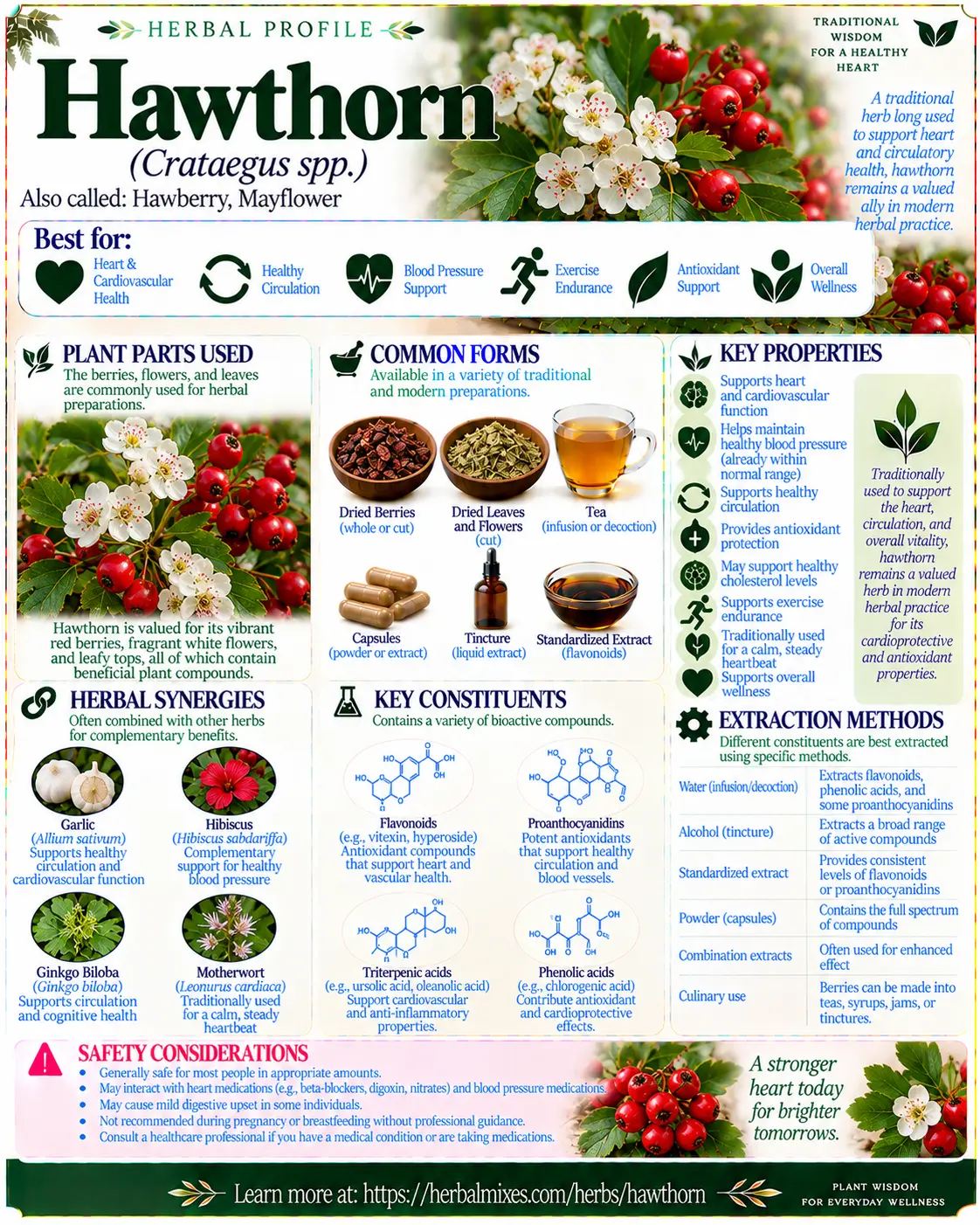
Cardiovascular support — Hawthorn is best known as a traditional heart and circulation tonic. The European Medicines Agency recognizes hawthorn leaf and flower within the therapeutic areas of circulatory disorders and mild mental stress, although many uses are based on long-standing traditional experience rather than definitive clinical evidence.
Healthy circulation — Hawthorn contains flavonoids and oligomeric procyanidins associated with vascular and antioxidant activity. These constituents may help support normal blood-vessel function and peripheral circulation.
Heart function support — Standardized hawthorn leaf-and-flower extracts have been studied as adjuncts in people with chronic heart failure. Older trials suggested improvements in symptoms and exercise tolerance, but NCCIH now describes the overall evidence as conflicting, so hawthorn should never replace conventional heart-failure treatment.
Stress-related heart awareness — European traditional use includes hawthorn leaf and flower for temporary nervous cardiac complaints such as awareness of heartbeat after serious medical causes have been excluded. This is not appropriate for unexplained chest pain or new palpitations.
Vascular antioxidant support — Hawthorn flavonoids and procyanidins provide antioxidant activity that may help protect vascular tissues from oxidative stress. This is a supportive property rather than evidence that hawthorn prevents cardiovascular disease.
Available Herbal Products
Buying Guides for Available Hawthorn Products
Hawthorn Blend – Liquid tincture. Combines flowering aerial parts with hawthorn berries in a 1:5 hydroalcoholic extract, providing both major parts traditionally used in Western herbalism. Seller: Herb Pharm – View Herb Pharm Hawthorn Blend →
Hawthorn Supreme – Berry, leaf, and flower extract capsules. Combines organic hawthorn berry with leaf-and-flower extract in a convenient capsule for people who prefer a whole-spectrum cardiovascular-support preparation. Seller: Gaia Herbs – View Gaia Herbs Hawthorn Supreme →
Hawthorn Berries – Whole-berry capsules. Provides powdered hawthorn berry without a standardized extract, making it a simple option for people who prefer traditional whole-fruit preparations. Seller: Nature’s Way – View Nature’s Way Hawthorn Berries →
Clinical research on hawthorn cardiovascular effects has generally focused more on standardized leaf-and-flower extracts than on berry-only products. The EMA medicinal monograph specifically covers Crataegus leaf with flower and describes dried, powdered, tincture, liquid-extract, and dry-extract preparations.
Herbal Synergies
Hawthorn pairs especially well with motherwort, ginkgo, garlic, linden, and rose depending on whether the goal is cardiovascular, circulatory, or stress-related support.
Hawthorn + Motherwort
Best for: Stress-related heart awareness and nervous cardiovascular support
Hawthorn contributes cardiovascular and vascular tonic activity, while motherwort is traditionally used as a calming nervine with a particular affinity for nervous tension accompanied by awareness of heartbeat.
The pairing is most appropriate after concerning causes of palpitations have been medically excluded.
Best extraction: Tincture. Hydroalcoholic extraction captures hawthorn flavonoids and procyanidins alongside motherwort’s bitter and alkaloid-containing constituents.
Hawthorn + Ginkgo Biloba
Best for: Peripheral circulation and vascular support
Hawthorn contributes broader cardiovascular tonic activity, while ginkgo is more specifically associated with microcirculation and peripheral or cerebral blood flow.
Best extraction: Hawthorn tincture or standardized extract combined with standardized ginkgo extract. Clinical ginkgo research generally relies on standardized preparations rather than ordinary tea.
Hawthorn + Garlic
Best for: Broad cardiovascular wellness
Hawthorn contributes flavonoids and procyanidins, while garlic provides sulfur compounds associated with cholesterol, blood-pressure, and vascular support.
This combination addresses cardiovascular wellness through substantially different phytochemical pathways.
Best extraction: Hawthorn standardized extract or tincture alongside fresh, aged, or standardized garlic.
Because both herbs may influence cardiovascular function, people taking heart or blood-pressure medications should use the combination with professional guidance.
Hawthorn + Linden
Best for: Cardiovascular support with nervous tension
Hawthorn provides the cardiovascular role while linden adds gentle nervine, relaxing, and traditional circulatory properties.
This pairing is particularly suited to herbal formulas aimed at tension rather than stimulating cardiovascular activity.
Best extraction: Hot infusion or tincture. Hawthorn leaf and flower and linden flowers both release flavonoids into hot water, while tincture provides broader extraction.
Hawthorn + Rose
Best for: Gentle heart tonic and emotional wellness formulas
Hawthorn berries and flowers provide cardiovascular and antioxidant support, while rose contributes flavonoids, tannins, aromatic compounds, and a gentle calming quality.
Best extraction: Tea, tincture, or syrup. Both herbs lend themselves particularly well to berry-and-flower formulas.
Key Herbal Properties
Cardiovascular tonic — Hawthorn is traditionally used to support overall heart and circulatory function and remains one of the most recognized cardiovascular herbs in Western herbalism.
Circulatory — Flavonoids and procyanidins may influence vascular function, helping explain hawthorn’s traditional association with circulation.
Antioxidant — Hawthorn contains numerous polyphenols capable of scavenging reactive oxygen species and supporting vascular antioxidant defenses.
Vascular supportive — Hawthorn constituents have been investigated for effects on endothelial signaling and vascular tone. These mechanisms remain supportive rather than proof of treatment for hypertension or vascular disease.
Mild cardiotonic — Standardized leaf-and-flower extracts have been studied for effects on cardiac function and exercise capacity, particularly in older heart-failure studies. Current evidence remains mixed.
Nervine — EMA traditional-use materials include hawthorn leaf and flower for mild symptoms of mental stress and nervous cardiac complaints after serious conditions have been excluded.
Astringent — Hawthorn berries and leaves contain tannins that contribute mild astringency, particularly in whole-herb preparations.




Active Compounds
The most important hawthorn constituents include flavonoids and oligomeric procyanidins, along with phenolic acids, triterpenes, and tannins. European Pharmacopoeia-quality hawthorn leaf and flower contains a minimum specified flavonoid content expressed as hyperoside.
Oligomeric Procyanidins
Found mainly in: Leaves, flowers, and berries
Oligomeric procyanidins (OPCs) are polymeric flavan-3-ol compounds regarded as important contributors to hawthorn’s cardiovascular and antioxidant activity.
They have been investigated for effects on vascular tone, endothelial function, and cardiac tissue.
Best extraction: Hydroalcoholic extract. Water can extract some procyanidins, but alcohol-water mixtures provide broader and more consistent recovery and are commonly used in standardized hawthorn preparations.
Hyperoside
Found mainly in: Leaves and flowers
Hyperoside, a quercetin glycoside, is one of the characteristic flavonoids found in hawthorn leaf and flower. It is important enough that European Pharmacopoeia specifications express total flavonoids relative to hyperoside.
Best extraction: Hot infusion or hydroalcoholic tincture. As a flavonoid glycoside, hyperoside has useful polarity and can be extracted into both water and water-alcohol mixtures.
Vitexin Derivatives
Found mainly in: Leaves and flowers
Vitexin and vitexin-related flavonoids form another important part of hawthorn’s flavonoid profile and contribute antioxidant and vascular activity.
Best extraction: Hydroalcoholic extract or hot infusion. Diluted alcohol generally provides broader flavonoid extraction.
Rutin
Found mainly in: Leaves and flowers
Rutin is a flavonoid glycoside that contributes to hawthorn’s antioxidant and vascular-supportive profile.
Best extraction: Hot water or hydroalcoholic tincture. Rutin’s glycoside structure gives it reasonable polarity.
Quercetin Derivatives
Found mainly in: Leaves, flowers, and berries
Hawthorn contains multiple quercetin-derived flavonoids, which contribute antioxidant effects and may support endothelial function.
Best extraction: Hydroalcoholic extract. Mixed water-alcohol solvents efficiently capture a broad range of flavonoid glycosides and aglycones.
Chlorogenic Acid
Found mainly in: Leaves and fruit
Chlorogenic acid is a phenolic acid contributing antioxidant activity to hawthorn preparations.
Best extraction: Hot water or hydroalcoholic extraction. It is relatively polar and extracts readily into water.
Triterpenes
Found mainly in: Leaves, flowers, and fruit
Hawthorn contains pentacyclic triterpenes such as ursolic and oleanolic acid derivatives. These compounds add to the herb’s broader anti-inflammatory and cardiovascular pharmacology.
Best extraction: Alcohol or hydroalcoholic extract. Triterpenes are less water soluble than flavonoid glycosides and benefit from alcohol-containing preparations.
Tannins
Found mainly in: Leaves, bark, and berries
Tannins provide mild astringency and contribute additional antioxidant activity.
Best extraction: Hot-water infusion or hydroalcoholic tincture. Tannins extract readily into water.
FAQ
What is hawthorn best used for?
Hawthorn is mainly used for cardiovascular and circulation support.
It has also been studied as an adjunct in heart failure, but NCCIH considers the clinical evidence conflicting, so diagnosed cardiovascular disease requires standard medical management rather than self-treatment with hawthorn.
Are hawthorn berries or hawthorn leaf and flower better?
They are not identical.
Leaf and flower preparations have been the focus of European herbal monographs and much of the standardized clinical research. Berries are widely used in traditional syrups, tinctures, teas, and whole-herb cardiovascular formulas.
Many herbalists combine all three parts.
Is hawthorn tea or tincture better?
Tea can extract many flavonoids, tannins, and water-soluble procyanidins and is suitable for gentle traditional use.
A hydroalcoholic tincture or standardized extract captures a broader chemical spectrum and more closely resembles many preparations used commercially and in research. EMA lists several 35–70% ethanol preparations for hawthorn leaf and flower.
How quickly does hawthorn work?
Hawthorn is generally regarded as a tonic herb used consistently over time, not an immediate remedy.
Clinical trials of standardized extracts have typically evaluated effects over weeks or months rather than hours or days.
Can hawthorn be taken every day?
Commercial hawthorn products are frequently intended for daily use, but NCCIH notes that research has not established safety beyond approximately 16 weeks. People using heart or blood-pressure medications should obtain medical guidance before regular supplementation.
Safety & Precautions
Hawthorn deserves particular caution because many people interested in it already have cardiovascular disease or take cardiovascular medications.
Do not use hawthorn as a substitute for prescribed treatment for heart failure, coronary artery disease, arrhythmias, hypertension, or other diagnosed heart conditions.
NCCIH reports that evidence regarding hawthorn in heart failure is conflicting and notes that one clinical study suggested possible early progression of heart failure in patients taking a specific hawthorn preparation. Drug interactions were one possible explanation.
People taking blood-pressure medications, heart medications, vasodilators, or medicines used for heart failure should discuss hawthorn with their physician or pharmacist before use. Additive cardiovascular effects are possible.
Common reported adverse effects include dizziness, nausea, vomiting, diarrhea, and muscle pain.
Safety during pregnancy and breastfeeding has not been established. Gaia Herbs specifically advises against use of its Hawthorn Supreme during pregnancy or lactation.
Seek urgent medical attention for chest pain, fainting, severe shortness of breath, new or worsening irregular heartbeat, pain spreading to the arm or jaw, or sudden swelling associated with breathing difficulty rather than attempting to manage these symptoms with hawthorn.
Be especially careful when purchasing products marketed as “tejocote root” or Mexican hawthorn for weight loss. NCCIH reports that the FDA found several products labeled as Crataegus mexicana actually contained yellow oleander, a highly toxic plant capable of causing serious or fatal poisoning.
Anyone with cardiovascular disease or taking prescription medications should discuss regular therapeutic hawthorn use with an appropriate healthcare professional.
References
- NCCIH — Hawthorn: Usefulness and Safety
- European Medicines Agency — Crataegi folium cum flore
- EMA — European Union Herbal Monograph on Hawthorn Leaf and Flower
- EMA — Assessment Report on Hawthorn Leaf and Flower
- PubMed — Hawthorn Extract for Treating Chronic Heart Failure: Meta-analysis
- PubMed — Cochrane Review: Hawthorn Extract for Chronic Heart Failure
- Herb Pharm — Hawthorn Blend
- Gaia Herbs — Hawthorn Supreme
- Nature’s Way — Hawthorn Berries
Disclaimer
Disclaimer: This article is for educational purposes only and is not intended to diagnose, treat, cure, or prevent any disease. Herbal products can cause side effects and interact with medications. Consult a qualified healthcare professional before using herbs therapeutically, especially if you are pregnant, breastfeeding, taking prescription medications, or managing a medical condition.