

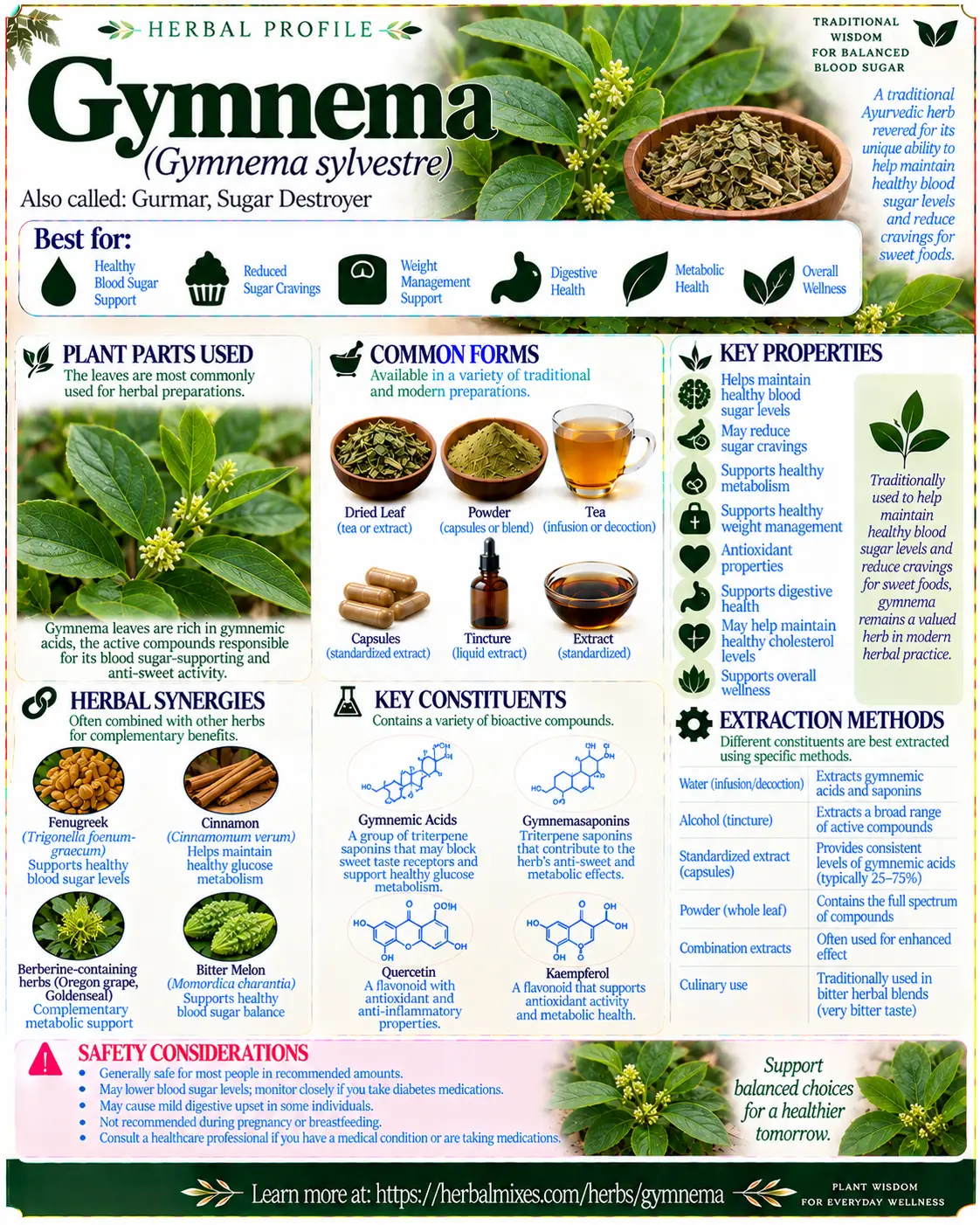
What Gymnema Is Good For
Blood sugar support — Gymnema is best known for traditional use in supporting healthy glucose metabolism. Preliminary human studies suggest extracts may influence fasting glucose, post-meal glucose, and HbA1c, but the clinical evidence remains limited and gymnema should not replace diabetes treatment.
Sugar cravings — Gymnemic acids can temporarily reduce the perception of sweetness when they contact the tongue. This unusual effect explains the traditional name gurmar, often translated as “sugar destroyer,” and may make sweet foods temporarily less appealing.
Glucose absorption — Gymnemic acids have been investigated for their ability to reduce intestinal glucose absorption and influence glucose-handling pathways. Much of the mechanistic evidence comes from laboratory and animal research rather than large clinical trials.
Metabolic wellness — Gymnema has been investigated for broader effects on carbohydrate and lipid metabolism. Some small studies suggest potential metabolic benefits, but evidence is not yet strong enough to establish it as a treatment for metabolic disorders.
Healthy cholesterol support — Experimental and limited clinical research suggests gymnema extracts may influence triglycerides and cholesterol metabolism. This remains a secondary use compared with its better-known glucose-related applications.
Available Herbal Products
Buying Guides for Available Gymnema Products
Gymnema Sylvestre Extract – Standardized capsules. Provides 400 mg of Gymnema sylvestre leaf extract standardized to gymnemic acids, making it a useful choice when predictable constituent content is important. Seller: NOW Foods – View NOW Gymnema Sylvestre Extract →
Gymnema Premium Extract – Leaf extract capsules. Provides 500 mg of gymnema leaf extract per serving in a simple capsule format designed for blood sugar metabolism support. Seller: Nature’s Way – View Nature’s Way Gymnema →
Gymnema Extract 520 mg – Extract capsules. A convenient single-herb capsule option for people who prefer measured supplementation rather than tea or tincture. Seller: Vitacost – View Vitacost Gymnema Extract →
Himalaya Organic Gymnema – Herbal tablets. An organic gymnema preparation intended for people looking for a traditional Ayurvedic-style supplement in tablet form. Seller: Vitacost – View Himalaya Organic Gymnema →
Gymnema Leaf Alcohol-Free – Liquid extract. An alcohol-free liquid preparation suitable for people who prefer drops rather than capsules or traditional alcohol tinctures. Seller: Vitacost – View Nature’s Answer Gymnema Leaf Alcohol-Free →
Herbal Synergies
Gymnema pairs especially well with cinnamon, fenugreek, bitter melon, holy basil, and ginger depending on whether the goal is glucose metabolism, appetite control, or broader metabolic support.
Gymnema + Cinnamon
Best for: Blood sugar and metabolic support
Gymnema contributes gymnemic acids associated with glucose absorption and sweet-taste modulation, while cinnamon provides polyphenols traditionally used in metabolic formulas.
The combination approaches glucose metabolism through different phytochemical pathways, but people taking glucose-lowering medication need to be particularly cautious about additive effects.
Best extraction: Standardized extracts or tinctures. Gymnema’s saponins work well in hydroalcoholic preparations, while cinnamon can be used as powder, tincture, or concentrated extract.
Gymnema + Fenugreek
Best for: Post-meal glucose and appetite support
Gymnema provides gymnemic acids and sugar-taste suppression, while fenugreek contributes soluble fiber, galactomannans, and steroidal saponins.
Together they make a logical metabolic combination, particularly around carbohydrate-rich meals.
Best extraction: Gymnema extract plus fenugreek powder or soaked seed. Consuming fenugreek’s fiber directly is important, while standardized extraction is more useful for gymnema’s gymnemic acids.
Gymnema + Bitter Melon
Best for: Practitioner-guided glucose metabolism support
Both herbs are strongly associated with traditional blood sugar management. Bitter melon contributes charantin-related compounds and other metabolic constituents, while gymnema contributes gymnemic acids.
Because both may lower glucose, this combination deserves professional guidance in anyone taking diabetes medication.
Best extraction: Standardized extracts or separate preparations. Using standardized products allows more predictable dosing than loosely prepared teas.
Gymnema + Holy Basil
Best for: Stress-related eating and metabolic wellness
Gymnema contributes sugar-craving and glucose-related actions, while holy basil provides adaptogenic and stress-supportive properties.
This pairing may be particularly appropriate when stress and habitual sweet-food intake occur together.
Best extraction: Hydroalcoholic tincture or standardized extracts. Both herbs contain multiple constituent classes that are captured more broadly by mixed water-alcohol extraction.
Gymnema + Ginger
Best for: Metabolic support with sluggish digestion
Gymnema supplies the glucose-related role, while ginger contributes warming digestive, carminative, and motility-supportive actions.
Best extraction: Gymnema standardized extract with ginger tea, tincture, or powder.
Key Herbal Properties
Hypoglycemic — Gymnema extracts may lower blood glucose, which explains both their traditional metabolic use and the primary safety concern when combined with diabetes medications.
Sweet-taste modifying — Gymnemic acids can temporarily interfere with sweet-taste perception at the tongue, making sugary foods taste less sweet.
Metabolic supportive — Gymnema has traditionally been used to support carbohydrate and glucose metabolism, with modern research investigating several complementary mechanisms.
Lipid supportive — Experimental and limited clinical research suggests possible effects on cholesterol and triglyceride metabolism.
Antioxidant — Gymnema contains saponins, flavonoids, and phenolic compounds with free-radical-scavenging activity.
Anti-inflammatory — Gymnemic acids and other constituents influence inflammatory pathways experimentally, though this does not establish gymnema as a treatment for inflammatory disease.
Digestive — Gymnema has traditional applications for indigestion and digestive complaints, although these uses have much less modern clinical support than its metabolic role.






Active Compounds
Gymnema’s most characteristic constituents are gymnemic acids, a group of triterpenoid saponins. The plant also contains gymnemasaponins, gurmarin, gymnemagenin, flavonoids, and other phytochemicals that may contribute to its metabolic and antioxidant properties.
Gymnemic Acids
Found mainly in: Leaves
Gymnemic acids are triterpenoid saponins considered the primary bioactive marker compounds in gymnema. They are associated with temporary suppression of sweet taste and have been studied for effects on intestinal glucose absorption and metabolic signaling.
Best extraction: Hydroalcoholic extract or standardized extract. Saponins possess both water- and lipid-interacting regions, making mixed water-alcohol extraction particularly effective.
Standardized commercial extracts are preferable when predictable gymnemic-acid content is desired.
Gymnemagenin
Found mainly in: Leaves
Gymnemagenin is the triterpenoid aglycone forming the structural backbone of several gymnemic acids.
It is useful phytochemically because many gymnemic acid compounds are essentially glycosylated derivatives built around this core.
Best extraction: Hydroalcoholic extraction. The aglycone is less water soluble than its glycosylated derivatives, so alcohol improves extraction.
Gymnemasaponins
Found mainly in: Leaves
Gymnemasaponins are another group of triterpenoid saponins characteristic of Gymnema sylvestre. They contribute to the broader metabolic and pharmacological profile of the plant.
Best extraction: Hydroalcoholic extract. Diluted alcohol efficiently captures a broad spectrum of saponins.
Gurmarin
Found mainly in: Leaves
Gurmarin is a small polypeptide associated with gymnema’s unusual ability to alter sweet-taste perception. Its importance appears to vary among species and experimental models.
Best extraction: Water-based extraction. As a peptide, gurmarin is more compatible with aqueous preparations than highly nonpolar solvents.
Because proteins and peptides can be sensitive to processing, standardized extracts may not necessarily contain the same gurmarin profile as fresh leaf preparations.
Flavonoids
Found mainly in: Leaves
Gymnema contains flavonoids that contribute antioxidant activity and complement its better-known saponin fraction.
Best extraction: Hot-water infusion or hydroalcoholic tincture. Many flavonoid glycosides extract readily in polar solvents.
Phenolic Compounds
Found mainly in: Leaves and aerial parts
Phenolic constituents add antioxidant activity and may contribute to the herb’s broader metabolic effects.
Best extraction: Water or hydroalcoholic extract. Mixed solvents generally recover a wider range of phenolic compounds.
Tannins
Found mainly in: Leaves
Gymnema leaves contain tannins that contribute mild astringency and antioxidant activity.
Best extraction: Hot-water infusion or diluted alcohol. Tannins are readily water soluble.
FAQ
What is gymnema best used for?
Gymnema is primarily used for blood sugar and glucose metabolism support and for its unusual ability to temporarily reduce the taste of sweetness.
Clinical studies are promising but still too limited to consider gymnema a replacement for standard diabetes management.
Does gymnema really stop sugar from tasting sweet?
It can temporarily reduce sweet-taste perception when gymnemic-acid-containing material contacts the tongue.
The effect is temporary and does not mean the sugar itself has disappeared or that eating sugar no longer affects blood glucose.
Is gymnema tea or standardized extract better?
Tea extracts some water-soluble saponins and other compounds, but a standardized extract provides more predictable gymnemic-acid exposure.
For metabolic use, standardized capsules are therefore generally easier to evaluate and dose consistently. NOW Foods, for example, specifically standardizes its extract to gymnemic acids.
Can gymnema be taken every day?
Commercial products are commonly intended for daily use, but regular use deserves caution because gymnema may lower blood glucose.
People taking insulin or oral diabetes medicines should not begin daily gymnema supplementation without medical guidance. NOW Foods specifically advises consultation when using insulin or oral diabetic medications.
Can gymnema replace metformin or other diabetes medication?
No.
Gymnema has interesting glucose-related pharmacology, but available evidence does not establish it as a replacement for metformin, insulin, or other prescribed diabetes treatment. Stopping or reducing medication without medical supervision can result in dangerous hyperglycemia.
Safety & Precautions
The most important safety concern with gymnema is excessively low blood glucose, particularly when it is combined with diabetes medications.
People taking insulin, metformin, sulfonylureas, meglitinides, or other glucose-lowering medicines should discuss gymnema with their healthcare professional before use. Commercial manufacturers likewise advise medical supervision when insulin or oral diabetes medications are used.
Symptoms of low blood glucose may include shakiness, sweating, dizziness, weakness, hunger, confusion, irritability, or palpitations. People using glucose-lowering medications should monitor according to their clinician’s recommendations.
Safety during pregnancy and breastfeeding has not been adequately established. NOW Foods specifically advises against its gymnema product during pregnancy and nursing.
Gymnema may also interfere with glucose management around surgery, particularly when fasting or medication adjustments are involved. Tell your surgical team about all glucose-active supplements you use.
Clinical safety data for prolonged high-dose use remain limited. The evidence-based systematic review of gymnema emphasizes that the available literature is much smaller than that available for established diabetes medications.
Rare liver-related adverse events have been reported in association with herbal supplements containing gymnema, although causality and frequency are difficult to establish. Stop use and seek medical evaluation for unexplained jaundice, dark urine, severe fatigue, or persistent upper abdominal discomfort.
Because gymnema’s ability to suppress sweet taste may encourage unusual eating behavior, remember that foods still contain the same sugar and calories even when they temporarily taste less sweet.
Anyone with diabetes, hypoglycemia, liver disease, a chronic medical condition, or prescription medications should discuss regular therapeutic use of gymnema with an appropriate healthcare professional.
References
- PubMed — Evidence-Based Systematic Review of Gymnema sylvestre
- PubMed — Phytochemical and Pharmacological Properties of Gymnema sylvestre
- PubMed Central — Comprehensive Review on Gymnema sylvestre
- PubMed — Recent Developments in the Antidiabetic Potential of Gymnema Species
- PubMed — Systematic Review of Gymnema sylvestre in Obesity and Diabetes Management
- PubMed — Gymnema sylvestre: A Memoir
- NOW Foods — Gymnema Sylvestre Extract
- Nature’s Way — Gymnema
- Vitacost — Gymnema Sylvestre Products
Disclaimer
Disclaimer: This article is for educational purposes only and is not intended to diagnose, treat, cure, or prevent any disease. Herbal products can cause side effects and interact with medications. Consult a qualified healthcare professional before using herbs therapeutically, especially if you are pregnant, breastfeeding, taking prescription medications, or managing a medical condition.