

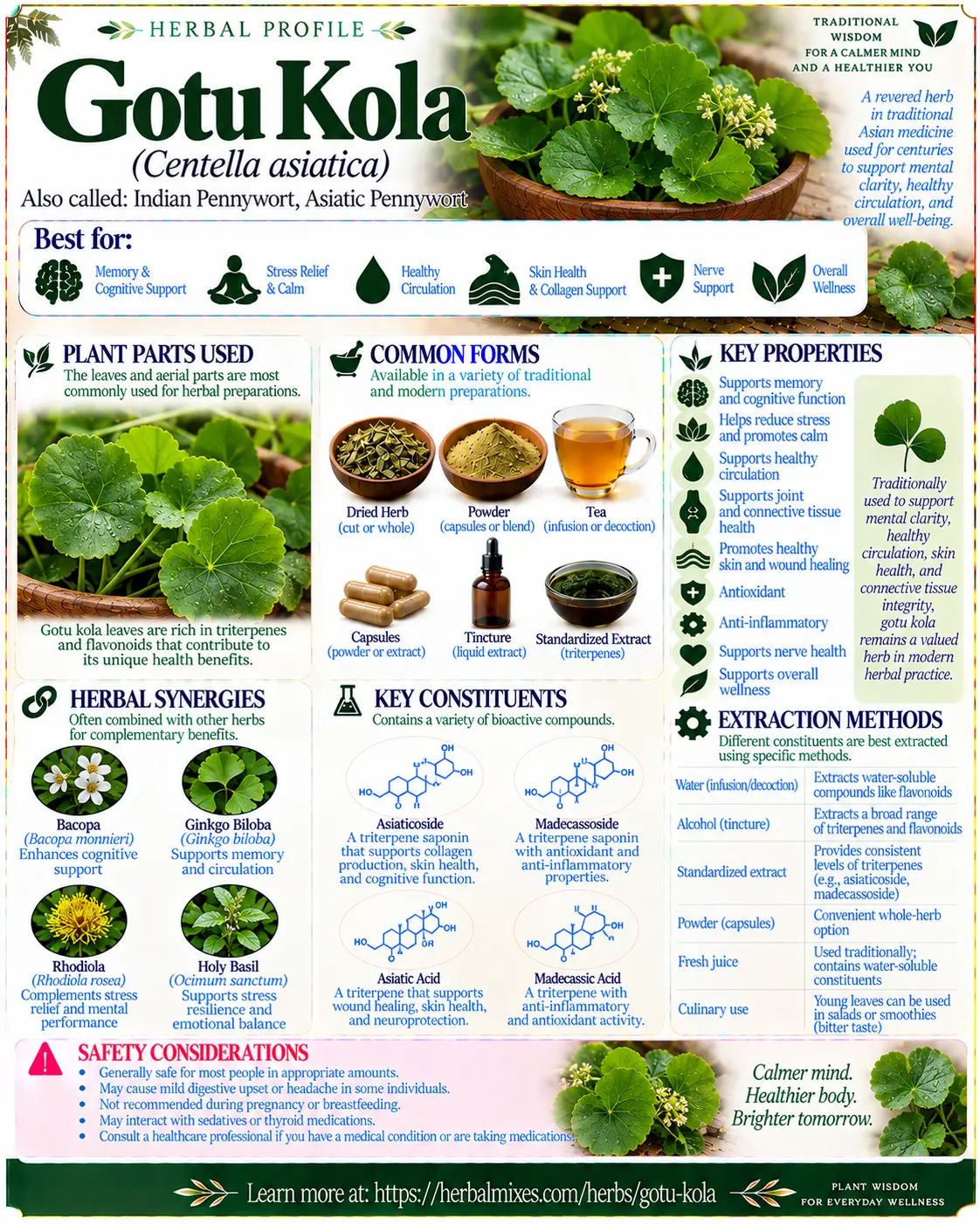
What Gotu Kola Is Good For
Cognitive support — Gotu kola is traditionally used as a nervine and cognitive-support herb, especially in Ayurvedic practice. Modern research has explored effects on attention, memory, and neurological function, but evidence in humans remains limited and should not be interpreted as proof that gotu kola prevents cognitive decline.
Healthy circulation — Gotu kola has a strong traditional association with microcirculation and connective-tissue integrity. Clinical research has investigated standardized triterpene extracts for chronic venous insufficiency and related circulation problems, although product type and dose matter considerably.
Skin & connective tissue support — This is one of gotu kola’s best-supported traditional applications. Its triterpenes—particularly asiaticoside, madecassoside, asiatic acid, and madecassic acid—are associated with collagen formation and tissue repair.
Minor wound healing — The European Medicines Agency recognizes Centella asiatica within the therapeutic area of skin disorders and minor wounds, particularly for topical preparations.
Stress resilience — Gotu kola is traditionally used as a calming restorative herb rather than a strong sedative. It is often incorporated into formulas intended to support concentration while reducing nervous tension.
Skin appearance and scar support — Standardized centella preparations are widely used topically in skin-care and scar-focused products because triterpenes may support collagen remodeling. Evidence varies by preparation and condition, so topical centella should not be assumed to erase established scars.
Available Herbal Products
Buying Guides for Available Gotu Kola Products
Organic Gotu Kola – Cut and sifted dried herb. A useful option if you want to prepare your own gotu kola tea, infusions, blends, or homemade extracts. Seller: Starwest Botanicals – View Starwest Botanicals Organic Gotu Kola →
Gotu Kola Liquid Herbal Extract – Aerial-parts tincture. A 1:4 certified organic hydroalcoholic extract that provides a concentrated alternative to tea or capsules and is designed for cognitive and circulatory support. Seller: Herb Pharm – View Herb Pharm Gotu Kola →
Gotu Kola Herb – Whole-herb capsules. Contains gotu kola leaf and stem in a simple capsule format for people who prefer dried whole herb rather than a tincture. Seller: Nature’s Way – View Nature’s Way Gotu Kola →
Brain & Memory – Combination liquid extract. Combines gotu kola with ginkgo and other cognitive herbs for people looking for a broader concentration and memory-support formula rather than gotu kola alone. Seller: Herb Pharm – View Herb Pharm Brain & Memory →
Mental Alertness – Combination capsules. Includes gotu kola with ginkgo, eleuthero, oats, peppermint, and rosemary in a caffeine-free cognitive-support blend. Seller: Gaia Herbs – View Gaia Herbs Mental Alertness →
Herbal Synergies
Gotu kola pairs especially well with ginkgo, bacopa, rosemary, calendula, and ashwagandha depending on whether the goal is cognition, circulation, skin repair, or stress resilience.
Gotu Kola + Ginkgo Biloba
Best for: Memory, concentration, and healthy circulation
Gotu kola contributes traditional nervine and connective-tissue support, while ginkgo is more specifically associated with cerebral and peripheral circulation.
The combination is commonly used in cognitive formulas because it approaches mental performance from both nervous-system and circulation-oriented perspectives. Herb Pharm currently uses the pairing in its Brain & Memory formula.
Best extraction: Hydroalcoholic extract or standardized preparations. Gotu kola triterpenes and ginkgo flavonoids/terpene lactones are better represented in concentrated extracts than in a simple mixed tea.
Gotu Kola + Bacopa
Best for: Memory and long-term cognitive support
Both herbs have strong traditional associations with cognition, but their chemistry differs. Gotu kola contributes centelloid triterpenes, while bacopa provides bacosides.
Best extraction: Standardized or hydroalcoholic extracts. Both herbs contain constituents that are better represented in concentrated extracts than in casual weak infusions.
Gotu Kola + Rosemary
Best for: Mental clarity and focus
Gotu kola provides calm cognitive and nervous-system support, while rosemary contributes stimulating aromatic compounds traditionally associated with alertness and circulation.
Best extraction: Gotu kola tincture with rosemary tincture or covered infusion. Alcohol provides broad extraction of gotu kola triterpenes, while rosemary’s volatile compounds can also be captured in a covered tea.
Gotu Kola + Calendula
Best for: Skin and connective-tissue support
Gotu kola contributes triterpenes associated with collagen formation and tissue repair, while calendula adds traditional vulnerary, soothing, and anti-inflammatory properties.
Best extraction: Separate or combined topical extracts. Gotu kola performs well in standardized topical extracts, while calendula is commonly prepared as oil, tincture, or cream.
Gotu Kola + Ashwagandha
Best for: Stress resilience with mental fatigue
Gotu kola is traditionally calming without being strongly sedating, while ashwagandha provides broader adaptogenic and restorative support.
This pairing may suit people whose concentration worsens during prolonged stress rather than those looking for a stimulant.
Best extraction: Tincture or standardized extracts. A combined hydroalcoholic preparation can capture a broad spectrum from both herbs.
Key Herbal Properties
Nervine — Gotu kola is traditionally used to support a calm but alert nervous system and is often included in formulas for concentration and stress resilience.
Nootropic — Traditional herbal systems associate gotu kola with memory and cognition. Modern evidence remains preliminary, so it is better described as a cognitive-support herb than a proven cognitive enhancer.
Vulnerary — Gotu kola has an especially strong reputation for supporting tissue repair and wound healing, an application recognized in the EMA herbal monograph.
Connective-tissue supportive — Centella triterpenes may influence collagen synthesis and extracellular-matrix remodeling, helping explain traditional use for skin, scars, and vessel integrity.
Circulatory — Gotu kola is traditionally used to support microcirculation and venous function, particularly through its effects on connective tissue surrounding blood vessels.
Anti-inflammatory — Asiaticoside, madecassoside, and their aglycones influence inflammatory pathways experimentally. This does not establish gotu kola as a treatment for inflammatory disease.
Antioxidant — Triterpenes, caffeoylquinic acids, and other phenolic constituents contribute measurable antioxidant activity. NCCIH research materials identify both triterpenes and caffeoylquinic acids as characteristic compounds in Centella asiatica.
Adaptogenic/restorative — Gotu kola is often used traditionally as a long-term restorative herb for mental and nervous-system resilience, although “adaptogen” is not its most universally accepted primary classification.








Active Compounds
Gotu kola is particularly rich in pentacyclic triterpenoids known collectively as centelloids, especially asiaticoside, madecassoside, asiatic acid, and madecassic acid. It also contains caffeoylquinic acids, flavonoids, tannins, and small amounts of volatile oil.
Asiaticoside
Found mainly in: Aerial parts and leaves
Asiaticoside is one of the major triterpene saponins in gotu kola and one of the plant’s principal quality-control markers. It is associated experimentally with collagen formation, wound repair, antioxidant activity, and tissue remodeling.
Best extraction: Water or hydroalcoholic extract. Asiaticoside is a glycosylated triterpene and can be recovered in water-based preparations, although standardized hydroalcoholic extracts provide a broader and more predictable triterpene profile. NCCIH analytical work has detected substantial asiaticoside in water extracts.
Madecassoside
Found mainly in: Aerial parts and leaves
Madecassoside is another major triterpene saponin closely related to asiaticoside. It has been investigated for skin-repair, antioxidant, anti-inflammatory, and connective-tissue effects.
Best extraction: Hydroalcoholic or standardized extract. Mixed solvents are useful when the goal is recovery of multiple triterpenes rather than one highly water-soluble fraction.
Asiatic Acid
Found mainly in: Aerial herb
Asiatic acid is the aglycone related to asiaticoside. It is more lipophilic than its glycoside and has been studied experimentally for neurological, inflammatory, antioxidant, and tissue-repair effects.
Best extraction: Alcohol or standardized extract. Its lower water solubility makes plain tea less efficient than hydroalcoholic extraction for this constituent.
Madecassic Acid
Found mainly in: Aerial herb
Madecassic acid is the aglycone corresponding to madecassoside and is one of the major centelloids identified in Centella asiatica.
Best extraction: Hydroalcoholic extract. Alcohol improves extraction of the less-polar aglycone compared with water alone.
Caffeoylquinic Acids
Found mainly in: Leaves and aerial portions
Gotu kola contains several caffeoylquinic acids, including chlorogenic acid and dicaffeoylquinic-acid derivatives. NCCIH analytical work identifies these as characteristic components of water extracts.
Best extraction: Hot water or hydroalcoholic extraction. These polar phenolic compounds extract readily into water.
Flavonoids
Found mainly in: Leaves and aerial herb
Gotu kola contains flavonoids that contribute antioxidant activity and complement its triterpenoid chemistry.
Best extraction: Hot infusion or hydroalcoholic tincture. Many flavonoid glycosides have useful water solubility, while diluted alcohol provides a broader spectrum.
Tannins
Found mainly in: Aerial portions
Tannins contribute mild astringency and may complement gotu kola’s traditional use for tissue integrity.
Best extraction: Hot-water infusion or diluted alcohol. Tannins are readily water soluble.
Volatile Constituents
Found mainly in: Aerial herb
Gotu kola contains a small volatile-oil fraction, although this is far less important than its triterpene chemistry. The EMA assessment describes approximately 0.1% essential oil and other volatile constituents.
Best extraction: Covered infusion or alcohol tincture. Covering hot-water preparations reduces loss of volatile compounds.
FAQ
What is gotu kola best used for?
Gotu kola is best known for skin and connective-tissue support, healthy circulation, and traditional cognitive and nervous-system support.
The EMA specifically recognizes Centella asiatica within the therapeutic area of skin disorders and minor wounds.
Is gotu kola the same as bacopa or Brahmi?
No.
Gotu kola is Centella asiatica, while bacopa is Bacopa monnieri. Both may be called Brahmi in different traditions, which creates considerable confusion. Always check the botanical name when buying a product.
Is tea or tincture better for gotu kola?
Tea can extract asiaticoside, caffeoylquinic acids, tannins, and other polar constituents, and NCCIH analytical work confirms that water extracts contain measurable centella compounds.
A hydroalcoholic tincture or standardized extract generally captures a broader mixture that also includes less water-soluble triterpene aglycones such as asiatic acid.
Can gotu kola be taken every day?
Gotu kola is commonly used as a daily herb in traditional practice and appears in products intended for ongoing use. However, robust long-term safety data for concentrated preparations are limited.
Because rare liver-related adverse events have been reported and the EMA assessment raises safety concerns at high experimental doses, long-term concentrated use is best approached conservatively.
Does gotu kola help scars?
Gotu kola triterpenes are strongly associated with collagen remodeling and tissue repair, which explains why centella extracts are widely used in topical scar and skin products.
Results depend on the scar, preparation, concentration, and duration of use. It should not be expected to completely remove established scars.
Safety & Precautions
Gotu kola is generally well tolerated in moderate amounts, but concentrated preparations can occasionally cause headache, dizziness, gastrointestinal discomfort, or skin reactions.
The EMA assessment includes concerns from animal studies involving liver toxicity, kidney toxicity, and reproductive effects at sufficiently high doses. Animal findings do not directly predict ordinary human use, but they support avoiding excessive or unnecessarily prolonged supplementation.
Rare cases of liver injury have also been reported with oral centella products. People with existing liver disease or unexplained abnormal liver tests should discuss oral gotu kola use with a healthcare professional.
Avoid medicinal use during pregnancy unless specifically advised by a qualified professional. The EMA assessment describes reproductive-toxicity findings in animal studies, and several current commercial formulas containing gotu kola advise against use during pregnancy.
Safety during breastfeeding has not been adequately established, so concentrated therapeutic use is best avoided unless professionally recommended.
Gotu kola may have a calming effect in some people. Use caution when combining concentrated preparations with sedative medications, sleep medications, or other strongly calming herbs.
People taking multiple medications should discuss regular supplementation with a pharmacist or healthcare professional because clinical interaction data remain incomplete.
Topical preparations can occasionally cause contact dermatitis or skin irritation. Stop use if persistent redness, itching, swelling, or rash develops.
For wounds that are deep, infected, heavily bleeding, associated with fever, or failing to heal, seek appropriate medical treatment rather than relying on topical herbs.
Anyone with liver disease, a chronic medical condition, pregnancy, breastfeeding, or prescription medications should discuss regular therapeutic use of gotu kola with an appropriate healthcare professional.
References
- European Medicines Agency — Centellae asiaticae herba
- EMA — Assessment Report on Centella asiatica Herba
- Kew Plants of the World Online — Centella asiatica (L.) Urb.
- NCCIH — Centella asiatica Product Integrity Research
- PubMed — Centella asiatica Research
- PubMed — Centella asiatica Wound Healing Research
- PubMed — Centella asiatica Cognitive Function Research
- Herb Pharm — Gotu Kola Liquid Herbal Extract
- Nature’s Way — Gotu Kola Herb
- Starwest Botanicals — Organic Gotu Kola
Disclaimer
Disclaimer: This article is for educational purposes only and is not intended to diagnose, treat, cure, or prevent any disease. Herbal products can cause side effects and interact with medications. Consult a qualified healthcare professional before using herbs therapeutically, especially if you are pregnant, breastfeeding, taking prescription medications, or managing a medical condition.