

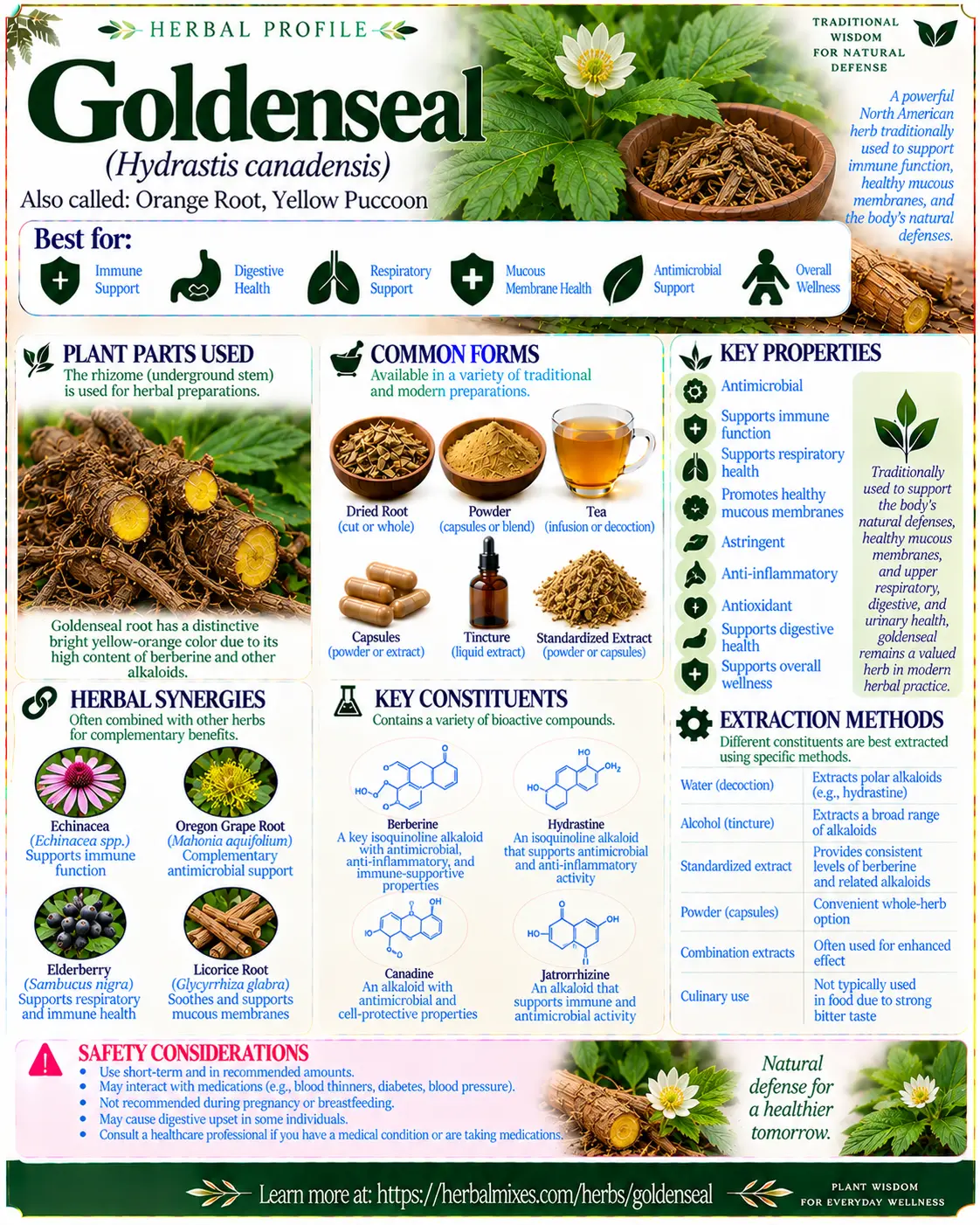
What Goldenseal Is Good For
Digestive support — Goldenseal is traditionally used as a bitter digestive herb, particularly for sluggish digestion and gastrointestinal discomfort. However, rigorous human clinical trials confirming these uses are lacking.
Occasional diarrhea — Goldenseal has historically been used for digestive disturbances including diarrhea. Its berberine-rich root has antimicrobial and astringent-related traditional associations, but research on isolated berberine should not automatically be applied to whole goldenseal.
Mucous membrane support — Herbalists traditionally use goldenseal for irritated or excessive mucous secretions involving the respiratory and digestive tracts. Commercial products continue to emphasize this traditional mucosal role, although good clinical evidence is limited.
Bitter digestive stimulation — Its intensely bitter isoquinoline alkaloids make goldenseal suitable for small amounts in digestive bitters formulas when the goal is stimulation rather than soothing.
Seasonal respiratory support — Goldenseal is frequently included in echinacea formulas for short-term respiratory and immune support. NCCIH notes, however, that there is currently not enough evidence to establish goldenseal as useful for any health condition.
Goldenseal should therefore be viewed as a specialized traditional herb rather than a broadly proven antimicrobial or immune remedy.
Available Herbal Products
Buying Guides for Available Goldenseal Products
Goldenseal Root 500 mg – Whole-root capsules. Provides Hydrastis canadensis root powder in a straightforward form for people who prefer the whole herb rather than a standardized extract. The manufacturer recommends short-term rather than continuous high-level use. Seller: iHerb – View NOW Foods Goldenseal Root →
Goldenseal Root 550 mg – Whole-root capsules. A single-herb preparation containing Hydrastis canadensis root and useful for people looking for a simple powdered-root supplement rather than a combination formula. Seller: iHerb – View Nature’s Answer Goldenseal Root →
Goldenseal Root 600 mg – Whole-root capsules. Provides one measured dose of powdered goldenseal root per capsule and is intended for adult use. Seller: iHerb – View Nutricost Goldenseal Root →
Echinacea Goldenseal – Combination capsules. Combines goldenseal root with several echinacea preparations for people specifically looking for a short-term seasonal herbal formula rather than goldenseal alone. Seller: Gaia Herbs – View Gaia Herbs Echinacea Goldenseal →
When buying goldenseal, favor products that clearly identify Hydrastis canadensis and preferably specify cultivated or responsibly sourced material. Wild goldenseal has been heavily harvested, and Kew currently lists the species as vulnerable under the IUCN assessment included in its botanical record.
Herbal Synergies
Goldenseal pairs especially well with echinacea, Oregon grape root, marshmallow root, gentian, and calendula depending on whether the goal is seasonal support, digestive stimulation, or mucous membrane care.
Goldenseal + Echinacea
Best for: Short-term seasonal respiratory support
Goldenseal contributes bitter isoquinoline alkaloids and traditional mucous-membrane support, while echinacea is more specifically associated with short-term immune and respiratory formulas.
The combination is extremely common commercially, but it should not be interpreted as proven treatment for respiratory infection.
Best extraction: Tincture or standardized liquid/capsule preparation. Both herbs contain constituents that are well represented in hydroalcoholic extracts.
Goldenseal + Oregon Grape Root
Best for: Bitter digestive and antimicrobial-oriented formulas
Both herbs contain berberine-type alkaloids, but Oregon grape root provides a less conservation-sensitive alternative in many formulas.
Because their chemistry overlaps considerably, they are sometimes more interchangeable than truly synergistic.
Best extraction: Hydroalcoholic tincture. Berberine and related alkaloids extract well into alcohol-water mixtures.
Use conservative amounts because combining two berberine-rich herbs increases exposure to pharmacologically active alkaloids.
Goldenseal + Marshmallow Root
Best for: Irritated mucous membranes with digestive sensitivity
Goldenseal is strongly bitter and drying, while marshmallow root is moistening and demulcent. This pairing helps balance goldenseal’s drying character when mucosal irritation accompanies digestive upset.
Best extraction: Separate preparations. Goldenseal works best as tincture, while marshmallow’s mucilage is best obtained through a cold-water infusion.
Goldenseal + Gentian
Best for: Markedly sluggish digestion
Both herbs are intensely bitter. Gentian specializes in bitter digestive stimulation, while goldenseal adds alkaloid-rich traditional digestive activity.
Best extraction: Tincture. Small doses are generally sufficient because both herbs are strongly bitter.
This combination is generally inappropriate when gastritis, ulcers, or significant acid irritation are present.
Goldenseal + Calendula
Best for: Traditional mucous membrane and topical herbal formulas
Goldenseal contributes alkaloid-rich antimicrobial activity demonstrated in laboratory research, while calendula provides soothing, vulnerary, and anti-inflammatory traditional actions.
Best extraction: Combination tincture for internal formulations or professionally formulated topical preparations.
Avoid putting homemade goldenseal preparations directly into the eyes.
Key Herbal Properties
Bitter — Goldenseal’s root and rhizome are intensely bitter because of their isoquinoline alkaloids. This supports its traditional role as a digestive stimulant.
Antimicrobial — Berberine and related compounds demonstrate antibacterial and antifungal activity in laboratory studies. Whole goldenseal extracts may also contain compounds that enhance berberine’s antibacterial effects experimentally.
Astringent — Goldenseal is traditionally used when tissues or secretions are considered excessive or boggy, especially involving mucous membranes.
Digestive — Bitter alkaloids help explain its traditional use for gastrointestinal complaints, although clinical evidence is insufficient.
Anticatarrhal — Traditional Western herbalism uses goldenseal for excessive mucous secretions of the respiratory tract. This is a traditional herbal classification rather than a proven medical effect.
Anti-inflammatory — Berberine and other goldenseal constituents have demonstrated anti-inflammatory activity experimentally. Clinical significance for whole goldenseal remains uncertain.
Mucous membrane tonic — Goldenseal is traditionally associated with irritated, congested, or chronically imbalanced mucosal tissues, especially in short-term formulas.
Antioxidant — Several alkaloids and related constituents demonstrate antioxidant-related activity experimentally, though this is secondary to the herb’s better-known bitter and alkaloid chemistry.






Active Compounds
Goldenseal’s characteristic chemistry is dominated by isoquinoline alkaloids, especially berberine, hydrastine, and canadine. Root and rhizome contain substantially higher alkaloid concentrations than aerial portions.
Berberine
Found mainly in: Rhizome and roots
Berberine is the bright yellow isoquinoline alkaloid responsible for much of goldenseal’s color and many of its antimicrobial laboratory effects.
Research on purified berberine is extensive, but NCCIH emphasizes that very little berberine may be absorbed when whole goldenseal is taken orally, so isolated-berberine research should not automatically be attributed to goldenseal.
Best extraction: Hydroalcoholic tincture or decoction. Berberine salts have useful solubility in alcohol-water mixtures and hot water.
Hydrastine
Found mainly in: Rhizome and roots
Hydrastine is one of the major alkaloids distinctive to goldenseal and is commonly used as a quality-control marker along with berberine.
It contributes to goldenseal’s pharmacological profile and may participate in drug-metabolizing enzyme inhibition.
Best extraction: Hydroalcoholic tincture. Alcohol-water mixtures efficiently extract hydrastine along with berberine and canadine.
Canadine
Found mainly in: Rhizome and roots
Canadine, also known as tetrahydroberberine, is another characteristic isoquinoline alkaloid found in authentic Hydrastis canadensis. It helps distinguish goldenseal from cheaper berberine-containing substitutes.
Best extraction: Hydroalcoholic tincture. Canadine is less polar than berberine and benefits from an alcohol-containing solvent.
Isoquinoline Alkaloid Complex
Found mainly in: Rhizome and roots
The combined berberine-hydrastine-canadine profile is more representative of goldenseal than berberine alone.
This is particularly important when evaluating product authenticity, because other yellow roots may contain berberine but lack the characteristic hydrastine and canadine profile.
Best extraction: Hydroalcoholic tincture or concentrated extract.
Flavonoids
Found mainly in: Aerial portions
Goldenseal’s leaves and stems contain flavonoid-related compounds that appear to contribute to antimicrobial synergy in laboratory experiments.
One study found that aerial extracts enhanced berberine’s antibacterial activity by interfering with bacterial efflux pumps even though the aerial portions contained less alkaloid than the roots.
Best extraction: Hydroalcoholic tincture. Mixed solvents capture both flavonoids and residual alkaloids.
Efflux-Pump-Inhibiting Constituents
Found mainly in: Aerial portions
Researchers have identified compounds in aerial goldenseal extracts that appear to inhibit bacterial efflux pumps, mechanisms bacteria use to remove antimicrobial compounds from cells.
These constituents may help explain why whole-plant extracts sometimes behave differently from isolated berberine in laboratory studies.
Best extraction: Hydroalcoholic extract.
The exact compounds responsible for this effect have not been fully established.
FAQ
What is goldenseal best used for?
Goldenseal is traditionally used for digestive complaints, bitter stimulation, and mucous membrane support.
However, NCCIH states that no rigorous human studies have established goldenseal as effective for any health condition.
Is goldenseal the same as berberine?
No.
Goldenseal contains berberine, but it also contains hydrastine, canadine, and many other constituents. Purified berberine supplements therefore cannot be considered equivalent to whole goldenseal.
NCCIH also notes that berberine absorption from orally consumed goldenseal may be quite limited.
Can goldenseal be used every day?
Goldenseal is better suited to short-term, targeted use than indefinite daily supplementation.
NCCIH reports that short-term amounts around 3 g per day have been used without serious adverse effects in small studies, but long-term safety remains uncertain.
Some commercial products also specifically recommend limiting continuous use.
Why is sustainably sourced goldenseal important?
Wild goldenseal has been heavily harvested because the medicinal root requires killing the plant during harvest.
Kew’s botanical record includes an IUCN vulnerable classification, and reputable manufacturers increasingly use cultivated material.
Can goldenseal be used for a cold or infection?
Goldenseal is widely marketed for colds and respiratory infections, but there is not enough clinical evidence to show that it treats or prevents them.
Laboratory antimicrobial activity of berberine or goldenseal extracts should not be interpreted as proof that an oral supplement can replace appropriate treatment for an infection.
Safety & Precautions
Goldenseal has a high potential for medication interactions and deserves considerably more caution than an ordinary culinary herb.
NCCIH reports that goldenseal inhibits important drug-metabolizing enzymes including CYP2D6 and CYP3A4, which are involved in processing many prescription medications.
A clinical study also found that goldenseal reduced blood concentrations of metformin by about 25%, an effect large enough to potentially interfere with glucose control in people taking metformin for type 2 diabetes.
If you take any prescription medication, regular goldenseal supplementation should therefore be discussed with a healthcare professional or pharmacist before use.
Goldenseal should not be used during pregnancy or breastfeeding, and it should not be given to infants. NCCIH specifically warns that the berberine constituent can be harmful to newborns.
Safety during prolonged use is uncertain. Short-term use has been studied more than continuous long-term supplementation.
People with diabetes require particular caution because of the documented interaction with metformin and possible metabolic effects.
Do not use goldenseal as a substitute for antibiotics or other appropriate treatment for serious bacterial infections.
Avoid homemade goldenseal eyewashes. Eye redness, pain, discharge, injury, or visual changes require appropriate medical evaluation and sterile treatment when necessary.
Quality is also important. NCCIH notes that some commercial goldenseal products have contained undeclared ingredients or substitute plants.
Choose products that clearly identify Hydrastis canadensis and preferably specify cultivated or responsibly sourced material.
Anyone with a medical condition or taking prescription medications should discuss goldenseal use with an appropriate healthcare professional before taking it therapeutically.
References
- NCCIH — Goldenseal: Usefulness and Safety
- NCCIH — Herb-Drug Interactions: Goldenseal
- Kew Plants of the World Online — Hydrastis canadensis L.
- PubMed Central — Goldenseal Extracts and Antibacterial Synergy
- PubMed Central — Determination of Hydrastine and Berberine in Goldenseal
- PubMed — Goldenseal and Its Active Constituents: Efficacy and Toxicological Issues
- PubMed Central — Pharmacokinetic Interactions Between Herbal Medicines and Drugs
- Gaia Herbs — Echinacea Goldenseal
- iHerb — NOW Foods Goldenseal Root
- Nature’s Way — Goldenseal Root
Disclaimer
Disclaimer: This article is for educational purposes only and is not intended to diagnose, treat, cure, or prevent any disease. Herbal products can cause side effects and interact with medications. Consult a qualified healthcare professional before using herbs therapeutically, especially if you are pregnant, breastfeeding, taking prescription medications, or managing a medical condition.