

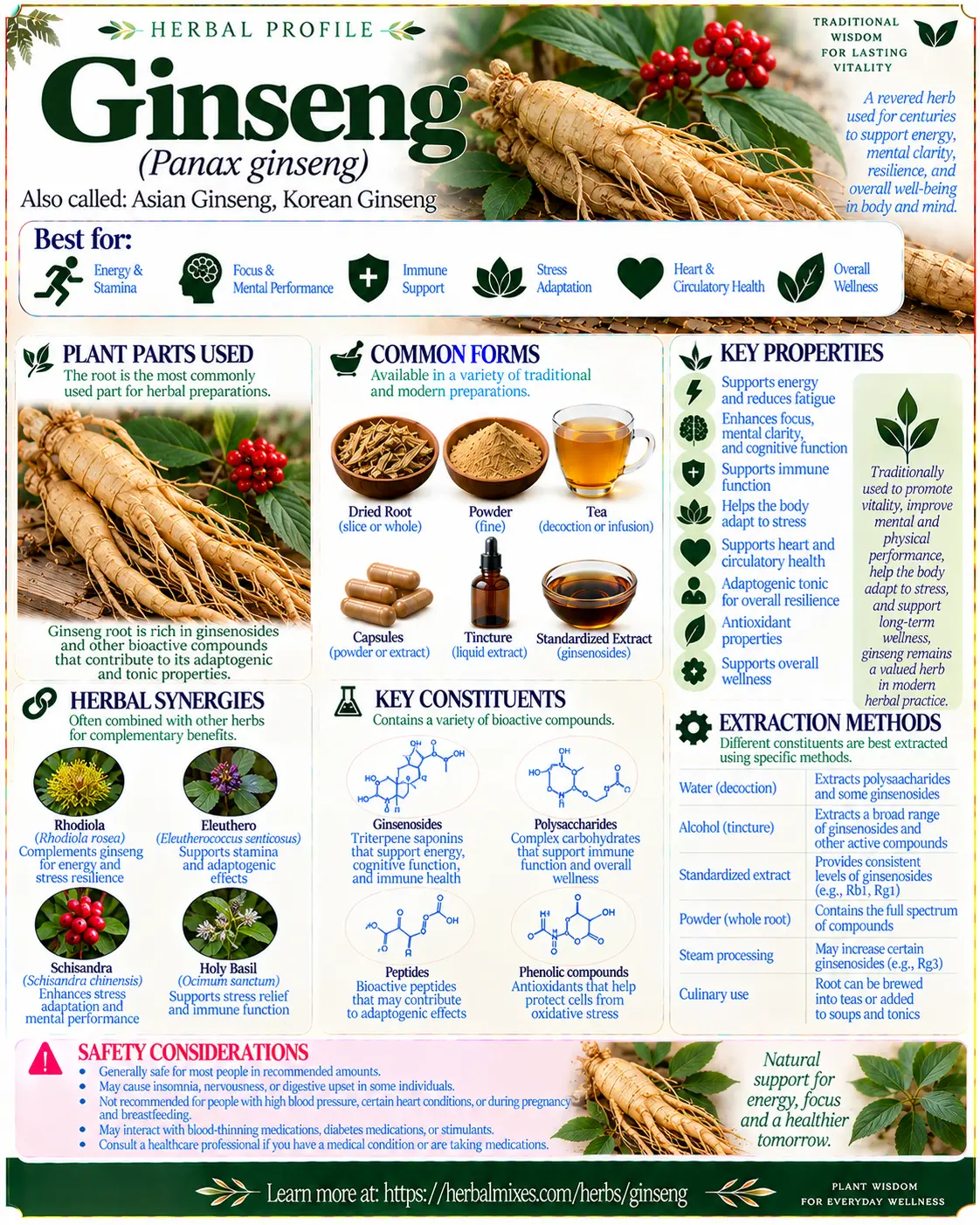
What Ginseng Is Good For
Fatigue & low energy — Asian ginseng is best known as an adaptogenic tonic used when energy and resilience feel depleted. A 2023 review cited by NCCIH found a small potential benefit for general fatigue, while the EMA recognizes Panax ginseng root for fatigue and weakness based on traditional use.
Physical stamina — Ginseng is traditionally used to support endurance, vitality, and recovery during periods of physical strain. Evidence for improving athletic performance is inconsistent, so it is better regarded as a general vitality herb rather than a proven performance enhancer.
Mental performance — Some research suggests Asian ginseng may modestly support attention, reaction time, arithmetic skills, and abstract thinking in middle-aged adults. Evidence for memory enhancement by ginseng alone is less convincing.
Stress resilience — Ginseng is widely classified as an adaptogen, meaning it is traditionally used to help the body maintain function during periods of physical or mental stress. This is a traditional herbal concept rather than a single measurable clinical effect.
General weakness & recovery — Ginseng has traditionally been used when fatigue, weakness, or reduced vitality follows periods of strain or convalescence. The EMA specifically places ginseng root in the therapeutic area of fatigue and weakness.
Healthy immune function — Preliminary research has explored Asian ginseng extracts for immune function and respiratory infections. NCCIH notes that limited evidence suggests some extracts may reduce the risk of developing influenza, but evidence is not strong enough to consider ginseng a flu treatment or preventive medicine.
Available Herbal Products
Buying Guides for Available Ginseng Products
Asian Ginseng Liquid Herbal Extract – Root tincture. Made from certified organic Panax ginseng white root at a 1:4 herb-to-menstruum ratio, this is a practical choice for people who prefer a concentrated liquid adaptogenic preparation. Seller: Herb Pharm – View Herb Pharm Asian Ginseng →
Asian Ginseng Alcohol-Free – Root glycerite. A glycerin-based preparation made from certified organic Panax ginseng root for people who want a liquid extract without alcohol. Seller: Herb Pharm – View Herb Pharm Asian Ginseng Alcohol-Free →
Asian Ginseng Standardized Extract – Standardized capsules. Standardized to 7% ginsenosides, making this a useful option when you want a more predictable concentration of ginseng’s principal saponins. Seller: Nature’s Way – View Nature’s Way Asian Ginseng Standardized Extract →
Panax Ginseng 500 mg – Root capsules. Provides whole Asian ginseng root in a simple capsule format for people who prefer whole-root supplementation rather than a standardized extract. Seller: NOW Foods – View NOW Panax Ginseng 500 mg →
The term ginseng can refer to several different herbs. This article specifically covers Panax ginseng. American ginseng is Panax quinquefolius, while eleuthero or “Siberian ginseng” is a different plant entirely and should not be considered interchangeable.
Herbal Synergies
Ginseng pairs especially well with rhodiola, schisandra, astragalus, ginkgo, and ginger depending on whether the goal is energy, stress resilience, cognition, or recovery.
Ginseng + Rhodiola
Best for: Fatigue, stamina, and stress resilience
Ginseng acts as a traditional restorative tonic, while rhodiola is commonly used for mental and physical fatigue during periods of stress. Their adaptogenic roles overlap, but rhodiola tends to be used more for acute stress-related fatigue while ginseng is often used as a deeper vitality tonic.
Best extraction: Tincture or standardized extracts. Both herbs contain mixed-polarity constituents that are efficiently extracted with water-alcohol combinations.
Ginseng + Schisandra
Best for: Energy, endurance, and stress recovery
Ginseng contributes ginsenoside-rich tonic activity, while schisandra provides lignans traditionally associated with resilience, endurance, and liver support.
The pairing is particularly useful in broader adaptogenic formulas rather than as a short-term stimulant.
Best extraction: Tincture or combined standardized extracts. Hydroalcoholic extraction works well for ginseng saponins and schisandra lignans.
Ginseng + Astragalus
Best for: General weakness and immune-supportive tonics
Ginseng contributes restorative and adaptogenic activity, while astragalus adds polysaccharides, saponins, and traditional immune-tonic properties.
This is a logical combination when the goal is long-term vitality rather than immediate stimulation.
Best extraction: Decoction or combination extraction. Both roots tolerate prolonged hot-water extraction, though hydroalcoholic extracts provide a broader constituent profile.
Ginseng + Ginkgo Biloba
Best for: Mental performance and cognitive support
Ginseng contributes adaptogenic and energy-supportive activity, while ginkgo is more strongly associated with circulation and cognitive function.
NCCIH notes that some observed memory benefits involving ginseng appeared when it was combined with ginkgo rather than from ginseng alone.
Best extraction: Standardized extracts. Both herbs are better represented in research by controlled extracts than by simple teas.
Ginseng + Ginger
Best for: Low energy with sluggish digestion
Ginseng provides tonic and adaptogenic support, while ginger contributes warming digestive, carminative, and nausea-supportive properties.
This pairing can make ginseng formulas feel more digestively balanced, particularly for people who find rich roots or concentrated extracts heavy.
Best extraction: Decoction or tincture. Both roots extract well into hot water, while alcohol provides a broader spectrum of constituents.
Key Herbal Properties
Adaptogenic — Ginseng is one of the best-known adaptogenic herbs and is traditionally used to support resilience during physical and psychological stress.
Tonic — Ginseng is traditionally used as a general restorative tonic for fatigue, weakness, reduced vitality, and recovery.
Energizing — Ginseng may support perceived energy and stamina without containing caffeine. Clinical evidence suggests a possible small benefit for general fatigue.
Nootropic — Some research suggests modest effects on attention and cognitive performance, particularly in middle-aged adults, though evidence remains limited.
Immunomodulatory — Ginsenosides and polysaccharides influence immune signaling in experimental research. Human evidence for preventing respiratory infections remains preliminary.
Antioxidant — Ginsenosides and phenolic compounds demonstrate antioxidant activity and may contribute to cellular protection during stress.
Metabolic supportive — Asian ginseng may influence glucose metabolism, and NCCIH notes that it may lower blood sugar in some people.
Cardiovascular supportive — Ginsenosides have been studied for vascular, endothelial, and circulatory effects, although clinical benefits vary by preparation and condition.





Active Compounds
The most characteristic constituents of Panax ginseng are ginsenosides, also known as panaxosides. These triterpene saponins occur alongside polysaccharides, peptides, phenolic compounds, sterols, and volatile constituents. Ginsenosides such as Rb1, Rb2, Rc, Rd, Re, and Rg1 are commonly used as chemical markers for ginseng quality.
Ginsenoside Rb1
Found mainly in: Root
Rb1 is one of the major protopanaxadiol-type ginsenosides found in Asian ginseng. Experimental research associates it with neurological, metabolic, anti-inflammatory, and stress-related effects.
Best extraction: Decoction or hydroalcoholic extract. Ginsenosides are amphiphilic saponins and can be extracted into hot water, while diluted alcohol often provides broader and more efficient recovery.
Ginsenoside Rg1
Found mainly in: Root
Rg1 is a major protopanaxatriol-type ginsenoside and one of the principal marker compounds used to characterize Panax ginseng.
It has been studied experimentally for cognitive, neurological, immune, and metabolic effects.
Best extraction: Hot-water decoction or hydroalcoholic extract. Both traditional decoctions and standardized liquid extracts can recover this relatively polar saponin.
Ginsenoside Re
Found mainly in: Root
Ginsenoside Re belongs to the protopanaxatriol group and contributes to the overall saponin profile of Asian ginseng.
It has been investigated for antioxidant, cardiovascular, metabolic, and neurological activity.
Best extraction: Water or hydroalcoholic extract. Its glycoside-rich structure makes it reasonably compatible with polar extraction.
Ginsenoside Rd
Found mainly in: Root
Ginsenoside Rd is a protopanaxadiol ginsenoside commonly measured among the characteristic chemical markers of ginseng.
Experimental research has explored neuroprotective and anti-inflammatory effects, but this does not establish clinical treatment claims.
Best extraction: Hydroalcoholic extraction or decoction.
Ginsenoside Rb2
Found mainly in: Root
Rb2 is another major ginsenoside found in Panax ginseng and forms part of the characteristic fingerprint used in botanical quality assessment.
Best extraction: Hot-water or hydroalcoholic extraction.
Ginsenoside Rc
Found mainly in: Root
Ginsenoside Rc is a protopanaxadiol-type saponin commonly occurring alongside Rb1, Rb2, and Rd.
Best extraction: Hydroalcoholic tincture or decoction. Mixed water-alcohol extraction provides an effective broad-spectrum ginseng preparation.
Polysaccharides
Found mainly in: Root
Ginseng contains complex polysaccharides that have been investigated for immunomodulatory, antioxidant, and metabolic effects.
Unlike many ginsenosides, polysaccharides are highly water soluble and are especially relevant to traditional decoctions.
Best extraction: Decoction. Prolonged hot-water extraction is particularly effective for water-soluble polysaccharides.
Phenolic Compounds
Found mainly in: Root
Ginseng also provides smaller amounts of phenolic acids and other antioxidant compounds that complement the better-known ginsenoside fraction.
Best extraction: Hydroalcoholic extract or decoction. Mixed solvents capture a wider range of phenolics while retaining saponins.
FAQ
What is ginseng best used for?
Asian ginseng is primarily used for fatigue, weakness, energy, stamina, and stress resilience. The EMA recognizes Panax ginseng root for fatigue and weakness, while NCCIH reports a possible small benefit for general fatigue.
Is Korean red ginseng different from regular ginseng?
Yes, but both usually come from Panax ginseng.
White ginseng is typically dried without steaming, while red ginseng is steamed and dried. Processing changes the ginsenoside profile and produces additional transformed compounds, so the two preparations are chemically different. NCCIH confirms that “red” and “white” ginseng refer to different preparations of Asian ginseng.
Is ginseng tea or standardized extract better?
Both have useful applications.
A decoction extracts water-soluble ginsenosides and polysaccharides and reflects traditional use. A standardized extract provides more predictable ginsenoside content, which can be preferable when consistency matters.
Can ginseng be taken every day?
Short-term oral use at recommended amounts appears to be safe for most adults for up to about six months, according to NCCIH. Long-term safety is less certain.
Some people prefer cycling ginseng or using it during periods of increased demand rather than taking it indefinitely.
Is ginseng the same as American ginseng or Siberian ginseng?
No.
Panax ginseng is Asian or Korean ginseng. Panax quinquefolius is American ginseng and has a different ginsenoside balance. “Siberian ginseng” refers to eleuthero (Eleutherococcus senticosus), which is botanically unrelated to true Panax ginseng.
Safety & Precautions
Short-term oral use of Asian ginseng in recommended amounts appears generally safe for most adults, but long-term safety is less certain.
The most commonly reported side effect is insomnia. For people sensitive to stimulating herbs, taking ginseng earlier in the day may be preferable.
Less commonly reported adverse effects include allergic reactions, rash, and liver-related events. Anyone who develops significant unexplained symptoms after beginning a concentrated supplement should discontinue it and seek appropriate medical advice.
Ginseng may lower blood glucose, so people with diabetes or those taking insulin or glucose-lowering medicines should monitor carefully and discuss supplementation with a healthcare professional.
Asian ginseng may affect blood clotting. Research examining interaction with warfarin has produced mixed findings, so people taking anticoagulant or antiplatelet medication should not assume the combination is risk-free.
Potential interactions have also been raised with blood-pressure medications, calcium-channel blockers, statins, and some antidepressants, although evidence for many of these interactions remains uncertain.
People with autoimmune disorders should use caution because NCCIH notes that Asian ginseng may worsen autoimmune conditions.
Therapeutic use during pregnancy and breastfeeding is generally discouraged because adequate safety data are lacking. NCCIH also notes that some experts recommend against use in infants and children.
Anyone experiencing persistent unexplained fatigue should consider medical evaluation because fatigue can result from anemia, thyroid disorders, sleep problems, infections, medication effects, cardiovascular disease, depression, and many other conditions.
Anyone with a medical condition or taking prescription medications should discuss regular ginseng supplementation with an appropriate healthcare professional.
References
- NCCIH — Asian Ginseng: Usefulness and Safety
- NCCIH — Herb-Drug Interactions: Asian Ginseng
- European Medicines Agency — Ginseng Radix
- Kew Plants of the World Online — Panax ginseng
- PubMed Central — Isolation and Analysis of Ginseng: Advances and Challenges
- Herb Pharm — Asian Ginseng
- Herb Pharm — Asian Ginseng Alcohol-Free
- Nature’s Way — Asian Ginseng Standardized Extract
- NOW Foods — Panax Ginseng 500 mg
Disclaimer
Disclaimer: This article is for educational purposes only and is not intended to diagnose, treat, cure, or prevent any disease. Herbal products can cause side effects and interact with medications. Consult a qualified healthcare professional before using herbs therapeutically, especially if you are pregnant, breastfeeding, taking prescription medications, or managing a medical condition.