

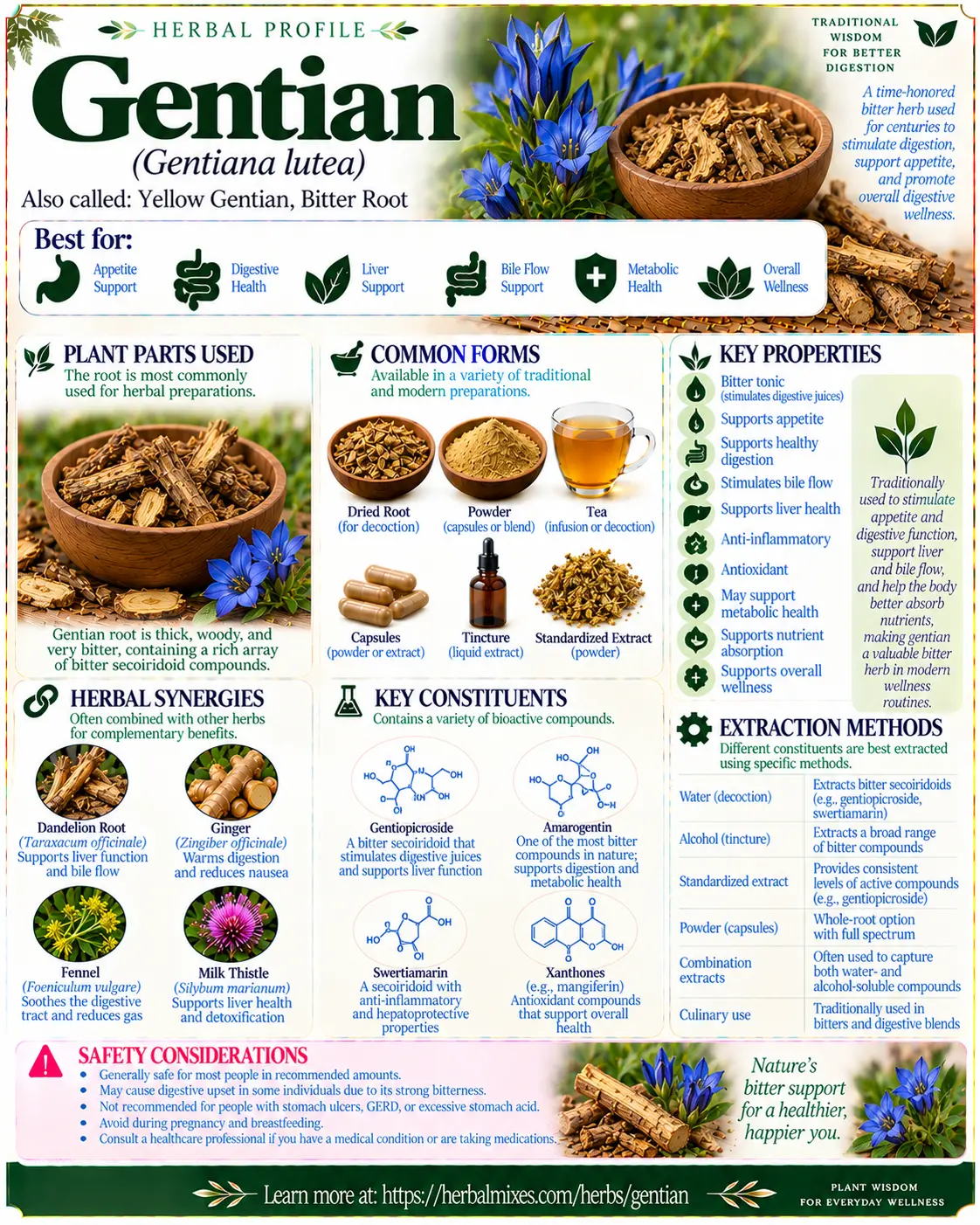
What Gentian Is Good For
Poor appetite — Gentian is one of the classic bitter digestive herbs. Its intense bitterness stimulates bitter taste receptors and is traditionally used before meals when appetite is temporarily reduced. The European Medicines Agency recognizes gentian root for temporary loss of appetite based on long-standing traditional use.
Sluggish digestion — Gentian is commonly used when digestion feels slow or heavy. Bitter compounds may stimulate salivation, gastric secretions, and other digestive responses before food reaches the stomach.
Indigestion — EMA recognizes gentian root for mild gastrointestinal complaints such as dyspepsia and indigestion, although this indication is based primarily on traditional use rather than strong controlled clinical evidence.
Post-meal fullness — Gentian may be useful when fullness or digestive heaviness seems associated with weak digestive stimulation rather than irritation or reflux.
Digestive secretion support — The herb’s secoiridoid bitters—including amarogentin and gentiopicroside—help explain its strong bitter action and traditional role in stimulating digestive function.
Available Herbal Products
Buying Guides for Available Gentian Products
Gentian Liquid Herbal Extract – Root tincture. A concentrated 1:4 hydroalcoholic extract made from certified organic Gentiana lutea rhizome and root and designed to be taken shortly before meals. Seller: Herb Pharm – View Herb Pharm Gentian →
Gentian Root Extract – Low-alcohol liquid extract. A 1:1 preparation providing a convenient bitter liquid form for people who prefer less alcohol than a conventional tincture. Seller: Nature’s Answer – View Nature’s Answer Gentian Root →
Cut & Sifted Gentian Root – Dried root. A useful option if you want to prepare your own bitter tea, digestive blend, tincture, or bitters formula at home. Seller: iHerb – View Frontier Co-op Gentian Root →
Betaine HCl, Pepsin & Gentian Bitters – Digestive capsules. Combines gentian root with betaine hydrochloride and pepsin for people seeking a broader digestive-support formula rather than gentian alone. Seller: iHerb – View Doctor’s Best Betaine HCl, Pepsin & Gentian Bitters →
Betaine HCl Pepsin with Gentian Root Extract – Digestive capsules. Combines a concentrated 5:1 gentian root extract with betaine HCl and pepsin and is intended for use with meals. Seller: iHerb – View Vital Nutrients Betaine HCl Pepsin with Gentian Root →
Herbal Synergies
Gentian pairs especially well with ginger, dandelion root, artichoke leaf, fennel, and orange peel depending on whether the goal is appetite, digestive stimulation, gas, or post-meal heaviness.
Gentian + Ginger
Best for: Sluggish digestion with nausea or abdominal heaviness
Gentian supplies strong bitter digestive stimulation, while ginger adds warming, aromatic, carminative, and nausea-supportive actions. The combination is especially useful when poor appetite and slow digestion occur together with queasiness or a cold, heavy feeling after meals.
Best extraction: Tincture or combination tincture-and-tea preparation. Gentian’s bitter glycosides extract well in water and alcohol, while ginger performs well in both hot water and hydroalcoholic preparations.
Gentian + Dandelion Root
Best for: Poor appetite and sluggish digestion
Both herbs are bitters, but gentian provides a much stronger bitter stimulus while dandelion root adds gentler digestive and traditional hepatic support.
Best extraction: Tincture or decoction. Both roots tolerate hot-water extraction, while hydroalcoholic extraction provides a broader constituent profile.
Gentian + Artichoke Leaf
Best for: Fullness after rich or fatty meals
Gentian stimulates digestive reflexes through bitterness, while artichoke leaf is traditionally used to support digestion and bile-related digestive processes. The combination is logical when meals feel heavy rather than when the stomach is irritated.
Best extraction: Tincture. Hydroalcoholic extraction is practical for the bitter secoiridoids of gentian and the bitter phenolic compounds of artichoke.
Gentian + Fennel
Best for: Sluggish digestion with gas and bloating
Gentian encourages digestive secretions, while fennel contributes aromatic carminative and antispasmodic effects. This makes the combination more balanced than using a strong bitter alone when gas and abdominal tension are also present.
Best extraction: Gentian tincture with fennel infusion, or a combined hydroalcoholic extract. Fennel’s volatile oils are well suited to covered hot-water infusion, while gentian extracts effectively into alcohol-water mixtures.
Gentian + Orange Peel
Best for: Poor appetite and mild digestive heaviness
Gentian provides intense bitterness, while orange peel contributes aromatic oils and a gentler bitter quality. Orange peel also makes gentian formulas more palatable.
Best extraction: Tincture. Alcohol-water mixtures capture gentian’s bitter glycosides while also extracting aromatic and bitter constituents from citrus peel.
Key Herbal Properties
Bitter — Gentian is among the strongest classic herbal bitters. Its bitter secoiridoids stimulate taste receptors and help explain its traditional use before meals.
Digestive stimulant — Gentian may promote digestive readiness by stimulating salivation and gastric secretions through bitter-reflex mechanisms.
Appetite stimulant — Gentian is traditionally used for temporary loss of appetite, an indication recognized in the EMA herbal monograph.
Stomachic — Traditional Western herbalism classifies gentian as a stomachic herb used to support normal stomach function and digestion.
Tonic — Gentian is traditionally used in small amounts as a digestive tonic rather than as a rapidly acting symptomatic remedy.
Choleretic/cholagogue-related — Gentian constituents such as gentiopicroside have demonstrated effects related to bile secretion in experimental research, but this should not be interpreted as established treatment for gallbladder disease.
Anti-inflammatory — Gentian root extracts and isolated constituents have demonstrated anti-inflammatory activity in experimental models, including recent ex vivo intestinal research. Clinical significance remains uncertain.
Antioxidant — Xanthones and other phenolic compounds contribute antioxidant activity, although this is secondary to gentian’s much better-established bitter digestive role.




Active Compounds
Gentian root is dominated by intensely bitter secoiridoid glycosides, especially gentiopicroside, amarogentin, swertiamarin, and sweroside, along with xanthones and other phenolic compounds. These bitter molecules largely explain its traditional digestive use.
Gentiopicroside
Found mainly in: Root and rhizome
Gentiopicroside, also called gentiopicrin, is one of the major bitter secoiridoid glycosides in gentian. It contributes substantially to the herb’s bitter taste and has been investigated for digestive, anti-inflammatory, hepatoprotective, and other biological effects.
Best extraction: Water or hydroalcoholic tincture. As a glycoside, gentiopicroside has good polarity and can be extracted into water, but alcohol-water mixtures provide a broader root extract.
Amarogentin
Found mainly in: Root and rhizome
Amarogentin is one of the compounds responsible for gentian’s extraordinarily strong bitterness. It is a secoiridoid glycoside and an important contributor to bitter-receptor stimulation.
Best extraction: Hydroalcoholic tincture or bitter tea. Amarogentin can be extracted with polar solvents, making both water and diluted alcohol practical.
Swertiamarin
Found mainly in: Root
Swertiamarin is another bitter secoiridoid glycoside found in Gentiana lutea. Experimental research has investigated compounds of this class for anti-inflammatory, metabolic, and hepatoprotective effects.
Best extraction: Water or hydroalcoholic tincture. Its glycosidic structure makes it compatible with polar solvents.
Sweroside
Found mainly in: Root
Sweroside belongs to the same secoiridoid family and contributes to the broader bitter chemical profile of gentian root.
Best extraction: Hydroalcoholic tincture or hot-water extraction. Mixed water and alcohol provide a broad-spectrum preparation containing multiple secoiridoids.
Amaroswerin
Found mainly in: Root
Amaroswerin is a very bitter secoiridoid related to amarogentin. Experimental studies have examined secoiridoids such as amaroswerin for gastroprotective activity, but this does not establish clinical treatment effects.
Best extraction: Hydroalcoholic tincture. A water-alcohol mixture efficiently captures bitter glycosides while preserving other root constituents.
Isogentisin
Found mainly in: Root
Isogentisin is a xanthone found in Gentiana lutea. Xanthones contribute antioxidant and other experimental biological activities that complement the herb’s better-known secoiridoids.
Best extraction: Hydroalcoholic tincture. Xanthones are generally less water soluble than many glycosides, so alcohol improves extraction.
Gentisin
Found mainly in: Root
Gentisin is another xanthone found in gentian root. It has been investigated experimentally for antioxidant and vascular-related effects, though these observations should not be confused with established clinical benefits.
Best extraction: Alcohol or hydroalcoholic tincture. Alcohol improves extraction of this less-polar constituent class compared with plain water.
Loganic Acid
Found mainly in: Root
Loganic acid is an iridoid-related constituent identified in modern phytochemical analyses of gentian root. It contributes to the plant’s broader iridoid/secoiridoid chemical profile.
Best extraction: Water or diluted alcohol. Its polar structure makes hydroalcoholic preparations especially practical.
FAQ
What is gentian best used for?
Gentian is best suited to temporary loss of appetite and sluggish digestion, especially when digestion feels weak rather than irritated. EMA recognizes traditional use for temporary appetite loss and mild digestive complaints such as indigestion.
When should gentian be taken?
Gentian bitters are commonly taken shortly before meals so the bitter taste can trigger digestive reflexes before food arrives.
Herb Pharm, for example, recommends its gentian extract approximately 15–20 minutes before meals.
Is gentian tea or tincture better?
Both can work well.
Tea readily extracts gentian’s water-soluble bitter glycosides, while a hydroalcoholic tincture captures a broader range of constituents and is easier to take because only a small amount of the intensely bitter liquid is needed.
Why is gentian so bitter?
Gentian contains exceptionally bitter secoiridoid compounds, particularly amarogentin and gentiopicroside. Amarogentin is regarded as one of the plant kingdom’s most intensely bitter naturally occurring compounds.
That bitterness is not merely a flavor problem—it is central to gentian’s traditional digestive function.
Can gentian be taken every day?
Gentian is usually used around meals for limited periods rather than automatically taken indefinitely. The EMA recommends consulting a healthcare professional if digestive symptoms persist longer than two weeks or worsen.
Safety & Precautions
Gentian root preparations have a relatively long history of traditional use, and the EMA reported no specific adverse effects in the information assessed for its monograph. However, clinical safety data remain less extensive than for common food herbs.
Because gentian strongly stimulates digestive activity, use caution if you have gastritis, active peptic ulcer disease, severe acid reflux, or significant stomach irritation. Strong bitters may aggravate symptoms in some sensitive individuals.
People with persistent abdominal pain, unexplained vomiting, gastrointestinal bleeding, difficulty swallowing, unexplained weight loss, or persistent changes in appetite should seek medical evaluation rather than self-treating with bitters.
Safety during pregnancy and breastfeeding has not been adequately established. Therapeutic use is best avoided unless recommended by an appropriately qualified healthcare professional.
The EMA monograph applies to adults, and adequate safety information for medicinal use in children is limited.
Gentian may theoretically affect gastric secretion and digestion of medications. Although major drug interactions are not well established, people taking multiple prescription medicines should discuss regular concentrated gentian use with a healthcare professional or pharmacist.
Do not confuse yellow gentian (Gentiana lutea) with other bitter plants or unrelated products sold under similar common names. The accepted medicinal species discussed here is Gentiana lutea L.
Anyone with a medical condition or taking prescription medications should discuss regular therapeutic gentian use with an appropriate healthcare professional.
References
- European Medicines Agency — Gentianae radix
- Kew Plants of the World Online — Gentiana lutea L.
- PubMed Central — Medicinal, Biological and Phytochemical Properties of Gentiana Species
- PubMed Central — Gentiopicroside: Pharmacological Significance and Future Perspectives
- PubMed Central — Gentianaceae Family-Derived Bioactive Compounds
- PubMed — Research Progress of Natural Product Gentiopicroside
- PubMed — Phytochemical Profiling and Anti-inflammatory Activity of Gentiana lutea Roots
- Herb Pharm — Gentian Liquid Herbal Extract
- Nature’s Answer — Gentian Root Extract
- iHerb — Frontier Co-op Cut & Sifted Gentian Root
Disclaimer
Disclaimer: This article is for educational purposes only and is not intended to diagnose, treat, cure, or prevent any disease. Herbal products can cause side effects and interact with medications. Consult a qualified healthcare professional before using herbs therapeutically, especially if you are pregnant, breastfeeding, taking prescription medications, or managing a medical condition.