

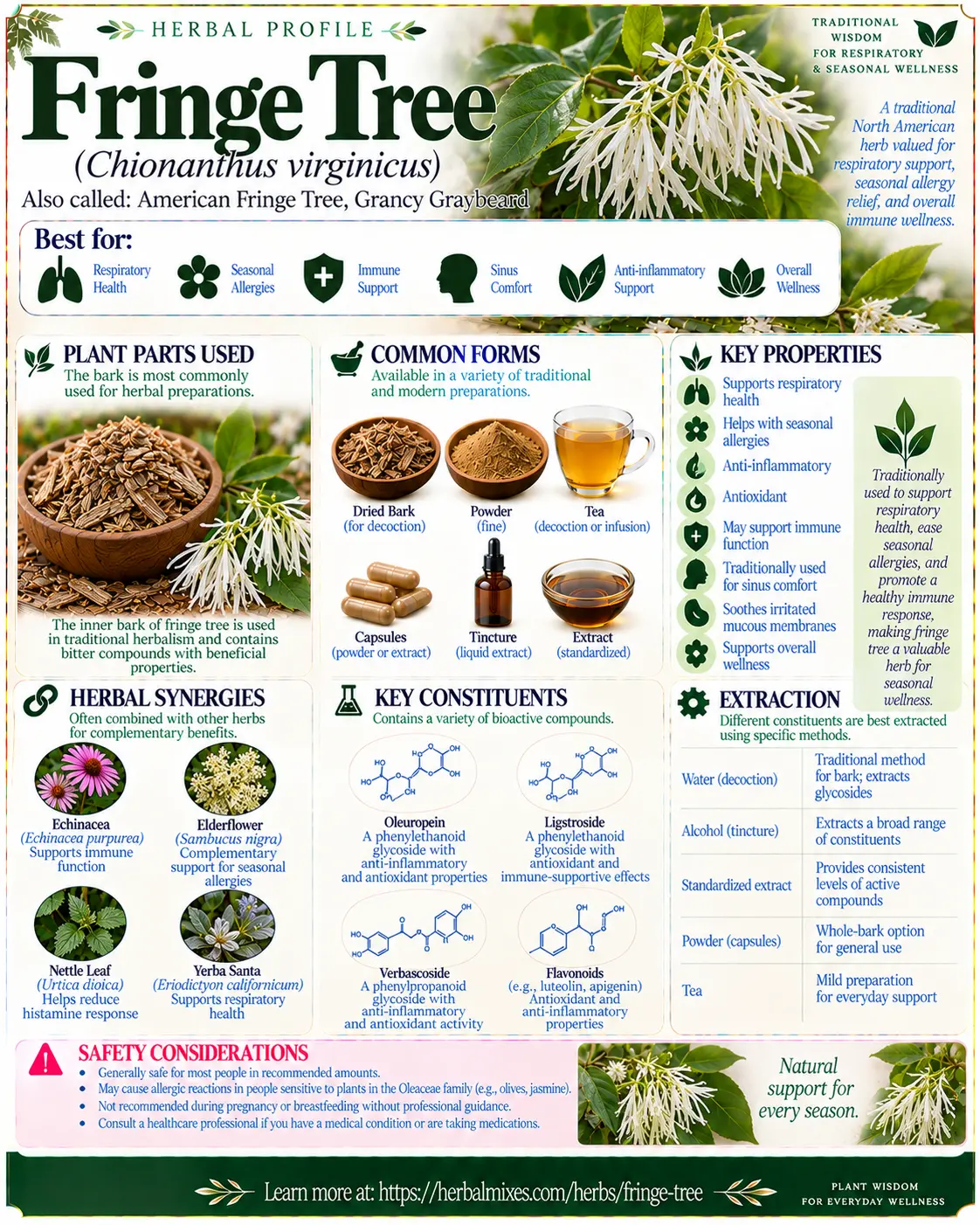
What Fringe Tree Is Good For
Liver & gallbladder support — Fringe tree bark has a long-standing place in Western herbalism as a bitter hepatic herb, particularly in formulas intended to support normal liver and gallbladder function. Modern clinical studies confirming these uses are lacking, so this remains primarily a traditional application.
Sluggish digestion — Its bitter bark is traditionally used when digestion feels slow, heavy, or poorly stimulated, particularly when inadequate digestive secretions are suspected.
Bile-flow support — Herbalists traditionally classify fringe tree as a cholagogue/choleretic-type herb, meaning it is used to support the production or movement of bile. This traditional action has not been established in controlled human trials and should not be interpreted as treatment for gallstones or gallbladder disease.
Digestive fullness after rich foods — Fringe tree may be incorporated into bitter formulas for people who experience heaviness or fullness after fatty meals, particularly when combined with complementary digestive bitters.
Occasional constipation associated with sluggish digestion — Traditional herbal references sometimes associate fringe tree with sluggish bowel function when it occurs alongside poor bile flow or digestive inactivity. It is not a bulk-forming laxative and should not replace evaluation of persistent constipation.
Modern research on fringe tree is largely phytochemical rather than clinical. Studies of the root bark have identified numerous secoiridoids and lignans, but these findings do not establish clinical efficacy for liver or gallbladder disorders.
Available Herbal Products
Buying Guides for Available Fringe Tree Products
Fringe Tree Liquid Herbal Extract – Bark tincture. A classic 1:5 hydroalcoholic extract made from responsibly wildcrafted Chionanthus virginicus bark and well suited to traditional bitter and hepatic formulas. Seller: Herb Pharm – View Herb Pharm Fringe Tree →
Fringe Tree Herbal Tincture – Bark tincture. A 1:4 liquid preparation made from ethically wildcrafted fringe tree bark, alcohol, and water; a useful choice when a stronger traditional liquid extraction is preferred. Seller: Prairie Doctor Brand – View Prairie Doctor Fringe Tree Tincture →
Fringe Tree Bark Tincture – Dried-bark liquid extract. A cold-extracted alcohol preparation for readers who want a conventional fringe tree bark tincture in several bottle sizes. Seller: Hawaii Pharm – View Hawaii Pharm Fringe Tree Tincture →
Fringe Tree Alcohol-Free Extract – Bark glycerite. An alcohol-free liquid preparation made from dried Chionanthus virginicus bark, vegetable glycerin, and water; useful for people who specifically prefer to avoid alcohol. Seller: Hawaii Pharm – View Hawaii Pharm Fringe Tree Alcohol-Free Extract →
Fringe Tree Bark Glycerite – Dried-bark glycerite. A practitioner-oriented alcohol-free preparation from sustainably sourced fringe tree bark. Purchasing is restricted to qualified practitioners and clinical herbalists. Seller: Heron Botanicals – View Heron Botanicals Fringe Tree Glycerite →
Herbal Synergies
Fringe tree pairs especially well with dandelion root, artichoke leaf, milk thistle, and gentian when the goal is traditional bitter, digestive, or liver-supportive formulation.
Fringe Tree + Dandelion Root
Best for: Sluggish digestion and traditional liver support
Fringe tree contributes a strongly bitter, traditionally hepatic character, while dandelion root adds bitter digestive and mild prebiotic properties. Together they make sense when the goal is to encourage digestive secretions before meals rather than simply soothe an irritated stomach.
Best extraction: Tincture or combined tincture/decoction. Fringe tree’s lignans and secoiridoids are well represented in hydroalcoholic extracts, while dandelion root can be extracted by either alcohol or prolonged hot water.
Fringe Tree + Artichoke Leaf
Best for: Heavy digestion after fatty meals
Fringe tree has traditionally been used around liver and gallbladder function, while artichoke leaf is a better-studied bitter used to support digestion and bile-related digestive processes. The combination is particularly logical when meals high in fat leave a sensation of heaviness or fullness.
Best extraction: Tincture. A hydroalcoholic preparation captures a broad range of bitter and phenolic constituents from both herbs.
People with known gallstones, bile-duct obstruction, or significant gallbladder disease should consult a healthcare professional before using strong bile-stimulating herbal formulas.
Fringe Tree + Milk Thistle
Best for: Broad liver-support formulas
Fringe tree provides traditional bitter and gallbladder-oriented support, while milk thistle contributes silymarin-rich hepatoprotective constituents with substantially more modern research behind them. Their roles are therefore complementary rather than redundant.
Best extraction: Combination extraction. Fringe tree works well as a tincture, while milk thistle’s silymarin is poorly extracted into ordinary tea and is better supplied as ground seed or a standardized extract.
Fringe Tree + Gentian
Best for: Markedly sluggish appetite and digestion
Both are bitter herbs, but gentian is especially useful for stimulating digestive reflexes through intense bitterness, while fringe tree is traditionally directed more toward hepatic and biliary digestion.
Best extraction: Tincture. Alcohol is practical for concentrating the bitter constituents of both herbs into small pre-meal doses.
This is generally a better combination for sluggish digestion than for gastritis, ulcers, or significant acid irritation.
Fringe Tree + Ginger
Best for: Sluggish digestion with fullness or mild nausea
Fringe tree contributes bitter digestive stimulation, while ginger provides warming aromatic, carminative, and nausea-supportive actions. Ginger can make a strongly bitter formula more balanced when sluggish digestion is accompanied by queasiness or abdominal heaviness.
Best extraction: Tincture or combination tincture-and-tea preparation. Hydroalcoholic extraction suits fringe tree, while ginger performs well in either alcohol or hot water.
Key Herbal Properties
Bitter — Fringe tree bark has traditionally been valued as a bitter digestive herb. Bitter taste stimulates digestive reflexes and explains much of its historical use before meals.
Hepatic — Western herbalists traditionally classify fringe tree as an herb with an affinity for liver function. This designation reflects traditional practice rather than strong human clinical evidence.
Cholagogue — Fringe tree is traditionally described as supporting the movement or release of bile. Because evidence is primarily historical and empirical, this action should be used cautiously in people with diagnosed gallbladder or bile-duct disorders.
Choleretic — Some traditional herbal sources use fringe tree to support bile production. Modern controlled studies establishing this effect in humans are lacking.
Digestive — Its bitter character makes fringe tree most relevant when digestive function seems sluggish rather than inflamed or overly sensitive.
Tonic — In traditional Western herbalism, small amounts have been incorporated into formulas intended to gradually support digestive and hepatic function rather than provide rapid symptomatic relief.
Mild laxative — Fringe tree has occasionally been described traditionally as supporting bowel movement when constipation accompanies sluggish digestion. It is not considered a primary laxative herb.




Active Compounds
Modern phytochemical investigation of Chionanthus virginicus has identified secoiridoids and lignans as major constituent groups, including oleuropein, ligustroside, phillyrin, pinoresinol derivatives, and related compounds. Research has focused much more on identifying and standardizing these molecules than on demonstrating clinical effects.
Oleuropein
Found mainly in: Root bark
Oleuropein is a secoiridoid also familiar from other members of the olive family. It has been identified in Chionanthus virginicus root bark and contributes to the plant’s characteristic secoiridoid chemistry.
Best extraction: Hydroalcoholic tincture. Oleuropein has appreciable polarity and can be extracted with water-alcohol mixtures, which also capture other fringe tree constituent groups.
Ligustroside
Found mainly in: Root bark
Ligustroside is another secoiridoid identified in fringe tree. Like oleuropein, it is characteristic of Oleaceae chemistry and may contribute to the bitter phytochemical profile of the bark.
Best extraction: Hydroalcoholic tincture. A mixture of alcohol and water provides broader extraction than either solvent alone.
Angustifolioside B
Found mainly in: Root bark
Angustifolioside B is a secoiridoid identified during detailed phytochemical analysis of fringe tree root bark. Its presence helps characterize the botanical material chemically, although its individual contribution to traditional herbal effects has not been established clinically.
Best extraction: Hydroalcoholic extract. Water-alcohol mixtures are practical for extracting secoiridoid glycosides alongside other bark constituents.
Phillyrin
Found mainly in: Root bark
Phillyrin is an important lignan found in fringe tree root bark. Researchers use it alongside oleuropein and related molecules as one of the chemical markers useful in quality-control analysis of fringe tree preparations.
Best extraction: Hydroalcoholic tincture. Phillyrin and related lignans are well suited to mixed alcohol-water extraction.
Pinoresinol Glycosides
Found mainly in: Root bark
Fringe tree contains several pinoresinol-derived lignans, including pinoresinol glucosides. These phenolic compounds form part of the lignan fraction characterized in phytochemical studies.
Best extraction: Hydroalcoholic tincture. Diluted alcohol helps extract glycosylated lignans while retaining more water-soluble constituents.
Excelside B
Found mainly in: Root bark
Excelside B was identified during later chemical characterization of Chionanthus virginicus. It belongs to the broader secoiridoid-related chemical profile used to distinguish and evaluate fringe tree preparations.
Best extraction: Hydroalcoholic extract. This provides a practical broad-spectrum preparation for both secoiridoid and lignan fractions.
Acetoxypinoresinol Glucoside
Found mainly in: Root bark
Acetoxypinoresinol-4″-O-β-D-glucoside is a lignan glycoside reported from fringe tree during phytochemical quality-control research. Its medicinal relevance as an isolated molecule has not yet been established.
Best extraction: Hydroalcoholic tincture. Mixed water and ethanol are more appropriate than plain oil for this type of glycosylated phenolic compound.
FAQ
What is fringe tree mainly used for in herbal medicine?
Fringe tree is primarily a traditional liver, gallbladder, and bitter digestive herb. Modern clinical evidence is sparse, so it is better understood as a specialized traditional botanical than as a well-established treatment.
Which part of fringe tree is used medicinally?
The bark, particularly root bark, has historically been used medicinally. Modern phytochemical studies specifically examining fringe tree herbal preparations have analyzed the root bark, while commercial tinctures commonly use bark.
Is tincture or tea better for fringe tree?
A hydroalcoholic tincture is generally the more practical preparation. Fringe tree contains both lignans and secoiridoids, and modern commercial preparations and phytochemical research frequently use liquid or mother-tincture preparations.
The bark is also very bitter, making a small amount of tincture easier to use than a large cup of tea.
Can fringe tree be used for gallstones?
Fringe tree has a history of traditional use around gallbladder function, but that does not mean it has been proven to dissolve or treat gallstones.
Anyone with diagnosed gallstones, severe right-upper-abdominal pain, jaundice, fever, bile-duct obstruction, or suspected gallbladder disease should seek medical evaluation before using bile-stimulating herbs.
Is fringe tree the same as Chinese fringe tree or Usnea “old man’s beard”?
No. Medicinal fringe tree in this article is Chionanthus virginicus. Chinese fringe tree (Chionanthus retusus) is a different species, while the name “old man’s beard” is also used for unrelated plants and lichens such as Usnea. Checking the botanical name is therefore especially important.
Safety & Precautions
Modern safety information for fringe tree is limited, and there are not enough high-quality human studies to establish its safety during long-term therapeutic use.
Avoid medicinal use during pregnancy and breastfeeding because adequate safety data are unavailable.
Safety in children has not been adequately established, so therapeutic use should be supervised by an appropriately qualified healthcare professional.
People with gallstones, bile-duct obstruction, active gallbladder disease, unexplained jaundice, or significant liver disease should not self-treat with fringe tree. Herbs traditionally used to influence bile flow may be inappropriate when bile movement is physically obstructed.
Seek medical attention for yellowing of the skin or eyes, dark urine, pale stools, persistent right-upper-abdominal pain, vomiting, fever, or unexplained liver-test abnormalities rather than attempting to manage these symptoms with herbal bitters.
Reliable clinical information about drug interactions is insufficient. This does not mean interactions do not exist; it means they have not been adequately studied.
Because fringe tree is generally used as a concentrated bitter tincture rather than a food, follow the manufacturer’s suggested serving and avoid assuming that higher doses provide greater benefit.
Anyone with liver or gallbladder disease, a chronic medical condition, or prescription medications should discuss regular fringe tree use with an appropriate healthcare professional.
References
- Kew Plants of the World Online — Chionanthus virginicus L.
- Kew Medicinal Plant Names Services — Chionanthus virginicus
- PubMed — Chionanthus virginicus L.: Phytochemical Analysis and Quality Control of Herbal Drug and Preparations
- PubMed — Lignans and Secoiridoids from the Root Bark of Chionanthus virginicus
- Herb Pharm — Fringe Tree Liquid Herbal Extract
- Prairie Doctor Brand — Fringe Tree Herbal Tincture
- Hawaii Pharm — Fringe Tree Bark Tincture
- Hawaii Pharm — Fringe Tree Alcohol-Free Extract
- Heron Botanicals — Fringe Tree Bark Glycerite
Disclaimer
Disclaimer: This article is for educational purposes only and is not intended to diagnose, treat, cure, or prevent any disease. Herbal products can cause side effects and interact with medications. Consult a qualified healthcare professional before using herbs therapeutically, especially if you are pregnant, breastfeeding, taking prescription medications, or managing a medical condition.