

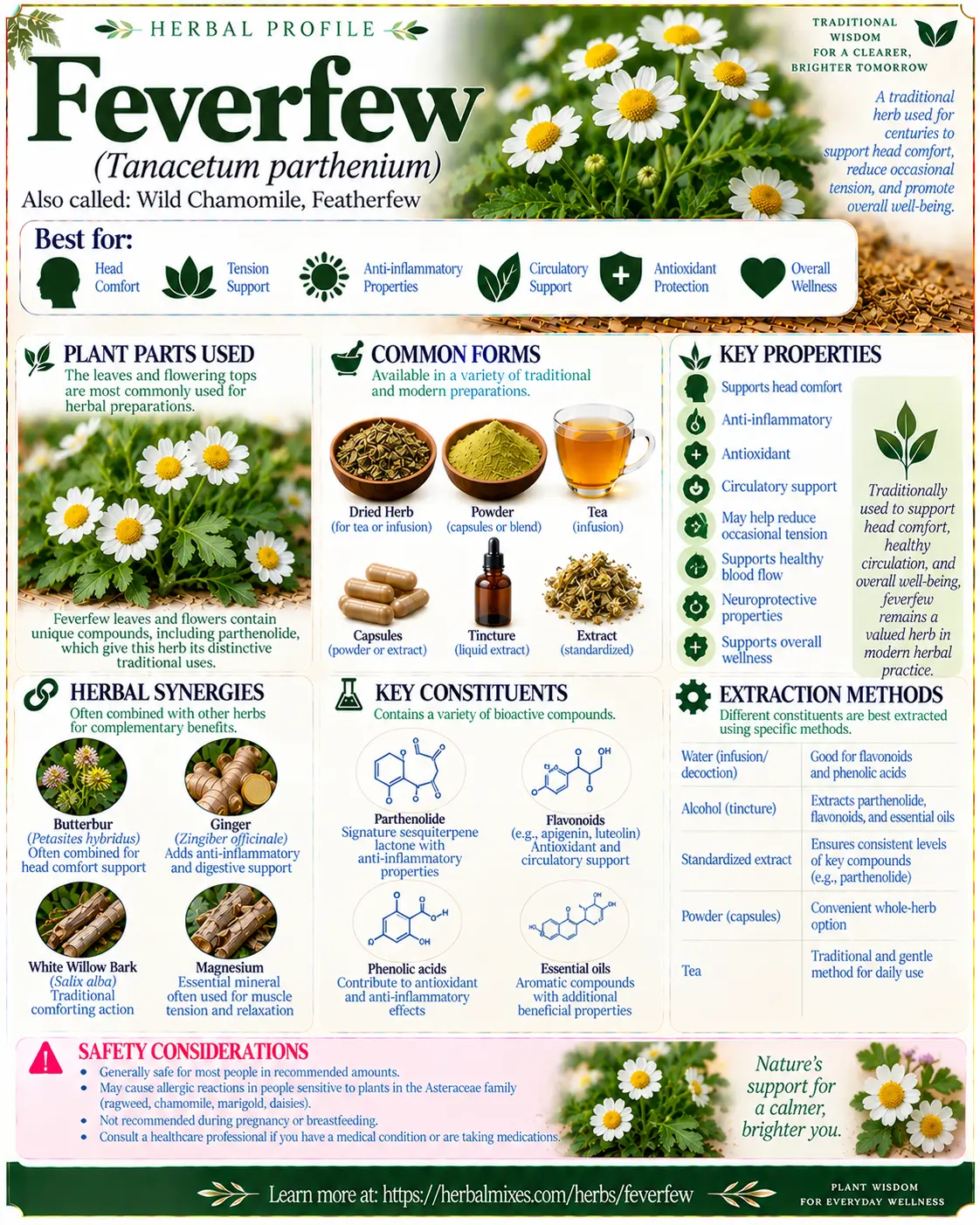
What Feverfew Is Good For
Migraine & Tension Headache Relief — Feverfew is globally renowned as a premier botanical for helping prevent and reduce the frequency and severity of migraine headaches and vascular tension.
Vascular & Platelet Balance — Active parthenolides help inhibit the release of inflammatory serotonin and prostaglandins from blood platelets, supporting smooth vascular tone in the cranium.
Inflammatory & Musculoskeletal Comfort — Traditionally utilized to modulate normal inflammatory pathways throughout joints, tendons, and connective tissues.
Menstrual Cycle & Cramp Support — Helps ease painful menstrual gripping and encourages normal pelvic blood flow during the monthly cycle.
Bitter Tonic & Digestion — Its bitter aromatic principles stimulate upper digestive secretions and appetite when taken in liquid or traditional preparation forms.
Available Herbal Products
Buying Guides for Available Feverfew Products
Standardized Feverfew Leaf Extract Capsules – Concentrated capsules. Formulated with a guaranteed percentage of active parthenolides to provide reliable daily migraine and vascular support. Seller: Gaia Herbs – View Gaia Herbs Feverfew →
Feverfew Leaf Liquid Extract – Hydroalcoholic tincture. A fast-absorbing liquid format designed for convenient daily dosing to support headache prevention and vascular ease. Seller: Herb Pharm – View Herb Pharm Feverfew Extract →
Organic Cut Feverfew Leaf – Dried aerial parts. Purchased primarily for traditional herbal tea infusions or botanical study under professional guidance. Seller: Mountain Rose Herbs – View Mountain Rose Herbs Feverfew →
Migraine & Vascular Support Formula – Concentrated capsules combining feverfew leaf extract with butterbur, magnesium, and white willow bark. Designed for comprehensive headache prevention. Seller: Solaray – View Solaray Formulas →
Herbal Synergies
Feverfew leaf pairs especially well with Butterbur Root, White Willow Bark, and Skullcap Herb, depending on the goal of the formula.
Feverfew Leaf + Butterbur Root -Best for: Comprehensive migraine prevention, calming cranial blood vessels, and reducing headache frequency Feverfew inhibits inflammatory platelet aggregation and cranial vessel spasms, while butterbur root delivers active petasins that support normal cerebrovascular tone. Together, they form the gold standard natural migraine prevention duo. Best extraction: Standardized extract capsules. Ensures consistent daily dosing of both active sesquiterpene profiles.
Feverfew Leaf + White Willow Bark – Best for: Easing acute tension headaches, soothing throbbing head discomfort, and managing inflammatory aches Feverfew stabilizes cranial blood vessels to stop migraine patterns, whereas white willow bark supplies natural salicin compounds that act as a botanical analgesic to soothe acute pain. Best extraction: Tincture combination or capsule blend. Delivers rapid synergistic relief.
Feverfew Leaf + Skullcap Herb – Best for: Calming stress-induced headaches, relaxing nervous tension, and easing cranial tightness Feverfew addresses vascular and inflammatory headache triggers, while skullcap acts as a premier nervine to quiet an overstimulated nervous system and relax muscle tension. Best extraction: Hydroalcoholic tincture blend. Blends vascular support with deep nervous system calm.
Key Herbal Properties
Antimigraine / Vascular Tonic — Modulates cranial blood vessel constriction and dilation, significantly reducing migraine frequency.
Anti-inflammatory (Vascular & Joint) — Inhibits inflammatory prostaglandins and thromboxanes throughout blood vessels and connective tissues.
Platelet Aggregation Inhibitor — Calms the excessive clumping of blood platelets and subsequent release of inflammatory serotonin.
Bitter Tonic — Stimulates upper digestive secretions, gastric juices, and appetite.
Emmenagogue (Mild) — Encourages smooth pelvic circulation and menstrual flow.




Active Compounds
Parthenolide (Sesquiterpene Lactone — Primary Bioactive Marker) Found mainly in: Leaves and flowers The principal bioactive compound responsible for feverfew’s powerful migraine-preventive, anti-inflammatory, and platelet-stabilizing properties. (Note: Look for products standardized for parthenolide content to ensure therapeutic efficacy). Best extraction: Standardized extract or high-proof alcohol tincture. Parthenolide dissolves efficiently in hydroalcoholic solvents.
Volatile Oils (including Camphor and Chrysanthenyl Acetate) Found mainly in: Aromatic leaves Contribute to the plant’s strong fragrance and digestive-stimulating properties. Best extraction: Alcohol-water extract. Soluble in alcohol solutions.
Flavonoids (including Quercetin) Found mainly in: Aerial parts Provide antioxidant protection and support healthy inflammatory balance. Best extraction: Alcohol-water extract. Soluble in hydroalcoholic solutions.
FAQ
What is feverfew best used for? Feverfew is primarily used as a leading botanical supplement for the prevention and management of migraine headaches and vascular tension.
Why is it called “feverfew”? Its historical name derives from the Latin febrifuga, meaning “fever driver,” as it was traditionally brewed into teas to reduce fevers, though it is primarily known today for headaches.
Can chewing fresh feverfew leaves cause mouth sores? Yes, chewing raw, fresh feverfew leaves directly can occasionally cause painful mouth ulcers or tongue irritation in sensitive individuals; taking standardized capsules or liquid extracts avoids this issue.
How long does feverfew take to work for migraines? Unlike an acute painkiller taken after a headache starts, feverfew acts as a preventative tonic that must be taken consistently every day for 4 to 6 weeks to build up in the body and reduce migraine frequency.
Can feverfew be stopped abruptly? If you have used feverfew consistently for migraine prevention over a long period, it is best to taper off gradually rather than stopping abruptly, as some people experience a temporary “post-feverfew syndrome” of rebound headaches or joint stiffness.
Safety & Precautions
Mouth Ulcers & Mucosal Irritation: Chewing raw, fresh leaves can cause contact dermatitis and painful mouth ulcers; always consume dried preparations, capsules, or well-diluted tinctures.
Blood-Thinning Medications: Exercise caution if you take prescription anticoagulant medications (such as aspirin, warfarin, or heparin), as feverfew’s antiplatelet activity can enhance blood thinning.
Surgical Discontinuation: Discontinue feverfew supplementation at least two weeks prior to scheduled surgeries or dental procedures.
Pregnancy & Breastfeeding: Avoid internal use of feverfew during pregnancy due to its traditional emmenagogue properties and uterine-stimulating potential.
Asteraceae Allergy: Individuals with known severe allergies to plants in the Asteraceae (daisy/ragweed) family—such as ragweed, marigolds, or chrysanthemums—should exercise caution.
Consult a qualified healthcare professional before using feverfew therapeutically, especially if you manage underlying medical conditions or take prescription drugs.
References
National Center for Complementary and Integrative Health (NCCIH)
PubMed Central – Tanacetum parthenium (Feverfew) Parthenolide and Migraine Pharmacology
European Medicines Agency (EMA) Monograph on Tanacetum parthenium, herba
World Health Organization (WHO) Monographs on Selected Medicinal Plants
Mountain Rose Herbs Feverfew Monograph
Disclaimer
Disclaimer: This article is for educational purposes only and is not intended to diagnose, treat, cure, or prevent any disease. Herbal products can cause side effects and interact with medications. Consult a qualified healthcare professional before using herbs therapeutically, especially if you are pregnant, breastfeeding, taking prescription medications, or managing a medical condition.