

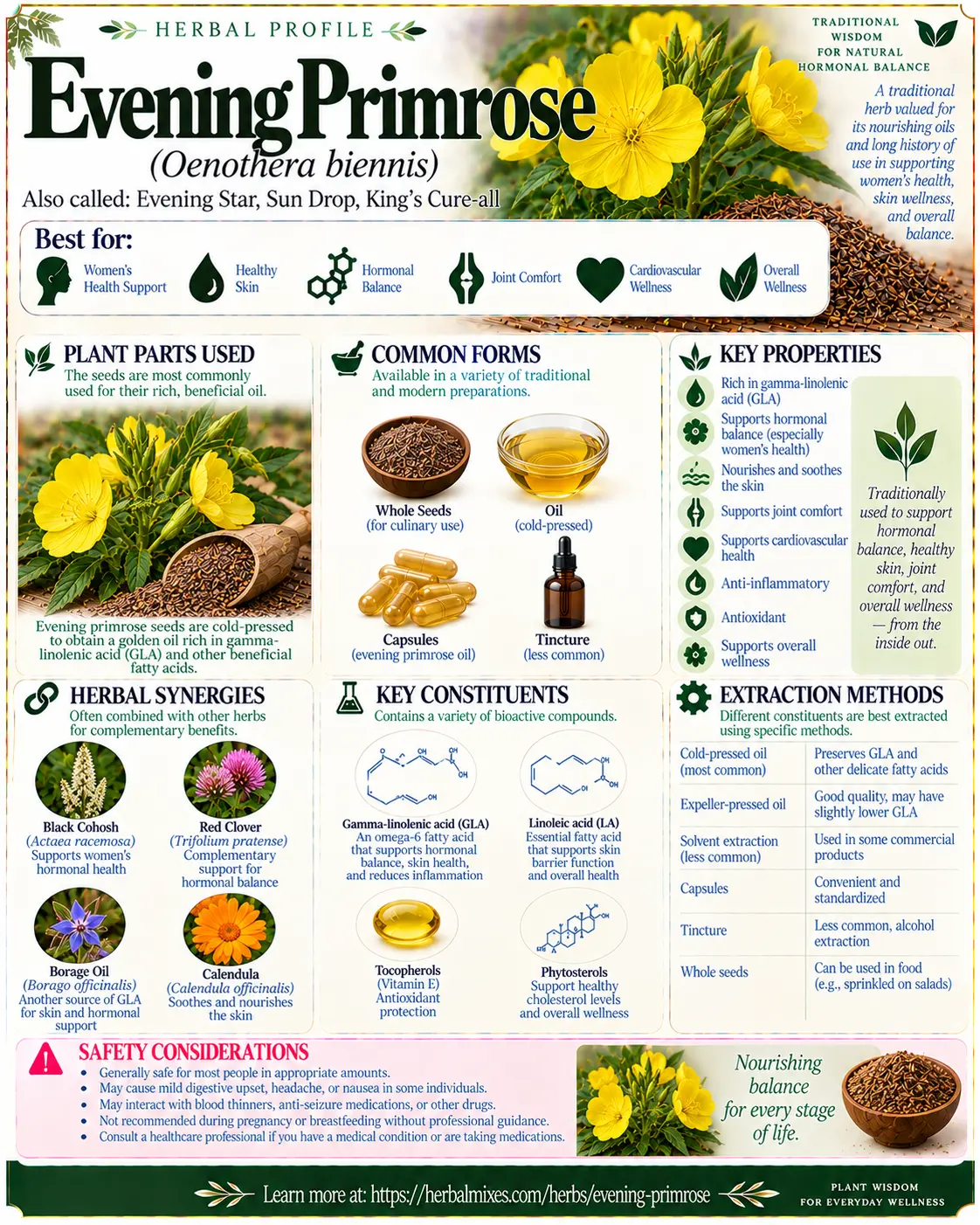
What Evening Primrose Is Good For
Hormonal Balance & Cycle Comfort — Evening primrose oil is globally renowned for its rich gamma-linolenic acid (GLA) content, traditionally used to support normal hormonal balance and ease premenstrual discomfort.
Skin Barrier Health & Hydration — Deeply nourishes dry, flaky skin from within, helping maintain skin elasticity, moisture retention, and a smooth complexion.
Inflammatory Comfort & Joint Ease — Helps modulate normal inflammatory pathways throughout the body, providing gentle support for joint flexibility and tissue comfort.
Nerve Moisture & Peripheral Support — Supports healthy nerve function and cellular membrane integrity, particularly in the extremities.
Breast Tenderness Relief — Widely utilized to help ease cyclical breast tenderness and mild hormonal sensitivity associated with the monthly cycle.
Available Herbal Products
Buying Guides for Available Evening Primrose Products
Cold-Pressed Evening Primrose Oil Softgels (1000 mg) – Pure encapsulated seed oil standardized to contain 10% GLA. The most convenient and popular format for daily hormonal and skin barrier support. Seller: Nature’s Way – View Nature’s Way Evening Primrose →
Organic Evening Primrose Seed Oil (Liquid) – Cold-pressed carrier oil. Ideal for direct culinary drizzling, adding to smoothies, or applying topically to dry, mature, or irritated skin. Seller: Mountain Rose Herbs – View Mountain Rose Herbs Evening Primrose Oil →
Women’s Hormonal Balance Formula – Softgel capsules combining evening primrose oil with borage oil and natural vitamin E. Designed to provide comprehensive skin and cycle support. Seller: Nordic Naturals – View Nordic Naturals Formulas →
Evening Primrose Liquid Extract – Hydroalcoholic aerial parts tincture. Captured from the fresh flowering plant to support lymphatic flow and gentle tissue soothing. Seller: Herb Pharm – View Herb Pharm Evening Primrose Extract →
Herbal Synergies
Evening primrose oil pairs especially well with Borage Seed Oil, Black Currant Seed Oil, and Vitex (Chaste Tree Berry), depending on the goal of the formula.
Evening Primrose Oil + Borage Seed Oil – Best for: Maximizing GLA intake, supporting skin barrier hydration, and deep inflammatory balance Evening primrose oil provides steady gamma-linolenic acid for hormonal balance and skin moisture, while borage seed oil delivers an even higher concentration of GLA (around 20-24%) for intensive systemic support. Together, they form the ultimate essential fatty acid duo. Best extraction: Cold-pressed softgel capsules. Preserves the delicate polyunsaturated fatty acids from oxidation.
Evening Primrose Oil + Vitex (Chaste Tree Berry) – Best for: Comprehensive premenstrual cycle support, balancing progesterone ratios, and easing breast tenderness Evening primrose oil supplies essential fatty acids that modulate inflammatory prostaglandins linked to menstrual cramping and breast discomfort, whereas vitex acts on the pituitary gland to support healthy luteal phase progesterone balance. Best extraction: Softgel combined with liquid tincture. Blends fatty acid nutrition with endocrine-regulating herbal extracts.
Evening Primrose Oil + Black Currant Seed Oil – Best for: Promoting glowing skin elasticity, soothing dry skin conditions, and supporting joint comfort Evening primrose nourishes the lipid barrier, while black currant seed oil adds both GLA and beneficial alpha-linolenic acid (ALA) for balanced omega fatty acid ratios. Best extraction: Blended seed oil softgels. Ensures optimal stability and daily dosing convenience.
Key Herbal Properties
Prostaglandin Precursor (GLA) — Supplies gamma-linolenic acid, which the body converts into anti-inflammatory series-1 prostaglandins (PGE1), supporting hormonal and tissue comfort.
Nutritive / Emollient (Topical) — Deeply softens, moisturizes, and protects dry, irritated, or maturing skin tissues.
Anti-inflammatory (Systemic) — Helps modulate inflammatory pathways throughout blood vessels, nerves, and skin.
Endocrine Adjunct — Supports normal hormonal receptor sensitivity and smooth cycle regulation.


Active Compounds
Gamma-Linolenic Acid (GLA — Omega-6 Essential Fatty Acid, ~8-10% of oil) Found mainly in: Cold-pressed seeds The primary bioactive fatty acid responsible for evening primrose’s powerful hormonal, skin-conditioning, and anti-inflammatory benefits. Best extraction: Mechanical cold-pressing. Heat-free expeller pressing protects fragile unsaturated fatty acids from rancidity and degradation.
Linoleic Acid (Omega-6 Fatty Acid, ~70% of oil) Found mainly in: Seeds An essential fatty acid that supports cellular membrane structure and skin barrier moisture retention. Best extraction: Cold-pressed oil extraction.
Mucilage and Tannins Found mainly in: Aerial leaves and stems Provide mild demulcent and tissue-toning astringency when prepared as fresh plant extracts. Best extraction: Hydroalcoholic tincture (aerial parts).
FAQ
What is evening primrose oil best used for? Evening primrose oil is primarily used to support normal hormonal balance, ease premenstrual discomfort and breast tenderness, and nourish dry skin from within.
Why is evening primrose called an “evening” primrose? The plant’s bright yellow blossoms uniquely unfurl rapidly in the evening twilight just as the sun sets, releasing a sweet fragrance to attract nocturnal moth pollinators.
Can evening primrose oil be applied directly to the skin? Yes, pure cold-pressed evening primrose oil makes a wonderful facial and body oil for nourishing dry, sensitive, or aging skin, as it absorbs well and supports the lipid barrier.
How long does it take for evening primrose oil to work for hormonal support? Because essential fatty acids must gradually incorporate into cell membranes and influence prostaglandin production, consistent daily supplementation is typically required for 4 to 8 weeks to notice full benefits.
Is evening primrose oil safe to take during pregnancy? Evening primrose oil is generally discontinued during early and mid-pregnancy, though it is sometimes utilized by midwives very late in pregnancy (near term) to help ripen the cervix under professional guidance.
Safety & Precautions
Bleeding & Surgical Discontinuation: Exercise caution if you take prescription anticoagulant medications, and discontinue evening primrose oil supplementation at least two weeks prior to scheduled surgeries.
Seizure Disorders: Individuals with epilepsy or those taking medications that lower the seizure threshold should consult a healthcare provider before using high-dose evening primrose oil.
Pregnancy & Breastfeeding: Avoid high therapeutic doses during early and mid-pregnancy; consult a qualified clinical herbalist or healthcare provider before use near term or during lactation.
Gastrointestinal Sensitivity: High doses can occasionally cause mild digestive upset or soft stools in sensitive individuals; taking softgels with meals helps prevent this.
Consult a qualified healthcare professional before using evening primrose therapeutically, especially if you manage underlying medical conditions or take prescription drugs.
References
National Center for Complementary and Integrative Health (NCCIH)
National Library of Medicine – Essential Fatty Acids and Skin Barrier Function Review
World Health Organization (WHO) Monographs on Selected Medicinal Plants
Mountain Rose Herbs Evening Primrose Oil Monograph
Herb Pharm Evening Primrose Profile
Disclaimer
Disclaimer: This article is for educational purposes only and is not intended to diagnose, treat, cure, or prevent any disease. Herbal products can cause side effects and interact with medications. Consult a qualified healthcare professional before using herbs therapeutically, especially if you are pregnant, breastfeeding, taking prescription medications, or managing a medical condition.