

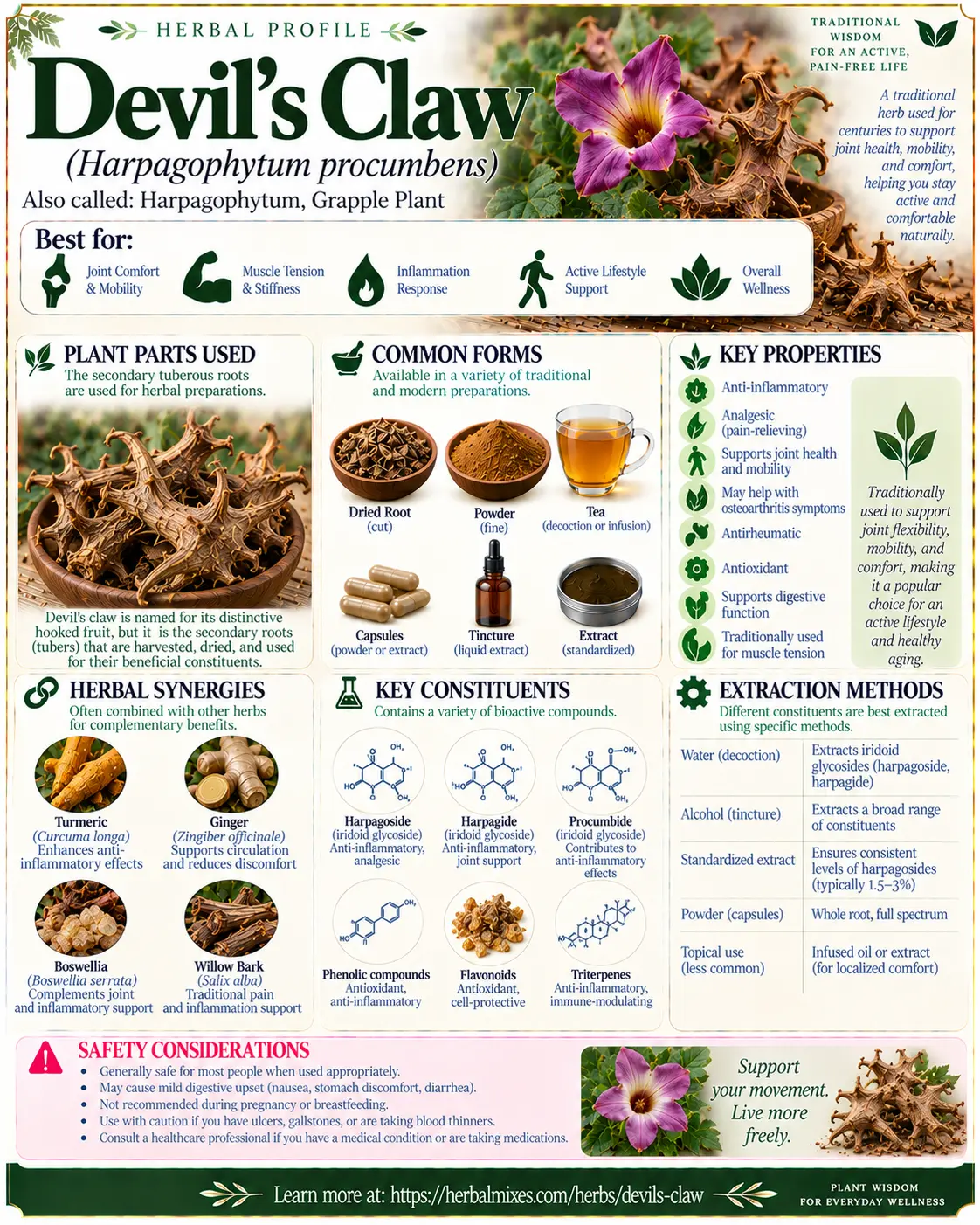
What Devil’s Claw Is Good For
Joint Comfort & Mobility Support — Devil’s claw is globally renowned for its active iridoid glycosides, traditionally used to ease stiffness, support comfortable joint movement, and maintain structural flexibility.
Back & Muscular Stiffness — Widely utilized to help relieve lower back aches, neck tension, and muscular discomfort associated with daily physical strain or overexertion.
Inflammatory & Tissue Balance — Helps modulate normal inflammatory pathways throughout connective tissue, tendons, and musculoskeletal structures.
Uric Acid & Metabolic Support — Supports normal metabolic waste clearance and uric acid balance, contributing to overall joint ease.
Digestive Bitter Tonic — Its intense bitter active compounds stimulate upper digestive secretions and appetite when taken in liquid or traditional decoction forms.
Available Herbal Products
Buying Guides for Available Devil’s Claw Products
Organic Devil’s Claw Root Cut & Sifted – Dried secondary tuber pieces. An authentic, traditional choice for simmering into a long, bitter herbal decoction to support joint health. Seller: Mountain Rose Herbs – View Mountain Rose Herbs Devil’s Claw →
Devil’s Claw Root Liquid Extract – Hydroalcoholic tincture. A fast-absorbing liquid format that allows for convenient daily dosing to support joint comfort and flexibility. Seller: Herb Pharm – View Herb Pharm Devil’s Claw Extract →
Standardized Devil’s Claw Extract Capsules – Concentrated capsules. Formulated with a guaranteed percentage of active harpagosides to provide reliable daily musculoskeletal support. Seller: Nature’s Way – View Nature’s Way Devil’s Claw →
Advanced Joint Comfort Formula – Concentrated capsules combining devil’s claw root extract with turmeric, white willow bark, and boswellia. Designed to provide comprehensive synergistic joint support. Seller: Solaray – View Solaray Joint Formulas →
Herbal Synergies
Devil’s claw root pairs especially well with Turmeric Root, White Willow Bark, and Boswellia Resin, depending on the goal of the formula.
Devil’s Claw Root + Turmeric Root – Best for: Comprehensive joint comfort, easing stiffness, and maintaining systemic inflammatory balance Devil’s claw supplies harpagosides that target musculoskeletal aches and joint mobility, while turmeric root delivers curcuminoids to calm inflammatory cascades throughout the body. Together, they form the gold standard natural joint support duo. Best extraction: Capsules or liquid extract combination. Combining these concentrated extracts ensures potent daily delivery of both active profiles.
Devil’s Claw Root + White Willow Bark – Best for: Relieving acute back tension, soothing muscular discomfort, and supporting physical recovery Devil’s claw moderates deep joint stiffness, whereas white willow bark provides natural salicin compounds that act as a botanical counterpart to aspirin, easing acute aches. Best extraction: Decoction or capsule blend. Simmering these roots together extracts their active glycosides.
Devil’s Claw Root + Boswellia Resin (Frankincense) – Best for: Supporting cartilage health, enhancing joint flexibility, and easing exercise-induced stiffness Devil’s claw supports overall joint comfort, while boswellia supplies boswellic acids that protect connective tissue and maintain smooth joint articulation. Best extraction: Standardized extract capsules. Maximizes the bioavailability of both resinous and root constituents.
Key Herbal Properties
Anti-inflammatory (Musculoskeletal) — Modulates normal inflammatory pathways to ease tension in joints, tendons, and lower back tissues.
Analgesic (Mild) — Helps soothe aches and reduce the perception of physical discomfort associated with stiffness.
Bitter Tonic — Stimulates upper digestive secretions, gastric juices, and appetite regulation.
Alterative — Supports metabolic waste clearance and tissue health over time.
Choleretic (Mild) — Encourages healthy liver and gallbladder secretion.




Active Compounds
Harpagoside (Iridoid Glycoside — Primary Bioactive Marker) Found mainly in: Secondary storage tubers (roots) The principal bioactive iridoid glycoside responsible for devil’s claw’s potent joint-soothing, mobility-enhancing, and anti-inflammatory properties. Best extraction: Standardized extract, hydroalcoholic tincture, or long water decoction. Harpagosides dissolve efficiently in alcohol-water solutions and simmering water.
Prochizide and Other Iridoid Glycosides (including Procumbide and Harpagide) Found mainly in: Tuberous roots Work synergistically with harpagoside to enhance musculoskeletal comfort. Best extraction: Alcohol-water extract. Soluble in hydroalcoholic solvents.
Flavonoids and Phytosterols Found mainly in: Root tissues Antioxidant compounds that support cellular health and protect connective tissues from oxidative stress. Best extraction: Water or alcohol infusion. Soluble in hydroalcoholic solutions.
FAQ
What is devil’s claw best used for? Devil’s claw is primarily used to support joint comfort, ease lower back and muscular stiffness, and maintain healthy physical mobility.
Why is it called devil’s claw? It earns its dramatic name from the woody, claw-like hooks and spines that encircle its seed capsules, which cling tightly to the feet of passing desert animals in the Kalahari.
Can devil’s claw irritate the stomach? Because devil’s claw is rich in bitter principles, high doses taken on an empty stomach can occasionally stimulate gastric acid production; individuals with sensitive stomachs should take capsules with food.
How does devil’s claw taste? Devil’s claw tea has a strongly bitter, earthy, and woody flavor profile due to its high concentration of active iridoid glycosides.
Can devil’s claw be taken every day? Yes, it is commonly taken daily over several weeks or months as a continuous supplement to maintain long-term joint flexibility and comfort.
Safety & Precautions
Peptic Ulcers & Gastric Sensitivity: Individuals with active gastric or duodenal ulcers should exercise caution or avoid high-dose bitter herbs, as devil’s claw stimulates digestive secretions.
Gallbladder Conditions: Individuals with complete bile duct obstructions or active gallstones should consult a physician before using bitter herbs that influence bile flow.
Blood-Thinning Medications: Exercise caution if you take prescription anticoagulant medications, as high-dose devil’s claw can occasionally interact with blood clotting parameters.
Pregnancy & Breastfeeding: Avoid internal use of devil’s claw during pregnancy due to its traditional potential to stimulate uterine smooth muscle.
Consult a qualified healthcare professional before using devil’s claw therapeutically, especially if you manage underlying medical conditions or take prescription drugs.
References
National Center for Complementary and Integrative Health (NCCIH)
PubMed Central – Harpagophytum procumbens (Devil’s Claw) Harpagosides and Joint Pharmacology
European Medicines Agency (EMA) Monograph on Harpagophytum procumbens radix
World Health Organization (WHO) Monographs on Selected Medicinal Plants
Mountain Rose Herbs Devil’s Claw Monograph
Herb Pharm Devil’s Claw Profile
Disclaimer
Disclaimer: This article is for educational purposes only and is not intended to diagnose, treat, cure, or prevent any disease. Herbal products can cause side effects and interact with medications. Consult a qualified healthcare professional before using herbs therapeutically, especially if you are pregnant, breastfeeding, taking prescription medications, or managing a medical condition.