

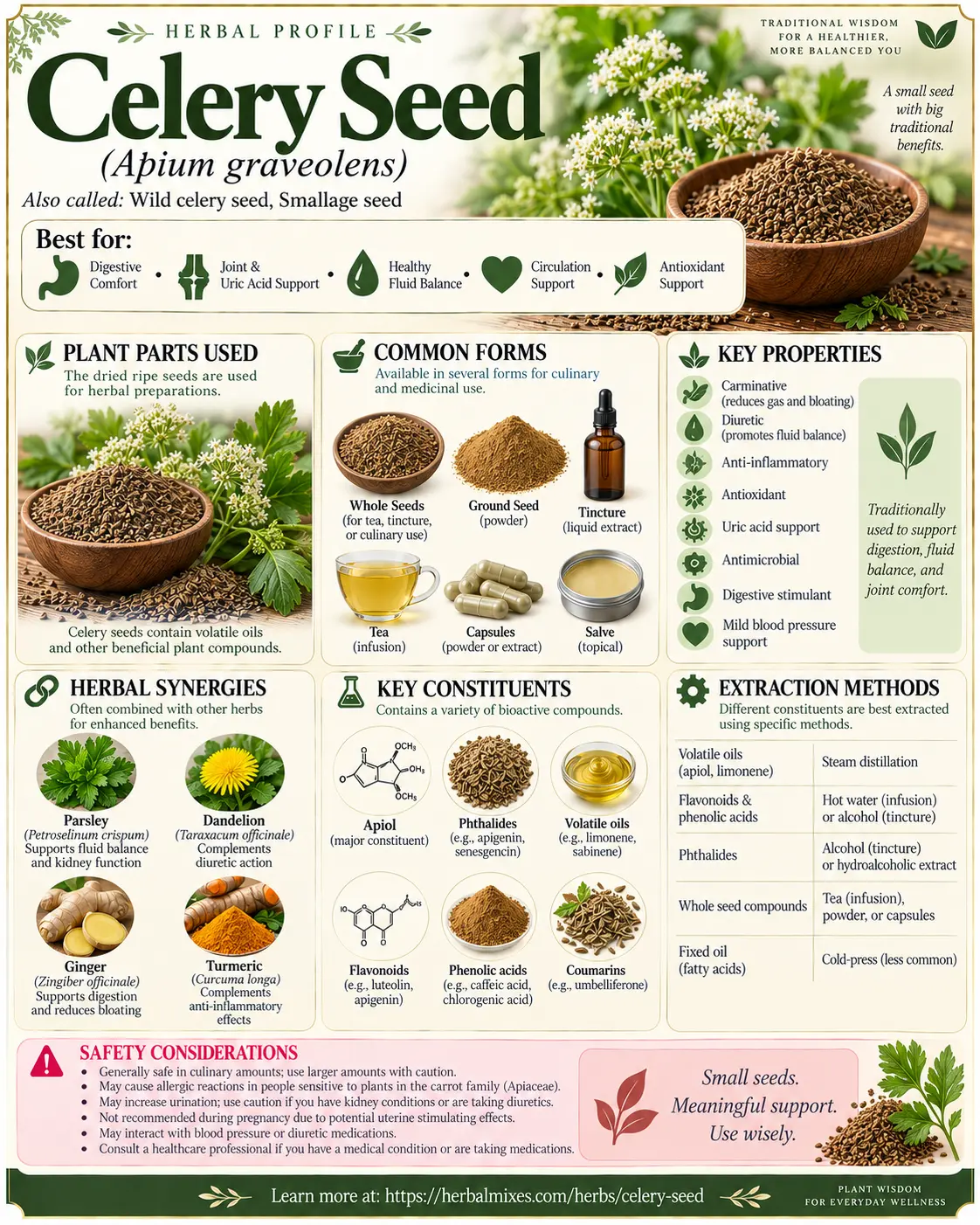
What Celery Seed Is Good For
Uric Acid & Joint Comfort — Celery seed is globally renowned for its ability to support normal uric acid metabolism, helping ease stiffness and maintain comfortable joint and tendon mobility.
Mild Diuretic & Renal Support — Acts as a gentle diuretic that encourages healthy fluid balance and renal elimination of metabolic waste products.
Blood Pressure Support — Active seed constituents (such as 3-n-butylphthalide) help support normal vascular tone and cardiovascular health within healthy parameters.
Digestive Carminative — Its warm, aromatic volatile oils help dispel intestinal gas, ease bloating, and stimulate post-meal digestion.
Anti-inflammatory Support — Helps modulate normal inflammatory pathways throughout connective tissue and musculoskeletal systems.
Available Herbal Products
Buying Guides for Available Celery Seed Products
Organic Whole Celery Seeds – Dried aromatic seeds. An authentic, traditional choice for simmering into a warming diuretic tea or crushing fresh for culinary spice blends. Seller: Mountain Rose Herbs – View Mountain Rose Herbs Celery Seeds →
Celery Seed Liquid Extract – Hydroalcoholic tincture. A fast-absorbing liquid format that allows for convenient daily dosing to support uric acid balance and joint comfort. Seller: Herb Pharm – View Herb Pharm Celery Seed Extract →
Standardized Celery Seed Extract Capsules – Concentrated capsules. Formulated with a guaranteed concentration of active phthalides to provide reliable daily cardiovascular and joint support. Seller: Nature’s Way – View Nature’s Way Celery Seed →
Joint & Uric Acid Support Formula – Advanced capsules combining celery seed extract with tart cherry and turmeric. Designed to provide comprehensive synergistic support for joint flexibility. Seller: Solaray – View Solaray Joint Formulas →
Herbal Synergies
Celery seed pairs especially well with Tart Cherry, Dandelion Root, and Nettle Leaf, depending on the goal of the formula.
Celery Seed + Tart Cherry Extract – Best for: Comprehensive uric acid metabolism, easing joint stiffness, and supporting mobility Celery seed supplies active phthalides and diuretic compounds that accelerate uric acid excretion through the kidneys, while tart cherry delivers rich anthocyanins that soothe connective tissue. Together, they form the gold standard natural combination for joint comfort. Best extraction: Capsules or liquid tincture combination. Combining concentrated extracts ensures potent daily delivery of both active profiles.
Celery Seed + Dandelion Root – Best for: Enhanced renal clearance, fluid balance, and metabolic cleansing Celery seed supports uric acid elimination and vascular tone, whereas dandelion root acts as a premier hepatic and renal tonic that encourages thorough fluid balance. Best extraction: Decoction or tincture blend. Simmering crushed celery and dandelion roots extracts their active mineral salts and bitter glycosides.
Celery Seed + Stinging Nettle Leaf – Best for: Cleansing metabolic waste, supporting urinary tract health, and easing seasonal joint tension Celery seed targets uric acid clearance, while nettle leaf provides deep nutritive mineralization and gentle diuretic support. Best extraction: Infusion combined with tincture. Steeping nettle leaves while taking celery seed extract creates a well-rounded cleansing protocol.
Key Herbal Properties
Uricosuric / Uric Acid Modulator — Supports the kidneys in filtering and excreting excess uric acid from the bloodstream.
Diuretic — Increases urine output, encouraging renal clearance and normal fluid balance.
Carminative — Relieves flatulence, gas buildup, and abdominal cramping via aromatic volatile oils.
Anti-inflammatory — Modulates inflammatory pathways to ease tension in joints and tendons.
Vasodilator (Mild) — Supports vascular relaxation and normal blood pressure maintenance.




Active Compounds
3-n-Butylphthalide (Phthalides) and Sedanolide Found mainly in: Seeds (fruits) The primary bioactive aromatic compounds responsible for celery seed’s characteristic scent, vascular toning, and blood pressure-supporting properties. Best extraction: High-proof alcohol tincture or lipid solvent. Phthalides are fat-soluble aromatic compounds that dissolve efficiently in alcohol.
Apiin and Flavonoids (including Quercetin) Found mainly in: Seed coat Antioxidant compounds that protect cellular tissues from oxidative stress and enhance diuretic action. Best extraction: Hot water infusion or alcohol-water extract. Soluble in both warm water and hydroalcoholic solvents.
Volatile Oils and Terpenes (including Limonene) Found mainly in: Crushed seeds Contribute to the plant’s carminative, antimicrobial, and digestive-stimulating actions. Best extraction: Steam distillation or hydroalcoholic tincture. Volatile oils capture effectively in alcohol solutions.
FAQ
What is celery seed best used for? Celery seed is primarily used to support normal uric acid metabolism, ease joint stiffness, and promote healthy fluid balance through gentle diuretic action.
Do you get the same benefits from eating fresh celery stalks? While fresh celery stalks are wonderful for hydration and mineral intake, the concentrated active constituents (like 3-n-butylphthalide and specific seed volatile oils) are found in much higher concentrations in the seeds.
Can celery seed be taken every day? Yes, celery seed is commonly taken daily as a continuous supplement to maintain joint mobility, uric acid balance, and vascular health over time.
How does celery seed taste? Celery seed has a warm, pungent, slightly bitter, and intensely earthy flavor profile that mirrors the savory taste of fresh celery intensified.
Is celery seed safe to use during pregnancy? No, internal therapeutic doses of celery seed should be avoided during pregnancy due to its traditional emmenagogue and smooth-muscle-stimulating properties.
Safety & Precautions
Pregnancy & Breastfeeding: Strictly avoid therapeutic medicinal doses of celery seed during pregnancy, as it has a traditional history of stimulating uterine contractions and acting as an emmenagogue. (Culinary food seasoning amounts are safe).
Kidney Disease: Individuals with severe acute kidney inflammation or impaired renal function should consult a physician before using strong diuretic herbs.
Allergies: Individuals with known severe allergies to plants in the Apiaceae (carrot/parsley) family—such as carrots, parsnips, or fennel—should exercise caution.
Medication Interactions: Exercise caution if you take prescription blood pressure medications (antihypertensives) or diuretics, as celery seed may exert additive effects.
Consult a qualified healthcare professional before using celery seed therapeutically, especially if you manage underlying medical conditions or take prescription drugs.
References
National Center for Complementary and Integrative Health (NCCIH)
PubMed Central – Apium graveolens (Celery Seed) Phthalides and Uric Acid Pharmacology
European Medicines Agency (EMA) Monograph on Apium graveolens L., fructus
World Health Organization (WHO) Monographs on Selected Medicinal Plants
Mountain Rose Herbs Celery Seed Monograph
Herb Pharm Celery Seed Profile
Disclaimer
Disclaimer: This article is for educational purposes only and is not intended to diagnose, treat, cure, or prevent any disease. Health conditions can vary; consult a qualified healthcare professional before using herbs therapeutically, especially if you are pregnant, breastfeeding, taking prescription medications, or managing a medical condition.