

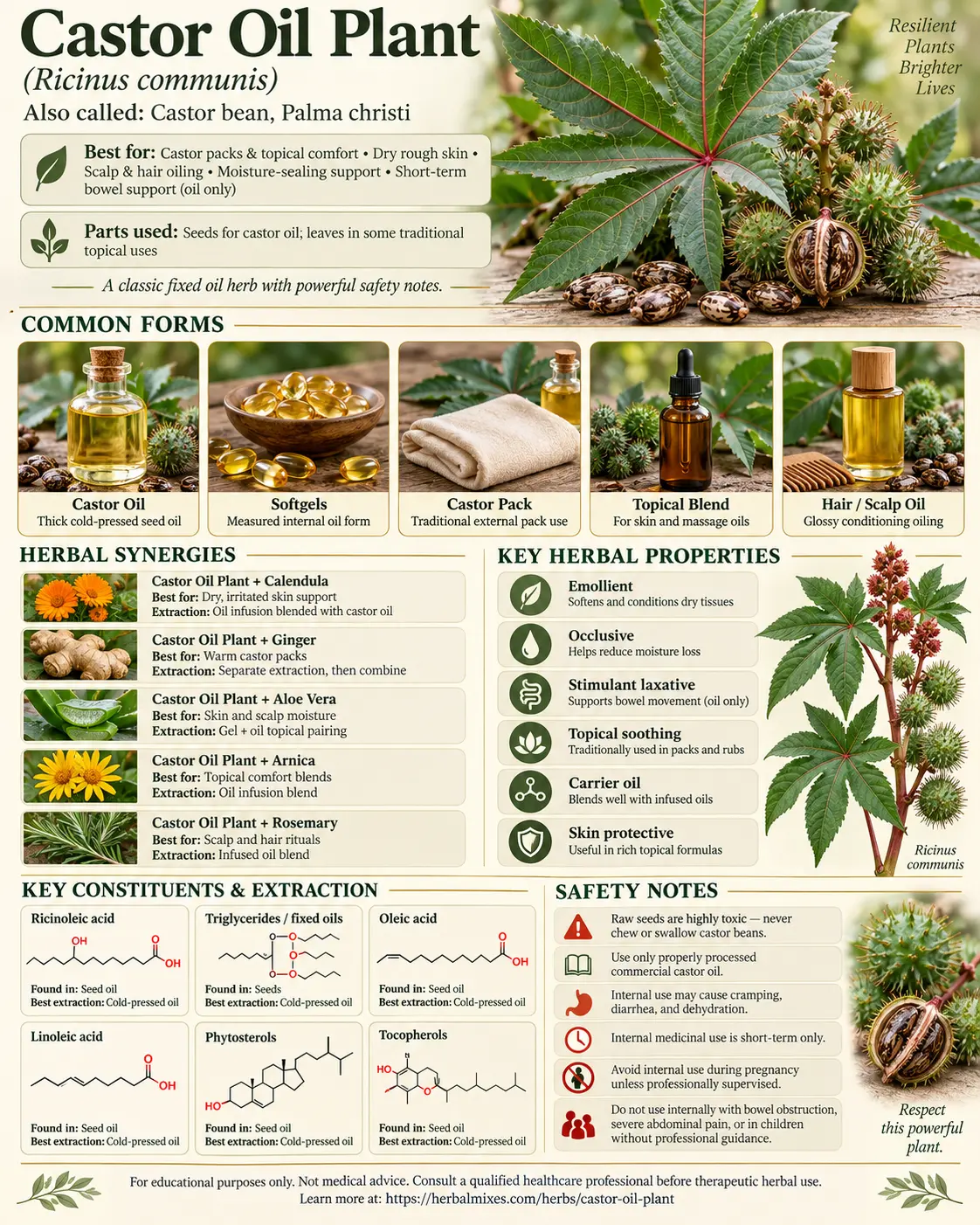
What Castor Oil Is Good For
Topical Castor Oil Packs — Castor oil is globally renowned for its use in flannel packs applied over the abdomen or joints to support deep relaxation, lymphatic circulation, and localized tissue comfort.
Lymphatic Drainage Support — Applied topically, it helps stimulate superficial lymphatic circulation, encouraging fluid movement and tissue decongestion.
Skin Hydration & Barrier Care — Rich in ricinoleic acid, it deeply penetrates the skin barrier to lock in moisture, soften rough patches, and soothe minor surface irritations.
Abdominal & Digestive Comfort — Traditionally massaged into the abdomen in gentle clockwise circles to ease occasional sluggish digestion and support pelvic ease.
Hair & Scalp Conditioning — Widely used in cosmetic hair oils to condition the scalp, support healthy hair follicles, and promote a lustrous shine.
Available Herbal Products
Buying Guides for Available Castor Oil Products
Organic Cold-Pressed Castor Oil (Glass Bottle) – Pure hexane-free oil. The gold standard for crafting therapeutic castor oil packs and deep skin conditioning. Seller: Heritage Store – View Heritage Store Castor Oil →
Organic Cotton Flannel Pack Kit – Reusable organic flannel wrap. Designed specifically to hold castor oil snugly against the abdomen or joints during therapeutic pack sessions. Seller: Queen of the Thrones – View Queen of the Thrones Castor Packs →
Castor Oil Hair & Scalp Serum – Nourishing oil blend. Formulated with pure castor oil combined with rosemary and lavender essential oils to support scalp health and hair strength. Seller: Mielle Organics – View Mielle Organics Hair Care →
Organic Castor Bean Seeds – Raw seeds. Intended primarily for botanical study or garden cultivation (Note: Seeds contain the toxic protein ricin and must never be ingested or chewed). Seller: Mountain Rose Herbs – View Mountain Rose Herbs Seeds →
Herbal Synergies
Castor oil pairs especially well with Frankincense Essential Oil, Ginger Essential Oil, and Lavender Essential Oil, depending on the goal of the formula.
Castor Oil + Frankincense Essential Oil – Best for: Deep tissue renewal, skin rejuvenation, joint comfort, and lymphatic packs Castor oil provides a deeply penetrating, soothing lipid base, while frankincense adds active boswellic compounds and aromatic resins that support cellular comfort and skin elasticity. Together, they create an exceptional luxury pack oil. Best extraction: Topical oil blend. Add 3 to 5 drops of frankincense essential oil to a tablespoon of castor oil before massaging into skin or applying to a flannel pack.
Castor Oil + Ginger Essential Oil – Best for: Warming stiff joints, easing abdominal tightness, and stimulating local circulation Castor oil acts as a deep vehicle for tissue conditioning, whereas ginger essential oil delivers warming oleoresins that bring comforting heat to sluggish areas. Best extraction: Topical massage blend. Dilute ginger essential oil properly in castor oil for safe external application.
Castor Oil + Lavender Essential Oil – Best for: Relaxing nervous tension, easing menstrual abdominal cramping, and soothing skin Castor oil relaxes deep tissue tension when applied as a warm pack, while lavender offers calming aromatherapy and gentle anti-inflammatory support. Best extraction: Warm abdominal pack. Blending lavender into your castor oil pack enhances overall relaxation before rest.
Key Herbal Properties
Emollient — Deeply softens, moisturizes, and protects skin and tissue surfaces.
Lymphagogue (Topical) — Encourages the movement and drainage of superficial lymphatic fluid when applied externally.
Counterirritant / Anodyne — Helps soothe localized discomfort and stiffness when massaged into joint and muscle tissues.
Cathartic (Internal – Historical) — Historically used internally as a potent stimulant laxative, though oral use is largely obsolete due to severe cramping and modern alternatives.
Vulnerary — Supports the normal recovery and moisture barrier of dry or irritated skin.


Active Compounds
Ricinoleic Acid (Omega-9 Fatty Acid — accounts for ~90% of the oil) Found mainly in: Pressed seed oil A unique, highly bioactive monounsaturated fatty acid responsible for castor oil’s exceptional ability to penetrate skin barriers, reduce inflammation, and stimulate topical lymphatic flow. Best extraction: Mechanical cold-pressing of the seeds. Cold-pressing extracts the pure fixed oil without chemical solvents (ensuring hexane-free quality).
Ricin and Ricinins (Toxic Lectins / Alkaloids) Found mainly in: Raw solid seed mash (press cake) Potent toxic proteins and alkaloids present exclusively in the solid seed matter. Crucial Safety Note: Ricin is water-soluble and protein-based; it is completely left behind in the press cake during oil expression and is not present in pure, cold-pressed castor oil. Best extraction: None (avoided). Processed oils are rigorously filtered to ensure zero toxic residues.
FAQ
Is castor oil safe to ingest for constipation? While historically used as an internal oral laxative, modern herbalists and physicians strongly advise against consuming castor oil internally due to violent cramping, nausea, and severe dehydration risks; use safe modern alternatives or topical packs instead.
How do you do a castor oil pack? Saturate a piece of organic cotton flannel with castor oil, place it over the abdomen or a stiff joint, cover it with a plastic barrier, and apply a warm heating pad or hot water bottle for 30 to 60 minutes.
Does castor oil contain toxic ricin? No. Pure, high-quality, cold-pressed castor oil is entirely free of ricin, as ricin is a water-soluble protein locked inside the solid seed pulp and does not transfer into the pressed oil.
Can castor oil be used on eyelashes and eyebrows? Yes, many people apply a tiny drop of pure organic castor oil to eyelashes or brows before bed to condition hair strands and support a lush appearance.
Does castor oil stain fabrics? Yes, castor oil is a thick, persistent plant oil that easily stains clothing, sheets, and cotton flannel permanently; use dedicated towels or old garments during pack sessions.
Safety & Precautions
External Use Only: Strictly restrict castor oil use to external topical applications, packs, and cosmetics. Never ingest castor oil internally.
Allergy & Patch Testing: Always perform a patch test on a small area of skin before applying castor oil broadly to check for individual sensitivity or contact dermatitis.
Raw Seed Toxicity: Never chew, crush, or ingest raw castor beans, as they contain lethal amounts of the toxin ricin.
Broken Skin: Avoid applying thick oil packs directly to severely broken, infected, or weeping open wounds without professional guidance.
Pregnancy & Abdominal Packs: Avoid applying intense abdominal castor oil packs during pregnancy, as deep pelvic warming and stimulation can affect the uterus.
Consult a qualified healthcare professional before using castor oil therapeutically, especially if you manage underlying medical conditions or take prescription drugs.
References
National Center for Complementary and Integrative Health (NCCIH)
PubMed Central – Ricinus communis (Castor Oil) Ricinoleic Acid and Dermatological Pharmacology
National Library of Medicine – Castor Oil Toxicity and Ricin Safety Profile
World Health Organization (WHO) Monographs on Selected Medicinal Plants
Mountain Rose Herbs Castor Oil Monograph
Heritage Store Castor Oil Guide
Disclaimer
Disclaimer: This article is for educational purposes only and is not intended to diagnose, treat, cure, or prevent any disease. Herbal products can cause side effects and interact with medications. Consult a qualified healthcare professional before using herbs therapeutically, especially if you are pregnant, breastfeeding, taking prescription medications, or managing a medical condition.