

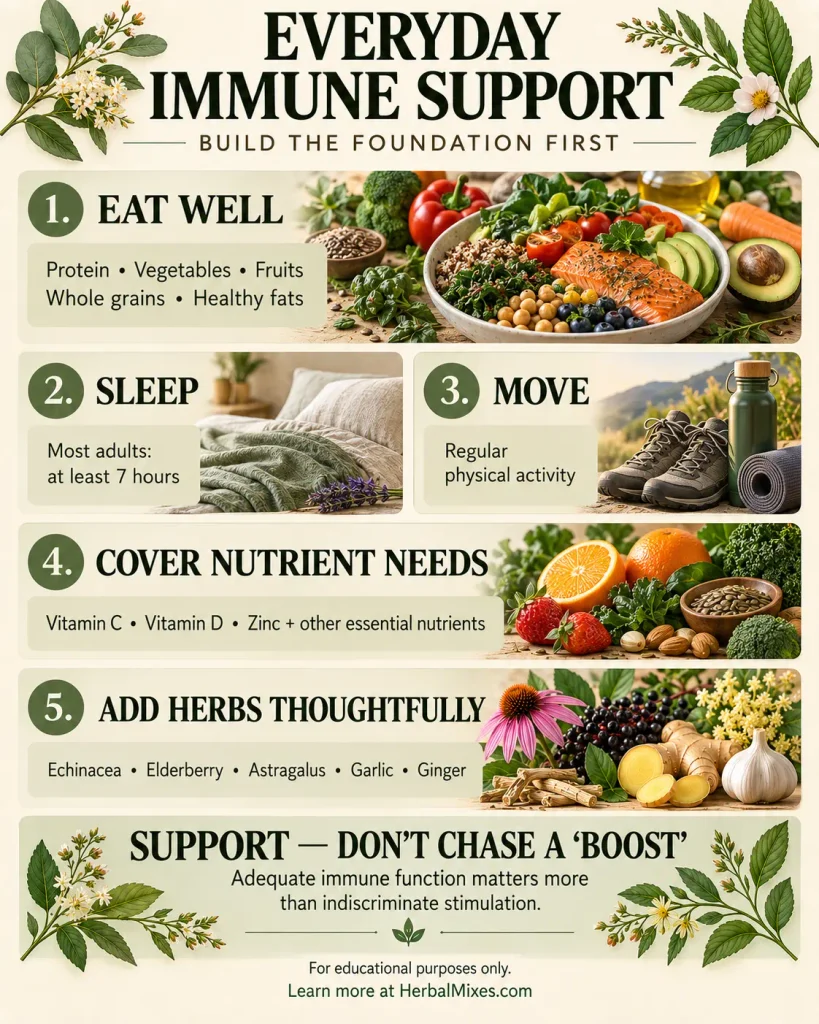
A healthy immune system isn’t something you simply “boost” with one herb or supplement. Sleep, nutrition, physical activity and adequate micronutrients provide the foundation, while herbs such as echinacea, elderberry, astragalus and garlic and many other herbs that can play more specific supporting roles.
Below, we’ll separate everyday immune support from cold-and-flu treatment and look at which herbs, preparations and habits actually make sense.
Available Ready-to-Use Products
Echinacea Extract
Best for: Short-term seasonal herbal support
Echinacea products are among the most widely used herbal preparations for respiratory-season support.
Different species, plant parts and extraction methods produce substantially different products, so “echinacea” shouldn’t be treated as one standardized intervention.
Elderberry Syrup
Best for: Convenient seasonal herbal routine
Elderberry syrup is one of the most familiar immune-oriented herbal forms.
Its dark-purple fruit supplies anthocyanins and other polyphenols, but elderberry should not be marketed as a guaranteed way to prevent respiratory infections.
Quality matters because concentration, berry species, added sugar and serving sizes vary widely.
Astragalus Root Extract
Best for: Traditional long-term wellness formulas
Astragalus root occupies a different niche from short-term respiratory products such as echinacea.
It has a long history in traditional Chinese medicine and is commonly included in general wellness formulas. Human evidence supporting broad “immune boosting” claims remains limited.
Aged Garlic Extract
Best for: Food-based botanical support + convenient standardized form
Garlic is both a culinary food and a medicinal botanical. Various garlic preparations have been studied for cardiovascular and other effects, while immune-related claims remain more complicated.
A standardized extract offers a different constituent profile from fresh garlic.
[BUYING GUIDE LINK → Aged Garlic Extract]
Everyday Herbal Tea
Best for: Hydration + sustainable daily ritual
A mild tea containing herbs such as ginger, rosehip or other food-like botanicals can provide a simple daily wellness ritual.
Tea should complement—not replace—adequate nutrition, sleep and other basic health behaviors.
What Is Everyday Immune Support?
The immune system is not one organ or one switch.
It is a complex network of cells, tissues, organs and physical barriers that helps protect the body from potentially harmful microorganisms and other threats.
It includes both innate immunity, which provides rapid general defenses, and adaptive immunity, which develops targeted responses to specific threats.
Even the skin and cells lining the digestive tract participate in this defense system.
That complexity is why the popular phrase “boost your immune system” can be misleading.
More immune activity isn’t automatically better.
The useful goal is normal, well-regulated immune function.
Nutrition matters because immune cells require adequate energy, protein, vitamins and minerals. Sleep and physical activity also influence immune function.
And while herbs may affect biological pathways involved in immunity, demonstrating that an herb changes a laboratory immune marker is not the same as proving that taking it will prevent illness.
“Immune Support” vs. “Immune Boosting”
These terms shouldn’t be treated as interchangeable.
Immune support can reasonably describe behaviors that help the immune system function normally—for example:
- eating a nutritious diet;
- obtaining adequate essential nutrients;
- sleeping sufficiently;
- staying physically active;
- avoiding smoking;
- using recommended vaccination to develop immunity to specific diseases.
“Immune boosting,” on the other hand, often implies that more immune activity is inherently desirable.
That isn’t how the immune system works.
A better HerbalMixes principle is:
Support normal immune function rather than trying to indiscriminately stimulate it.
The Foundation Comes Before Herbs
Before choosing an immune-support supplement, focus on the fundamentals.
Eat a Varied, Nutrient-Dense Diet
The immune system requires numerous nutrients to function properly.
Important examples include:
Vitamin A • Vitamin B6 • Vitamin B12 • Vitamin C • Vitamin D • Vitamin E • Folate • Copper • Iron • Magnesium • Selenium • Zinc
Deficiencies can impair immune function.
But that doesn’t mean increasingly large supplemental doses create increasingly strong immunity.
For people without a deficiency, routinely taking extra micronutrients generally provides little benefit for preventing or treating specific infections.
Get Enough Sleep
Sleep supports immune function and recovery.
For most adults, at least seven hours of sleep per night is an important general target.
Chronic inadequate sleep can negatively affect immune responses.
Stay Physically Active
Regular physical activity contributes to overall health and is associated with healthier immune function.
The goal isn’t exhausting exercise every day. Consistent, appropriate movement matters more than occasional extremes.
Don’t Smoke
Smoking interferes with the body’s ability to fight disease and increases the risk of numerous health problems.
Avoiding tobacco therefore belongs in any meaningful discussion of everyday immune health.
Keep Vaccinations Current
Healthy habits support general immune health.
Vaccination serves a different purpose: it trains the adaptive immune system to recognize specific pathogens.
Herbs, nutritious foods and sleep do not replace vaccination against diseases for which vaccination is recommended.
What Should Herbal Support Focus On?
Nutritional Support
Food comes first.
Rosehips, citrus, peppers, berries, garlic, leafy vegetables, legumes, nuts, seeds and many other foods contribute vitamins, minerals and phytochemicals within a balanced diet.
Polyphenol-Rich Botanicals
Plants such as elderberry contain colorful polyphenols including anthocyanins.
These compounds are biologically interesting, but antioxidant content alone does not prove that a food or herb prevents infection.
Traditional Seasonal Support
Echinacea and elderberry fit better into seasonal respiratory routines than into promises of permanently “stronger immunity.”
Long-Term Wellness Tradition
Astragalus has traditionally occupied a more tonic-like role.
This makes it conceptually different from using echinacea at the beginning of respiratory symptoms.
Food-Based Herbal Support
Garlic and ginger are particularly useful because they can be incorporated into ordinary meals rather than requiring another supplement.
7 Herbs for Everyday Immune Support
1. Echinacea (Echinacea purpurea, E. angustifolia, E. pallida)
Best role: Seasonal respiratory support
Echinacea is one of the best-known immune-related herbs.
It has historically been used for respiratory complaints, and modern echinacea products are heavily marketed for the common cold.
Clinical research, however, has produced mixed results.
Some evidence suggests certain echinacea preparations may modestly affect the likelihood or duration of respiratory infections, while other studies show little benefit.
A major difficulty is that products vary by:
species • root vs. aerial parts • fresh vs. dried herb • extraction method • dose
The European Medicines Agency maintains monographs for specific Echinacea purpurea preparations related to cough-and-cold use, which underscores why the preparation matters, not merely the herb’s name.
Best preparation: Standardized extract • Tincture • Tea depending on plant part
Pairs well with: Elderberry • Rosehip • Ginger
Use with care: Allergy to daisy-family plants • pregnancy/breastfeeding • immune-related medical conditions or medications warrant professional guidance
2. Elderberry (Sambucus nigra)
Best role: Seasonal fruit-based support
Black elderberry is rich in anthocyanins and has become one of the most popular seasonal wellness botanicals.
It is commonly prepared as syrup, extract, gummies or tea blends.
Some clinical studies have investigated elderberry during respiratory illness, but evidence is not strong enough to conclude that elderberry reliably prevents infections or should replace established preventive or medical care.
This makes elderberry best positioned as an optional seasonal botanical, not a shield against illness.
Best preparation: Properly prepared syrup • Standardized extract
Pairs well with: Rosehip • Echinacea • Ginger
Use with care: Raw or improperly prepared elder plant material can contain potentially harmful compounds. Use appropriately prepared products.
3. Astragalus Root (Astragalus membranaceus)
Best role: Traditional daily wellness tonic
Astragalus root has a long history in traditional Chinese medicine and is frequently included in formulas marketed for immune health.
Laboratory and preliminary research suggests biologically interesting effects on immune pathways.
However, laboratory immune activity is not the same as clinical proof that taking astragalus prevents infections in healthy adults.
Its strongest rationale in an everyday routine therefore comes from traditional use, with modern evidence remaining limited.
Best preparation: Decoction • Extract • Traditional formula
Pairs well with: Ginger • Reishi • Schisandra
Use with care: People with autoimmune disease or taking immunosuppressive drugs should discuss use with a healthcare professional.
4. Garlic (Allium sativum)
Best role: Food-first botanical support
Garlic fits naturally into an everyday wellness article because it is both food and herb.
It contains sulfur-containing compounds that have been extensively studied for biological activity.
Clinical evidence supporting garlic specifically for preventing common colds remains limited, so claims such as “garlic prevents infection” go too far.
The simplest approach is also the most sustainable:
use garlic regularly as food when you enjoy and tolerate it.
Best preparation: Food • Aged extract • Standardized supplement
Pairs well with: Ginger • Thyme • Turmeric
Use with care: Concentrated garlic supplements may increase bleeding risk, particularly with anticoagulant or antiplatelet medications.
5. Ginger (Zingiber officinale)
Best role: Food-based warming wellness support
Ginger is another botanical that works well as both food and herbal preparation.
It isn’t a proven immune “booster,” but it contains numerous bioactive compounds and can contribute to a varied plant-rich diet.
Its stronger clinical evidence relates to issues such as nausea rather than preventing infection.
For everyday use, fresh ginger can simply be incorporated into food or tea.
Best preparation: Food • Fresh tea • Extract
Pairs well with: Garlic • Elderberry • Rosehip • Turmeric
Use with care: Concentrated supplements may interact with medications; food-level use is a different exposure from high-dose extracts.
6. Rosehip (Rosa canina and related Rosa species)
Best role: Nutritive fruit + seasonal tea ingredient
Rosehips are colorful fruits naturally containing vitamin C and a range of polyphenols and carotenoids.
Their value in an everyday wellness routine is primarily nutritive and culinary, rather than as a proven infection-prevention treatment.
Rosehip pairs particularly well with elderberry because the two fruits provide complementary flavors and make an appealing seasonal syrup or tea.
Best preparation: Tea • Food • Syrup
Pairs well with: Elderberry • Hibiscus • Ginger
Use with care: Product nutrient content varies considerably with processing and storage.
7. Reishi (Ganoderma spp.)
Best role: Traditional mushroom-based wellness support
Reishi has a long history in East Asian traditional medicine and contains polysaccharides and triterpenes studied for biological effects.
However, broad claims that reishi “strengthens immunity” or prevents infections are not justified by current evidence.
Its place in an everyday wellness article should therefore remain firmly within traditional use and emerging research, not established infection prevention.
Best preparation: Hot-water extract • Dual extract • Decoction
Pairs well with: Astragalus • Schisandra • Ginger
Use with care: Possible medication interactions and effects on bleeding or immune function deserve consideration, particularly with concentrated extracts.

Best Herbal Combinations for Everyday Immune Support
Elderberry + Rosehip
Best for: Seasonal fruit-based wellness routine
Elderberry contributes anthocyanin-rich dark fruit while rosehip adds a tart nutritive component.
This pairing works especially well as tea or properly prepared syrup.
Best preparation: Tea • Syrup
Echinacea + Elderberry + Rosehip
Best for: Seasonal herbal routine
This combination brings together a traditionally respiratory-focused herb with two colorful fruits.
Its role should remain supportive rather than being marketed as prevention or treatment of influenza or other respiratory infections.
Best preparation: Tea • Extract blend • Syrup
Astragalus + Ginger
Best for: Traditional daily warming tonic
Astragalus provides the traditional tonic role while ginger makes the preparation warmer and more culinary.
Best preparation: Decoction
Garlic + Ginger + Turmeric
Best for: Food-first botanical routine
This is less about taking an “immune supplement” and more about incorporating diverse herbs and spices into ordinary meals.
Best preparation: Food • Broth • Soup
[NEW SYNERGY OPPORTUNITY → Garlic + Ginger + Turmeric]
Astragalus + Reishi + Schisandra
Best for: Traditional tonic-style formulation
This combination belongs in the long-term traditional-wellness category rather than acute cold treatment.
Evidence for broad immune claims remains limited.
Best preparation: Decoction • Professionally formulated extract

Tea, Food, Tincture or Extract?
Food
Best for: Everyday foundation
Garlic, ginger, berries, vegetables, legumes, nuts, seeds and other nutrient-rich foods fit naturally into daily life.
For most healthy people, this is a better foundation than building a large supplement stack.
Herbal Tea
Best for: Hydration + daily ritual
Tea provides fluid and a relatively gentle way to use many herbs.
Examples include:
Ginger + Rosehip
Elderberry + Rosehip
Astragalus + Ginger decoction
Tincture
Best for: Convenient concentrated herbal use
Tinctures make dosing convenient but are more concentrated than ordinary food or tea.
That makes medication interactions and contraindications more important.
Standardized Extract
Best for: When research relates to a specific preparation
This distinction is especially relevant with herbs such as echinacea.
Research on one defined extract does not automatically prove that every tea, tincture, gummy or capsule labeled “echinacea” will behave the same way.
What About Vitamin C?
Vitamin C is essential for normal immune function.
Getting enough matters.
Good food sources include fruits and vegetables such as citrus, peppers, kiwi, broccoli and strawberries.
But adequate and more are not the same thing.
Regular vitamin C supplementation may modestly shorten the duration of a cold in some people, and it appears particularly useful for people under extreme physical stress.
Taking vitamin C only after cold symptoms begin has not shown consistent benefit.
For adults, very high supplemental intake can cause diarrhea, nausea and abdominal cramps.
The everyday goal should therefore be adequacy, not megadosing.
What About Zinc?
Zinc is another essential nutrient required for normal immune function.
Deficiency can impair immunity.
Some evidence suggests zinc lozenges or syrup started soon after cold symptoms appear may shorten the duration of a cold.
That’s different from taking high-dose zinc indefinitely for “immune boosting.”
Long-term excessive zinc intake can lead to copper deficiency and impaired immune function—exactly the opposite of the intended goal.
What About Vitamin D?
Vitamin D participates in immune function, and maintaining adequate vitamin D status is important for health.
However, the appropriate amount depends on factors such as diet, sun exposure, age and individual vitamin D status.
More isn’t automatically better.
If deficiency is suspected, testing and individualized guidance may be more useful than arbitrarily taking increasingly large doses.
Can You Really “Boost” Your Immune System?
This is one of the most important questions on the page.
The immune system isn’t a muscle that simply becomes better as its activity increases.
It needs to be appropriately regulated.
That means supporting:
adequate nutrition
normal sleep
physical activity
healthy tissue barriers
appropriate immune responses
specific immunity through vaccination where appropriate
rather than trying to make every immune pathway more active.
For HerbalMixes, “support normal immune function” is therefore more accurate than “boost immunity.”
Everyday Immune-Support Routine
A practical routine can be surprisingly simple.
Morning
Start with a nutritious meal containing protein and plant foods.
If you enjoy herbal tea, ginger or rosehip can fit naturally here.
During the Day
Eat a varied diet rather than relying on supplements to compensate for a consistently poor one.
Include fruits, vegetables, protein foods, whole grains, legumes, nuts, seeds and healthy fats as appropriate for you.
Stay physically active.
Evening
Use a caffeine-free herbal tea if you enjoy one.
Prioritize sufficient sleep rather than adding another “immune booster” to the supplement cabinet.
Seasonally
Echinacea or elderberry may be considered as optional botanicals, but use realistic expectations.
Neither should replace vaccination, hygiene, nutrition or medical care.
What the Evidence Actually Says
Healthy habits: Strong foundation. CDC specifically emphasizes nutrition, sleep, physical activity, avoiding smoking and recommended vaccination for supporting immune health.
Micronutrients: Essential. Deficiencies can weaken immune function, but in the absence of deficiency, taking additional vitamins and minerals generally does little to prevent infections.
Echinacea: Studied extensively for respiratory infections, with mixed results. Product differences make broad claims especially difficult.
Elderberry: Interesting seasonal botanical with limited clinical evidence; it should not be presented as proven infection prevention.
Astragalus: Long traditional use and interesting laboratory research, but insufficient evidence for broad preventive claims in healthy people.
Garlic: Nutritionally useful food and biologically active botanical; evidence for preventing common colds remains limited.
Ginger: Valuable food and herbal preparation, but its better-supported clinical uses are not primarily immune-related.
Rosehip: Nutritive fruit containing vitamin C and polyphenols; not established as an infection-prevention treatment.
Reishi: Traditional use and laboratory research do not establish broad clinical immune benefits.
The practical conclusion is straightforward:
Build everyday immune health around healthy habits and adequate nutrition. Herbs are optional additions—not the foundation.
When Immune Support Becomes Medical Care
An everyday immune-support routine is intended for generally healthy periods.
It is not a treatment plan for:
- influenza;
- pneumonia;
- COVID-19;
- strep throat;
- persistent fever;
- serious bacterial infection;
- severe respiratory illness;
- immune deficiency;
- autoimmune disease.
Seek appropriate medical evaluation for significant or worsening illness.
People with autoimmune disease, organ transplants, cancer treatment, immune deficiencies or medications that alter immune function should discuss concentrated herbal supplements with their healthcare team rather than assuming an “immune-stimulating” herb is desirable.
Frequently Asked Questions
What is the best herb for everyday immune support?
There isn’t one best herb. Echinacea fits seasonal respiratory use, elderberry fits fruit-based seasonal preparations, astragalus has a traditional tonic role, and garlic and ginger work particularly well as everyday foods.
What is the best way to support the immune system every day?
Start with adequate nutrition, sufficient sleep, regular physical activity, avoiding smoking and keeping recommended vaccinations current. Herbal products are secondary to these fundamentals.
Does echinacea boost the immune system?
Echinacea can affect immune-related biological pathways and has been studied for respiratory infections, but “boosting immunity” oversimplifies both the herb and the immune system. Clinical results are mixed and depend partly on the preparation.
Is elderberry good for everyday immune support?
Elderberry can fit into a seasonal wellness routine, particularly as a properly prepared syrup or extract. Evidence does not establish it as a reliable way to prevent respiratory infections.
Is astragalus good for immune support?
Astragalus has a long traditional reputation as a tonic and has been studied for immune-related biological effects. Strong clinical evidence for preventing infection in healthy adults is lacking.
Is garlic good for the immune system?
Garlic contains biologically active sulfur compounds and is a nutritious food. Evidence supporting garlic specifically for preventing respiratory infections remains limited, but incorporating garlic into a healthy diet is reasonable for people who tolerate it.
Should I take vitamin C every day?
Vitamin C is essential, but many people can obtain adequate amounts from food. Regular supplementation may modestly shorten colds in some situations, but high doses aren’t automatically more beneficial.
Can too much zinc weaken immunity?
Yes. While adequate zinc is essential for immune function, chronically excessive zinc can cause copper deficiency and can itself impair immune function.
Can herbs replace vaccines?
No. Healthy habits and herbs can support general wellness, while vaccines train the immune system to recognize particular diseases. They serve different purposes.
Should I take several immune supplements together?
More isn’t necessarily better. Combining multiple products can duplicate ingredients, increase doses and create medication interactions. Review the complete ingredient list rather than evaluating each supplement separately.
References
NIH Office of Dietary Supplements — Dietary Supplements for Immune Function and Infectious Diseases
NIH Office of Dietary Supplements — Immune Function: Health Professional Fact Sheet
CDC — Support Your Immune Health
CDC — Healthy Habits: Enhancing Immunity
NCCIH — Echinacea: Usefulness and Safety
European Medicines Agency — Echinacea purpurea Herb
European Medicines Agency — Echinacea purpurea Root
Disclaimer
This article is for educational purposes only and is not medical advice. Herbal products and dietary supplements do not replace a nutritious diet, adequate sleep, vaccination, diagnosis or appropriate medical treatment.
Talk with a qualified healthcare professional before using concentrated herbal supplements if you are pregnant or breastfeeding, take prescription medication, have an autoimmune condition or immune deficiency, receive immunosuppressive treatment, or are managing a serious medical condition.