

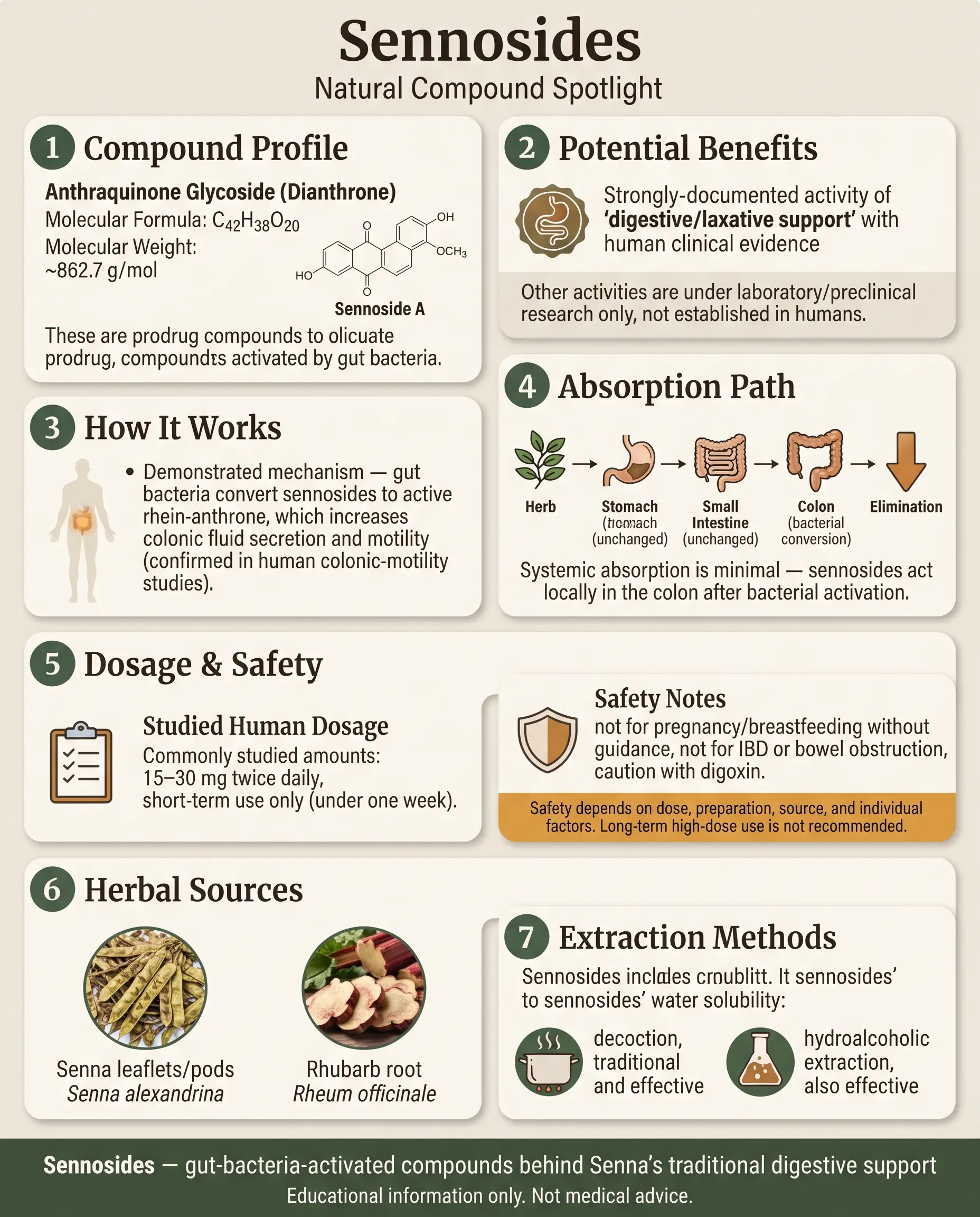
Sennosides are naturally occurring dianthrone glycosides — a subclass of anthraquinone compounds — found principally in the leaf and pod of Senna, with related sennosides also present in Rhubarb Root. They’re one of the most extensively studied plant-derived laxative compounds, notable because they function as a “prodrug”: inert until the body’s own gut bacteria activate them.
Benefits
Sennosides are traditionally used, with substantial human clinical evidence, to relieve occasional constipation. Their laxative action is well-documented: they increase colonic fluid secretion and stimulate colonic motility. Beyond this established digestive use, laboratory and animal research has explored other biological activities of sennosides (including antioxidant and anti-inflammatory effects), but these remain preclinical and are not established in human clinical use — the digestive/laxative effect is the only benefit with strong human evidence.
How It Works
Sennosides themselves are pharmacologically inactive. In the colon, resident gut bacteria hydrolyze the glycoside bond, releasing the active metabolite rhein-anthrone. This demonstrated mechanism produces two effects: increased intestinal fluid transport (inhibiting electrolyte and water reabsorption while increasing chloride secretion) and increased colonic motility (stimulated propulsive contractions). Both effects are documented in human colonic-motility studies, not just animal models — a relatively strong evidence base for a plant compound.
Absorption Path
INGESTION → STOMACH (unchanged) → SMALL INTESTINE (largely unchanged, minimal absorption) → COLON (bacterial hydrolysis to rhein-anthrone) → LOCAL ACTION on colonic mucosa → minor SYSTEMIC ABSORPTION → LIVER metabolism → ELIMINATION (urine/feces). Systemic absorption of sennosides is documented as minimal — most of the pharmacological action happens locally in the colon after bacterial activation, which is part of why the onset (6–12 hours) is fairly predictable and consistent across studies.
Dosage & Safety
Unlike many isolated plant compounds, sennosides do have a recognized human dosing range: commonly studied and OTC-labeled amounts run 15–30 mg twice daily, with FDA OTC monograph products capping around 68.8–100 mg/day depending on formulation, for short-term use only (generally under one week). Longer-term, high-dose use has been associated in the literature with melanosis coli (a benign pigment change in the colon lining) and raised genotoxicity questions in laboratory studies — these are not established human carcinogenicity risks, but they’re the basis for the short-term-use recommendation. Not advised during pregnancy or breastfeeding without medical guidance, and not for anyone with intestinal obstruction, ileus, or active bowel inflammation. Consult a healthcare provider before use, particularly with digoxin or other medications, since altered bowel transit and potassium levels can affect drug absorption.
Processing Specifics
Sennosides are water-soluble and reasonably heat-stable for typical tea/decoction preparation, though prolonged high heat isn’t necessary or advantageous. Properly dried Senna leaf or pod is standard — fresh plant material isn’t typically used. Sennoside content and A:B ratio can vary by species and growing conditions (Senna tends toward roughly equal A and B; Rhubarb sources are typically A-predominant).
Found In
Sennosides are concentrated in a small number of well-documented herbs: Senna (Senna alexandrina / Cassia angustifolia), Rhubarb Root (Rheum officinale).
Related Properties
Sennosides are the compound behind the laxative and cathartic properties associated with these herbs.
Extraction Methods
Sennosides are water-soluble and moderately alcohol-soluble, making decoction (hot water) and hydroalcoholic extraction the best-supported methods for recovery. Not suited to steam distillation or oil-based extraction — sennosides are non-volatile, polar glycosides.
Recipes & Products to Try
Editorial recipe ideas for the site owner to match to existing content: Senna Leaf Tea, Rhubarb Root Decoction, Bedtime Digestive Tea Blend, Senna & Ginger Infusion (ginger included to help offset cramping).
Real, currently available commercial products:
Senokot Regular Strength Laxative Tablets (Atlantis Consumer Healthcare) — standardized senna concentrate tablets, 8.6 mg sennosides per tablet, FDA OTC monograph product
Organic Smooth Move Tea (Traditional Medicinals) — organic senna leaf tea blend for occasional overnight constipation relief
Organic Whole Senna Leaf (Mountain Rose Herbs) — bulk dried whole senna leaf for teas, extracts, and formulations
Related Synergies
Senna + Ginger — a traditional pairing where ginger is used to offset the cramping some people experience with sennosides (complementary phytochemistry, traditional herbal pairing rather than demonstrated pharmacological synergy). Rhubarb Root + Licorice Root — a traditional combination (seen in classical Chinese formulas) where licorice is thought to soften the harsher purgative action.
The Takeaway
Sennosides are unusual among plant compounds in having genuine, well-documented human dosing data and a clearly demonstrated mechanism — they’re essentially inert until your own gut bacteria activate them. That predictability is exactly why short-term, occasional use from properly prepared Senna or Rhubarb Root remains one of the most time-tested approaches to occasional constipation.
Frequently Asked Questions
What is Sennosides?
A group of anthraquinone glycoside compounds, primarily from Senna, that act as a stimulant laxative once activated by gut bacteria.
Which herbs contain Sennosides?
Senna (the primary source) and Rhubarb Root.
What type of compound is it?
A dianthrone glycoside within the broader anthraquinone family.
How is Sennosides extracted?
Best recovered through decoction (hot water) or hydroalcoholic extraction; not suited to distillation or oil-based methods.
Is Sennosides heat sensitive?
Reasonably stable — a standard tea steep or short simmer is sufficient; prolonged boiling isn’t necessary.
Is there an established human dosage?
Yes — commonly studied amounts are 15–30 mg twice daily, short-term use only (generally under one week).
References
Chen, Y., et al. “Pharmacology, Toxicology, and Metabolism of Sennoside A, A Medicinal Plant-Derived Natural Compound.” Frontiers in Pharmacology, 2021. https://www.ncbi.nlm.nih.gov/pmc/articles/PMC8576406/
National Institute of Diabetes and Digestive and Kidney Diseases. “Senna.” LiverTox: Clinical and Research Information on Drug-Induced Liver Injury, NCBI Bookshelf. https://www.ncbi.nlm.nih.gov/books/NBK547922/
National Center for Biotechnology Information. “Sennosides, CID 5199.” PubChem. https://pubchem.ncbi.nlm.nih.gov/compound/Sennosides
Disclaimer
Disclaimer: These are general phytochemistry and herbal-education notes, not a substitute for medical advice.