

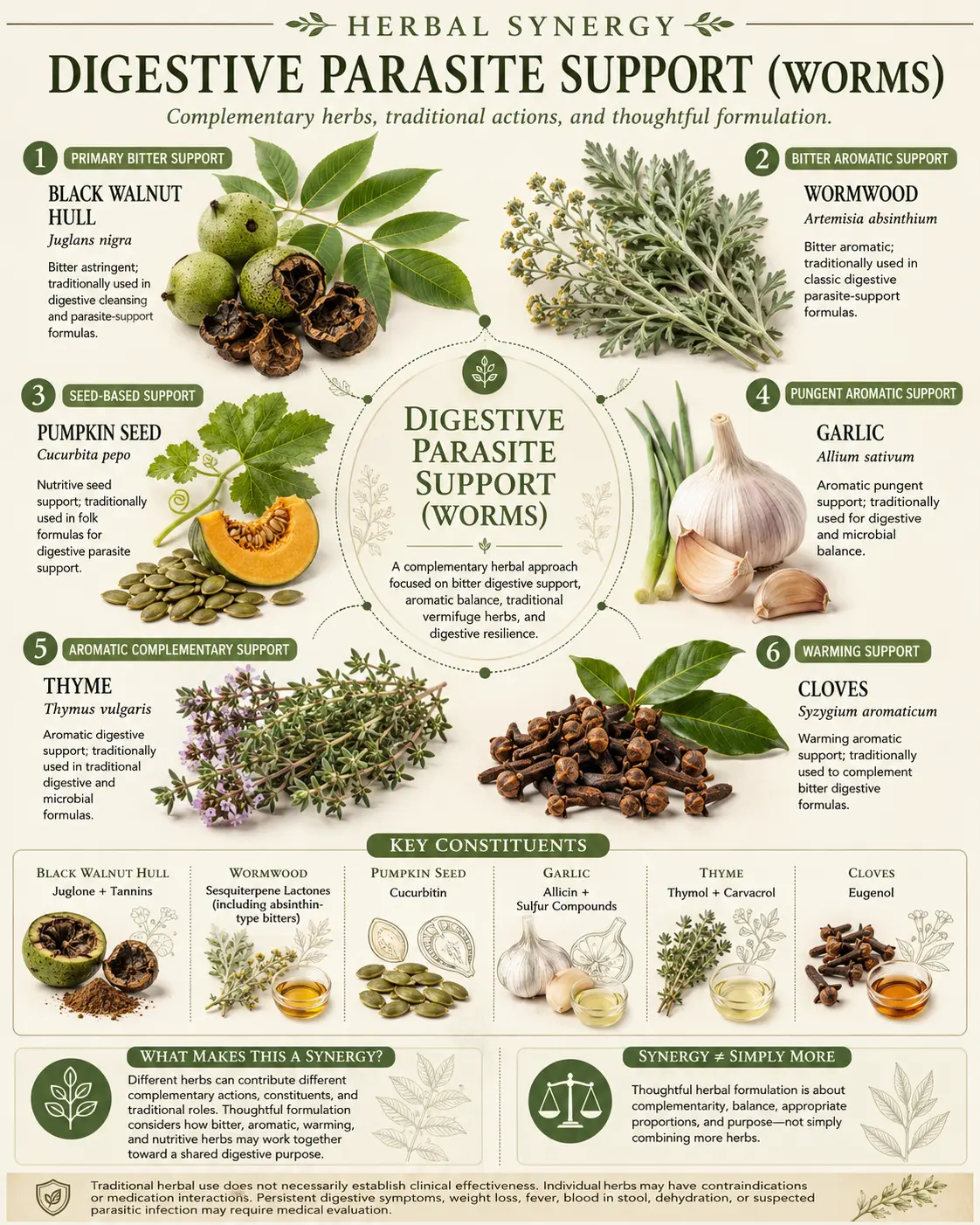
A note before we start: this article is specifically about traditional and evidence-informed support for a confirmed parasitic infection — not a general “parasite cleanse” for vague, undiagnosed symptoms. If you suspect a real parasitic infection, the right first step is proper diagnosis (a stool test, ordered by a healthcare provider), not guessing based on symptoms alone. Once a real infection is confirmed, prescription antiparasitic medications are highly effective, safe, and inexpensive — genuinely the evidence-based standard of care. The herbs below are best understood as traditional or complementary support, not a replacement for that.
This is a category where it’s worth being unusually direct about evidence quality, because a lot of what circulates online about “herbal parasite cleanses” is genuinely overstated. A couple of options here have real human clinical data; others are popular but rest almost entirely on lab studies and tradition.
| Herb/Food | What It Adds |
| Pumpkin Seed | The clear evidence leader — a real human clinical trial found it effective for expelling confirmed tapeworm infection |
| Papaya Seed | Also has genuine human clinical data, including a pediatric study, with activity against multiple parasite types |
| Black Walnut Hull | Widely marketed for this purpose, but the evidence is almost entirely in-vitro (lab dish) rather than human trials |
| Wormwood | Real antiparasitic activity in related species, but with genuine safety limits on dose and duration |
Pumpkin seed and papaya seed stand apart from the rest of this category because they actually have human clinical trial data behind them — genuinely uncommon for “parasite cleanse” ingredients. Black walnut hull and wormwood are the backbone of a very popular traditional combination (often marketed as a “3-herb cleanse”), but it’s honest to say their evidence is considerably thinner and their safety profile deserves more respect than casual “cleanse” marketing usually gives it.
Recipe for Digestive Parasite Support
Ground Pumpkin Seed & Papaya Seed Blend
Why this blend: Both ingredients have real human clinical evidence behind them, working through different mechanisms — pumpkin seed’s cucurbitin paralyzes parasite muscles, while papaya seed’s benzyl isothiocyanate works through a different metabolic disruption, giving broader coverage than either alone.
Ingredients
- 2 tbsp raw, hulled pumpkin seeds, ground into a paste or fine meal
- 1 tsp dried, ground papaya seeds
- Water or a small amount of honey, to make a paste
Yield: One serving
Preparation
- Grind the raw pumpkin seeds into a fine paste or meal using a blender or mortar and pestle.
- Mix in the ground papaya seeds.
- Add a small amount of water or honey to make the mixture easier to eat.
- Eat on an empty stomach in the morning.
How to Use This reflects the general approach used in the human trials behind this article — taken on an empty stomach, as a single application or over a few days as directed by a healthcare provider. This is not a “cleanse” to repeat indefinitely.
Herbalist’s Note Papaya seeds have a notably peppery, bitter taste — most people find them easier to take mixed into something rather than eaten plain.
Safety This is intended for a confirmed parasitic infection, ideally alongside medical guidance — not as an undirected, ongoing “cleanse” for vague symptoms.
Ready-to-Use Products With This Synergy
NOW Foods Raw Pumpkin Seeds Brand: NOW Foods Key herbs: Raw, hulled pumpkin seeds Why it fits: Whole, raw pumpkin seeds are the actual form used in the human clinical trial behind this article’s strongest evidence — a food-grade product like this reflects that study more directly than a processed extract capsule would. Buy: amazon.com
Terrasoul Superfoods Organic Papaya Seeds Brand: Terrasoul Superfoods Key herbs: Dried, organic papaya seeds Why it fits: A food-grade papaya seed product, reflecting the ingredient studied in the human clinical trial referenced in this article. Buy: amazon.com
Nature’s Way Black Walnut Hull Brand: Nature’s Way Key herbs: Black walnut hull Why it fits: Included for readers wanting the traditional black walnut option specifically — worth pairing this purchase with the honest evidence and safety context in this article rather than assuming its popularity reflects strong clinical proof. Buy: amazon.com
Herbal Synergies for Digestive Parasite Support
Different situations call for different levels of confidence in what you’re using. A confirmed tapeworm infection, diagnosed by a healthcare provider, is specifically where pumpkin seed has real, directly relevant human trial evidence — this is the best-matched use case in this entire article. Broader intestinal parasite concerns, including in children, is where papaya seed’s own human data applies. And the traditional black-walnut-and-wormwood approach, while extremely popular in wellness spaces, is better understood as a traditional practice with lab-level support than a clinically proven protocol — worth knowing that distinction clearly before choosing it.
As always: synergy is about thoughtful complementarity — not simply adding more herbs to the pot, and never a substitute for proper diagnosis when a real infection is suspected.
Core Herbal Synergy Combinations
Pumpkin Seed (with or without areca nut, under guidance) Best for: Confirmed tapeworm infection specifically — the best-evidenced use case in this article. Why it works: A real human clinical study in China treated confirmed tapeworm infections with ground pumpkin seed, achieving whole-worm expulsion in 75% of cases alone, rising to 89% when combined with areca nut extract. This is genuine, directly relevant human data — worth knowing that areca nut itself carries its own safety considerations and is best used under guidance rather than self-directed.
Pumpkin Seed + Papaya Seed Best for: Broader-spectrum support, since papaya seed’s evidence extends to protozoan parasites like Giardia, not just worms. Why it works: These two work through different mechanisms — pumpkin seed’s cucurbitin paralyzes helminth (worm) muscles, while papaya seed’s benzyl isothiocyanate showed activity against a broader range of organisms in its own human study, including amoeba and Giardia. This is the blend recipe above.
Papaya Seed Alone Best for: A gentler starting option, including for use in children under guidance, given its trial specifically included pediatric participants. Why it works: The human clinical study behind papaya seed’s evidence was conducted in children with no adverse effects reported at the doses used — a notably reassuring safety signal for a category where good pediatric data is rare.
Black Walnut + Wormwood (traditional combination) Best for: Readers specifically seeking the traditional herbal approach, with full awareness of its evidence limits. Why it works, and its real limits: This combination (often marketed with clove as a “3-herb protocol”) has real laboratory evidence for antiparasitic activity, but no published randomized controlled trials in humans confirm its effectiveness for actual parasite elimination. It also carries genuine safety considerations — wormwood’s thujone content limits how long it should be used, and black walnut’s juglone has been associated with liver strain in concentrated or prolonged use. This is a traditional approach, not a clinically validated one.
Herbs Used in These Synergies
Pumpkin Seed Botanical name: Cucurbita pepo Traditional actions: Traditional anthelmintic (anti-worm) Role in the synergy: The best-evidenced option in this article — a real human clinical trial in confirmed taeniasis (tapeworm) patients found ground pumpkin seed achieved whole-worm expulsion in 75% of cases, a genuinely strong result for a food-based intervention. Key constituents: Cucurbitin
Papaya Seed Botanical name: Carica papaya Traditional actions: Traditional anthelmintic Role in the synergy: Has its own human clinical trial data, notably including a pediatric study with no reported adverse effects, and evidence extending beyond worms to protozoan parasites like Giardia and amoeba — a broader spectrum than most herbs in this category. Key constituents: Benzyl isothiocyanate (BITC), papain
Black Walnut Hull Botanical name: Juglans nigra Traditional actions: Traditional antiparasitic Role in the synergy: Widely used and marketed for this purpose, with real in-vitro (lab dish) antiparasitic activity, but no published human clinical trials confirming effectiveness for actual parasite elimination — its popularity considerably outpaces its evidence tier. Key constituents: Juglone
Wormwood Botanical name: Artemisia absinthium Traditional actions: Traditional antiparasitic Role in the synergy: Related to Artemisia annua, the source of the genuinely proven antimalarial drug artemisinin — but this specific species and its traditional use for intestinal worms has much thinner human evidence, and carries a real safety limit due to its thujone content. Key constituents: Absinthin, thujone
Safety and When to Seek Medical Advice
This section matters more than usual for this topic. Please read it in full.
Get a proper diagnosis first. If you suspect a parasitic infection, the right first step is a stool test ordered by a healthcare provider, not self-diagnosis based on symptoms sometimes attributed to parasites online (fatigue, bloating, skin issues, and similar vague symptoms have many possible causes, and attributing them to an undiagnosed parasite without testing is a common source of health misinformation).
Use Caution If:
- You’re pregnant — most antiparasitic herbs, including wormwood and black walnut, are generally not recommended during pregnancy; some conventional antiparasitic medications are also restricted in pregnancy, which is exactly why proper diagnosis and medical guidance matter here
- You’re considering wormwood — its thujone content limits safe duration of use; extended or high-dose use has been associated with neurotoxic effects, and the FDA limits thujone content in consumable products for this reason
- You’re considering black walnut hull — avoid prolonged or high-dose use given real concerns about liver and kidney strain with concentrated extracts; this is not a “more is better” herb
- You’re on blood-thinning medication — black walnut has been noted to have potential effects on clotting; check with a provider before combining
- You’re treating a child — papaya seed has some reassuring pediatric safety data specifically, but check with a pediatrician before using any antiparasitic herb in a child, and never use wormwood or black walnut in children without direct medical guidance
See a Healthcare Professional If: You suspect a parasitic infection at all — this deserves proper stool testing, not guesswork. Also seek care if you have persistent gastrointestinal symptoms, unexplained weight loss, visible worms or worm segments in stool, or symptoms that don’t improve with initial treatment. Confirmed parasitic infections are generally very treatable with prescription antiparasitic medication, which is safe, effective, and often a single dose or short course — there’s no need to rely on herbs alone once a real diagnosis is made.
Q&A
Do herbal “parasite cleanses” actually work? It depends entirely on which herbs and which parasite. Pumpkin seed and papaya seed have real human clinical evidence behind specific uses. The popular black-walnut-and-wormwood “cleanse” combination has much weaker, mostly lab-based evidence — its popularity in wellness spaces outpaces what’s actually been proven in humans.
How do I know if I actually have parasites? A stool test (sometimes called an ova and parasites, or O&P, test) ordered by a healthcare provider is the reliable way to know. Symptoms alone — fatigue, bloating, digestive changes — have many possible causes and aren’t a reliable way to self-diagnose a parasitic infection.
Should I just use prescription medication instead of herbs? For a confirmed infection, prescription antiparasitic medication is genuinely the evidence-based standard of care — highly effective, safe, and often just a single dose or short course. Herbs here are best thought of as traditional or complementary support, not a replacement for that.
Is the pumpkin seed evidence really that strong? Yes, genuinely — a real human clinical trial in patients with confirmed tapeworm infection found meaningful expulsion rates, which is a notably higher evidence tier than most of what circulates in the “parasite cleanse” space.
Can I give these herbs to my child? Papaya seed has the most reassuring pediatric data specifically, from a study that included children with no adverse effects reported. Still, check with a pediatrician before using any antiparasitic herb in a child, and avoid wormwood or black walnut in children without direct medical guidance.
How long can I safely use wormwood or black walnut? Not indefinitely — wormwood’s thujone content limits safe duration, and black walnut’s juglone has been linked to liver and kidney strain with prolonged or concentrated use. Neither is meant for ongoing, repeated “cleansing.”
When should I see a doctor instead of trying herbs? If you suspect a parasitic infection at all. Proper testing and, if confirmed, prescription treatment is the reliable path — herbs are a complement to that process, not a substitute for diagnosis.
References
Pumpkin Seeds for Parasites: How Cucurbitin Works, Dosage & Evidence – Zuma Nutrition
Papaya Seeds for Parasites: How BITC Works, Dosage & Evidence – Zuma Nutrition
Anthelmintic Potential of Carica Papaya Seed Extracts in Paediatric Candies – IJPS Journal
Parasite Cleanse: What the Science Says – Supplement Science
Disclaimer
This article is for educational and informational purposes only and is not intended to diagnose, treat, cure, or prevent parasitic infection. It is not a substitute for proper medical diagnosis (including stool testing) or prescription antiparasitic treatment when a real infection is confirmed. Herbs are biologically active and may interact with medications or be inappropriate for some people, including during pregnancy or in children. If you suspect a parasitic infection, consult a qualified healthcare professional for proper testing and treatment rather than relying on herbal preparations alone.
Available Herbal Products
Explore and shop ready-made products offering this benefit.