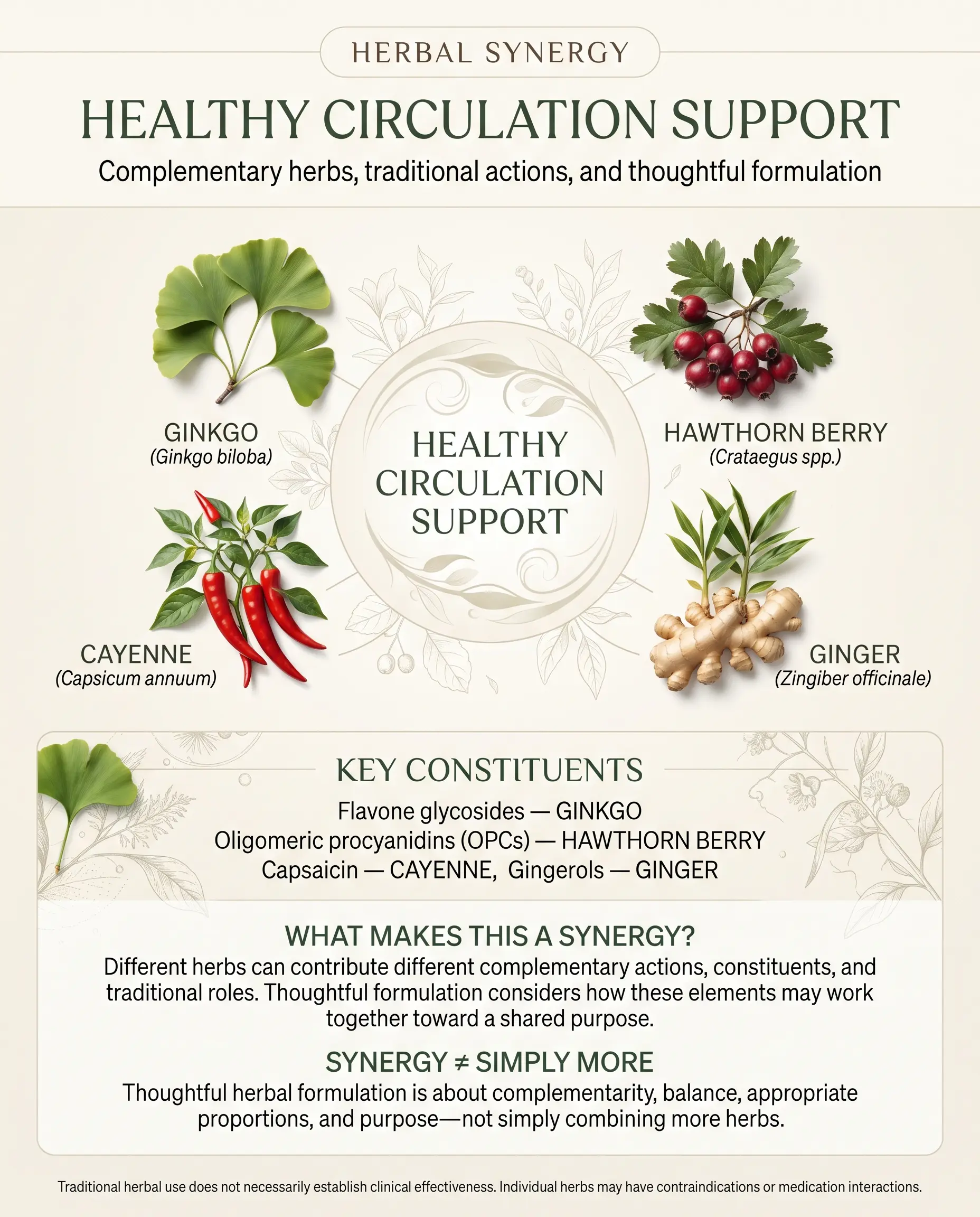
Circulation support in herbalism usually means one specific thing more than any other: chronic venous insufficiency (CVI) — the heavy, aching, swollen-leg feeling that comes from veins not efficiently returning blood from the legs to the heart. This is a category with one of the strongest evidence bases in all of herbal medicine, anchored by a genuinely substantial body of clinical trial data.
| Herb | What It Adds |
| Horse Chestnut | The clear evidence leader — a 17-trial Cochrane review supports it for leg swelling, pain, and heaviness |
| Butcher’s Broom | A traditional venous tonic, often paired with horse chestnut in commercial formulas |
| Centella Asiatica (Gotu Kola) | Real trial evidence specifically for venous hypertension and capillary filtration |
| Ginger | Traditionally included for its own circulatory-support reputation and warming quality |
Horse chestnut stands well above the others here — few herbs anywhere have 17 randomized controlled trials behind a single use, and this is one of them. Butcher’s broom and centella asiatica work through related but distinct traditional mechanisms (venous tone and capillary permeability, respectively), which is why they’re so often combined with horse chestnut in real commercial formulas rather than used alone.
Recipe for Healthy Circulation Support
Horse Chestnut & Ginger Circulation Tea
Why this blend: Horse chestnut has the strongest clinical evidence in this entire category for supporting healthy circulation in the legs, and ginger adds warmth and its own traditional circulatory reputation.
Ingredients
- 1 tsp dried horse chestnut seed (or follow a standardized extract product’s dosing instead — see note below)
- ½ tsp fresh grated ginger (or ¼ tsp dried)
- 1 cup (240 ml) hot water
Yield: 1 cup
Preparation
- Combine the horse chestnut and ginger in a small saucepan.
- Simmer gently for 10 minutes — horse chestnut is a tough seed and benefits from real heat.
- Strain and drink warm.
How to Use Honestly, a tea is not how horse chestnut was studied in the clinical trials behind this article — those used standardized extracts delivering a specific, measured amount of aescin (the active compound). If you want results closer to what the research actually showed, a standardized supplement is the more reliable choice; this tea is best thought of as a general, gentle habit rather than a substitute for that.
Herbalist’s Note Raw, unprocessed horse chestnut seed and leaf contain compounds that are toxic if eaten improperly prepared — this is one herb where sourcing a properly processed product matters more than usual.
Safety Never eat raw horse chestnut seeds — see the safety section below for why proper processing matters here specifically.
Ready-to-Use Products With This Synergy
Nature’s Way Horse Chestnut Extract Brand: Nature’s Way Key herbs: Horse chestnut seed extract, standardized to 20% aescin Why it fits: A standardized extract delivering a measured aescin dose, reflecting the form used in the clinical trials behind horse chestnut’s evidence for healthy leg circulation. Buy: naturesway.com
Nature’s Way Leg Veins Premium Blend Brand: Nature’s Way Key herbs: Horse chestnut, butcher’s broom, cayenne, dandelion, gotu kola, grape seed extract Why it fits: A six-herb blend combining horse chestnut with several of the other traditionally used circulation herbs discussed in this article, reflecting how these are typically combined in practice. Buy: amazon.com
Nature’s Herbs Veno-care Horse Chestnut Extract Brand: Nature’s Herbs Key herbs: Horse chestnut seed extract, butcher’s broom root, ginger root, rutin Why it fits: This is very close to an exact match to the horse-chestnut-and-ginger combination discussed in this article, with butcher’s broom and rutin added for additional traditional venous support. Buy: kroger.com
Herbal Synergies for Healthy Circulation Support
Not everyone reaching for “circulation support” has the same concern. Leg heaviness, aching, and visible swelling by the end of the day — the classic signs of chronic venous insufficiency — is where horse chestnut’s substantial evidence base applies most directly. General, milder support for venous tone, especially alongside horse chestnut, is where butcher’s broom and centella asiatica traditionally fit. And anyone specifically dealing with visible varicose veins or significant leg swelling should know this is a genuinely medical condition worth an initial evaluation, not just a “try some herbs” situation.
As always: synergy is about thoughtful complementarity — not simply adding more herbs to the pot.
Core Herbal Synergy Combinations
Horse Chestnut Alone Best for: The single most evidence-backed option, especially for leg swelling and heaviness. Why it works: A Cochrane systematic review of 17 randomized controlled trials found horse chestnut seed extract improved leg pain, edema (swelling), and itchiness when taken as capsules over two to sixteen weeks — genuinely one of the more substantial evidence bases behind any single herb covered in this entire content series.
Horse Chestnut + Butcher’s Broom Best for: A broader traditional approach to venous support, reflecting how these are most commonly combined commercially. Why it works: This is the pairing found in most real commercial venous-support products — horse chestnut brings the strongest individual evidence, while butcher’s broom adds a traditional venous-toning action, with some surveys finding physicians rate its efficacy for CVI symptoms quite favorably, even though its formal trial evidence is thinner than horse chestnut’s.
Horse Chestnut + Centella Asiatica Best for: Venous hypertension specifically, including symptoms tied to prolonged standing or sitting (like long flights). Why it works: Centella asiatica has its own genuine clinical trial evidence for reducing capillary filtration and edema in venous hypertension, including a placebo-controlled, dose-ranging trial — a complementary mechanism to horse chestnut’s own effects.
Horse Chestnut + Ginger Best for: A gentler, everyday habit alongside a standardized horse chestnut supplement. Why it works: Ginger adds warmth and its own traditional circulatory reputation, functioning as a supportive daily habit rather than a replacement for the standardized extract dosing that the clinical evidence is actually built on. This is the tea recipe above.
Herbs Used in These Synergies
Horse Chestnut Botanical name: Aesculus hippocastanum Traditional actions: Traditional venous tonic Role in the synergy: The best-evidenced herb in this entire article — a Cochrane review of 17 randomized trials found standardized horse chestnut seed extract (50-150 mg aescin/day) meaningfully reduced leg volume, pain, and heaviness in people with chronic venous insufficiency, with a generally favorable safety profile. Key constituents: Aescin (a saponin complex)
Butcher’s Broom Botanical name: Ruscus aculeatus Traditional actions: Traditional venous tonic Role in the synergy: A long-standing European herb for venous circulation, commonly combined with horse chestnut in commercial formulas — physician surveys have rated its perceived efficacy favorably, though its own formal clinical trial base is considerably smaller than horse chestnut’s. Key constituents: Ruscogenins (steroidal saponins)
Centella Asiatica (Gotu Kola) Botanical name: Centella asiatica Traditional actions: Traditional circulatory and wound-support herb Role in the synergy: Has its own genuine clinical trial support specifically for venous hypertension — a placebo-controlled, dose-ranging trial found it reduced capillary filtration and edema, a different but complementary mechanism to horse chestnut’s action. Key constituents: Triterpenoid saponins (asiaticoside, madecassoside)
Ginger Botanical name: Zingiber officinale Traditional actions: Warming, traditionally circulatory-supportive Role in the synergy: Included for its traditional warming and circulatory reputation, functioning as a gentle daily complement rather than a primary evidence-driven component of this combination. Key constituents: Gingerols, shogaols
Safety and When to Seek Medical Advice
Use Caution If:
- You’re taking blood-thinning medication, including warfarin, heparin, or even regular aspirin — horse chestnut can potentiate anticoagulant effects and this combination can be genuinely hazardous; use only under direct medical supervision if combining
- You’re pregnant, breastfeeding, or trying to conceive — no safety data exists for horse chestnut in these situations, so it’s best avoided
- You have a kidney disorder or bleeding disorder — check with a provider before using horse chestnut or butcher’s broom
- You’re considering raw, unprocessed horse chestnut — never eat raw horse chestnut seeds, leaves, or bark; they contain compounds that are genuinely toxic when improperly prepared, which is exactly why standardized, properly processed extracts matter here
- You’re allergic to ragweed or related plants — some circulation-support blends include herbs from this plant family; check labels and patch test if sensitive
See a Healthcare Professional If: Leg swelling is sudden, one-sided, or accompanied by pain, warmth, or redness (which can indicate a blood clot and needs immediate medical attention, not herbal support), or if you notice visible varicose veins, skin changes, or ulceration developing. Chronic venous insufficiency itself deserves an initial medical evaluation to confirm the diagnosis and rule out other causes of leg swelling, even though herbal support can be a reasonable complement to standard treatment (like compression stockings) afterward.
Q&A
What’s the best-evidenced herb for circulation here? Horse chestnut, without question — a 17-trial Cochrane systematic review supports it for reducing leg pain, swelling, and heaviness in chronic venous insufficiency, which is a substantial evidence base for any herb, let alone one this well-studied.
Is a horse chestnut tea as good as the supplement studies? No, honestly — the clinical trials used standardized extracts with a measured aescin dose, not tea. A tea can be a pleasant daily habit, but if you want results closer to what the research actually showed, a standardized supplement is the more reliable choice.
Is it safe to eat horse chestnut seeds directly? No — raw, unprocessed horse chestnut is genuinely toxic. Always use a properly processed, standardized product rather than raw seeds, leaves, or bark.
Can I take horse chestnut with my blood thinner? Not without your doctor’s direct involvement — horse chestnut can amplify the effect of blood thinners like warfarin, heparin, or even aspirin, which is a real safety concern, not a minor caution.
What’s the difference between horse chestnut and butcher’s broom? Horse chestnut has by far the stronger clinical trial base. Butcher’s broom is more traditional, commonly combined with horse chestnut in real products, and has more physician-reported (rather than rigorously trial-tested) support for its efficacy.
Which combination is gentlest? Ginger alone, or ginger alongside a standardized horse chestnut supplement rather than a stronger multi-herb blend — a good starting point before considering a fuller combination.
When should I see a doctor instead of trying herbs? If leg swelling is sudden, one-sided, or comes with pain, warmth, or redness — those need immediate medical attention to rule out a blood clot. And any chronic venous insufficiency diagnosis is worth an initial medical evaluation before self-managing with herbs alone.
References
Horse Chestnut Seed Extract for Long-Term or Chronic Venous Insufficiency – Cochrane
Horse Chestnut Seed Extract for Chronic Venous Insufficiency – Cochrane Library
Horse Chestnut Seed Extract – Clinical Advisor
Botanicals for Chronic Venous Insufficiency – Academia.edu (Angiology)
Disclaimer
This article is for educational and informational purposes only and is not intended to diagnose, treat, cure, or prevent disease. Herbs are biologically active and may interact with medications or be inappropriate for some people. If you are pregnant, breastfeeding, taking medication, managing a health condition, or experiencing persistent or severe symptoms, consult a qualified healthcare professional before using herbal preparations.
Available Herbal Products
Explore and shop ready-made products offering this benefit.