

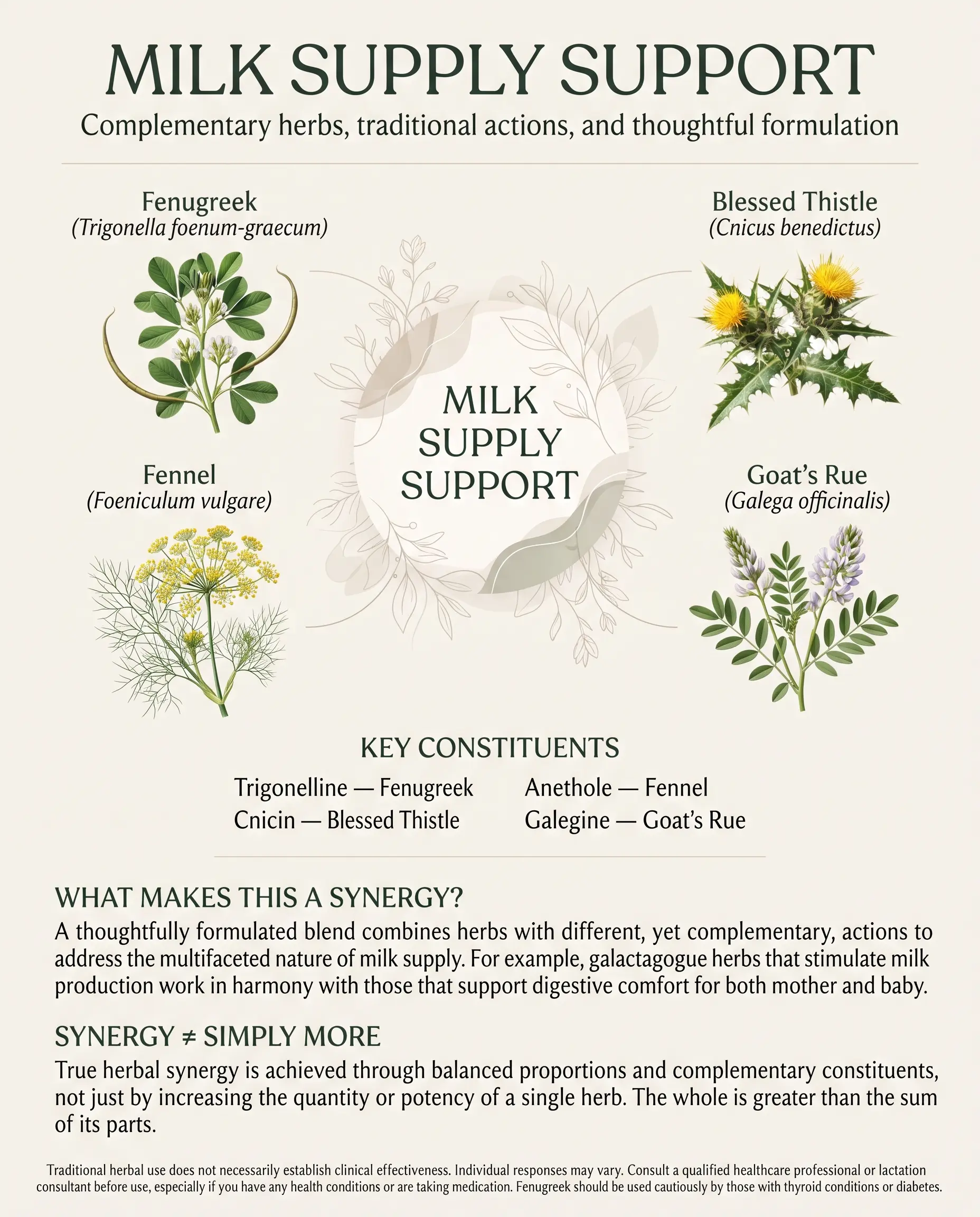
A note before we start: if you’re concerned about low milk supply, the single most useful first step is usually seeing an IBCLC (International Board Certified Lactation Consultant) or your provider — not reaching for herbs. Most low-supply concerns come down to how often and how effectively milk is being removed (feeding or pumping frequency and technique), not a herb deficiency, and a lactation consultant can identify and address that directly. Herbs discussed here are a possible complement to that support, not a substitute for it.
Herbal galactagogues (milk-supply herbs) are some of the most widely used herbs in all of herbalism, and also some of the most honestly under-evidenced — it’s worth knowing that going in, rather than assuming popularity equals proof.
| Herb | What It Adds |
| Fenugreek | The most studied option, though the evidence is genuinely mixed — some analyses show benefit, others find no advantage over placebo |
| Blessed Thistle | Traditionally paired with fenugreek, though with even less direct evidence on its own |
| Fennel | A gentler, traditional addition, also used for infant gas relief through breastmilk |
| Moringa | Among the better-evidenced herbal options, though high-quality trials are still limited |
It’s worth being direct: this is a category where tradition runs well ahead of proof. Fenugreek is the most-studied herb here, but recent, more rigorous analyses have found it isn’t clearly better than placebo — a real, meaningful caveat given how commonly it’s recommended. None of the herbs in this article should be seen as a fix for a genuine supply problem; they’re best understood as a low-risk complement alongside addressing the actual, usually mechanical, causes of low supply.
Recipe for Milk Supply Support
Fenugreek, Fennel & Blessed Thistle Tea
Why this blend: This reflects the most traditional and commonly used lactation herb combination, pairing fenugreek (the most studied option) with fennel and blessed thistle, which are traditionally included alongside it.
Ingredients
- 1 tsp fenugreek seeds
- 1 tsp fennel seeds
- ½ tsp dried blessed thistle
- 1 cup (240 ml) hot water
Yield: 1 cup
Preparation
- Combine all three ingredients in a mug or infuser.
- Pour hot water over the herbs and cover.
- Steep, covered, for 10 minutes.
- Strain and drink warm, up to 3 times daily.
How to Use Give it several days of consistent use before deciding whether it’s helping — and remember that frequent, effective milk removal matters more than any herb here.
Herbalist’s Note Don’t be alarmed if your milk, sweat, or urine starts smelling like maple syrup after starting fenugreek — this is a well-known, completely harmless effect, not a sign anything is wrong.
Safety Skip this if you or your baby have a legume allergy, and check with a provider first if you have diabetes or take blood-thinning medication — see the safety section below.
Ready-to-Use Products With This Synergy
Traditional Medicinals Organic Mother’s Milk Tea Brand: Traditional Medicinals Key herbs: Fennel, anise, coriander, fenugreek, blessed thistle Why it fits: This is very close to the exact combination discussed in this article, a long-standing, lactation-consultant-recommended formula that’s been used for over 40 years. Buy: traditionalmedicinals.com
Motherlove More Milk Plus Brand: Motherlove Key herbs: Fenugreek, blessed thistle, nettle, fennel Why it fits: A liquid extract version of the same core combination, for readers who prefer drops over tea. Buy: amazon.com
Legendairy Milk Brewer’s Yeast Powder Brand: Legendairy Milk Key herbs: Not herb-based (brewer’s yeast) Why it fits: Included as an alternative for anyone specifically avoiding fenugreek — brewer’s yeast is a traditional lactation-cookie ingredient with a different profile and no legume-allergy concern. Buy: amazon.com
Herbal Synergies for Milk Supply Support
Before reaching for any combination, it’s worth understanding what’s actually driving a supply concern. If milk removal is infrequent or not fully effective — a common and very fixable issue — that’s the priority to address first, ideally with an IBCLC’s help, since no herb reliably compensates for that. Once removal itself is optimized and a genuine supply boost still feels wanted, fenugreek-based combinations are the most traditional and commonly used option, despite their mixed formal evidence. And for anyone with a legume allergy or fenugreek sensitivity, there are gentler alternatives worth knowing about.
As always: synergy is about thoughtful complementarity — not simply adding more herbs to the pot, and never a substitute for addressing the underlying cause of a supply concern.
Core Herbal Synergy Combinations
Fenugreek + Blessed Thistle Best for: The most traditional, commonly recommended combination. Why it works: This is the classic pairing found in most commercial lactation products, though it’s worth being honest that direct trial evidence for the combination specifically is limited — one small trial found it modestly better than fenugreek alone, but this wasn’t replicated in a larger study. It’s popular more because of tradition than because of strong combination-specific proof.
Fenugreek + Fennel Best for: Supply support alongside possible infant gas relief. Why it works: Fennel is traditionally included partly because its carminative properties may pass through breastmilk and help with infant gas — a complementary benefit alongside fenugreek’s own (mixed) evidence for milk volume.
Moringa Alone Best for: An alternative for anyone wanting to avoid fenugreek’s legume-family status. Why it works: Some reviews describe moringa as having “some of the stronger” evidence among herbal galactagogues, though high-quality randomized trials remain limited overall. Worth knowing one lactation-focused clinical resource has flagged a theoretical concern about its effect on blood clotting, which is part of why it’s presented here as a standalone option rather than stacked with other herbs.
Brewer’s Yeast (non-herbal alternative) Best for: Anyone avoiding fenugreek specifically due to allergy or sensitivity. Why it works: A traditional lactation-support ingredient (often baked into “lactation cookies”) that isn’t part of the legume family and doesn’t carry fenugreek’s specific allergy and blood-sugar considerations — a reasonable alternative rather than a directly comparable substitute.
Herbs Used in These Synergies
Fenugreek Botanical name: Trigonella foenum-graecum Traditional actions: Traditional galactagogue Role in the synergy: The most-studied herb in this category, but genuinely mixed evidence — one meta-analysis found a significant increase in milk volume versus placebo, while a separate, more recent analysis concluded there’s no good evidence it outperforms placebo. Both conclusions come from legitimate research; the honest summary is that it may help some, but the evidence doesn’t clearly establish a reliable effect. Key constituents: Diosgenin (a phytoestrogen), soluble fiber
Blessed Thistle Botanical name: Cnicus benedictus Traditional actions: Traditional galactagogue, traditionally paired with fenugreek Role in the synergy: Almost always used alongside fenugreek rather than alone, though direct evidence for its own galactagogue effect — or for the combination specifically — is limited. Key constituents: Cnicin (a bitter compound)
Fennel Botanical name: Foeniculum vulgare Traditional actions: Traditional galactagogue, carminative Role in the synergy: Included partly for its own traditional galactagogue reputation and partly because its gas-easing properties may benefit a nursing infant through breastmilk. Key constituents: Anethole, fenchone
Moringa Botanical name: Moringa oleifera Traditional actions: Traditional galactagogue Role in the synergy: Among the better-regarded herbal options in terms of existing evidence, though the overall research base across all herbal galactagogues remains thin — worth knowing this is a relative, not absolute, endorsement. Key constituents: Various vitamins, minerals, and phytonutrients
Safety and When to Seek Medical Advice
This section matters more than usual for this topic. Please read it in full.
Use Caution If:
- You or your baby have a legume allergy — fenugreek is part of the legume family and can cause allergic reactions, including in breastfed infants
- You have diabetes or take blood sugar-lowering medication — fenugreek and goat’s rue can both lower blood sugar, and combining them with diabetes medication needs medical guidance to avoid hypoglycemia
- You take blood-thinning medication — some galactagogue herbs (including goat’s rue) can affect bleeding risk
- You have a thyroid condition — fenugreek has been noted to potentially affect thyroid hormone levels; check with a provider if you have hypothyroidism
- You’re combining multiple galactagogue herbs or products at once — there’s a documented case of infant drowsiness, poor suckling, and lethargy linked to a mother using a multi-herb lactation tea combination; stick to one well-established product or combination rather than stacking several
See a Healthcare Professional If: Your baby seems unusually sleepy, floppy, or has trouble suckling after you start any herbal galactagogue — stop and seek guidance. Also seek support if low supply is persistent despite frequent, effective milk removal, since this deserves proper evaluation (which can include checking for retained placental tissue, thyroid issues, or other underlying causes) rather than ongoing herbal trial-and-error. An IBCLC is often the right first call for any supply concern, herbs or not.
Q&A
Does fenugreek actually work? Honestly, the evidence is mixed. Some studies and meta-analyses find a real increase in milk volume; a separate, more rigorous analysis found no clear advantage over placebo. It may genuinely help some mothers and not others, which matches what many lactation consultants report anecdotally.
Why does my milk smell like maple syrup? That’s a well-known, completely harmless effect of fenugreek — it shares a flavor compound with artificial maple flavoring, and it can show up in sweat, tears, urine, and breastmilk. It’s not a sign of any problem.
Should I try herbs first, or see a lactation consultant first? A lactation consultant, generally. Most supply concerns come down to how often and how effectively milk is being removed, which herbs can’t fix — an IBCLC can identify the actual issue and address it directly, with herbs as a possible complement rather than a first-line fix.
Can I combine several different lactation herbs or products at once? It’s safer not to stack multiple products or strong combinations without guidance — there’s a documented case of infant lethargy and poor suckling linked to a mother using a multi-herb combination tea. Pick one well-established option rather than layering several.
Is moringa better than fenugreek? Some reviews describe it as having relatively stronger evidence among herbal options, but the overall research quality across this whole category is limited. It’s a reasonable alternative, particularly for someone avoiding fenugreek specifically, rather than a clearly superior choice.
What if herbs don’t seem to be working? That’s common, and it doesn’t necessarily mean something is wrong — it may mean the actual driver of low supply is something herbs don’t address, like feeding frequency or latch. This is exactly the situation where an IBCLC’s evaluation is more useful than trying another herb.
When should I see a professional instead of continuing to try herbs? If your baby seems unusually sleepy or has trouble feeding after starting any herbal product, or if low supply persists despite frequent and effective milk removal — those situations need real evaluation, not continued herbal trial-and-error.
References
Effectiveness of Fenugreek as a Galactagogue: A Network Meta-Analysis – PubMed
Fenugreek – Drugs and Lactation Database (LactMed), NCBI Bookshelf
Goat’s Rue – Drugs and Lactation Database (LactMed), NCBI Bookshelf
Galactagogue – ScienceDirect Topics Overview
Galactagogues: A Physician’s Guide – Mama’s Milkworks
Disclaimer
This article is for educational and informational purposes only and is not intended to diagnose, treat, cure, or prevent any condition. It is not a substitute for guidance from an IBCLC (International Board Certified Lactation Consultant) or your healthcare provider, particularly for genuine or persistent low milk supply concerns. Herbs are biologically active and may interact with medications, affect blood sugar or thyroid function, or be inappropriate for some people, and can pass into breastmilk and affect a nursing infant. If your baby shows any unusual symptoms after you start an herbal product, or if supply concerns persist, consult a qualified healthcare professional or lactation consultant promptly.
Available Herbal Products
Explore and shop ready-made products offering this benefit.