

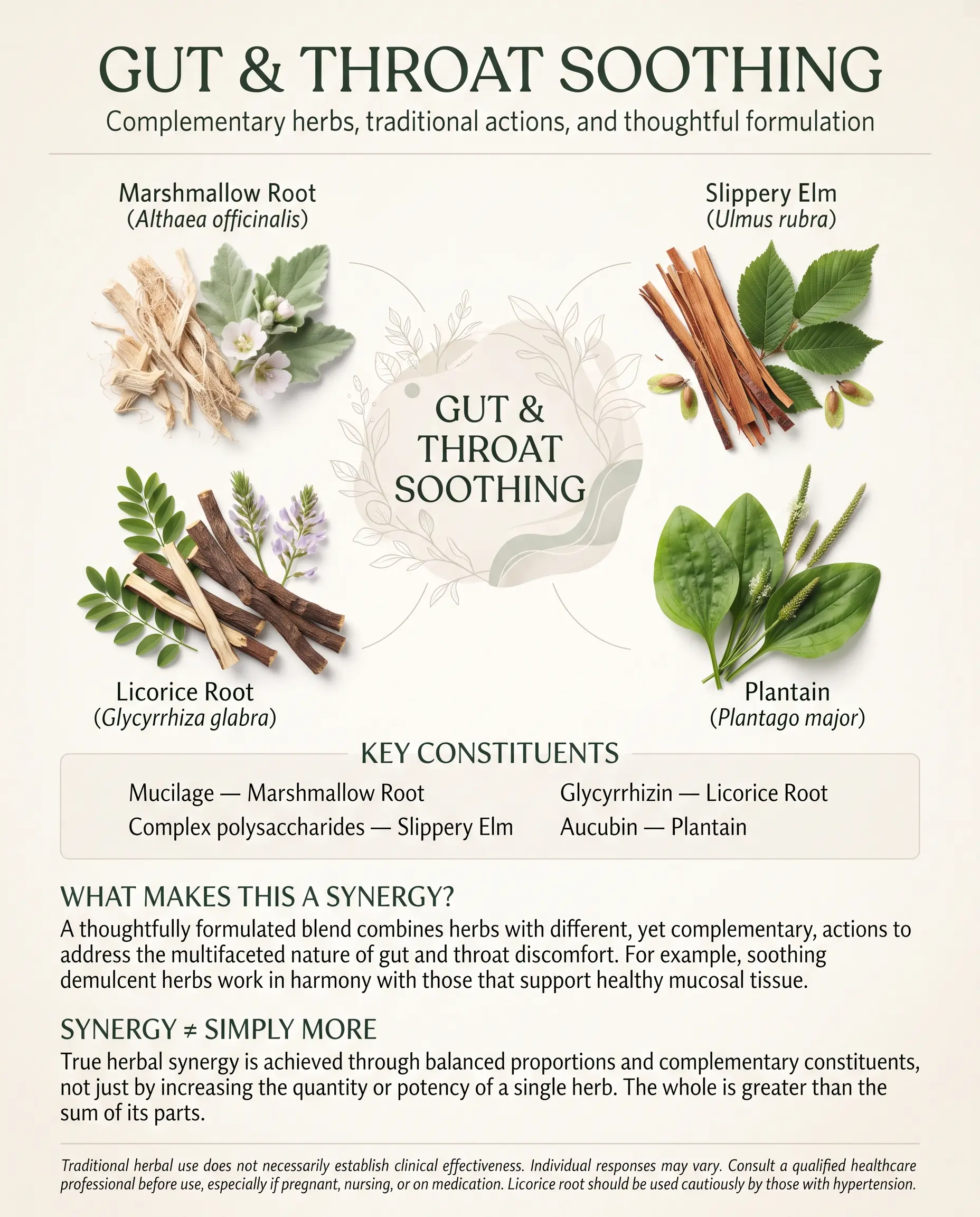
Demulcents are herbs rich in mucilage — a gel-like substance that coats and soothes irritated tissue, from the throat all the way down through the esophagus and stomach. This category has a genuinely interesting mechanistic story: the two main approaches here work in completely different ways, which is exactly why combining them makes sense.
| Herb | What It Adds |
| DGL Licorice | Works internally — stimulates the body’s own protective mucus production, with real clinical trial support for reflux |
| Marshmallow Root | A physical, gel-like coating with the highest mucilage content of the demulcent herbs |
| Slippery Elm | Another physical coating herb, with the strongest regulatory recognition of anything in this category |
| Chamomile | Adds a calming, anti-inflammatory quality alongside the coating herbs |
This is worth understanding clearly: DGL licorice and the mucilage herbs (marshmallow, slippery elm) aren’t redundant — DGL works by stimulating your own mucus production and has genuine anti-inflammatory effects, while marshmallow and slippery elm provide an external, physical coating. Combining an internal stimulant with an external coating covers the irritated tissue from two different angles at once.
Recipe for Gut & Throat Soothing
Marshmallow Root & Slippery Elm Coating Tea
Why this blend: Both herbs work through the same mucilage-coating mechanism, and combining them creates an especially thick, soothing coating that reaches from the throat down through the esophagus and stomach.
Ingredients
- 1 tsp dried marshmallow root
- 1 tsp slippery elm bark powder
- 1 cup (240 ml) hot water
Yield: 1 cup
Preparation
- Combine the marshmallow root and slippery elm in a mug or infuser.
- Pour hot water over the herbs and cover.
- Steep, covered, for 10–15 minutes — the longer steep helps release the mucilage fully.
- Strain (the tea will be noticeably thick and slippery) and drink warm.
How to Use Drink after meals and before bed, when reflux-related irritation is often most noticeable. Sip slowly to give the coating time to work its way down.
Herbalist’s Note This tea’s thick, slippery texture is exactly the mucilage doing its job — some people mix in a little honey to make the texture more palatable without losing the effect.
Safety Take this tea 1–2 hours apart from any medications, since the mucilage coating can slow how well your body absorbs them.
Ready-to-Use Products With This Synergy
Integrative Therapeutics Rhizinate (GutGard DGL) Brand: Integrative Therapeutics Key herbs: Deglycyrrhizinated licorice (GutGard extract) Why it fits: This is the exact clinically-studied DGL extract used in the reflux and functional dyspepsia trials referenced in this article, in a chewable format designed to mix with saliva for faster action. Buy: integrativepro.com
Traditional Medicinals Organic Throat Coat Tea Brand: Traditional Medicinals Key herbs: Slippery elm, licorice root, marshmallow root Why it fits: A ready-made tea combining the physical-coating herbs discussed in this article, useful for both throat and general upper-digestive soothing. Buy: traditionalmedicinals.com
Gaia Herbs Reflux Relief Brand: Gaia Herbs Key herbs: Aloe vera, marshmallow root, chamomile, licorice Why it fits: A chewable tablet combining several demulcent herbs into one convenient after-meal format. Buy: amazon.com
Herbal Synergies for Gut & Throat Soothing
Not all irritation calls for the same demulcent. Occasional reflux and heartburn-type discomfort is where DGL licorice’s clinical trial evidence is strongest, since it’s specifically been tested for exactly that. General throat and esophageal irritation — from acid, from a cough, or just general sensitivity — is where the physical-coating herbs (marshmallow root, slippery elm) fit best, since their whole mechanism is a protective barrier rather than a targeted internal effect. And broader upper-digestive discomfort, gastritis-type irritation, benefits from combining both approaches.
As always: synergy is about thoughtful complementarity — not simply adding more herbs to the pot.
Core Herbal Synergy Combinations
DGL Licorice + Marshmallow Root Best for: Reflux-type discomfort with some throat involvement. Why it works: DGL has real, direct clinical trial evidence for improving reflux symptoms and quality of life, working by stimulating the body’s own protective mucus production and anti-inflammatory action. Marshmallow root adds physical, external coating on top of that internal support — two genuinely different mechanisms working together rather than duplicating each other.
Marshmallow Root + Slippery Elm Best for: General throat and esophageal irritation, especially reaching further down than a typical throat-only remedy. Why it works: Both work through the same mucilage-coating mechanism, but combining them creates an especially thick coating and covers slightly different polysaccharide profiles between the two plants. This is the tea recipe above.
DGL Licorice Alone Best for: Someone who wants the single most clinically-tested option for reflux specifically. Why it works: A phase III randomized, placebo-controlled trial of 200 adults found DGL led to clinically significant improvement in heartburn and regurgitation starting from the second week of treatment — a genuinely well-designed trial, not just traditional use.
Marshmallow Root + Chamomile Best for: A gentler combination when inflammation and general sensitivity are the main issue, rather than acid-related discomfort specifically. Why it works: Marshmallow provides the physical coating while chamomile adds an anti-inflammatory, calming quality — a milder pairing than the DGL combinations, well suited to general upper-digestive sensitivity.
Herbs Used in These Synergies
DGL Licorice (Deglycyrrhizinated Licorice) Botanical name: Glycyrrhiza glabra (with glycyrrhizin removed) Traditional actions: Demulcent, traditionally used for peptic ulcers and reflux Role in the synergy: The best clinically-evidenced herb in this article — a randomized, placebo-controlled trial of 200 adults found DGL significantly improved GERD symptoms, and separate trials found it comparable to omeprazole for functional dyspepsia. The glycyrrhizin removal specifically addresses licorice’s main safety concern (blood pressure effects) while retaining much of its digestive benefit. Key constituents: Glabridin, flavonoids (glycyrrhizin removed)
Marshmallow Root Botanical name: Althaea officinalis Traditional actions: Demulcent Role in the synergy: Has among the highest mucilage content of any demulcent herb, forming a coating that reaches from the throat through the esophagus and into the stomach — well suited to conditions like LPR (laryngopharyngeal reflux) where the upper throat is involved. Key constituents: Mucilage (polysaccharides)
Slippery Elm Botanical name: Ulmus rubra Traditional actions: Demulcent Role in the synergy: Has the strongest regulatory recognition of any herb in this article — the FDA’s OTC monograph specifically recognizes slippery elm inner bark as a safe demulcent for sore throat irritation, a distinction very few herbal ingredients carry. Key constituents: Mucilage (rhamnose, galacturonic acid, galactose polysaccharides)
Chamomile Botanical name: Matricaria chamomilla Traditional actions: Anti-inflammatory, calming Role in the synergy: Adds a calming, anti-inflammatory quality that complements the physical coating provided by marshmallow and slippery elm, rather than coating tissue itself. Key constituents: Bisabolol, chamazulene, apigenin
Safety and When to Seek Medical Advice
Use Caution If:
- You’re taking any oral medication — mucilage from marshmallow root or slippery elm can slow medication absorption; take these herbs 1–2 hours apart from any prescription drugs, and confirm with a pharmacist
- You’re using full-strength (non-deglycyrrhizinated) licorice regularly — this can raise blood pressure and cause fluid retention; DGL specifically has had the concerning glycyrrhizin compound removed for this reason
- You have kidney disease — check with a provider before regular use of DGL, since licorice-related compounds are processed by the kidneys
- You’re pregnant or breastfeeding — check with a provider before regular use of concentrated demulcent extracts, particularly DGL
- You have a swallowing disorder or esophageal narrowing — dry, unsoaked soluble fiber preparations have rarely been associated with esophageal obstruction; always prepare these herbs properly hydrated, as directed
See a Healthcare Professional If: Reflux or digestive discomfort is severe, persistent, or accompanied by difficulty swallowing, unintentional weight loss, vomiting blood, or black/tarry stools. Frequent, ongoing reflux symptoms deserve proper medical evaluation, since they can occasionally point to something beyond simple irritation that needs its own diagnosis and treatment.
Q&A
What’s the difference between DGL and the mucilage herbs? DGL works internally, stimulating your body’s own protective mucus production with genuine anti-inflammatory effects. Marshmallow root and slippery elm work externally, providing a physical, gel-like coating over irritated tissue. They’re complementary rather than interchangeable.
Is DGL actually as good as medication for reflux? One trial found DGL comparable to omeprazole for functional dyspepsia specifically, and a separate large trial found real, clinically significant improvement in GERD symptoms. That’s genuinely strong evidence for an herbal approach, though it shouldn’t replace prescribed treatment without a doctor’s involvement for anyone with diagnosed GERD.
Why is DGL different from regular licorice? Regular licorice contains glycyrrhizin, a compound that can raise blood pressure and cause fluid retention with regular use. DGL has had this compound specifically removed, retaining much of licorice’s digestive benefit while addressing its main safety concern.
Can I take these herbs with my medications? Space them 1–2 hours apart — the mucilage in marshmallow root and slippery elm can slow how well your body absorbs other things taken at the same time, including medications.
Which combination is gentlest? Marshmallow root and chamomile — no licorice-related considerations, just physical coating and calming action.
Can I use these every day? Yes, that’s generally how they’re intended to be used — DGL is typically taken before or after meals regularly, and mucilage teas can be part of a daily routine, ideally spaced apart from medications.
When should I see a doctor instead of trying herbs? If reflux or digestive discomfort is severe, persistent, or comes with difficulty swallowing, unexplained weight loss, or any sign of bleeding (vomiting blood, black stools) — those need medical evaluation, not ongoing herbal management.
References
Deglycyrrhizinated Licorice for Gastroesophageal Reflux – Clinical Trial Summary
Demulcent – ScienceDirect Topics Overview
Slippery Elm 101: Is It Worth Taking? – Rupa Health
Disclaimer
This article is for educational and informational purposes only and is not intended to diagnose, treat, cure, or prevent disease. Herbs are biologically active and may interact with medications or be inappropriate for some people. If you are pregnant, breastfeeding, taking medication, managing a health condition, or experiencing persistent or severe symptoms, consult a qualified healthcare professional before using herbal preparations.
Available Herbal Products
Explore and shop ready-made products offering this benefit.