

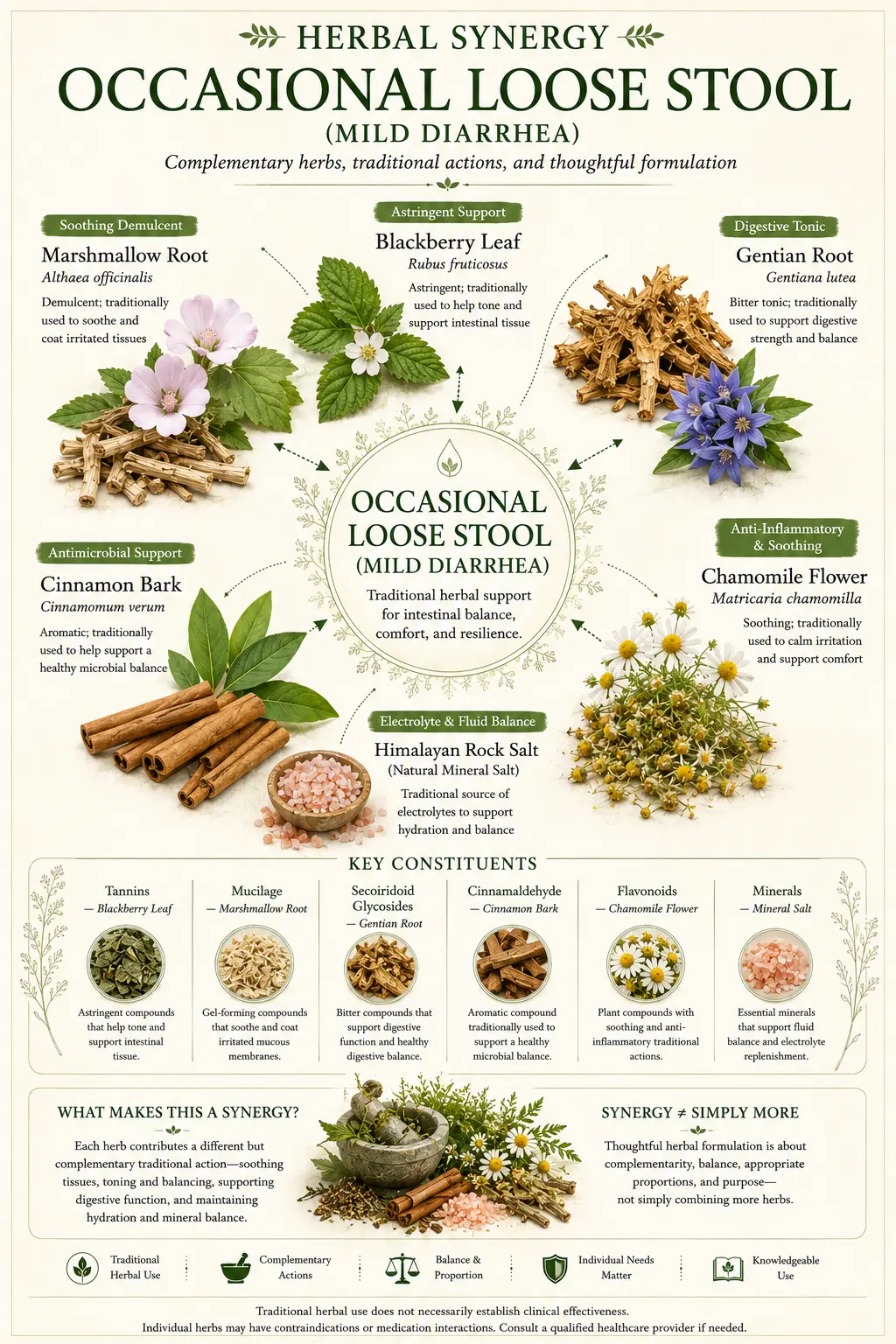
A note before we start: this article covers herbal support for mild, occasional loose stool in otherwise healthy people. Diarrhea’s biggest real risk — especially in young children and older adults — is dehydration, not the loose stool itself. The safety section below covers exactly when this needs medical attention instead of herbal support, and it’s worth reading before you need it.
Occasional loose stool usually benefits from two different actions working together: something astringent to help firm things up, and something soothing to calm an irritated gut in the meantime. This is a category with better direct clinical trial evidence than you might expect from herbalism.
| Herb | What It Adds |
| Tormentil Root | The standout here — a real randomized trial found it significantly shortened diarrhea duration in children |
| Apple Pectin + Chamomile | This exact combination has been tested in two separate clinical trials with positive results |
| Chamomile (alone) | Traditionally antispasmodic, calming gut irritation and cramping |
| Psyllium | A bulk-forming fiber that can help firm loose stool by absorbing excess water |
Tormentil is genuinely the evidence leader in this category — its tannin content has a real, demonstrated astringent effect. The apple-pectin-and-chamomile combination is equally notable, since it’s one of the few herbal combinations in this whole content series tested directly as a pairing, not just assembled from separate single-herb studies. Psyllium works completely differently, through bulk and water absorption rather than astringency.
Recipe for Occasional Loose Stool
Tormentil & Chamomile Settling Tea
Why this blend: Tormentil root has genuine clinical trial support for shortening diarrhea duration, and chamomile adds a calming, antispasmodic quality for the cramping that often comes along with loose stool.
Ingredients
- 1 tsp dried tormentil root
- 1 tsp dried chamomile flowers
- 1 cup (240 ml) hot water
Yield: 1 cup
Preparation
- Combine the tormentil root and chamomile in a mug or small saucepan.
- If simmering the tormentil (it’s a tough root and benefits from this), cook gently for 5–10 minutes, then add chamomile and steep off heat for 5 more minutes; if just steeping, pour hot water over both and cover.
- Steep, covered, for 10 minutes total.
- Strain and drink warm, up to 3 times a day while symptoms last.
How to Use Drink alongside plenty of fluids and, ideally, an oral rehydration solution if diarrhea is frequent — the tea supports comfort, but fluid replacement is the priority.
Herbalist’s Note Tormentil has a distinctly astringent, mouth-puckering taste — that’s the tannin content doing exactly what it’s meant to do.
Safety This is for mild, short-term loose stool only — see the safety section below for when this needs medical attention instead.
Ready-to-Use Products With This Synergy
A.Vogel Tormentil Complex Brand: A.Vogel Key herbs: Fresh tormentil root, oat herb (Avena sativa) Why it fits: A tormentil-based liquid extract reflecting the herb with the strongest clinical trial evidence in this article, traditionally used for diarrhea and IBS-related symptoms. Buy: victoriahealth.com
Diarrhoesan Apple Pectin & Chamomile Juice Brand: Diarrhoesan Key herbs: Apple pectin, chamomile flower extract Why it fits: This is the exact combination tested in two separate randomized, placebo-controlled trials for diarrhea, suitable from age 2 and with a mild fruit flavor. Buy: eliveragroup.co.uk
Pure Naturals Apple Pectin Capsules Brand: Pure Naturals Key herbs: Apple pectin Why it fits: A single-ingredient pectin supplement for readers who want to try the pectin side of the evidence-backed combination on its own, or pair it with a chamomile tea separately. Buy: walmart.com
Herbal Synergies for Occasional Loose Stool
Not all loose stool needs the same approach. A short bout with cramping and general irritation is where chamomile’s calming, antispasmodic quality fits well, often combined with an astringent like tormentil. In children specifically, the apple-pectin-and-chamomile combination has the most direct, relevant trial evidence of anything in this article. And loose stool that comes and goes as part of a broader pattern (rather than a single acute episode) is closer to where psyllium’s water-absorbing, stool-firming action becomes more relevant.
As always: synergy is about thoughtful complementarity — not simply adding more herbs to the pot.
Core Herbal Synergy Combinations
Tormentil + Chamomile Best for: General, short-term loose stool with some cramping. Why it works: Tormentil’s tannins provide genuine astringent action, evidenced in a randomized trial that found it shortened rotavirus-related diarrhea in children from 5 days to 3. Chamomile adds a calming, traditionally antispasmodic quality for the cramping that often accompanies loose stool. This is the tea recipe above.
Apple Pectin + Chamomile Best for: Diarrhea in children specifically, or anyone wanting the most directly trial-tested combination available. Why it works: This exact pairing was tested in two separate randomized, placebo-controlled trials (255 and 79 children respectively) and both found meaningfully reduced diarrhea duration compared to placebo. This is one of the few genuinely combination-tested pairings in all of herbal medicine, not just two herbs assembled based on individual evidence.
Tormentil Alone Best for: Someone who wants the single most directly evidenced option. Why it works: Tormentil’s own trial is the strongest single piece of evidence in this article — a real reduction in diarrhea duration and a lower need for rehydration fluids in the treatment group, with no toxicity concerns identified.
Psyllium Best for: Loose stool that’s part of an ongoing pattern, like IBS with a diarrhea-predominant tendency, rather than a single short episode. Why it works: Psyllium’s bulk-forming fiber absorbs excess water, which can help firm stool in ongoing or recurring loose stool patterns — a genuinely different mechanism than the astringent herbs above, better suited to a different kind of situation.
Herbs Used in These Synergies
Tormentil Botanical name: Potentilla erecta (also called Potentilla tormentilla) Traditional actions: Astringent Role in the synergy: The best-evidenced single herb in this article — a randomized, double-blind, placebo-controlled trial in children with rotavirus diarrhea found tormentil root extract shortened diarrhea duration significantly (3 days vs. 5 days) and reduced the need for rehydration fluids. Key constituents: Tannins, ellagitannins (including agrimoniin)
Apple Pectin Not a traditional herb (a soluble fiber derived from apples) Traditional actions: Not applicable — this is a food-derived fiber, studied specifically in combination with chamomile Role in the synergy: Part of a combination (with chamomile) tested in two separate randomized trials in children with acute diarrhea, both showing meaningfully shortened symptom duration compared to placebo. Key constituents: Pectin (soluble fiber)
Chamomile Botanical name: Matricaria chamomilla Traditional actions: Antispasmodic, calming Role in the synergy: Traditionally used to ease intestinal cramping and spasm, and specifically studied alongside apple pectin with genuine positive trial results for diarrhea in children. Key constituents: Bisabolol, chamazulene, apigenin
Psyllium Botanical name: Plantago ovata Traditional actions: Bulk-forming fiber Role in the synergy: Works by absorbing water, which can help firm loose stool in recurring patterns — the same mechanism that makes it useful for constipation in the opposite direction, since it normalizes stool consistency rather than working one way only. Key constituents: Mucilage (soluble fiber)
Safety and When to Seek Medical Advice
Use Caution If:
- You’re managing this for a young child — dehydration risk is much higher in children, and any of these herbs are a complement to oral rehydration, not a substitute for it
- You’re taking other medications — tannin-rich herbs like tormentil can theoretically reduce absorption of some medications if taken at the same time; space them a couple of hours apart
- You have a chronic bowel condition like IBD (Crohn’s or ulcerative colitis) — check with your gastroenterologist before adding any new herbal approach
- Diarrhea followed recent antibiotic use — this can occasionally signal something (like C. diff) that needs its own evaluation rather than general herbal support
- You’re pregnant or breastfeeding — check with a provider before regular use of concentrated tormentil extract
See a Healthcare Professional If: Diarrhea lasts more than 2 days in an adult or more than 24 hours in a young child, comes with high fever, severe abdominal pain, or blood in the stool, or shows signs of dehydration — reduced urination, dizziness, dry mouth, or (in infants) no wet diapers for several hours and no tears when crying. Also seek care if diarrhea follows recent travel to an area with different water/food safety standards, or recent antibiotic use. These situations need proper evaluation rather than ongoing herbal self-management.
Q&A
What’s the single best-evidenced option here? Tormentil root — its clinical trial found a genuine, statistically significant reduction in diarrhea duration in children with rotavirus infection, which is a rare and reassuring level of direct evidence for an herb in this category.
Is the apple pectin and chamomile combination really tested together, or is that just marketing? It’s genuinely tested — two separate randomized, placebo-controlled trials (in 255 and 79 children respectively) both found the specific pectin-and-chamomile combination reduced diarrhea duration compared to placebo.
What matters more — the herbs, or staying hydrated? Hydration, without question. These herbs are meant to complement fluid and electrolyte replacement, not replace it — especially in children, where dehydration is the real danger of diarrhea, not the loose stool itself.
Can I give tormentil to my child? The apple-pectin-and-chamomile combination is the one with pediatric-specific trial data (tested in children as young as 6 months in one study). Check with a pediatrician before giving tormentil specifically to a young child.
Is psyllium good for diarrhea, or does it cause constipation? Interestingly, it can help with both — its water-absorbing action tends to normalize stool consistency rather than working in only one direction, which is why it shows up in both constipation and diarrhea-predominant IBS contexts.
How long can I use these herbs before I should stop and see a doctor? If loose stool doesn’t improve within about 2 days in an adult, or 24 hours in a young child, that’s the point to check in with a healthcare provider rather than continuing herbal management alone.
When should I go straight to a doctor instead of trying herbs first? If there’s blood in the stool, high fever, severe abdominal pain, or signs of dehydration — those need medical evaluation right away, not a trial of herbal tea first.
References
Tormentil (Potentilla erecta): Evidence, Uses, Dosage, and Safety – The Wellness Voyage
Disclaimer
This article is for educational and informational purposes only and covers mild, short-term, occasional loose stool in otherwise healthy people. It is not intended to diagnose, treat, cure, or prevent disease, and it is not a substitute for medical care, particularly for diarrhea in young children, older adults, or anyone with signs of dehydration or other warning signs. Herbs are biologically active and may interact with medications or be inappropriate for some people. If you are pregnant, breastfeeding, taking medication, managing a health condition, or experiencing severe or persistent symptoms, consult a qualified healthcare professional before using herbal preparations.
Available Herbal Products
Explore and shop ready-made products offering this benefit.