

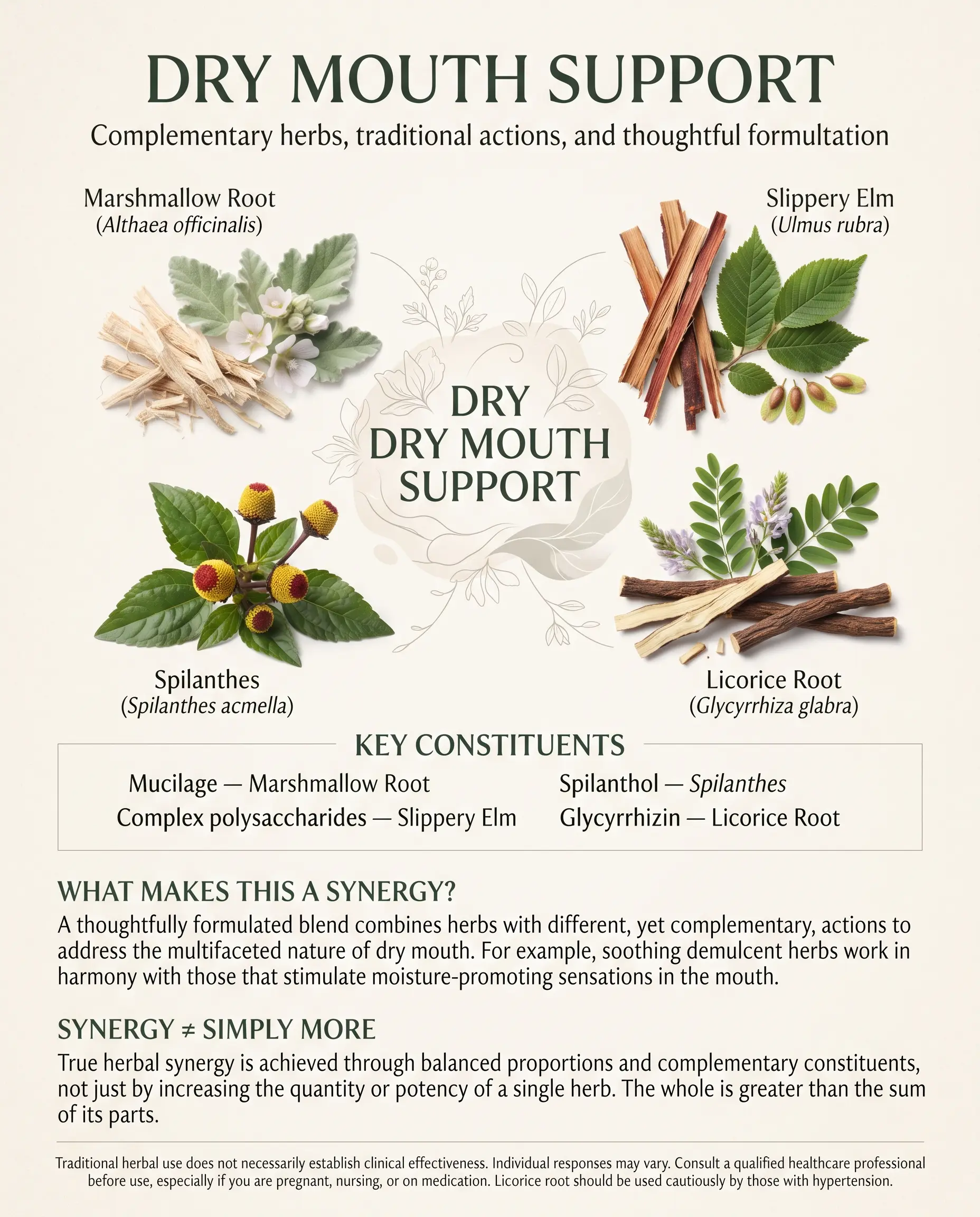
Dry mouth (xerostomia) usually comes down to two different problems: not enough saliva being produced, or the mouth needing something to physically hold moisture in between. Different herbs address each side, and this is a lesser-known category with more real clinical trial support than you might expect — including a study on the exact herb featured in this article’s recipe.
| Herb | What It Adds |
| Ginger | Shown in a clinical trial spray to improve both dry mouth sensation and actual salivary flow |
| Marshmallow Root | A demulcent shown in a study to help people with genuinely low saliva production |
| Slippery Elm | A traditional demulcent, physically coating the mouth to hold moisture in |
| Chamomile (with linseed) | Tested as a combined infusion, outperforming a conventional saliva substitute in one trial |
Ginger works by stimulating actual saliva production — a genuine sialagogue effect with trial support. Marshmallow root, slippery elm, and chamomile work differently, physically coating and moisturizing the mouth rather than triggering more saliva. Combining a stimulant with a coating demulcent covers both angles at once, which is exactly the logic behind this category.
Recipe for Dry Mouth Support
Marshmallow Root & Ginger Moistening Tea
Why this blend: Marshmallow root has direct clinical study support for helping people with low saliva production, and ginger adds a genuine saliva-stimulating effect shown in its own trial — a practical pairing that covers both “make more saliva” and “hold onto moisture.”
Ingredients
- 1 tsp dried marshmallow root
- ½ tsp fresh grated ginger (or ¼ tsp dried)
- 1 cup (240 ml) hot water
Yield: 1 cup
Preparation
- Combine the marshmallow root and ginger in a mug or infuser.
- Pour hot water over the herbs and cover.
- Steep, covered, for 10–15 minutes — marshmallow root’s mucilage benefits from the longer steep.
- Strain and sip slowly throughout the day, warm or cooled.
How to Use Sip slowly rather than drinking quickly — the point is to let the tea coat the mouth as you go, not just hydrate in one pass. Can be made in a larger batch and sipped cold throughout the day.
Herbalist’s Note Marshmallow root tea has a naturally slippery, mucilaginous texture — that’s the demulcent action working exactly as intended, not a sign anything went wrong.
Safety Sip slowly rather than gulping if you have swallowing difficulty alongside dry mouth, and check with a dentist if dry mouth is persistent, since it raises cavity and gum disease risk.
Ready-to-Use Products With This Synergy
Traditional Medicinals Organic Throat Coat Tea Brand: Traditional Medicinals Key herbs: Slippery elm, licorice root, marshmallow root Why it fits: A demulcent-focused blend built around the same coating, moisture-holding herbs discussed in this article, useful for sipping throughout the day. Buy: traditionalmedicinals.com
Planetary Herbals Slippery Elm Lozenges Brand: Planetary Herbals Key herbs: Slippery elm inner bark Why it fits: A portable lozenge format that combines the demulcent action of slippery elm with the mechanical saliva-stimulating effect of sucking on something — useful for on-the-go dry mouth relief. Buy: amazon.com
Biotene Dry Mouth Lozenges Brand: Biotene Key herbs: Not herb-based (xylitol-sweetened) Why it fits: Included for comparison — this is the most widely recommended dentist-trusted dry mouth product, working through xylitol and sucking-stimulated saliva flow rather than herbs specifically, useful alongside or instead of an herbal approach. Buy: biotene.com
Herbal Synergies for Dry Mouth Support
Not all dry mouth has the same cause, which matters for which herb fits best. Dry mouth from medication side effects (a very common cause — many blood pressure, antidepressant, and antihistamine medications cause this) often responds to a combination of a mild stimulant like ginger plus a coating demulcent for ongoing comfort. Dry mouth from mouth breathing or general dehydration may respond well to simply sipping a demulcent tea throughout the day. And more persistent, medically significant dry mouth (such as from Sjögren’s syndrome or radiation therapy) genuinely benefits from herbal support as a comfort measure, but should be managed alongside a doctor or dentist, not instead of one.
As always: synergy is about thoughtful complementarity — not simply adding more herbs to the pot.
Core Herbal Synergy Combinations
Marshmallow Root + Ginger Best for: General dry mouth, especially from medication side effects. Why it works: Marshmallow root has direct study support for helping people with genuinely reduced saliva production, while ginger has its own trial evidence as an actual saliva stimulant. Combining a “make more” herb with a “hold onto it” herb covers more ground than either alone. This is the tea recipe above.
Slippery Elm + Marshmallow Root Best for: Ongoing, portable comfort throughout the day. Why it works: Both are demulcents working through the same general mucilage-coating mechanism, making this pairing more about format and convenience (lozenges you can carry) than combining different mechanisms — a practical, low-effort daily option.
Chamomile + Linseed Best for: A gentler infusion-based approach, especially for sipping regularly. Why it works: This specific combination was tested directly in a clinical trial and found to improve dry mouth symptoms, thick saliva sensation, and swallowing difficulty compared to a conventional saliva substitute — a genuinely evidence-backed pairing, not just a formulation guess.
Ginger Alone (as a spray or tea) Best for: Someone specifically wanting to stimulate more saliva production rather than just moisturize. Why it works: A clinical trial using a ginger spray found it improved both the subjective feeling of dry mouth and objective salivary flow measurements — genuine evidence for an actual stimulant effect, not just symptomatic comfort.
Herbs Used in These Synergies
Ginger Botanical name: Zingiber officinale Traditional actions: Traditional sialagogue (saliva stimulant), warming Role in the synergy: A ginger spray was directly tested in a clinical trial for xerostomia and found to improve both dry mouth sensation and actual salivary flow — one of the few herbs in this article with evidence for genuinely stimulating more saliva, not just masking dryness. Key constituents: Gingerols, shogaols
Marshmallow Root Botanical name: Althaea officinalis Traditional actions: Demulcent, moisturizing Role in the synergy: A 2015 study found marshmallow root helped people with hyposalivation (objectively low saliva), though it wasn’t shown to outperform other demulcent options tested alongside it — still genuine, directly relevant supportive evidence. Key constituents: Mucilage (polysaccharides)
Slippery Elm Botanical name: Ulmus rubra Traditional actions: Demulcent, traditionally soothing Role in the synergy: Works through the same general mucilage-coating mechanism as marshmallow root, physically holding moisture against the tissues of the mouth — a long-standing traditional remedy for dry, irritated mucous membranes. Key constituents: Mucilage (polysaccharides)
Chamomile Botanical name: Matricaria chamomilla Traditional actions: Soothing, traditionally calming Role in the synergy: Tested specifically in combination with linseed as an infusion for dry mouth and found to improve symptoms more than a conventional saliva substitute — a genuinely trial-supported use, though specific to that combination rather than chamomile alone. Key constituents: Bisabolol, apigenin
Safety and When to Seek Medical Advice
Use Caution If:
- You’re taking medication that causes dry mouth as a known side effect — don’t stop or adjust any prescribed medication based on dry mouth alone; talk to your prescriber about whether an adjustment is appropriate
- You’re allergic to ragweed, daisies, or related plants — chamomile is part of this plant family
- You have swallowing difficulty alongside dry mouth — sip any tea or liquid slowly and check with a healthcare provider, since swallowing problems combined with dry mouth deserve their own evaluation
- You wear dentures — persistent dry mouth can affect denture fit and comfort, worth mentioning at your next dental visit
- Dry mouth is severe or persistent — this raises real risk for cavities, gum disease, and oral infections, so it’s worth a dental visit rather than herbal management alone long-term
See a Healthcare Professional If: Dry mouth is severe, persistent, or came on suddenly without an obvious cause (like starting a new medication), especially if it’s accompanied by dry eyes, joint pain, or difficulty swallowing — these can be signs of an underlying condition like Sjögren’s syndrome that benefits from proper diagnosis. Persistent dry mouth also significantly increases dental disease risk, so a dentist should be part of ongoing management, not just a one-time mention.
Q&A
What actually causes dry mouth? Most commonly, medication side effects — many blood pressure drugs, antidepressants, antihistamines, and others reduce saliva production. Other causes include dehydration, mouth breathing, aging, and less commonly, conditions like Sjögren’s syndrome or radiation therapy effects.
Does ginger really stimulate more saliva, or does it just feel that way? There’s real evidence here — a clinical trial using a ginger spray found it improved both the subjective dry mouth sensation and objectively measured salivary flow, which is a genuine stimulant effect, not just a placebo-like sensation.
What’s the difference between marshmallow root and ginger for this? Marshmallow root coats and moisturizes — it doesn’t necessarily make more saliva, it just holds moisture better. Ginger has evidence for actually stimulating saliva production. Combining them covers both angles.
Can I use these alongside a product like Biotene? Yes — there’s no conflict. Biotene works through xylitol and mechanical stimulation from sucking on a lozenge, which is a different mechanism than the herbs discussed here, so combining approaches is reasonable.
Is dry mouth from my medication something I should just live with? Not necessarily — it’s worth mentioning to your prescriber, since sometimes a dose adjustment or alternative medication is possible. Herbal support can help with comfort in the meantime, but it’s not a reason to avoid that conversation.
Which option is gentlest? The marshmallow root and ginger tea — mild, food-based, and appropriate for regular daily sipping.
When should I see a doctor or dentist instead of just managing this with herbs? If dry mouth is severe, persistent, came on suddenly, or comes with dry eyes or joint pain — that combination is worth a proper medical evaluation. And any persistent dry mouth deserves a dentist’s attention given the real risk to dental health.
References
Treatment Alternatives for Dry Mouth: A Scoping Review – PMC
Effectiveness of Malic Acid 1% in Patients with Xerostomia Induced by Antihypertensive Drugs – PMC
Marshmallow Root: Benefits, Risks, and Uses – Medical News Today
Natural Remedies for Dry Mouth (Xerostomia) – Memorial Sloan Kettering Cancer Center
Slippery Elm – LiverTox, NCBI Bookshelf
Disclaimer
This article is for educational and informational purposes only and is not intended to diagnose, treat, cure, or prevent disease. Herbs are biologically active and may interact with medications or be inappropriate for some people. If you are pregnant, breastfeeding, taking medication, managing a health condition, or experiencing persistent or severe symptoms, consult a qualified healthcare professional before using herbal preparations.
Available Herbal Products
Explore and shop ready-made products offering this benefit.