

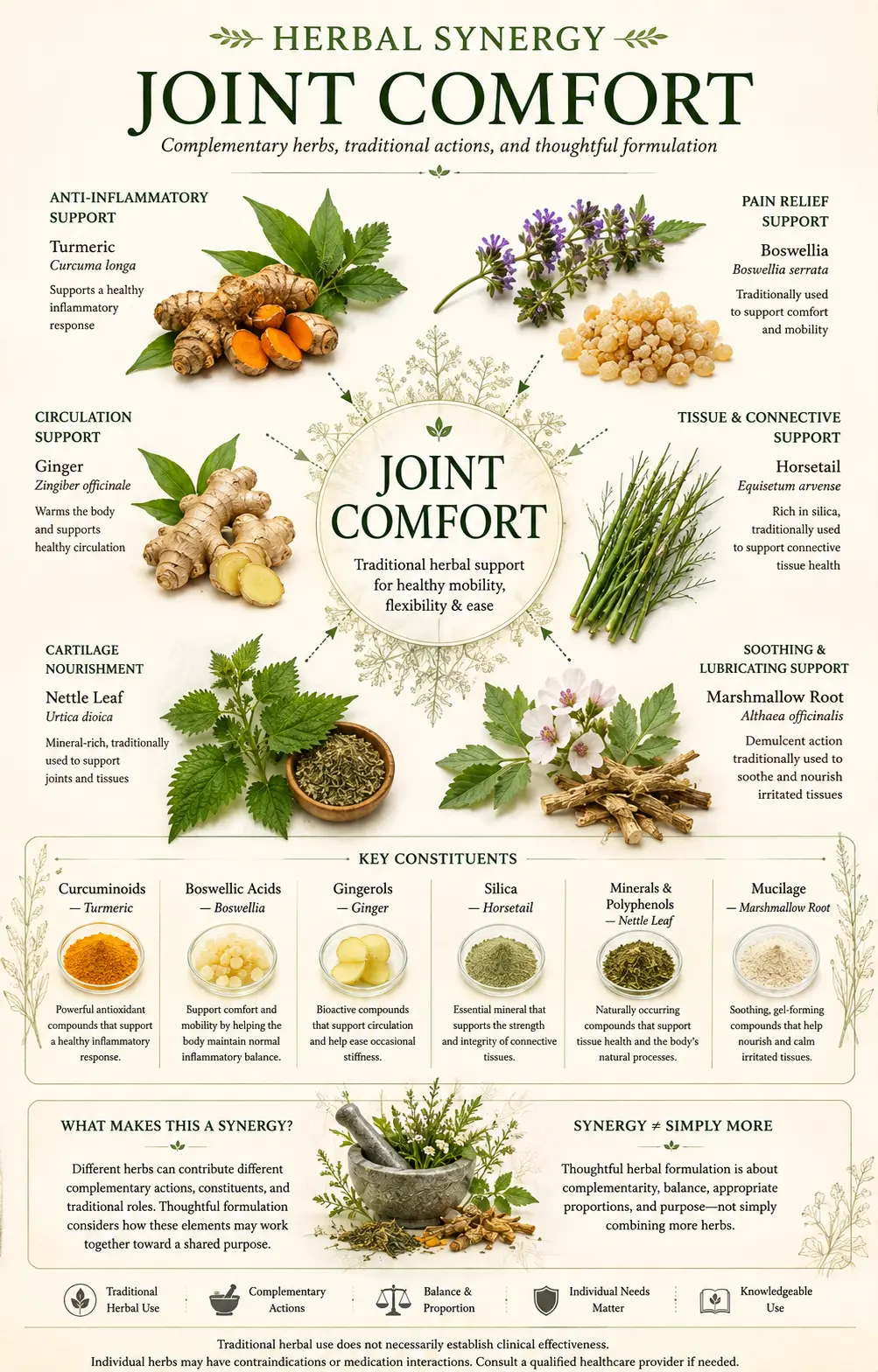
Joint discomfort — the stiffness, ache, and reduced mobility that comes with wear and tear or osteoarthritis — is one of the better-researched areas in herbal medicine, with two herbs in particular backed by real, sizeable clinical trial evidence. Different herbs work through different anti-inflammatory pathways, and there’s even a direct clinical trial testing the most popular combination as a pairing, not just as separate ingredients.
| Herb | What It Adds |
| Turmeric (Curcumin) | Strong meta-analysis evidence for knee osteoarthritis pain, working through the COX-2 and NF-κB pathways |
| Boswellia | Equally strong evidence, working through a different pathway (5-LOX) — genuinely complementary to turmeric, not redundant |
| Devil’s Claw | A traditional joint-comfort herb, with more modest research than turmeric or Boswellia |
| Ginger | Adds anti-inflammatory support and aids absorption when paired with black pepper |
Turmeric and Boswellia are the standouts, and this is a rare case where combining them isn’t just a formulation guess — a direct trial testing curcumin plus boswellic acid together found the combination outperformed curcumin alone. They work through genuinely different inflammatory pathways (COX-2/NF-κB for turmeric, 5-LOX for Boswellia), which is exactly the kind of complementary pairing this whole approach is built around.
Recipe for Joint Comfort
Turmeric & Ginger Joint Support Tea
Why this blend: Turmeric has strong trial evidence for joint pain, and ginger adds its own anti-inflammatory support while making the tea genuinely pleasant to drink daily — a simple, food-based complement to a Boswellia supplement if you’re using one.
Ingredients
- 1 tsp fresh grated turmeric root (or ½ tsp dried turmeric powder)
- ½ tsp fresh grated ginger (or ¼ tsp dried)
- Pinch of black pepper
- 1 cup (240 ml) hot water
Yield: 1 cup
Preparation
- Combine the turmeric, ginger, and black pepper in a mug or small saucepan.
- If simmering, cook gently for 5 minutes; if steeping, pour hot water over the ingredients and cover.
- Steep, covered, for 10 minutes.
- Strain and drink warm, ideally with a meal.
How to Use Drink once or twice daily as an ongoing habit — joint-comfort benefits from turmeric and Boswellia generally build over weeks, not days, so consistency matters more than any single cup.
Herbalist’s Note The black pepper isn’t optional flavoring here — piperine has been shown to increase curcumin absorption dramatically, so skipping it means a meaningfully weaker cup.
Safety If you’re on blood-thinning medication, check with a provider before making concentrated turmeric or ginger a daily habit — both have mild effects on blood clotting.
Ready-to-Use Products With This Synergy
Gaia Herbs Turmeric Supreme Joint Brand: Gaia Herbs Key herbs: Turmeric, devil’s claw, Boswellia (Indian frankincense), quercetin, black pepper, ginger Why it fits: This is an almost exact match to the combination discussed in this article — turmeric and Boswellia together, plus devil’s claw and ginger, with black pepper for absorption. Buy: gaiaherbs.com
NOW Foods Boswellia Extract Brand: NOW Foods Key herbs: Boswellia serrata Why it fits: A single-herb, standardized Boswellia supplement for readers who want to try the specific herb with the strongest joint-pain trial evidence on its own. Buy: amazon.com
Gaia Herbs Turmeric Supreme Extra Strength Brand: Gaia Herbs Key herbs: Turmeric, black pepper Why it fits: A simpler, single-focus turmeric-and-black-pepper formula for anyone who wants concentrated curcumin without the broader multi-herb blend. Buy: gaiaherbs.com
Herbal Synergies for Joint Comfort
Not all joint discomfort is the same. Knee osteoarthritis specifically has the deepest research behind both turmeric and Boswellia, so combining them makes the most sense there. Hand osteoarthritis has its own supportive trial evidence for the turmeric-Boswellia pairing as well. General, milder stiffness — the kind that comes and goes with weather or activity — is where a gentler daily habit like the tea recipe above fits, rather than a concentrated supplement. And joint discomfort tied to overuse or exercise is where ginger’s role becomes more relevant alongside the other two.
As always: synergy is about thoughtful complementarity — not simply adding more herbs to the pot.
Core Herbal Synergy Combinations
Turmeric + Boswellia Best for: Knee or hand osteoarthritis specifically, where the strongest evidence exists. Why it works: This is one of the best-evidenced combinations across this entire content series — a randomized clinical trial specifically testing curcumin plus boswellic acid found the combination outperformed curcumin alone for pain and stiffness. They work through different anti-inflammatory pathways (COX-2/NF-κB vs. 5-LOX), which explains why combining them adds real value rather than just doubling up on the same mechanism.
Boswellia Alone Best for: Fast-acting relief, since some trials have shown improvement within days rather than weeks. Why it works: A standardized Boswellia extract has shown meaningful reductions in pain and stiffness in as little as five days in one trial — notably faster than the weeks-long buildup typical of turmeric. A reasonable starting point if you want to see whether herbal support helps before committing to a longer routine.
Turmeric + Ginger + Black Pepper Best for: A gentle, everyday, food-based approach rather than concentrated supplements. Why it works: Turmeric brings the anti-inflammatory evidence, ginger adds its own traditional joint-support reputation, and black pepper meaningfully improves absorption. This is the tea recipe above — a lower-intensity daily habit rather than a targeted treatment.
Turmeric + Devil’s Claw Best for: Broader, traditional joint-comfort support alongside turmeric’s stronger evidence base. Why it works: Devil’s claw is a long-standing traditional joint-comfort herb, commonly paired with turmeric in commercial formulas — worth knowing its own evidence is more modest than turmeric or Boswellia’s, so this combination leans partly traditional rather than purely trial-driven.
Herbs Used in These Synergies
Turmeric (Curcumin) Botanical name: Curcuma longa Traditional actions: Anti-inflammatory, antioxidant Role in the synergy: Meta-analyses of trials involving over 800 participants with knee osteoarthritis support turmeric extract (around 1000 mg/day of curcumin) for reducing pain, though it’s generally somewhat less effective than ibuprofen for pain relief specifically — still a genuinely useful option, especially combined with Boswellia. Key constituents: Curcumin (a curcuminoid)
Boswellia Botanical name: Boswellia serrata (also called Indian frankincense) Traditional actions: Anti-inflammatory, traditionally used for chronic inflammatory conditions Role in the synergy: A meta-analysis of seven trials with 545 osteoarthritis patients found Boswellia extract significantly reduced pain and stiffness compared to placebo — and notably, some trials found it more effective than glucosamine sulfate, a much more commonly recommended joint supplement. Key constituents: Boswellic acids (particularly AKBA)
Devil’s Claw Botanical name: Harpagophytum procumbens Traditional actions: Traditional anti-inflammatory, used for joint discomfort Role in the synergy: A long-standing traditional joint herb frequently included in commercial formulas alongside turmeric and Boswellia, though its own clinical evidence base is more modest than either of those two. Key constituents: Harpagoside
Ginger Botanical name: Zingiber officinale Traditional actions: Anti-inflammatory, warming Role in the synergy: Traditionally used for joint support and general anti-inflammatory action, and included in several commercial joint formulas alongside turmeric — a supportive rather than primary herb in this category. Key constituents: Gingerols, shogaols
Safety and When to Seek Medical Advice
Use Caution If:
- You’re on blood-thinning medication or antiplatelet drugs (including aspirin) — Boswellia, turmeric, and ginger all have mild effects on blood clotting; check with a provider before combining any of them with these medications
- You’re taking NSAIDs regularly — Boswellia’s interaction with NSAIDs isn’t fully understood, so it’s worth mentioning to your provider if you use both
- You have gallstones or a bile duct obstruction — turmeric stimulates bile flow, which can be problematic in these situations
- You’re pregnant or breastfeeding — concentrated turmeric, Boswellia, and devil’s claw extracts generally aren’t recommended without medical guidance
- You have a known allergy to boswellic acids or are sensitive to NSAIDs generally — discontinue and consult a provider if you notice any allergic reaction
See a Healthcare Professional If: Joint pain is severe, comes with significant swelling, redness, or warmth (which can signal infection or gout rather than typical wear-and-tear), follows an injury, or is accompanied by fever. Persistent joint pain that isn’t improving with herbal or lifestyle approaches after several weeks deserves a proper evaluation rather than continued self-management.
Q&A
What’s the best-evidenced combination here? Turmeric and Boswellia together — this is one of the few combinations in this entire content series with a real clinical trial testing the pairing itself, not just each herb separately, and it outperformed curcumin alone.
How long before I notice a difference? Boswellia has shown improvement in as little as five days in one trial, while turmeric’s benefits typically build over several weeks of consistent use. Don’t expect overnight results from either, especially turmeric.
Is Boswellia actually better than glucosamine? Interestingly, some trials found it outperformed glucosamine sulfate specifically, which is notable given how commonly glucosamine is recommended for joint health — though it’s worth remembering that glucosamine’s own evidence base has been questioned in larger reviews too.
Can I take turmeric and Boswellia together safely? Generally yes — this is a commonly combined pairing in commercial products, and the clinical trial testing them together found no meaningful increase in side effects compared to either alone.
Which option is gentlest? The turmeric, ginger, and black pepper tea — a food-based daily habit rather than a concentrated extract, appropriate for milder, occasional stiffness rather than significant osteoarthritis pain.
Can I use these instead of my prescribed arthritis medication? Not without talking to your doctor first. These herbs can be a reasonable complement, and turmeric has even been shown in some trials to reduce the need for rescue NSAID medication, but they shouldn’t be swapped in for prescribed treatment without medical guidance.
When should I see a doctor instead of trying herbs? If joint pain is severe, comes with significant swelling, redness, warmth, or fever, or follows an injury — those need proper evaluation rather than ongoing herbal self-management.
References
Boswellia Serrata: Overview, Uses, Side Effects, Precautions, Interactions – WebMD
Disclaimer
This article is for educational and informational purposes only and is not intended to diagnose, treat, cure, or prevent disease. Herbs are biologically active and may interact with medications or be inappropriate for some people. If you are pregnant, breastfeeding, taking medication, managing a health condition, or experiencing persistent or severe symptoms, consult a qualified healthcare professional before using herbal preparations.
Available Herbal Products
Explore and shop ready-made products offering this benefit.