

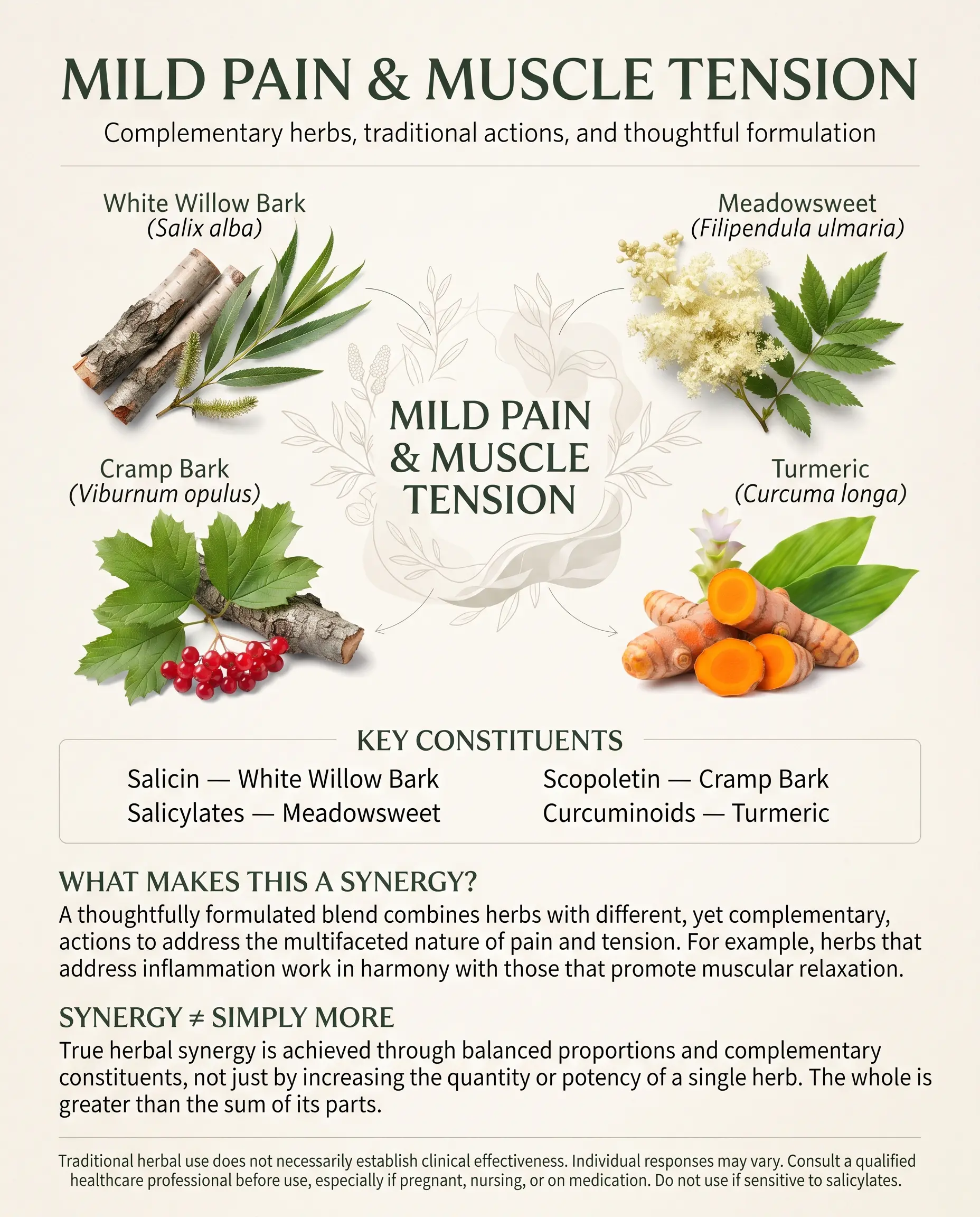
Mild pain and muscle tension usually call for two different approaches working together: something applied directly where it hurts, and something taken internally to ease inflammation more broadly. Different herbs are suited to different roles here, and — refreshingly for this category — the evidence is honest about which ones actually hold up and which ones are more hit-or-miss.
| Herb | What It Adds |
| Arnica (topical) | A traditional go-to for bruising and soreness, though clinical trial results are genuinely mixed |
| Turmeric/Curcumin (oral) | The best-evidenced option here, with multiple trials showing reduced muscle soreness after exercise |
| Ginger (oral) | Traditionally anti-inflammatory, often paired with turmeric to boost absorption and effect |
| Cayenne/Capsaicin (topical) | A warming counter-irritant, traditionally used to distract from and ease localized pain |
Turmeric is the clear evidence leader in this group, especially for delayed-onset muscle soreness after exercise. Arnica is more of a mixed bag — some trials support it, others don’t, and it’s worth knowing that going in rather than assuming it’s a sure thing. A sensible approach usually pairs a topical application (arnica or capsaicin, right where it hurts) with an oral anti-inflammatory (turmeric, often with ginger) working from the inside.
Recipe for Mild Pain & Muscle Tension
Ginger & Turmeric Warming Tea
Why this blend: Turmeric has real trial support for reducing exercise-related muscle soreness, and ginger is traditionally anti-inflammatory and pairs naturally with it — a simple internal complement to whatever topical you’re using on the sore spot itself.
Ingredients
- 1 tsp fresh grated turmeric root (or ½ tsp dried turmeric powder)
- ½ tsp fresh grated ginger (or ¼ tsp dried)
- Pinch of black pepper
- 1 cup (240 ml) hot water
Yield: 1 cup
Preparation
- Combine the turmeric, ginger, and black pepper in a mug or small saucepan.
- If using a saucepan, simmer gently for 5 minutes; if steeping in a mug, pour hot water over the herbs and cover.
- Steep, covered, for 10 minutes.
- Strain and drink warm.
How to Use Drink once or twice daily, ideally with a meal containing some fat — curcumin absorbs better that way, and the black pepper here helps too.
Herbalist’s Note The black pepper isn’t just for taste — piperine, its active compound, genuinely improves how much curcumin your body actually absorbs.
Safety Turmeric in food-level amounts is very safe, but concentrated extracts can interact with blood thinners — check with a provider if you’re on one.
Ready-to-Use Products With This Synergy
Gaia Herbs Turmeric Supreme Pain Brand: Gaia Herbs Key herbs: Turmeric, ginger, feverfew, devil’s claw, Jamaican dogwood, black pepper extract Why it fits: Combines turmeric (the best-evidenced herb in this article) with ginger and black pepper for absorption, plus additional traditional pain-support herbs, specifically formulated for occasional aches from overdoing it. Buy: gaiaherbs.com
Boiron Arnicare Gel Brand: Boiron Key herbs: Arnica montana Why it fits: A simple, single-ingredient topical arnica gel, non-greasy and fragrance-free, reflecting the traditional topical approach discussed in this article. Buy: walmart.com
Topricin Pain Relief Cream Brand: Topricin Key herbs: Arnica montana (plus additional homeopathic-dose botanicals) Why it fits: A topical cream built around arnica for direct, localized application to sore muscles and joints, applied several times daily. Buy: topricin.com
Herbal Synergies for Mild Pain & Muscle Tension
Not all mild pain needs the same approach. Localized soreness or bruising — a strained muscle, a bump, tension in one specific spot — is where topical arnica or capsaicin makes the most sense, applied right where it hurts. More generalized soreness, like the whole-body ache after an intense workout (delayed-onset muscle soreness, or DOMS), is where oral turmeric has its strongest evidence, since most of the research studies exactly this kind of exercise-induced soreness. And ongoing, low-grade tension benefits from combining both approaches rather than picking just one.
As always: synergy is about thoughtful complementarity — not simply adding more herbs to the pot.
Core Herbal Synergy Combinations
Turmeric + Ginger + Black Pepper Best for: Whole-body soreness after exercise (DOMS), or general internal anti-inflammatory support. Why it works: Turmeric has the strongest evidence in this entire article — multiple randomized trials found oral curcumin meaningfully reduced pain and muscle damage markers after intense exercise. Black pepper’s piperine significantly improves curcumin absorption, and ginger adds its own traditional anti-inflammatory action. This is the tea recipe above.
Topical Arnica + Oral Turmeric Best for: A specific sore or bruised spot, paired with general internal support. Why it works: Arnica applied directly addresses the localized area (even though its trial evidence is mixed — some studies show real pain reduction, others show none), while oral turmeric works more broadly from the inside. Using both covers the “right where it hurts” and “overall inflammation” angles at once.
Topical Capsaicin + Oral Ginger Best for: Localized muscle tension that responds well to warming, counter-irritant sensations. Why it works: Capsaicin’s warming, slightly distracting sensation is a traditional approach to easing localized tension, while ginger’s traditional anti-inflammatory reputation supports the same area from within. A warming pair, better suited to muscle tension than to acute bruising.
Turmeric + Devil’s Claw Best for: More persistent, nagging soreness rather than a single acute event. Why it works: Devil’s claw is a traditional herb for joint and muscle discomfort, often included alongside turmeric in commercial pain-support formulas — this combination leans more traditional than turmeric’s own DOMS-specific trial evidence, but reflects an established formulation pattern.
Herbs Used in These Synergies
Turmeric (Curcumin) Botanical name: Curcuma longa Traditional actions: Anti-inflammatory, antioxidant Role in the synergy: The strongest evidence in this article — multiple randomized, placebo-controlled trials found oral curcumin supplementation reduced pain intensity and markers of muscle damage after intense eccentric exercise, generally taken for several days before and after the activity. Key constituents: Curcumin (a curcuminoid)
Ginger Botanical name: Zingiber officinale Traditional actions: Anti-inflammatory, warming Role in the synergy: Traditionally paired with turmeric for its own anti-inflammatory reputation, and included in several commercial pain-support formulas alongside it. Key constituents: Gingerols, shogaols
Arnica Botanical name: Arnica montana Traditional actions: Traditional anti-inflammatory, used for bruising and soreness (topical only) Role in the synergy: A long-standing traditional topical remedy with a genuinely mixed clinical record — some trials found it reduced muscle pain and bruising, while others (including one specifically on calf-raise-induced soreness) found no benefit or even slightly increased pain. Worth trying, but not a guaranteed result. Key constituents: Sesquiterpene lactones, flavonoids
Cayenne/Capsaicin Botanical name: Capsicum annuum Traditional actions: Warming counter-irritant (topical only) Role in the synergy: Traditionally used topically for its warming, mildly distracting sensation over a sore or tense area, rather than for a direct anti-inflammatory mechanism. Key constituents: Capsaicin
Safety and When to Seek Medical Advice
Use Caution If:
- You’re on blood-thinning medication — concentrated turmeric/curcumin extracts may increase bleeding risk; check with a provider before regular high-dose use
- You have broken skin, an open wound, or a known allergy to ragweed or related plants — avoid topical arnica in these cases (arnica is for intact skin only, and is toxic if taken orally in non-homeopathic amounts)
- You’re using topical capsaicin — it causes a genuine warming/burning sensation; wash hands thoroughly after application and avoid contact with eyes or broken skin
- You’re pregnant or breastfeeding — concentrated turmeric, devil’s claw, and Jamaican dogwood extracts are generally not recommended without medical guidance
- You have gallstones or a bile duct obstruction — turmeric can stimulate bile flow; check with a provider first
See a Healthcare Professional If: Pain is severe, doesn’t improve within a week or two, is accompanied by significant swelling, redness, warmth, or fever (signs of possible infection), or follows a significant injury. Persistent or worsening pain deserves proper evaluation rather than ongoing herbal self-treatment.
Q&A
What’s the best-evidenced option here? Oral turmeric/curcumin, specifically for exercise-related muscle soreness — multiple clinical trials have shown it reduces pain and muscle damage markers, making it the standout in this category.
Does arnica actually work? The evidence is genuinely mixed. Some trials show real benefit for bruising and post-exercise soreness, while others — including one study on calf-raise soreness — found no improvement or even a slight increase in pain. It’s reasonable to try, but don’t expect guaranteed results.
Should I use a topical or an oral approach? Both, ideally — a topical (arnica or capsaicin) for a specific sore spot, and an oral option (turmeric, often with ginger) for broader internal support. They’re complementary rather than either-or.
Can I take turmeric every day? Culinary and moderate supplement amounts are commonly used daily. If you’re on blood-thinning medication or considering high-dose extracts, check with a healthcare provider first.
Which combination is gentlest? Turmeric and ginger as a simple tea — no topical warming sensation, no concentrated extracts, just a mild everyday anti-inflammatory habit.
Can I combine arnica gel with an oral turmeric supplement? Yes — they work through different routes (topical vs. oral) and are commonly used together without any known interaction concern.
When should I see a doctor instead of trying herbs? If pain is severe, doesn’t improve within a week or two, or comes with significant swelling, redness, warmth, or fever — that combination is worth getting checked rather than continuing to self-treat.
References
The Effect of Topical Arnica on Muscle Pain – PubMed
Curcumin Supplementation Likely Attenuates Delayed Onset Muscle Soreness (DOMS) – PubMed
Arnica – Memorial Sloan Kettering Cancer Center
Disclaimer
This article is for educational and informational purposes only and is not intended to diagnose, treat, cure, or prevent disease. Herbs are biologically active and may interact with medications or be inappropriate for some people. If you are pregnant, breastfeeding, taking medication, managing a health condition, or experiencing persistent or severe symptoms, consult a qualified healthcare professional before using herbal preparations.
Available Herbal Products
Explore and shop ready-made products offering this benefit.