

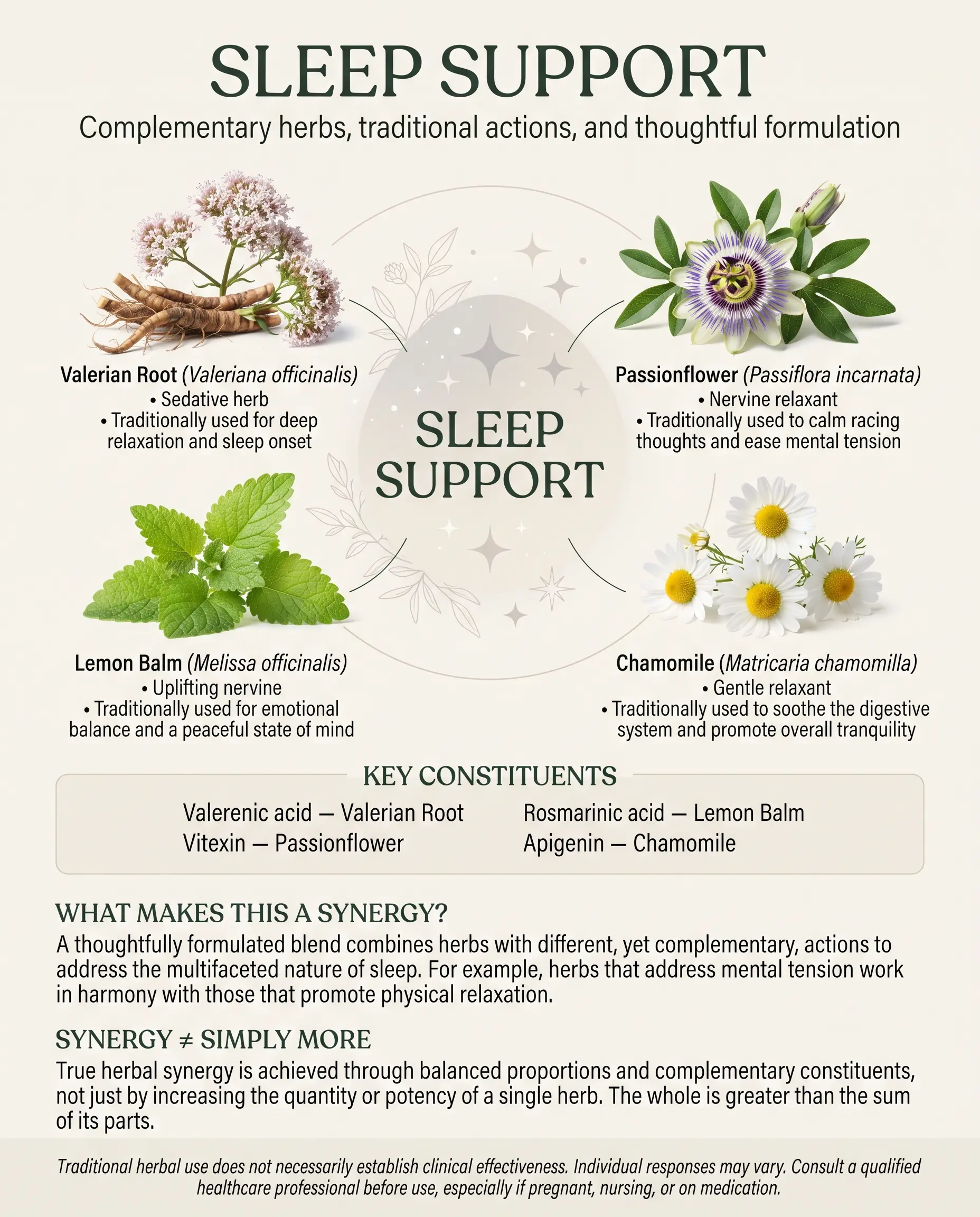
Trouble sleeping usually isn’t just one thing — it can be a mind that won’t stop racing, a body that’s too tense to settle, or a nervous system that just needs a nudge toward sleep. This is also a category with a genuinely interesting evidence story: one well-studied trial found that a single herb failed to beat placebo on its own, but succeeded once paired with a second one — real, documented synergy rather than just tradition.
| Herb | What It Adds |
| Valerian | The most-studied sleep herb, though evidence for it alone is inconsistent — it performs better in combination |
| Hops | Traditionally paired with valerian, and a clinical trial found the combination worked where valerian alone didn’t |
| Lemon Balm | Calms a racing or anxious mind, with trial support for improving sleep quality, especially alongside valerian |
| Passionflower | Traditionally used for a restless mind at bedtime, often included in multi-herb sleep blends |
Valerian is the backbone of this category, but the research is refreshingly honest about its limits when used alone. Hops and lemon balm are where the real complementary story lives — each fills in a gap that valerian alone tends to leave. A good sleep formula usually pairs valerian with one of these rather than relying on it solo.
Recipe for Sleep Support
Valerian & Lemon Balm Bedtime Tea
Why this blend: A clinical trial specifically testing this combination found it improved sleep quality with no reported side effects, making it a reasonably well-evidenced pairing rather than just a traditional guess.
Ingredients
- 1 tsp dried valerian root
- 1 tsp dried lemon balm leaf
- 1 cup (240 ml) hot water
Yield: 1 cup
Preparation
- Combine the valerian root and lemon balm in a mug or infuser.
- Pour hot water over the herbs and cover the cup.
- Steep, covered, for 10 minutes — valerian root benefits from the longer steep.
- Strain and drink warm, about 30–45 minutes before bed.
How to Use Drink roughly 30–45 minutes before your intended bedtime, as part of a consistent wind-down routine rather than only on nights you’re already struggling.
Herbalist’s Note Valerian root has a famously musky, earthy smell — lemon balm’s brightness does a lot of work here to make the tea actually pleasant to drink.
Safety Don’t combine this with alcohol or sedative medication, and skip driving or operating machinery if you feel drowsy afterward.
Ready-to-Use Products With This Synergy
Traditional Medicinals Organic Nighty Night Extra Tea Brand: Traditional Medicinals Key herbs: Valerian root, passionflower, lemon balm Why it fits: This is close to an exact match for the valerian-and-lemon-balm combination discussed in this article, with passionflower added for extra calming support. Buy: traditionalmedicinals.com
Traditional Medicinals Organic Nighty Night Tea Brand: Traditional Medicinals Key herbs: Passionflower, chamomile, hops, catnip, linden Why it fits: A valerian-free alternative built around the hops-and-passionflower side of this category, useful for anyone who prefers to avoid valerian’s strong smell or taste, or has a chamomile allergy. Buy: traditionalmedicinals.com
Gaia Herbs Sleep & Relax Herbal Tea Brand: Gaia Herbs Key herbs: Passionflower, chamomile, lemon balm Why it fits: A gentler, valerian-free blend combining several of the calming herbs discussed in this article for a milder nightly wind-down option. Buy: amazon.com
Herbal Synergies for Sleep Support
Not all sleep trouble looks the same. Difficulty falling asleep — a mind that won’t switch off — tends to respond well to valerian paired with hops or lemon balm, the combination with the clearest trial support. A racing or anxious mind at bedtime specifically is where lemon balm and passionflower’s calming reputation fits best. And for people who prefer to avoid valerian’s strong smell and taste altogether, hops-and-passionflower-based blends offer a gentler, still evidence-informed alternative.
As always: synergy is about thoughtful complementarity — not simply adding more herbs to the pot.
Core Herbal Synergy Combinations
Valerian + Hops Best for: Difficulty falling asleep, especially when a single herb alone hasn’t been enough. Why it works: This is the standout pairing in this whole category — a randomized clinical trial testing this exact combination found it significantly reduced sleep latency, while a single valerian extract at the same dose failed to beat placebo in the very same study. That’s about as close to documented synergy as herbalism gets.
Valerian + Lemon Balm Best for: Sleep trouble that comes with an anxious or overactive mind at bedtime. Why it works: A clinical trial in menopausal women with sleep disorders found this combination meaningfully improved sleep quality with no reported side effects. Lemon balm’s calming, GABA-supportive reputation complements valerian’s more general sedative action. This is the tea recipe above.
Passionflower + Hops + Chamomile Best for: A gentler, valerian-free option for people sensitive to its smell, taste, or effects. Why it works: None of these three herbs are as intensely studied individually as valerian, but together they form the backbone of several well-known commercial sleep tea blends, offering a milder alternative built around calming rather than strong sedation.
Lemon Balm + Passionflower Best for: An anxious, racing mind at bedtime without needing valerian’s stronger sedative profile. Why it works: Both herbs lean toward calming an overactive nervous system rather than directly inducing sleep, making this pairing well suited to someone whose sleep trouble is really an anxiety problem showing up at night.
Herbs Used in These Synergies
Valerian Botanical name: Valeriana officinalis Traditional actions: Sedative, sleep-promoting Role in the synergy: The most-studied sleep herb here, but a notably inconsistent performer alone — the clearest evidence comes from combinations with hops or lemon balm rather than valerian by itself. Key constituents: Valerenic acid, valepotriates
Hops Botanical name: Humulus lupulus Traditional actions: Sedative, traditionally paired with valerian Role in the synergy: The partner herb in the most compelling synergy story in this article — a clinical trial found the valerian-hops combination reduced sleep latency where valerian alone did not. Key constituents: Bitter acids (humulone, lupulone)
Lemon Balm Botanical name: Melissa officinalis Traditional actions: Calming, mild carminative Role in the synergy: Thought to support GABA activity in the brain, and shown in a clinical trial to improve sleep quality when combined with valerian — particularly useful when anxious thoughts are part of the sleep problem. Key constituents: Rosmarinic acid, citral
Passionflower Botanical name: Passiflora incarnata Traditional actions: Calming, mildly sedative Role in the synergy: A frequent component of commercial sleep tea blends, valued for calming a racing mind at bedtime rather than for strong sedation on its own. Key constituents: Flavonoids (vitexin, chrysin)
Safety and When to Seek Medical Advice
Use Caution If:
- You’re taking sedative medication, sleep aids, or drink alcohol — valerian, hops, and lemon balm can all add to drowsiness when combined with any of these
- You’re pregnant or breastfeeding — safety data for valerian and hops in pregnancy is limited; check with a provider before regular use
- You have liver concerns — valerian has very rarely been associated with liver injury, usually in combination with other herbs; the overall risk appears low but is worth knowing about
- You need to drive, operate machinery, or stay alert shortly after taking these — they’re intended for bedtime use, not daytime alertness
- You’re taking thyroid medication — lemon balm may interact with thyroid medications; check with a provider if this applies to you
See a Healthcare Professional If: Sleep trouble is severe, persistent (most nights for several weeks or more), or accompanied by loud snoring with pauses in breathing, excessive daytime sleepiness, or symptoms of depression or anxiety. Chronic insomnia often benefits from a structured approach like cognitive behavioral therapy for insomnia (CBT-I), and persistent sleep problems deserve a proper evaluation rather than ongoing herbal self-treatment alone.
Q&A
Does valerian actually work by itself? The evidence is genuinely mixed — some trials show a modest benefit, but a notable clinical trial found single-herb valerian extract failed to beat placebo at reducing sleep latency, while the same dose combined with hops succeeded. It seems to work better as part of a pairing than alone.
What’s the best combination to start with? Valerian and lemon balm has real trial support and is a good general starting point, especially if anxious thoughts are part of what’s keeping you up. Valerian and hops has the most compelling synergy evidence specifically for falling asleep faster.
Can I use these every night? Yes, that’s generally how they’re intended to be used — as part of a consistent bedtime routine rather than an occasional rescue remedy. That said, ongoing insomnia lasting weeks deserves a conversation with a healthcare provider.
I don’t like the smell of valerian — is there an alternative? Yes — passionflower, hops, and chamomile combinations (without valerian) are common in commercial sleep teas and offer a gentler, better-smelling alternative, though they haven’t been studied quite as extensively as the valerian pairings.
Can I combine this tea with melatonin or a sleep medication? Check with a healthcare provider or pharmacist first — combining sedating herbs with sleep medications or melatonin can increase drowsiness more than expected.
Which combination is gentlest? Lemon balm and passionflower, without valerian or hops — calming rather than strongly sedating.
When should I see a doctor instead of trying herbs? If sleep trouble is severe, lasts more than a few weeks, or comes with loud snoring, breathing pauses, or excessive daytime sleepiness — those need proper evaluation, potentially for sleep apnea or another condition herbs won’t address.
References
Valerian: Usefulness and Safety – NCCIH
Safety and Efficacy of Herbal Sedatives in Cancer Care – SAGE Journals
Disclaimer
This article is for educational and informational purposes only and is not intended to diagnose, treat, cure, or prevent disease. Herbs are biologically active and may interact with medications or be inappropriate for some people. If you are pregnant, breastfeeding, taking medication, managing a health condition, or experiencing persistent or severe symptoms, consult a qualified healthcare professional before using herbal preparations.
Available Herbal Products
Explore and shop ready-made products offering this benefit.