

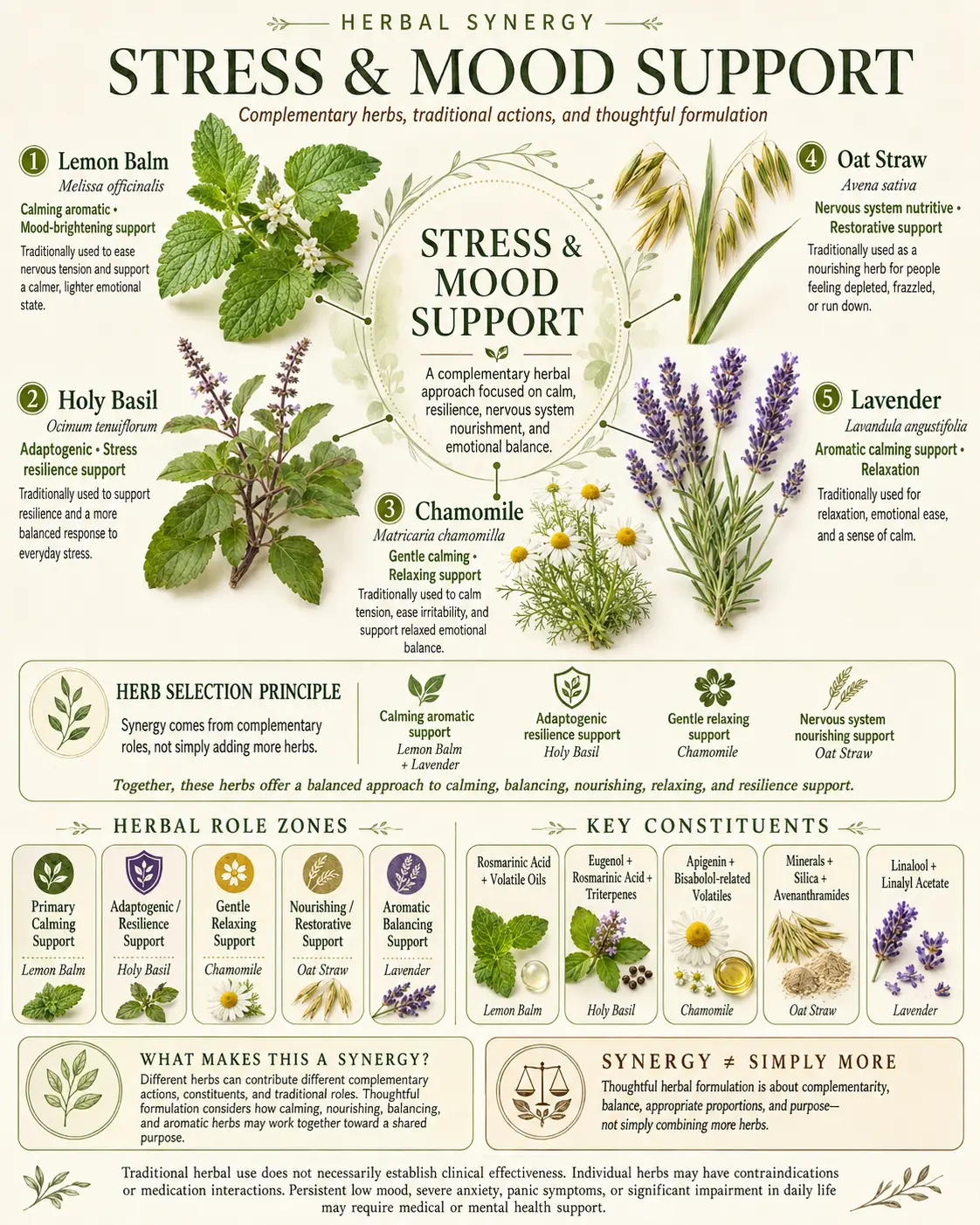
Stress shows up in more than one way — sometimes it’s a body that feels wound up and can’t settle, sometimes it’s a mind that won’t stop racing, and sometimes it’s a slower, grinding sense of being run down over time. Different herbs are traditionally suited to different parts of that picture, and this is a category where the research quality genuinely varies from herb to herb.
| Herb | What It Adds |
| Ashwagandha | An adaptogen with real clinical evidence for lowering cortisol, though its effect on how stressed you actually feel is more mixed |
| Lemon Balm | Calms quickly, with clinical support for easing anxiety and improving mood in the moment |
| Passionflower | Traditionally and somewhat clinically supported for calming a racing, anxious mind |
| Rhodiola | An adaptogen more associated with fatigue and mental resilience than acute calming |
Ashwagandha and rhodiola are both classified as adaptogens — herbs traditionally thought to help the body handle stress over time rather than calm you down in the moment. Lemon balm and passionflower work faster and more directly on the “I need to feel calmer right now” side. A sensible approach usually distinguishes between these two jobs rather than expecting one herb to do everything.
Recipe for Stress & Mood Support
Lemon Balm & Passionflower Calming Tea
Why this blend: Lemon balm has clinical support for easing anxiety and lifting mood relatively quickly, and passionflower adds a traditional, complementary calming action — a simple, fast-acting tea for the “I need to settle down” moments rather than a long-term daily habit.
Ingredients
- 1 tsp dried lemon balm leaf
- 1 tsp dried passionflower
- 1 cup (240 ml) hot water
Yield: 1 cup
Preparation
- Combine the lemon balm and passionflower in a mug or infuser.
- Pour hot water over the herbs and cover the cup.
- Steep, covered, for 8–10 minutes.
- Strain and drink warm.
How to Use Drink in the evening or during a stressful moment, up to 2–3 cups a day. This combination can be mildly calming, so it’s not the best choice right before something requiring sharp focus.
Herbalist’s Note This tea works on the moment, not the month — pair it with ashwagandha or rhodiola separately if you’re after longer-term stress resilience rather than immediate calm.
Safety Both herbs can add to drowsiness from sedatives or alcohol — avoid combining them with either.
Ready-to-Use Products With This Synergy
Gaia Herbs Ashwagandha Root Brand: Gaia Herbs Key herbs: Ashwagandha root Why it fits: A single-herb, standardized ashwagandha product reflecting the form and dosing used in most of the clinical trials on cortisol and stress. Buy: gaiaherbs.com
Gaia Herbs Sleep & Relax Herbal Tea Brand: Gaia Herbs Key herbs: Passionflower, lemon balm, chamomile, licorice root Why it fits: Combines lemon balm and passionflower with complementary calming herbs, closely reflecting the fast-acting combination discussed in this article. Buy: amazon.com
Traditional Medicinals Lemon Balm Tea Brand: Traditional Medicinals Key herbs: Lemon balm Why it fits: A simple, single-herb tea option for readers who want to start with lemon balm alone before building toward a full combination. Buy: traditionalmedicinals.com
Herbal Synergies for Stress & Mood Support
Not all stress needs the same kind of support. Acute, in-the-moment tension — a racing mind before a big meeting, trouble winding down at night — responds well to fast-acting calming herbs like lemon balm and passionflower. Longer-term, grinding stress that’s worn you down over weeks or months is more where adaptogens like ashwagandha and rhodiola come in, since their evidence base is built around ongoing daily use rather than single-dose relief. It’s worth being upfront: even the better-studied herbs here show real limits in the evidence, which the sections below address directly.
As always: synergy is about thoughtful complementarity — not simply adding more herbs to the pot.
Core Herbal Synergy Combinations
Ashwagandha + Lemon Balm Best for: Ongoing stress with an evening wind-down ritual layered on top. Why it works: Ashwagandha’s evidence base is built around daily supplementation reducing cortisol over weeks, while lemon balm offers a faster-acting calming effect for the moment you actually want to relax. Two different timeframes, one combination.
Lemon Balm + Passionflower Best for: A racing mind or acute anxious moment, especially before bed. Why it works: Both herbs are traditionally and somewhat clinically supported for calming nervous tension relatively quickly, without the slower-building profile of an adaptogen. This is the tea recipe above — reach for it in the moment, not as a long-term strategy on its own.
Ashwagandha + Rhodiola Best for: Longer-term stress resilience and a sense of being run down, rather than acute anxiety. Why it works: Both are classified as adaptogens, but with somewhat different traditional emphases — ashwagandha leans toward calming and cortisol regulation, rhodiola toward fatigue and mental stamina. Together they cover a broader “stress resilience” profile than either alone.
Lemon Balm + Chamomile Best for: The gentlest, most broadly tolerated combination — good for sensitive individuals or occasional use. Why it works: Neither herb is particularly potent on its own, which makes this a low-key, everyday option rather than something reserved for acute stress. A reasonable starting point for someone new to herbal stress support.
Herbs Used in These Synergies
Ashwagandha Botanical name: Withania somnifera Traditional actions: Adaptogen, traditionally calming Role in the synergy: The best clinically studied herb in this article — multiple meta-analyses show it meaningfully lowers cortisol, though the effect on self-reported “perceived stress” specifically is less consistent across studies, worth knowing going in. Key constituents: Withanolides
Lemon Balm Botanical name: Melissa officinalis Traditional actions: Calming, traditionally mood-supportive Role in the synergy: Has real clinical support, including trials showing improved mood and reduced anxiety-related symptoms after both single doses and short-term use — one of the faster-acting herbs in this category. Key constituents: Rosmarinic acid, citral
Passionflower Botanical name: Passiflora incarnata Traditional actions: Traditionally calming, mildly sedative Role in the synergy: Long used for anxious, racing thoughts, and shown to help in combination formulas alongside herbs like lemon balm and valerian, though standalone clinical evidence for passionflower specifically is thinner than for lemon balm. Key constituents: Flavonoids (vitexin, isovitexin)
Rhodiola Botanical name: Rhodiola rosea Traditional actions: Adaptogen, traditionally used for fatigue and mental stamina Role in the synergy: Traditionally paired with ashwagandha to round out an adaptogen combination — leans more toward mental fatigue and stamina than acute calming, making it a different tool than the faster-acting herbs in this article. Key constituents: Rosavins, salidroside
Safety and When to Seek Medical Advice
Use Caution If:
- You’re pregnant or trying to conceive — ashwagandha is a firm no during pregnancy, with traditional use as an abortifacient and modern guidance recommending complete avoidance
- You have a thyroid condition, especially hyperthyroidism — ashwagandha can increase thyroid hormone activity and may complicate existing thyroid disorders
- You have liver disease, or you’re taking a high-dose or non-root ashwagandha product — rare but real cases of liver injury have been reported, generally linked to high doses or products using leaf material rather than standardized root extract
- You’re taking sedatives, sleep medication, or drink alcohol regularly — lemon balm and passionflower can add to drowsiness when combined with either
- You’re on thyroid medication, immunosuppressants, or diabetes medication — ashwagandha may interact with all three; check with a provider
See a Healthcare Professional If: Stress, anxiety, or low mood is severe, persistent, interfering with daily functioning, or accompanied by thoughts of self-harm. Herbal support is meant for everyday stress and occasional anxious moments — it is not a substitute for proper mental health care when symptoms are significant or ongoing.
Q&A
What’s the difference between ashwagandha and lemon balm? Ashwagandha is an adaptogen, built around daily use to support the body’s stress response over weeks, with strong evidence for lowering cortisol specifically. Lemon balm works faster, calming anxious feelings and mood within hours rather than weeks.
Does ashwagandha actually reduce how stressed I feel, or just cortisol? Both, according to some meta-analyses — but the evidence for lowering cortisol is more consistent than the evidence for reducing self-reported perceived stress, where results across studies are more mixed. It’s genuinely useful, just not a guaranteed fix for how you feel day to day.
Can I take ashwagandha every day? Yes, that’s how it’s studied — clinical trials generally use it daily for 4 to 12 weeks. It’s not designed as an occasional, as-needed herb the way lemon balm or passionflower can be.
Is ashwagandha safe for everyone? No — it’s specifically not recommended during pregnancy, and people with thyroid conditions, liver disease, or who take certain medications should check with a provider first. See the safety section above.
Which combination is gentlest? Lemon balm and chamomile — mild, broadly well-tolerated, and a reasonable starting point if you’re new to herbal stress support.
Can I combine these with my prescribed anxiety or sleep medication? Check with your doctor or pharmacist first, especially with sedatives — lemon balm and passionflower can compound drowsiness.
When should I see a professional instead of trying herbs? If stress, anxiety, or low mood is severe, persistent, or interfering with your daily life — or if you’re having thoughts of self-harm — that calls for proper mental health support, not herbal tea.
References
Passionflower and Lemon Balm – NDNR (Naturopathic Doctor News and Review)
Comprehensive Safety Evaluation of Withania somnifera (Ashwagandha) – PMC
Disclaimer
This article is for educational and informational purposes only and is not intended to diagnose, treat, cure, or prevent disease. Herbs are biologically active and may interact with medications or be inappropriate for some people. If you are pregnant, breastfeeding, taking medication, managing a health condition, or experiencing persistent or severe symptoms, consult a qualified healthcare professional before using herbal preparations.
Available Herbal Products
Explore and shop ready-made products offering this benefit.