

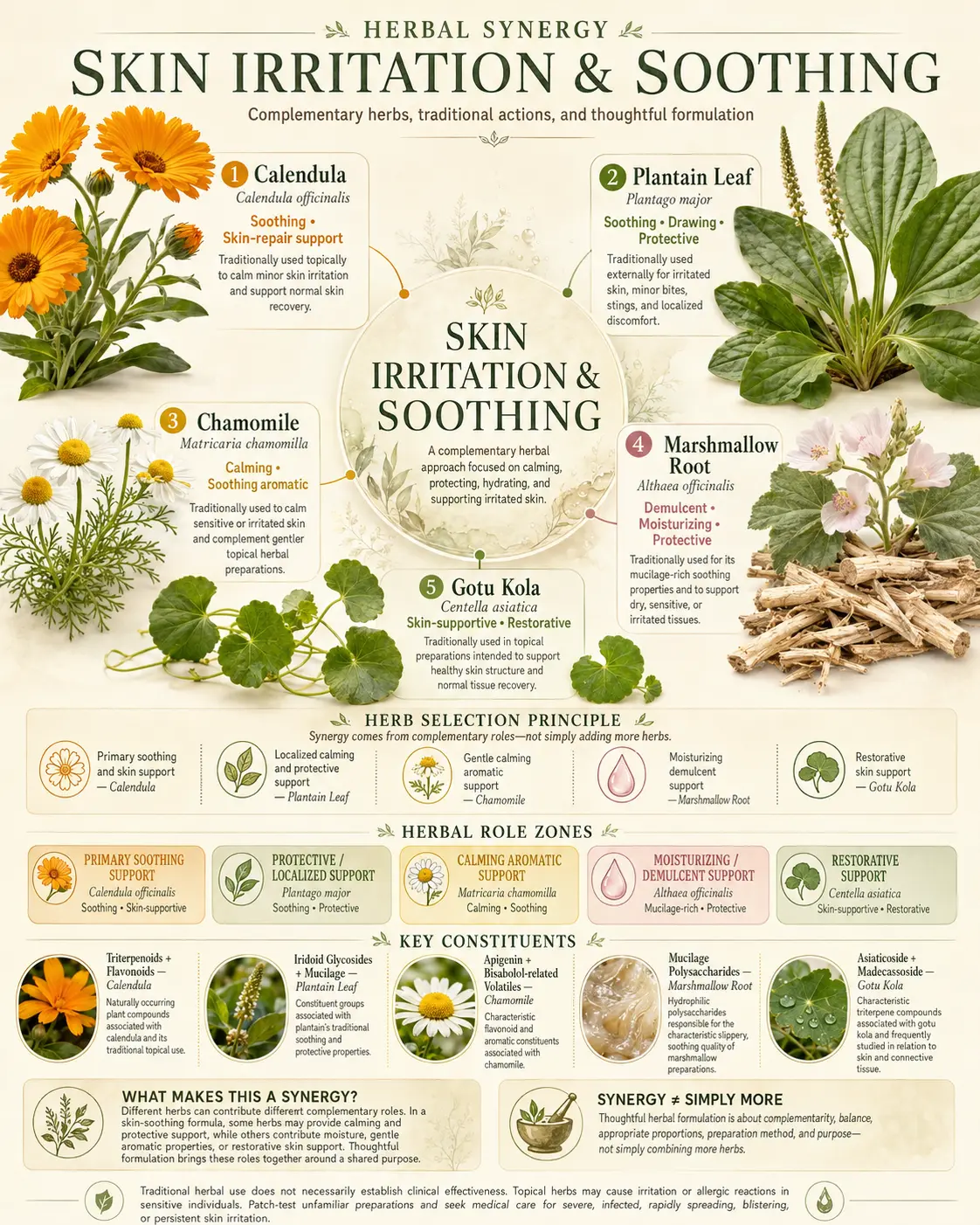
Irritated skin — whether it’s a mild rash, minor burn, dry patch, or general redness — usually needs support on two fronts: calming the inflammation itself, and protecting or repairing the skin barrier while it heals. Different herbs (and one FDA-recognized ingredient) are traditionally suited to different parts of that job.
| Herb | What It Adds |
| Calendula | A traditional wound-and-skin herb with genuine (if mixed) clinical evidence for supporting healing |
| Chamomile | Soothes redness and inflammation, traditionally and in some clinical research |
| Colloidal Oatmeal | The best-evidenced ingredient here — FDA-recognized and repeatedly shown to reduce itch and improve barrier function |
| Aloe Vera | Cooling and moisturizing, with real (though inconsistent) evidence specifically for minor burns |
Calendula and chamomile lean toward calming inflammation and supporting the skin’s own repair process, while colloidal oatmeal and aloe are more about immediate physical comfort — reducing itch, cooling, and protecting the barrier while things settle. A good skin-soothing approach often combines one from each side rather than relying on a single ingredient to do everything.
Recipe for Skin Irritation & Soothing
Calendula & Chamomile Soothing Compress
Why this blend: Calendula has traditional and some clinical support for supporting skin healing, and chamomile adds a calming, anti-inflammatory quality — together making a simple, gentle compress for irritated or mildly inflamed skin.
Ingredients
- 1 tbsp dried calendula flowers
- 1 tbsp dried chamomile flowers
- 2 cups (480 ml) hot water
Yield: Enough for 2–3 compress applications
Preparation
- Combine the calendula and chamomile in a heatproof bowl.
- Pour hot water over the herbs and cover.
- Steep, covered, for 15–20 minutes to make a strong infusion.
- Strain and let cool to a comfortable, skin-safe temperature.
How to Use Soak a clean, soft cloth in the cooled infusion and apply directly to the irritated area for 10–15 minutes, up to a few times a day. Discard any unused infusion after 24 hours.
Herbalist’s Note Always let the infusion cool fully before applying — irritated skin doesn’t need the extra stress of heat on top of everything else.
Safety Do this on unbroken, minor irritation only — not on open wounds, infected skin, or anything that looks like it needs medical attention. Patch-test on a small area first, especially if you have a known ragweed or daisy family allergy.
Ready-to-Use Products With This Synergy
Weleda Baby Calendula Diaper Cream Brand: Weleda Key herbs: Calendula extract, chamomile extract, sweet almond oil Why it fits: This is close to the exact calendula-and-chamomile combination discussed in this article, formulated specifically to soothe redness and irritated skin. Buy: weleda.com
Aveeno Baby Eczema Therapy Moisturizing Cream Brand: Aveeno Key herbs: Colloidal oatmeal Why it fits: Colloidal oatmeal is the single best-evidenced ingredient in this article, and this cream is built around it specifically for irritated, itchy, eczema-prone skin. Buy: amazon.com
Weleda Baby Calendula Nourishing Face Cream Brand: Weleda Key herbs: Calendula extract, lanolin, almond oil Why it fits: A gentler, leave-on option built around calendula alone, for everyday soothing of sensitive or slightly irritated skin rather than active flare-ups. Buy: weleda.com
Herbal Synergies for Skin Irritation & Soothing
Not all skin irritation calls for the same approach. A mild rash or general redness often responds well to calendula and chamomile’s calming, traditionally anti-inflammatory action. Itchy, dry, or eczema-prone skin has particularly strong evidence behind colloidal oatmeal specifically. And a minor burn or sun-exposed skin is where aloe vera’s cooling, evidence-supported role comes in. These aren’t interchangeable — using the wrong one won’t necessarily hurt, but it won’t be the most effective choice either.
As always: synergy is about thoughtful complementarity — not simply adding more herbs to the pot.
Core Herbal Synergy Combinations
Calendula + Chamomile Best for: General mild irritation, redness, or sensitive skin that needs calming. Why it works: Both herbs are traditionally anti-inflammatory, and each has some direct clinical support — calendula for wound and skin healing, chamomile for reducing inflammation-related redness. Together they’re a gentle, broadly useful pairing, and the compress recipe above.
Colloidal Oatmeal + Aloe Vera Best for: Itchy, dry skin alongside mild sunburn or heat-related irritation. Why it works: Colloidal oatmeal has the strongest evidence in this entire article for reducing itch and improving skin barrier function, while aloe adds a cooling, moisturizing layer with its own evidence specifically for minor burns. A practical combination for the “itchy and hot” combination that shows up after too much sun.
Calendula + Aloe Vera Best for: Minor burns, scrapes, or irritation where you want both a healing-support herb and a cooling one. Why it works: Calendula’s traditional wound-support role pairs naturally with aloe’s cooling, soothing sensation — one works more on the healing process, the other on immediate comfort.
Colloidal Oatmeal + Chamomile Best for: Widespread mild irritation, like a heat rash or general skin sensitivity, especially for children. Why it works: Colloidal oatmeal is gentle enough for daily use and has real evidence behind it, while chamomile adds a calming quality without introducing anything harsh. Often used as an oatmeal bath with chamomile added to the water.
Herbs Used in These Synergies
Calendula Botanical name: Calendula officinalis Traditional actions: Traditional wound-healer, anti-inflammatory Role in the synergy: Has a long traditional history for skin support, with clinical evidence that’s genuinely mixed — some studies on venous ulcers and acute wounds show benefit, while others (on burns and diabetic ulcers specifically) found no advantage over controls. Key constituents: Triterpenoids, flavonoids, carotenoids
Chamomile Botanical name: Matricaria chamomilla Traditional actions: Anti-inflammatory, calming Role in the synergy: Traditionally used topically for redness and irritation, with some newer clinical research (including comparisons showing meaningfully reduced eczema severity scores versus placebo) supporting its role, though larger confirmatory trials are still needed. Key constituents: Bisabolol, chamazulene, apigenin
Colloidal Oatmeal Botanical name: Avena sativa (oat) Traditional actions: Anti-inflammatory, skin barrier support Role in the synergy: The best-evidenced ingredient in this article — FDA-recognized as a skin protectant since 1989, with multiple clinical trials showing meaningful improvement in itch, dryness, and redness in eczema and irritant dermatitis. Key constituents: Avenanthramides (polyphenols)
Aloe Vera Botanical name: Aloe vera (syn. Aloe barbadensis) Traditional actions: Cooling, moisturizing, traditional wound-support Role in the synergy: Best evidence is specifically for minor partial-thickness burns, where some trials found faster healing compared to standard care, though results vary across studies and product formulations. Key constituents: Polysaccharides (acemannan), glycoproteins
Safety and When to Seek Medical Advice
Use Caution If:
- You’re allergic to ragweed, daisies, marigolds, or related plants — calendula and chamomile are both part of this plant family and can cause allergic reactions in sensitive people
- You have broken skin, an open wound, or signs of infection — these home remedies are for minor, intact-skin irritation, not for wounds that need proper wound care
- You’re using a product on a young infant — patch-test first, and check with a pediatrician for widespread or persistent rashes rather than assuming it’s simple irritation
- You’re using raw, unprocessed aloe from a home plant — this can cause more irritation than a properly formulated commercial gel, and the yellow latex layer just under the skin should be avoided
- You have a known sensitivity to any topical botanical — always patch-test a small area 24 hours before wider use
See a Healthcare Professional If: The irritation is spreading, doesn’t improve within a week or two, shows signs of infection (increasing redness, warmth, pus, fever), involves a burn larger than a small area or on the face/hands/genitals, or if you’re dealing with a chronic condition like eczema or psoriasis that isn’t responding to home care. These need a proper diagnosis and, often, a treatment plan beyond topical soothing.
Q&A
What’s the best option for everyday sensitive skin? Calendula and chamomile together — gentle, broadly calming, and well suited to regular use on skin that’s simply reactive or easily irritated rather than actively flaring.
Is colloidal oatmeal actually proven, or just traditional? It’s genuinely one of the better-evidenced options here — the FDA has recognized it as a skin protectant since 1989, and multiple clinical trials have shown real improvement in itch and skin barrier measures for eczema and irritant dermatitis.
Can I use aloe straight from a houseplant? It’s possible, but a properly formulated commercial gel is generally the safer and more consistent choice — raw aloe preparation carries more risk of irritation or contamination than most people expect.
Can I use these on a baby? Calendula and colloidal oatmeal are both common in baby-specific skin products, but always patch-test first and check with a pediatrician for anything beyond very mild, temporary irritation.
Can I use these every day? Yes — calendula, chamomile, and colloidal oatmeal are all commonly used as part of a daily skincare routine for sensitive or irritation-prone skin, not just during flare-ups.
Which combination is gentlest? Colloidal oatmeal and chamomile — no strong scents or active herbs beyond these two well-tolerated, broadly gentle ingredients.
When should I see a dermatologist instead? If irritation is spreading, not improving after a week or two, shows signs of infection, or is part of an ongoing condition like eczema that isn’t responding to home care — that’s worth a proper evaluation rather than continued home treatment.
References
Effect of Aloe Vera Gel on Healing of Burn Wound: A Clinical and Histologic Study – PubMed
WHAM Evidence Summary: Aloe Vera for Treating Burns
Disclaimer
This article is for educational and informational purposes only and is not intended to diagnose, treat, cure, or prevent disease. Herbs are biologically active and may interact with medications or be inappropriate for some people. If you are pregnant, breastfeeding, taking medication, managing a health condition, or experiencing persistent or severe symptoms, consult a qualified healthcare professional before using herbal preparations.
Available Herbal Products
Explore and shop ready-made products offering this benefit.