

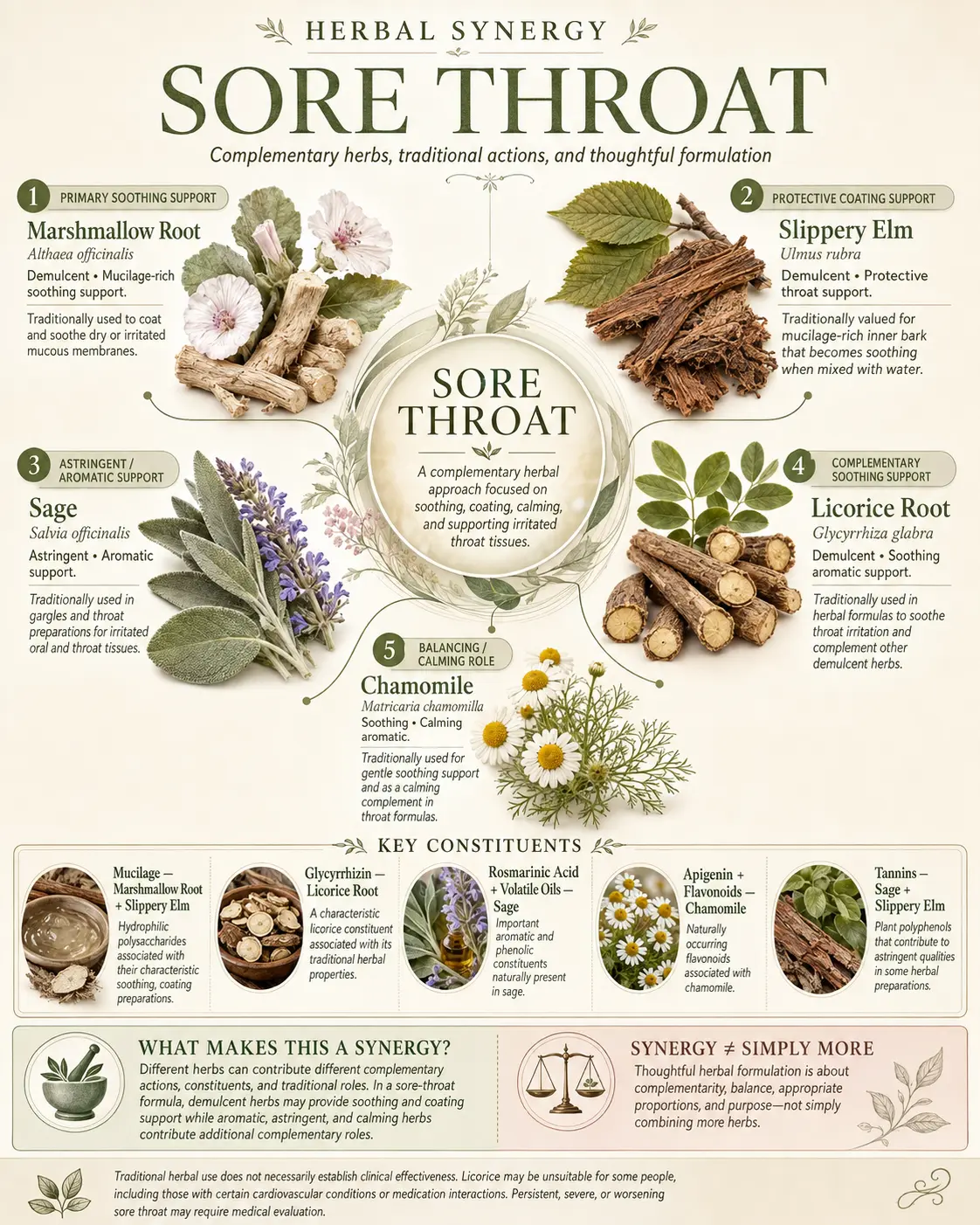
A sore throat is really two problems layered on top of each other: the pain and inflammation itself, and the raw, irritated tissue underneath it. Herbalists tend to address both — something to calm the inflammation directly, and something to physically coat and protect the tissue while it heals.
| Herb | What It Adds |
| Sage | The best clinically studied herb for sore throat pain specifically — shown to reduce pain within hours |
| Echinacea | Traditionally paired with sage in the clinically tested spray combination, for immune and inflammation support |
| Marshmallow Root | A demulcent that physically coats and soothes raw throat tissue |
| Propolis | Studied for both antimicrobial action and faster symptom resolution in throat infections |
| Honey | Coats the throat and has real evidence for easing throat-related coughing |
Sage and echinacea are the “calm the pain and inflammation” pair — genuinely studied together, not just traditionally paired. Marshmallow root and honey are the “physically protect the raw tissue” pair. Propolis sits in its own lane, with evidence for speeding up recovery generally. A good sore throat formula usually reaches for at least one from each camp.
Recipe for Sore Throat
Sage, Honey & Lemon Throat Tea
Why this blend: Sage is the best-studied single herb for sore throat pain, honey coats and soothes while offering real cough-relief evidence, and lemon adds a bit of acidity that many people find cutting through throat congestion.
Ingredients
- 1 tbsp dried sage leaf (or 3–4 fresh leaves)
- 1 cup (240 ml) hot water
- 1 tsp honey
- Juice of ¼ lemon
Yield: 1 cup
Preparation
- Place the sage leaves in a mug or infuser.
- Pour hot water over the sage and cover the cup.
- Steep, covered, for 8–10 minutes.
- Strain, let cool slightly, then stir in the honey and lemon juice.
How to Use Sip slowly, up to 3 times a day while the throat feels sore. Gargling a mouthful before swallowing can add extra direct contact with the irritated tissue.
Herbalist’s Note Sage is strongly flavored — if it tastes too medicinal on its own, the honey and lemon here aren’t just for taste, they genuinely help you actually finish the cup.
Safety Never give honey to a child under 12 months old due to infant botulism risk; use the sage tea alone for infants, or skip herbal remedies and check with a pediatrician.
Ready-to-Use Products With This Synergy
A.Vogel Echinaforce Sore Throat Spray Brand: A.Vogel Key herbs: Fresh echinacea (herb and root), fresh sage Why it fits: This is the exact echinacea-and-sage combination studied in a randomized, double-blind clinical trial against a standard pharmaceutical throat spray, with comparable results. Buy: shop.avogel.ca
Traditional Medicinals Organic Throat Coat Tea Brand: Traditional Medicinals Key herbs: Licorice root, slippery elm bark, marshmallow root, wild cherry bark Why it fits: Built around the same demulcent, throat-coating logic as the marshmallow root approach discussed in this article. Buy: traditionalmedicinals.com
Beekeeper’s Naturals Propolis Throat Spray Brand: Beekeeper’s Naturals Key herbs: Bee propolis extract Why it fits: A concentrated propolis spray reflecting the ingredient studied in clinical trials for faster sore throat symptom resolution. Buy: amazon.com
Herbal Synergies for Sore Throat
Not every sore throat needs the same approach. A sharp, sudden sore throat at the start of a cold responds well to something fast-acting like a sage spray, applied directly where it hurts. A throat that’s raw and scratchy from repeated coughing benefits more from a coating demulcent like marshmallow root or honey. And a throat that seems to be dragging on longer than expected is where something with broader supportive evidence, like propolis, tends to get used.
As always: synergy is about thoughtful complementarity — not simply adding more herbs to the pot.
Core Herbal Synergy Combinations
Sage + Echinacea Best for: A sudden, painful sore throat, especially early in a cold. Why it works: This exact pairing was tested head-to-head against a standard chlorhexidine-lidocaine throat spray in a randomized clinical trial and performed comparably — a rare case where the traditional combination and the clinical evidence line up precisely. Usually used as a direct spray rather than a tea, for fast, localized contact.
Marshmallow Root + Honey Best for: A raw, scratchy throat, especially one aggravated by coughing. Why it works: Marshmallow root’s mucilage physically coats irritated tissue, and honey adds a second layer of coating plus its own real evidence for easing throat-related cough. Neither herb needs to be fancy here — this is about simple, direct physical soothing.
Propolis + Honey Best for: A sore throat that seems to be lingering, or general immune support alongside symptom relief. Why it works: Propolis has clinical evidence for speeding up throat symptom resolution specifically, and honey’s natural antimicrobial and coating properties make it a natural pairing — many commercial propolis throat sprays are formulated with honey for exactly this reason.
Sage + Honey + Lemon Best for: An everyday, easy-to-make remedy for general sore throat discomfort. Why it works: Sage brings the best single-herb evidence for throat pain, honey coats and soothes, and lemon cuts through the flavor while adding a bit of acidity many people find helpful. Simple, accessible, and the tea recipe featured in this article.
Herbs Used in These Synergies
Sage Botanical name: Salvia officinalis Traditional actions: Anti-inflammatory, astringent, antimicrobial Role in the synergy: The standout herb in this lineup — a randomized, placebo-controlled trial of a 15% sage spray showed a statistically significant reduction in throat pain within two hours of use. Key constituents: Rosmarinic acid, essential oil compounds (thujone, camphor)
Echinacea Botanical name: Echinacea purpurea Traditional actions: Immune-supportive, traditionally anti-inflammatory Role in the synergy: Most notable here for its role alongside sage in a clinically tested combination spray, rather than for standalone throat-specific evidence. Key constituents: Alkylamides, polysaccharides
Marshmallow Root Botanical name: Althaea officinalis Traditional actions: Demulcent, soothing Role in the synergy: Its mucilage coats and protects irritated throat tissue — a purely physical, soothing action rather than an anti-inflammatory or antimicrobial one. Key constituents: Mucilage (polysaccharides)
Propolis Botanical name: Not applicable (bee-derived resin, not a plant) Traditional actions: Antimicrobial, traditionally soothing Role in the synergy: Studied specifically for sore throat symptom resolution — one trial found propolis spray users cleared throat symptoms roughly two days faster than a placebo group. Key constituents: Flavonoids (galangin, pinocembrin, chrysin), phenolic acids
Honey Traditional actions: Demulcent, coating, mild antimicrobial Role in the synergy: Coats the throat directly and has genuine clinical evidence for reducing cough — which matters here since coughing itself often re-irritates a sore throat. Key constituents: Not applicable (food, not an herb extract)
Safety and When to Seek Medical Advice
Use Caution If:
- You’re giving this to a child under 12 months old — never give honey to infants under one year due to infant botulism risk
- You’re allergic to bee products — propolis and honey should both be avoided if you have a known bee product allergy
- You’re pregnant or breastfeeding — sage in concentrated or essential-oil form (not culinary tea amounts) is generally used cautiously in pregnancy due to its thujone content
- You’re taking immune-modulating medications — echinacea is sometimes advised against for people on immunosuppressant therapy; check with a provider
- You’re using a spray product — follow the label’s maximum daily use and duration limits rather than using it indefinitely
See a Healthcare Professional If: The sore throat is severe, lasts more than a week, comes with high fever, difficulty swallowing or breathing, a rash, or white patches on the tonsils — these can indicate a bacterial infection like strep throat, which needs proper diagnosis and, if confirmed, antibiotic treatment rather than herbal management alone.
Q&A
What’s the fastest-acting option here? A sage spray, or a sage-and-echinacea combination like the one studied clinically — relief has been shown within about two hours of use, which is faster than most tea-based approaches.
Can I use a throat spray and drink tea on the same day? Generally yes — a spray for fast, localized relief and a tea like marshmallow-and-honey for ongoing soothing are complementary rather than redundant.
Can I give honey to my child for a sore throat? Yes, for children over 12 months. Never give honey to a child under 12 months old due to the risk of infant botulism.
How is this different from strep throat? Herbal approaches here are aimed at general viral or irritation-related sore throat. Strep throat is a bacterial infection that typically comes with high fever, white patches, and no cough — it needs a doctor’s diagnosis and antibiotics, not herbal remedies.
Can I use these every day? Sage tea and honey are fine for regular use during an active sore throat. Spray products like echinacea-sage or propolis sprays usually have a maximum recommended duration on the label — check it rather than using indefinitely.
Which combination is gentlest? Marshmallow root and honey — no astringent or stimulating herbs, just direct, physical coating and soothing.
When should I see a doctor instead? If the sore throat is severe, doesn’t improve within a week, or comes with high fever, difficulty swallowing, or white patches on the tonsils — that combination is worth getting checked rather than managed at home.
References
Honey for Acute Cough in Children – Cochrane
Licorice Root: Usefulness and Safety – NCCIH
Disclaimer
This article is for educational and informational purposes only and is not intended to diagnose, treat, cure, or prevent disease. Herbs are biologically active and may interact with medications or be inappropriate for some people. If you are pregnant, breastfeeding, taking medication, managing a health condition, or experiencing persistent or severe symptoms, consult a qualified healthcare professional before using herbal preparations.
Available Herbal Products
Explore and shop ready-made products offering this benefit.