

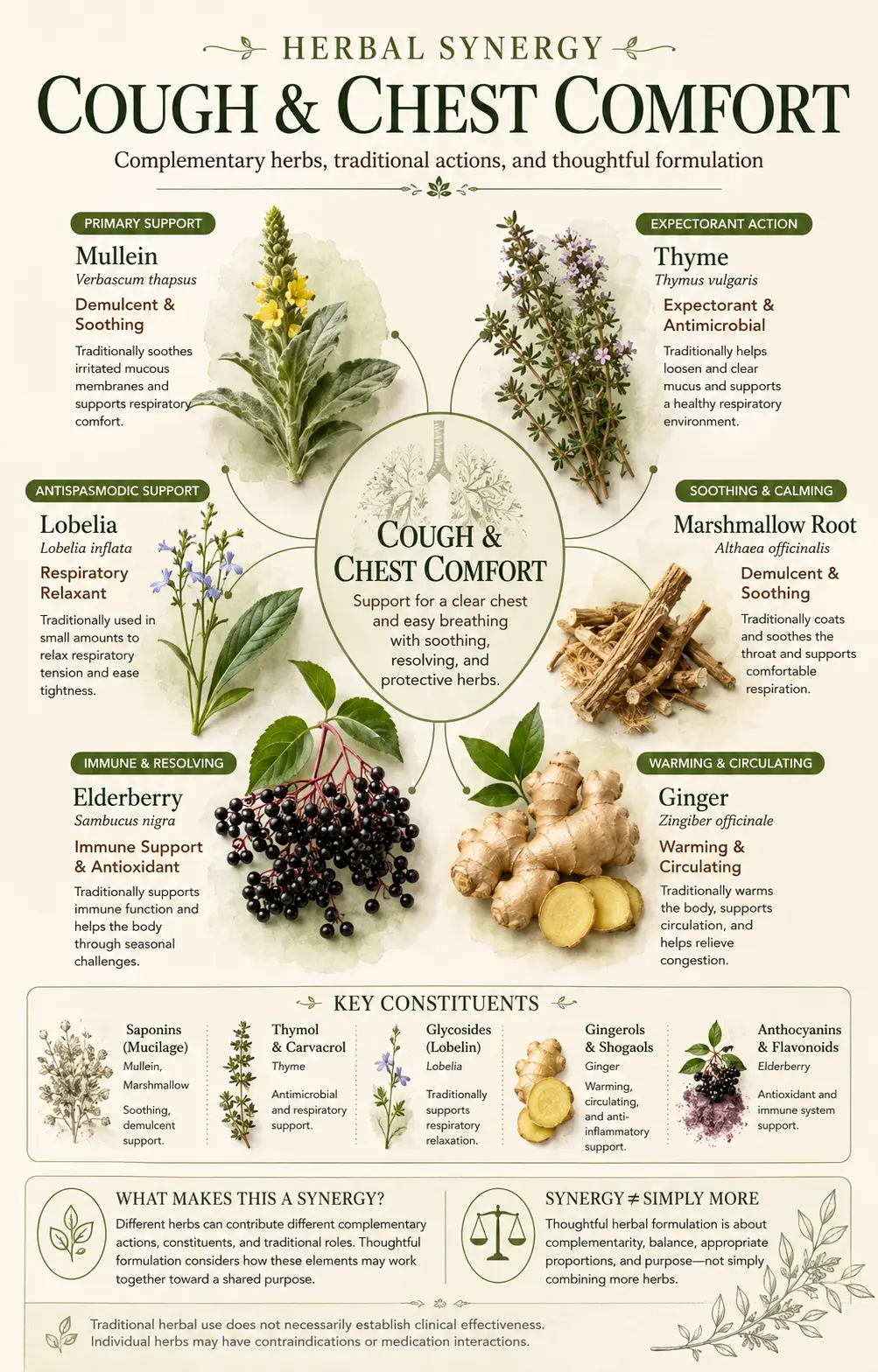
A cough isn’t one thing — sometimes it’s a raw, scratchy throat, sometimes it’s chest congestion that won’t budge, and sometimes it’s a dry, tickly irritation that just won’t quit. Different herbs are traditionally chosen for different parts of that picture, and one of them — a thyme-and-ivy combination — has real clinical trial evidence behind it.
| Herb | What It Adds |
| Thyme | Traditionally used to loosen mucus and ease coughing fits — the best-studied herb on this list |
| Ivy Leaf | Its extract is a genuine research standout for reducing cough frequency in acute bronchitis |
| Marshmallow Root | A demulcent that coats and soothes an irritated, raw throat |
| Licorice Root | Also demulcent and traditionally expectorant, with a distinct safety profile to know about |
| Honey | Has real clinical evidence for reducing cough frequency and severity, especially at night |
Thyme and ivy are the “get the mucus moving” pair, marshmallow and licorice are the “soothe the raw tissue” pair, and honey does a bit of both while making everything taste better. A good cough formula usually pulls from more than one of these categories, since a productive chest cough and a raw, dry throat aren’t the same problem.
Recipe for Cough & Chest Comfort
Thyme, Marshmallow Root & Honey Chest Tea
Why this blend: Thyme is traditionally used to help loosen chest congestion, marshmallow root soothes the throat irritation that comes from coughing itself, and honey adds real evidence-backed cough relief along with a flavor that makes the tea easy to actually drink.
Ingredients
- 1 tsp dried thyme
- 1 tsp dried marshmallow root
- 1 cup (240 ml) hot water
- 1 tsp honey, stirred in after steeping
Yield: 1 cup
Preparation
- Combine the thyme and marshmallow root in a mug or infuser.
- Pour hot water over the herbs and cover the cup.
- Steep, covered, for 10 minutes — marshmallow root benefits from the longer steep to release its mucilage.
- Strain, let cool slightly, then stir in the honey.
How to Use Drink warm, up to 3 times a day while symptoms are present. Adding honey after the tea has cooled slightly helps preserve its texture and flavor.
Herbalist’s Note Marshmallow root tea can look a little slimy once strained — that’s the mucilage doing exactly what it’s supposed to do, not a sign anything went wrong.
Safety Never give honey to a child under 12 months old due to infant botulism risk — for babies, skip the honey and use the thyme-marshmallow tea alone, or consult a pediatrician first.
Ready-to-Use Products With This Synergy
Traditional Medicinals Organic Throat Coat Tea Brand: Traditional Medicinals Key herbs: Licorice root, slippery elm bark, marshmallow root, wild cherry bark, fennel fruit Why it fits: A well-known demulcent blend built around the same soothing logic as this article’s marshmallow-and-licorice pairing, widely used for throat irritation from coughing. Buy: traditionalmedicinals.com
Gaia Herbs Echinacea Goldenseal Propolis Throat Spray Brand: Gaia Herbs Key herbs: Licorice, propolis, echinacea, goldenseal Why it fits: A fast-acting spray format built around licorice’s demulcent, soothing action, useful when a tea isn’t practical. Buy: vitacost.com
Prospan Cough Syrup (Ivy Leaf Extract EA 575) Brand: Prospan (Engelhard Arzneimittel) Key herbs: Ivy leaf extract Why it fits: This is the specific ivy leaf extract studied in the head-to-head clinical trials referenced in this article — a single-herb option for the person who wants the most research-backed ingredient on its own. Buy: amazon.com
Herbal Synergies for Cough & Chest Comfort
Not every cough calls for the same herbs. A tight, productive chest cough with congestion tends to respond well to thyme and ivy, which are traditionally (and, for this combination, clinically) associated with loosening mucus. A dry, raw, tickly cough — the kind that hurts more than it produces anything — usually responds better to soothing demulcents like marshmallow root, licorice, and honey. And nighttime coughing that disrupts sleep is where honey specifically has the clearest research behind it.
As always: synergy is about thoughtful complementarity — not simply adding more herbs to the pot.
Core Herbal Synergy Combinations
Thyme + Ivy Leaf Best for: Productive chest coughs with congestion, especially with acute bronchitis. Why it works: This is the one combination on this list with genuine clinical trial evidence for the pairing itself — multiple randomized, placebo-controlled trials of a thyme-ivy fluid extract combination showed significantly greater reductions in coughing fits compared to placebo. This isn’t just two traditional herbs stacked together; it’s a studied formula.
Marshmallow Root + Licorice Root Best for: A raw, sore throat that’s aggravating the cough itself. Why it works: Both herbs are demulcents that coat and soothe irritated throat tissue, but licorice adds a traditional expectorant quality on top of the soothing effect. This is the classic pairing behind most commercial “throat coat” style teas.
Thyme + Marshmallow Root + Honey Best for: A cough that’s both congested and leaving the throat raw — the “everything hurts” combination. Why it works: Thyme addresses the congestion side, marshmallow root soothes the throat that’s been aggravated by coughing, and honey adds real evidence-backed cough relief along with a pleasant taste. This is the tea recipe featured in this article.
Honey + Ginger Best for: A simple, everyday remedy for mild, occasional coughing — especially at night. Why it works: Honey has the clearest clinical evidence of anything on this list for reducing nighttime cough frequency and severity in children, and ginger adds warmth and a traditional soothing quality. About as simple as a cough remedy gets, and that’s the point.
Herbs Used in These Synergies
Thyme Botanical name: Thymus vulgaris Traditional actions: Expectorant, antispasmodic Role in the synergy: The most clinically studied herb in this lineup — particularly in combination with ivy leaf, where multiple randomized trials have shown a real reduction in coughing fits compared to placebo. Key constituents: Thymol, carvacrol
Ivy Leaf Botanical name: Hedera helix Traditional actions: Expectorant, mild bronchodilator Role in the synergy: A genuine clinical research standout for acute bronchitis with productive cough, most often used as a standardized extract (as in Prospan) rather than a home-brewed tea. Key constituents: Hederacoside C, alpha-hederin
Marshmallow Root Botanical name: Althaea officinalis Traditional actions: Demulcent, soothing Role in the synergy: Its mucilage coats irritated throat tissue, making it a go-to for the raw, scratchy feeling that comes with a persistent cough rather than the congestion itself. Key constituents: Mucilage (polysaccharides)
Licorice Root Botanical name: Glycyrrhiza glabra Traditional actions: Demulcent, traditional expectorant Role in the synergy: Soothes irritated tissue similarly to marshmallow root, but comes with its own distinct safety profile due to its glycyrrhizin content (see safety section) — not a herb to use in unlimited amounts. Key constituents: Glycyrrhizin
Honey Traditional actions: Demulcent, cough suppressant Role in the synergy: Has real clinical evidence, particularly in children, for reducing nighttime cough frequency and improving sleep quality during a cold — one of the better-evidenced remedies in this entire article. Key constituents: Not applicable (food, not an herb extract)
Safety and When to Seek Medical Advice
Use Caution If:
- You’re giving this to a child under 12 months old — never give honey to infants under one year due to the risk of infant botulism; use herb-only teas instead and check with a pediatrician
- You have high blood pressure or a heart condition — licorice root (unless it’s the deglycyrrhizinated/DGL form) can raise blood pressure and cause fluid retention with regular or prolonged use
- You’re pregnant — licorice root is generally not recommended during pregnancy
- You’re taking medications — licorice can interact with blood pressure medications and diuretics; check with a provider if you take either
- You’re using concentrated extracts or standardized products like ivy leaf syrup — follow label dosing rather than treating them like tea
See a Healthcare Professional If: Cough lasts more than a couple of weeks, is accompanied by high fever, difficulty breathing, chest pain, coughing up blood, or if a cough in a young child, older adult, or anyone with a chronic lung condition seems to be worsening. These need medical evaluation rather than ongoing herbal management.
Q&A
What’s the best combination to start with? Thyme and ivy leaf for a congested, productive cough — it’s the pairing with the strongest clinical evidence. For a raw, dry throat instead, marshmallow root and licorice root is the better fit.
Can I give honey to my child for a cough? Yes, for children over 12 months — honey has real clinical evidence for reducing cough frequency, especially at night. Never give honey to a child under 12 months old due to infant botulism risk.
When should I drink the tea? Anytime symptoms are bothering you, up to about 3 times a day. Many people find an evening cup particularly helpful before bed, when coughing tends to worsen.
Can I use these herbs every day? Thyme, marshmallow root, and honey are commonly used daily for the duration of a cold or cough. Licorice root is better used short-term, especially the full-strength (non-DGL) form, due to its blood pressure effects with prolonged use.
Which combination is gentlest? Marshmallow root and honey — no licorice, no stimulating herbs, just soothing demulcent action.
I have high blood pressure — is licorice off-limits? It’s worth avoiding regular licorice root use, or switching to deglycyrrhizinated licorice (DGL), which has most of the blood-pressure-affecting compound removed. Marshmallow root alone is a fine substitute in any of these combinations.
When should I see a doctor instead? If the cough lasts more than two weeks, comes with high fever, chest pain, breathing difficulty, or blood — that’s worth a proper medical evaluation, not more tea.
References
Honey for Acute Cough in Children – Cochrane
Licorice Root: Usefulness and Safety – NCCIH
Disclaimer
This article is for educational and informational purposes only and is not intended to diagnose, treat, cure, or prevent disease. Herbs are biologically active and may interact with medications or be inappropriate for some people. If you are pregnant, breastfeeding, taking medication, managing a health condition, or experiencing persistent or severe symptoms, consult a qualified healthcare professional before using herbal preparations.
Available Herbal Products
Explore and shop ready-made products offering this benefit.