

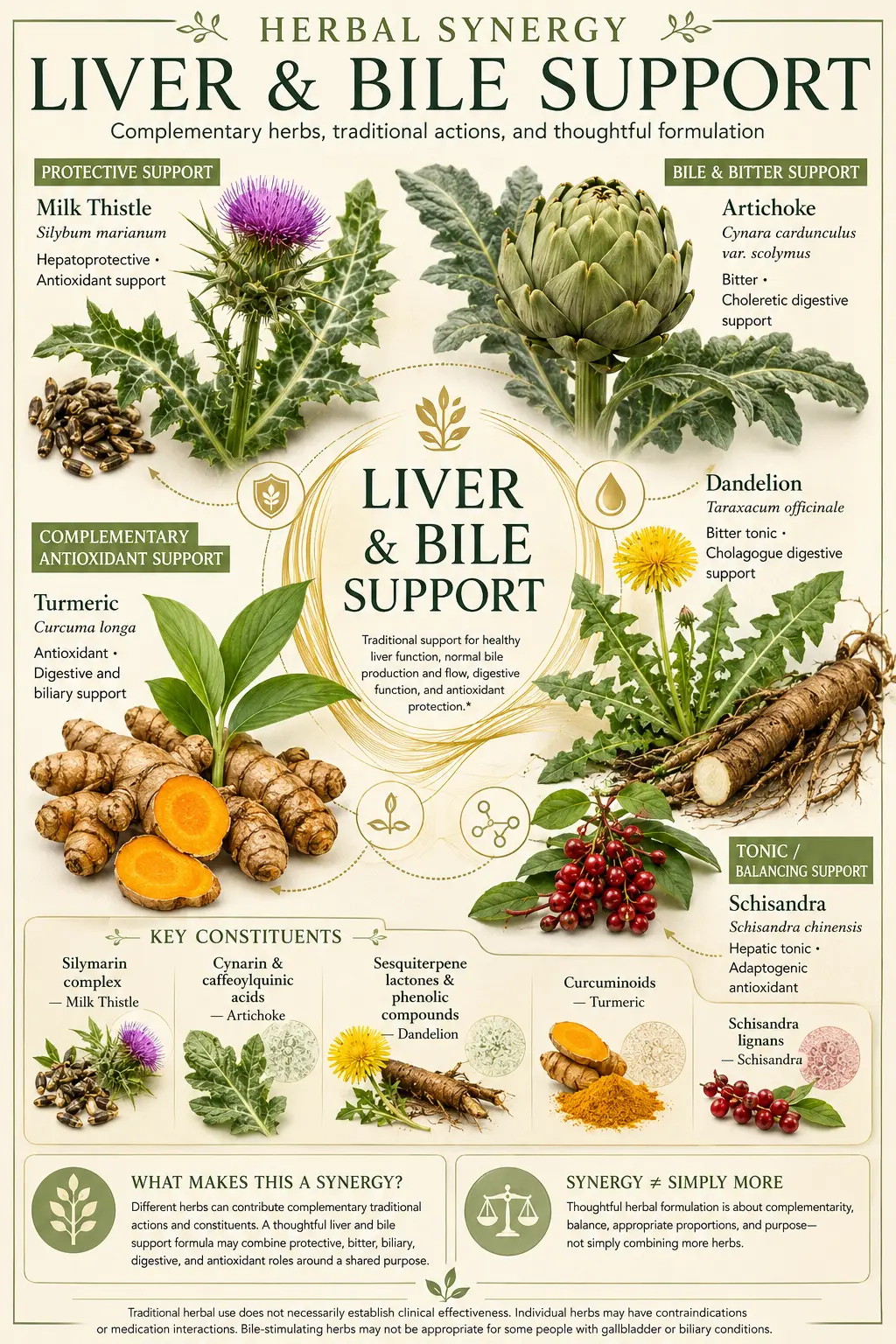
“Sluggish liver” isn’t a formal diagnosis, but the pattern people describe — heaviness after fatty meals, sluggish digestion, feeling foggy or off after rich food or alcohol — is one herbalists have addressed for generations by supporting two related but distinct things: the liver’s own function, and the flow of bile that helps digest fat in the first place.
| Herb | What It Adds |
| Milk Thistle | The most researched liver herb, traditionally and clinically studied for supporting liver cell function |
| Artichoke Leaf | A genuine choleretic — shown to increase bile flow, easing that heavy, post-fatty-meal feeling |
| Dandelion Root | A bitter and traditional cholagogue, thought to help move bile that’s already been made |
| Ginger | Warming digestive support that rounds out a formula without adding another bitter |
Milk thistle and artichoke leaf are doing genuinely different jobs — one is about supporting the liver cell itself, the other about getting bile moving — which is exactly why they’re so often paired rather than used alone. Dandelion root adds a traditional bitter layer, and ginger keeps the whole thing from tasting purely medicinal.
Recipe for Liver & Bile Support
Dandelion Root & Ginger Bitters Tea
Why this blend: Dandelion root is a traditional bitter thought to support bile flow, and ginger adds warmth so the tea isn’t just a mouthful of bitterness — a simple, everyday way to build a pre-meal bitters habit.
Ingredients
- 1 tsp roasted dandelion root
- ½ tsp fresh grated ginger (or ¼ tsp dried)
- 1 cup (240 ml) hot water
Yield: 1 cup
Preparation
- Combine the dandelion root and ginger in a mug or infuser.
- Pour hot water over the herbs and cover the cup.
- Steep, covered, for 10–12 minutes — dandelion root is tough and benefits from the longer steep.
- Strain and drink warm, about 15–20 minutes before a meal.
How to Use Drink before a meal, especially a rich or fatty one, rather than after — bitters are traditionally used to prime digestion, not fix it retroactively.
Herbalist’s Note Bitter taste is doing actual work here — the bitterness itself is part of the traditional mechanism, so resist the urge to add honey.
Safety Skip this if you have gallstones or a bile duct obstruction — see the safety section below.
Ready-to-Use Products With This Synergy
Urban Moonshine Healthy Liver Bitters Brand: Urban Moonshine Key herbs: Artichoke leaf, dandelion root, dandelion leaf, fenugreek seed, ginger root Why it fits: This is close to a textbook version of the combination discussed in this article — artichoke for bile flow, dandelion as the bitter, ginger for warmth — in a ready-to-use liquid bitters format. Buy: urbanmoonshine.com
Gaia Herbs Milk Thistle Capsules Brand: Gaia Herbs Key herbs: Milk thistle (standardized for silymarin) Why it fits: A single-herb, standardized-extract option for the person who wants the most-studied liver herb on its own, without a broader bitters formula. Buy: gaiaherbs.com
Gaia Herbs Liver Cleanse Brand: Gaia Herbs Key herbs: Milk thistle, burdock, turmeric, dandelion Why it fits: Combines the liver-support and bile-flow angles into one liquid phyto-capsule formula, similar in logic to pairing milk thistle with a bitter like dandelion. Buy: gaiaherbs.com
Herbal Synergies for Liver & Bile Support
Not everyone reaching for “liver support” has the same experience in mind. Some people are dealing with the heavy, sluggish feeling that follows a rich or fatty meal — that’s a bile-flow issue, and it responds well to bitters and choleretics used before eating. Others want general, ongoing liver support unrelated to any specific meal — that’s more where milk thistle’s research base comes in, as a daily rather than occasional herb. And some people simply want a gentler, food-based bitter habit rather than a targeted supplement.
As always: synergy is about thoughtful complementarity — not simply adding more herbs to the pot.
Core Herbal Synergy Combinations
Milk Thistle + Artichoke Leaf Best for: General, ongoing liver support alongside occasional heaviness after fatty meals. Why it works: Milk thistle is the best-researched single herb for liver cell support, while artichoke leaf has genuine evidence for increasing bile flow. Together they cover two different jobs — supporting the liver itself, and helping it do the specific work of processing fat — without either one duplicating the other.
Dandelion Root + Ginger Best for: An everyday, food-based bitters habit before meals. Why it works: Dandelion root’s bitterness is traditionally thought to prime digestive secretions before a meal even starts, and ginger keeps the tea from being unpleasant to drink regularly. This is the gentlest, most “just make it a habit” combination on the list — the tea recipe above.
Artichoke Leaf + Dandelion Root + Ginger Best for: Post-meal heaviness and sluggish digestion after rich food. Why it works: Artichoke does the heavy lifting on bile flow, dandelion root adds a complementary bitter layer, and ginger rounds out the formula with warmth and general digestive support. This is close to the formulation logic behind most commercial “liver bitters” products.
Milk Thistle + Dandelion Root Best for: People who want one supplement covering both liver-cell support and a bitter, bile-supporting action. Why it works: Milk thistle brings the best-studied liver-support evidence, while dandelion root contributes a traditional bitter and mild cholagogue action. A simple two-herb pairing rather than a complex formula — sometimes that’s plenty.
Herbs Used in These Synergies
Milk Thistle Botanical name: Silybum marianum Traditional actions: Hepatoprotective, antioxidant Role in the synergy: The most clinically studied liver herb, with research (mixed but substantial) looking at its silymarin content and effects on liver enzyme levels — generally used as an ongoing, daily herb rather than an occasional one. Key constituents: Silymarin (a complex of flavonolignans including silybin)
Artichoke Leaf Botanical name: Cynara scolymus (syn. Cynara cardunculus) Traditional actions: Choleretic, digestive bitter Role in the synergy: One of the few herbs on this list with real clinical evidence for its specific mechanism — increasing bile flow — making it the go-to for that “heavy after a fatty meal” feeling. Key constituents: Cynarin, chlorogenic acid
Dandelion Root Botanical name: Taraxacum officinale Traditional actions: Bitter, traditional cholagogue Role in the synergy: A traditional bitter thought to support bile movement, commonly paired with artichoke leaf or milk thistle in commercial formulas — important to note this is contraindicated with gallstones or bile duct obstruction (see safety section). Key constituents: Sesquiterpene lactones, inulin
Ginger Botanical name: Zingiber officinale Traditional actions: Warming digestive Role in the synergy: Added for flavor and general digestive support rather than as a primary liver or bile herb — it’s the “make this pleasant to actually drink” ingredient. Key constituents: Gingerols, shogaols
Safety and When to Seek Medical Advice
Use Caution If:
- You have gallstones or any bile duct obstruction — this is the single most important caution here. Choleretic and cholagogue herbs (dandelion root, artichoke) stimulate bile flow, which can trigger a painful gallbladder attack if bile can’t actually get where it’s going
- You’re pregnant or breastfeeding — milk thistle is generally not recommended during pregnancy or lactation without medical guidance
- You’re taking medications, particularly diabetes medications — several of these herbs (dandelion, milk thistle) may affect blood sugar
- You’re allergic to related plants — dandelion and artichoke are both part of the Asteraceae (daisy) family; ragweed allergy is a common cross-reactivity flag
- You have an active liver disease or are managing hepatitis — this deserves direct medical supervision, not self-directed herbal use
See a Healthcare Professional If: You experience yellowing of the skin or eyes, dark urine, pale stools, persistent right-upper-abdominal pain, unexplained fatigue, or any symptoms that suggest an actual liver or gallbladder condition rather than everyday sluggishness. These need proper diagnosis — herbs are not an appropriate substitute for evaluating a real liver or biliary problem.
Q&A
What’s the difference between milk thistle and dandelion root here? Milk thistle is about supporting the liver cell itself, with the strongest research base of any herb in this space. Dandelion root is a traditional bitter thought to support bile flow — a different mechanism entirely, which is why they’re often combined rather than treated as interchangeable.
Can I take these herbs together? Generally yes — milk thistle, artichoke, dandelion root, and ginger are commonly combined in commercial liver-support formulas. The main thing to check is the gallstone/bile duct caution above before adding any bitter or choleretic herb.
When should I drink bitters — before or after eating? Before, ideally 15–20 minutes ahead of a meal. Bitters are traditionally used to prime digestion in advance, not to fix discomfort after the fact.
Can I use these every day? Milk thistle is commonly used as a daily, ongoing supplement. Bitters like dandelion root are also often used daily before meals as a habit, though some people prefer to reserve them for richer meals specifically.
Is this evidence strong, or mostly traditional? It’s mixed. Artichoke leaf has real clinical evidence for increasing bile flow. Milk thistle has a large body of research, though results across trials are inconsistent, especially for serious liver disease. Dandelion root’s role here leans more traditional than clinically proven.
I have gallstones — can I still use these herbs? Not without medical guidance. Choleretic and cholagogue herbs increase bile flow and movement, which is exactly the wrong thing to stimulate if there’s a stone blocking a duct. This is the most important caution on this whole list.
When should I see a doctor instead? If you notice yellowing skin or eyes, dark urine, pale stools, or persistent abdominal pain — those are signs worth having properly evaluated, not managed with tea.
References
- Milk Thistle (PDQ) – National Cancer Institute
- Milk Thistle for Alcoholic and/or Hepatitis B or C Virus Liver Diseases – Cochrane
- Impact of Silymarin Supplements on Liver Enzyme Levels: A Systematic Review – PMC
- Effect of Artichoke Leaf Extract on Bile Flow in Humans: Systematic Review and Meta-Analysis – PubMed (via summary)
- Artichoke – Health Information Library, PeaceHealth
- The Effect of Ginger and Artichoke Extract Supplementation on Functional Dyspepsia – PMC
- Milk Thistle – StatPearls, NCBI Bookshelf
Disclaimer
This article is for educational and informational purposes only and is not intended to diagnose, treat, cure, or prevent disease. Herbs are biologically active and may interact with medications or be inappropriate for some people. If you are pregnant, breastfeeding, taking medication, managing a health condition, or experiencing persistent or severe symptoms, consult a qualified healthcare professional before using herbal preparations.
Recipe for Liver & Bile Support
Dandelion Root & Ginger Bitters Tea
Why this blend: Dandelion root is a traditional bitter thought to support bile flow, and ginger adds warmth so the tea isn’t just a mouthful of bitterness — a simple, everyday way to build a pre-meal bitters habit.
Ingredients
- 1 tsp roasted dandelion root
- ½ tsp fresh grated ginger (or ¼ tsp dried)
- 1 cup (240 ml) hot water
Yield: 1 cup
Preparation
- Combine the dandelion root and ginger in a mug or infuser.
- Pour hot water over the herbs and cover the cup.
- Steep, covered, for 10–12 minutes — dandelion root is tough and benefits from the longer steep.
- Strain and drink warm, about 15–20 minutes before a meal.
How to Use Drink before a meal, especially a rich or fatty one, rather than after — bitters are traditionally used to prime digestion, not fix it retroactively.
Herbalist’s Note Bitter taste is doing actual work here — the bitterness itself is part of the traditional mechanism, so resist the urge to add honey.
Safety Skip this if you have gallstones or a bile duct obstruction — see the safety section below.
Ready-to-Use Products With This Synergy
Urban Moonshine Healthy Liver Bitters Brand: Urban Moonshine Key herbs: Artichoke leaf, dandelion root, dandelion leaf, fenugreek seed, ginger root Why it fits: This is close to a textbook version of the combination discussed in this article — artichoke for bile flow, dandelion as the bitter, ginger for warmth — in a ready-to-use liquid bitters format. Buy: urbanmoonshine.com
Gaia Herbs Milk Thistle Capsules Brand: Gaia Herbs Key herbs: Milk thistle (standardized for silymarin) Why it fits: A single-herb, standardized-extract option for the person who wants the most-studied liver herb on its own, without a broader bitters formula. Buy: gaiaherbs.com
Gaia Herbs Liver Cleanse Brand: Gaia Herbs Key herbs: Milk thistle, burdock, turmeric, dandelion Why it fits: Combines the liver-support and bile-flow angles into one liquid phyto-capsule formula, similar in logic to pairing milk thistle with a bitter like dandelion. Buy: gaiaherbs.com
Herbal Synergies for Liver & Bile Support
Not everyone reaching for “liver support” has the same experience in mind. Some people are dealing with the heavy, sluggish feeling that follows a rich or fatty meal — that’s a bile-flow issue, and it responds well to bitters and choleretics used before eating. Others want general, ongoing liver support unrelated to any specific meal — that’s more where milk thistle’s research base comes in, as a daily rather than occasional herb. And some people simply want a gentler, food-based bitter habit rather than a targeted supplement.
As always: synergy is about thoughtful complementarity — not simply adding more herbs to the pot.
Core Herbal Synergy Combinations
Milk Thistle + Artichoke Leaf Best for: General, ongoing liver support alongside occasional heaviness after fatty meals. Why it works: Milk thistle is the best-researched single herb for liver cell support, while artichoke leaf has genuine evidence for increasing bile flow. Together they cover two different jobs — supporting the liver itself, and helping it do the specific work of processing fat — without either one duplicating the other.
Dandelion Root + Ginger Best for: An everyday, food-based bitters habit before meals. Why it works: Dandelion root’s bitterness is traditionally thought to prime digestive secretions before a meal even starts, and ginger keeps the tea from being unpleasant to drink regularly. This is the gentlest, most “just make it a habit” combination on the list — the tea recipe above.
Artichoke Leaf + Dandelion Root + Ginger Best for: Post-meal heaviness and sluggish digestion after rich food. Why it works: Artichoke does the heavy lifting on bile flow, dandelion root adds a complementary bitter layer, and ginger rounds out the formula with warmth and general digestive support. This is close to the formulation logic behind most commercial “liver bitters” products.
Milk Thistle + Dandelion Root Best for: People who want one supplement covering both liver-cell support and a bitter, bile-supporting action. Why it works: Milk thistle brings the best-studied liver-support evidence, while dandelion root contributes a traditional bitter and mild cholagogue action. A simple two-herb pairing rather than a complex formula — sometimes that’s plenty.
Herbs Used in These Synergies
Milk Thistle Botanical name: Silybum marianum Traditional actions: Hepatoprotective, antioxidant Role in the synergy: The most clinically studied liver herb, with research (mixed but substantial) looking at its silymarin content and effects on liver enzyme levels — generally used as an ongoing, daily herb rather than an occasional one. Key constituents: Silymarin (a complex of flavonolignans including silybin)
Artichoke Leaf Botanical name: Cynara scolymus (syn. Cynara cardunculus) Traditional actions: Choleretic, digestive bitter Role in the synergy: One of the few herbs on this list with real clinical evidence for its specific mechanism — increasing bile flow — making it the go-to for that “heavy after a fatty meal” feeling. Key constituents: Cynarin, chlorogenic acid
Dandelion Root Botanical name: Taraxacum officinale Traditional actions: Bitter, traditional cholagogue Role in the synergy: A traditional bitter thought to support bile movement, commonly paired with artichoke leaf or milk thistle in commercial formulas — important to note this is contraindicated with gallstones or bile duct obstruction (see safety section). Key constituents: Sesquiterpene lactones, inulin
Ginger Botanical name: Zingiber officinale Traditional actions: Warming digestive Role in the synergy: Added for flavor and general digestive support rather than as a primary liver or bile herb — it’s the “make this pleasant to actually drink” ingredient. Key constituents: Gingerols, shogaols
Safety and When to Seek Medical Advice
Use Caution If:
- You have gallstones or any bile duct obstruction — this is the single most important caution here. Choleretic and cholagogue herbs (dandelion root, artichoke) stimulate bile flow, which can trigger a painful gallbladder attack if bile can’t actually get where it’s going
- You’re pregnant or breastfeeding — milk thistle is generally not recommended during pregnancy or lactation without medical guidance
- You’re taking medications, particularly diabetes medications — several of these herbs (dandelion, milk thistle) may affect blood sugar
- You’re allergic to related plants — dandelion and artichoke are both part of the Asteraceae (daisy) family; ragweed allergy is a common cross-reactivity flag
- You have an active liver disease or are managing hepatitis — this deserves direct medical supervision, not self-directed herbal use
See a Healthcare Professional If: You experience yellowing of the skin or eyes, dark urine, pale stools, persistent right-upper-abdominal pain, unexplained fatigue, or any symptoms that suggest an actual liver or gallbladder condition rather than everyday sluggishness. These need proper diagnosis — herbs are not an appropriate substitute for evaluating a real liver or biliary problem.
Q&A
What’s the difference between milk thistle and dandelion root here? Milk thistle is about supporting the liver cell itself, with the strongest research base of any herb in this space. Dandelion root is a traditional bitter thought to support bile flow — a different mechanism entirely, which is why they’re often combined rather than treated as interchangeable.
Can I take these herbs together? Generally yes — milk thistle, artichoke, dandelion root, and ginger are commonly combined in commercial liver-support formulas. The main thing to check is the gallstone/bile duct caution above before adding any bitter or choleretic herb.
When should I drink bitters — before or after eating? Before, ideally 15–20 minutes ahead of a meal. Bitters are traditionally used to prime digestion in advance, not to fix discomfort after the fact.
Can I use these every day? Milk thistle is commonly used as a daily, ongoing supplement. Bitters like dandelion root are also often used daily before meals as a habit, though some people prefer to reserve them for richer meals specifically.
Is this evidence strong, or mostly traditional? It’s mixed. Artichoke leaf has real clinical evidence for increasing bile flow. Milk thistle has a large body of research, though results across trials are inconsistent, especially for serious liver disease. Dandelion root’s role here leans more traditional than clinically proven.
I have gallstones — can I still use these herbs? Not without medical guidance. Choleretic and cholagogue herbs increase bile flow and movement, which is exactly the wrong thing to stimulate if there’s a stone blocking a duct. This is the most important caution on this whole list.
When should I see a doctor instead? If you notice yellowing skin or eyes, dark urine, pale stools, or persistent abdominal pain — those are signs worth having properly evaluated, not managed with tea.
References
Milk Thistle (PDQ) – National Cancer Institute
Milk Thistle for Alcoholic and/or Hepatitis B or C Virus Liver Diseases – Cochrane
Impact of Silymarin Supplements on Liver Enzyme Levels: A Systematic Review – PMC
Artichoke – Health Information Library, PeaceHealth
The Effect of Ginger and Artichoke Extract Supplementation on Functional Dyspepsia – PMC
Milk Thistle – StatPearls, NCBI Bookshelf
Disclaimer
This article is for educational and informational purposes only and is not intended to diagnose, treat, cure, or prevent disease. Herbs are biologically active and may interact with medications or be inappropriate for some people. If you are pregnant, breastfeeding, taking medication, managing a health condition, or experiencing persistent or severe symptoms, consult a qualified healthcare professional before using herbal preparations.
Available Herbal Products
Explore and shop ready-made products offering this benefit.