

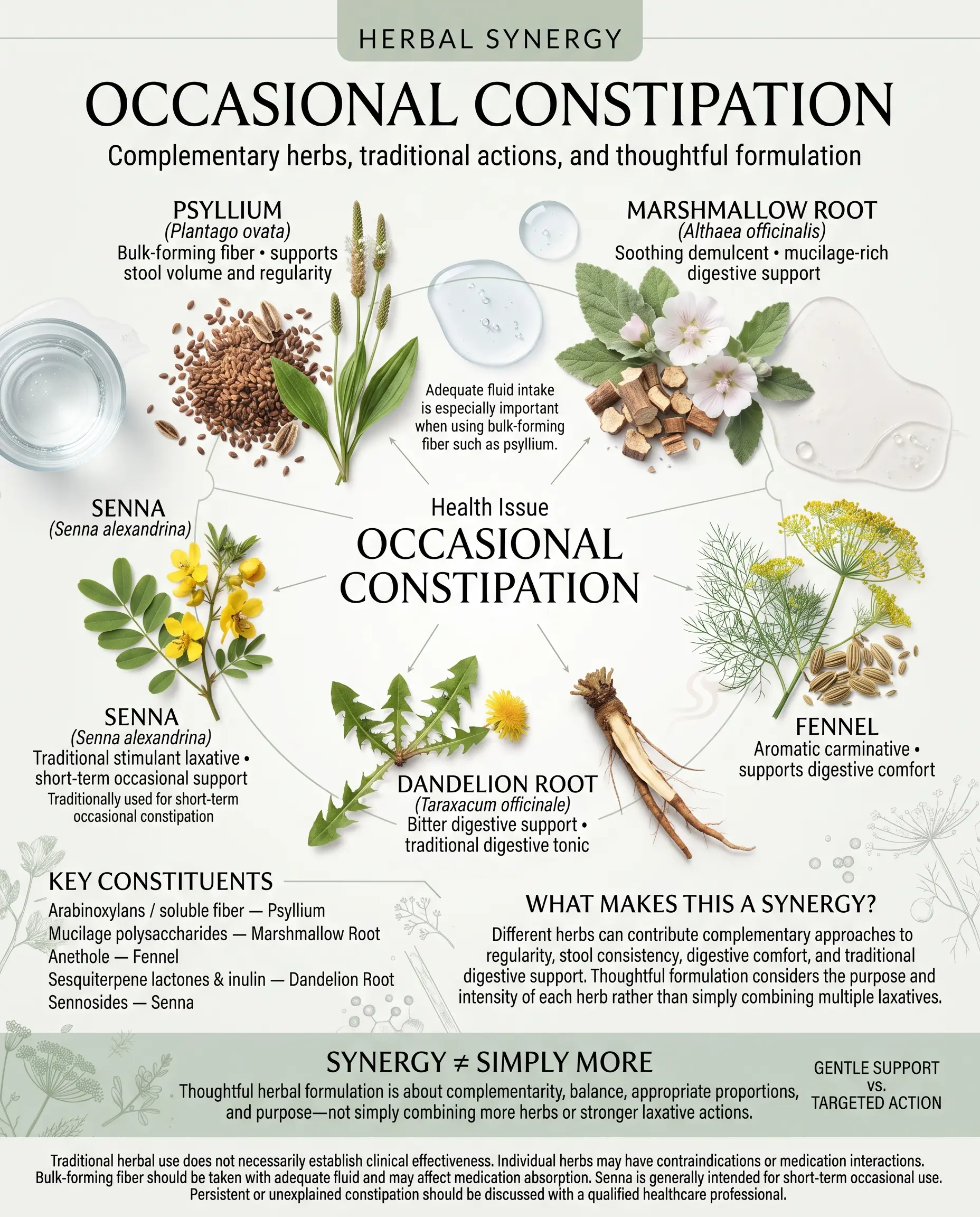
Constipation isn’t one problem — it can mean stool that’s too dry, a bowel that’s too sluggish, or muscles that just aren’t getting the message to move. Different herbs are traditionally chosen for different parts of that picture, which is why a well-built combination tends to work better than reaching for one “constipation herb” and hoping for the best.
| Herb | What It Adds |
| Psyllium | Bulk-forming fiber that softens and adds volume to stool — the best-evidenced option on this list |
| Senna | A stimulant that encourages the bowel muscles to contract and move things along |
| Ginger | Traditionally used to support motility and ease the cramping that can come with sluggish digestion |
| Fennel | Carminative that eases the gas and bloating that often shows up alongside constipation |
| Dandelion Root | A mild bitter and digestive stimulant traditionally used to support regularity |
Think of these as covering three different jobs: bulking the stool (psyllium), stimulating movement (senna), and easing the discomfort that tags along (ginger, fennel). Combining a bulk former with a gentle stimulant, for example, is a very different formula than combining two stimulants — even though both technically “help with constipation.”
Recipe for Occasional Constipation
Ginger, Fennel & Dandelion Root Evening Tea
Why this blend: Dandelion root gently stimulates digestion, fennel eases any accompanying gas, and ginger adds warmth and a mild motility nudge — a gentle, non-stimulant-laxative option for occasional, mild sluggishness.
Ingredients
- 1 tsp dried dandelion root (roasted or raw)
- 1 tsp crushed fennel seeds
- ½ tsp fresh grated ginger (or ¼ tsp dried)
- 1 cup (240 ml) hot water
Yield: 1 cup
Preparation
- Combine the dandelion root, fennel, and ginger in a mug or infuser.
- Pour hot water over the herbs and cover the cup.
- Steep, covered, for 10 minutes — dandelion root benefits from the slightly longer steep.
- Strain and drink warm.
How to Use Drink in the evening, ideally with a full glass of water alongside it — herbal support works best when paired with adequate fluid intake, not instead of it.
Herbalist’s Note This tea is a gentle nudge, not a stimulant laxative — don’t expect Smooth Move–level results from it, and that’s by design.
Safety This blend does not contain senna or another stimulant laxative; if it’s not enough on its own, that’s useful information, not a reason to add more herbs.
Ready-to-Use Products With This Synergy
Traditional Medicinals Organic Smooth Move Tea Brand: Traditional Medicinals Key herbs: Organic senna leaf, licorice root, fennel fruit, ginger rhizome, orange peel, cinnamon bark, coriander fruit Why it fits: A well-known senna-based tea combining a stimulant laxative with several carminative herbs (fennel, ginger) to ease the cramping that stimulant laxatives can sometimes cause. Buy: traditionalmedicinals.com
Metamucil Psyllium Fiber Supplement Brand: Metamucil Key herbs: Psyllium husk Why it fits: The best-studied bulk-forming fiber for constipation, useful as a daily foundation rather than an occasional stimulant. Buy: metamucil.com
Yogi Tea Get Regular Brand: Yogi Tea Key herbs: Senna leaf, ginger root, fennel seed, licorice root, peppermint leaf Why it fits: Another senna-plus-carminative blend, similar in formulation logic to the recipe above but built around a stimulant rather than a gentle nudge. Buy: yogiproducts.com
Herbal Synergies for Occasional Constipation
Not all constipation calls for the same approach. Mild, occasional sluggishness — the kind that shows up after travel or a change in routine — often responds to gentle, non-stimulant support like fiber or a mild digestive bitter. More stubborn, short-term constipation may call for a stimulant like senna, used briefly rather than as a daily habit. And constipation that comes with cramping or bloating benefits from adding a carminative herb alongside whatever’s doing the main work.
As always: synergy is about thoughtful complementarity — not simply adding more herbs to the pot.
Core Herbal Synergy Combinations
Psyllium + Water Best for: Ongoing, gentle support for regularity — not a same-day fix. Why it works: This isn’t really a multi-herb “synergy” in the traditional sense, but it’s worth including because psyllium’s bulk-forming action depends entirely on adequate fluid intake to work — without enough water, it can make things worse rather than better. It’s the foundation most other combinations on this list are built on top of.
Senna + Ginger + Fennel Best for: Occasional, short-term constipation where a gentle stimulant is appropriate. Why it works: Senna does the actual stimulating, while ginger and fennel are traditionally included to ease the cramping that stimulant laxatives can sometimes cause. This is the logic behind most commercial “smooth move”–style teas — the stimulant is the active ingredient, the carminatives are along for comfort.
Dandelion Root + Fennel + Ginger Best for: Mild, occasional sluggishness without reaching for a stimulant. Why it works: Dandelion root’s bitter action is traditionally thought to support digestive function generally, fennel eases gas, and ginger adds gentle warmth and motility support. This is the gentler cousin of the senna combination above — the tea recipe featured in this article.
Senna + Licorice Root Best for: Short-term use when a stronger nudge is needed. Why it works: Licorice root is traditionally included alongside senna in many commercial formulas, partly for flavor and partly for its own mild demulcent, soothing quality. Licorice in large amounts has its own cautions (see safety section), so this pairing is best left to short-term, occasional use — exactly how senna itself should be used.
Herbs Used in These Synergies
Psyllium Botanical name: Plantago ovata Traditional actions: Bulk-forming laxative Role in the synergy: The most rigorously studied option here — clinical research consistently shows psyllium improves stool frequency and consistency, generally used as a daily foundation rather than an occasional remedy. Key constituents: Mucilage (soluble fiber)
Senna Botanical name: Senna alexandrina (syn. Cassia senna) Traditional actions: Stimulant laxative Role in the synergy: The most reliably effective herb for occasional constipation, working by stimulating bowel muscle contractions — but intended for short-term, occasional use only. Key constituents: Sennosides
Ginger Botanical name: Zingiber officinale Traditional actions: Warming digestive, mild carminative Role in the synergy: Traditionally included to ease cramping and support general motility, rather than as a primary laxative on its own. Key constituents: Gingerols, shogaols
Fennel Botanical name: Foeniculum vulgare Traditional actions: Carminative Role in the synergy: Added to combinations to offset the gas and bloating that can accompany both constipation itself and stimulant laxative use. Key constituents: Anethole, fenchone
Dandelion Root Botanical name: Taraxacum officinale Traditional actions: Bitter, mild digestive stimulant Role in the synergy: A gentler traditional option for supporting digestive regularity, without the stimulant-laxative action of senna. Key constituents: Sesquiterpene lactones, inulin
Safety and When to Seek Medical Advice
Use Caution If:
- You’re pregnant or breastfeeding — senna is generally used cautiously and only when advised by a provider, particularly in the first trimester
- You’re taking medications, especially diuretics or heart medications — stimulant laxatives like senna can affect potassium levels, which matters for certain drug interactions
- You’re managing a chronic bowel condition (IBS, IBD, or similar) — check with a provider before adding stimulant herbs
- You’re allergic to related plants — fennel is part of the carrot/parsley family
- You’re using senna regularly — it’s intended for short-term use only, generally no more than about 10 consecutive days, to avoid dependency or bowel muscle changes over time
See a Healthcare Professional If: Constipation is severe, lasts more than a week or two despite home measures, or comes with severe abdominal pain, blood in the stool, unintentional weight loss, vomiting, or a sudden significant change in bowel habits. These deserve a proper evaluation rather than ongoing herbal management.
Q&A
What’s the difference between psyllium and senna? Psyllium is a bulk-forming fiber — it adds volume and softness to stool and works gradually with consistent use. Senna is a stimulant that triggers bowel contractions, usually working within 6–12 hours, but it’s meant for occasional use rather than daily reliance.
Can I combine psyllium and senna? Generally yes, but they work differently: psyllium as an ongoing daily habit, senna only occasionally and briefly. Some commercial products do combine gentle fiber with senna, but check labeling for guidance.
How long can I use senna-based teas? Most guidance points to a maximum of around 10 consecutive days. If it’s not resolving after a few days, that’s a signal to check in with a healthcare provider rather than keep going.
Which combination is gentlest? Dandelion root, fennel, and ginger — no stimulant laxative involved, just traditional digestive support.
Can I use these herbs daily? Psyllium (with adequate water) is commonly used daily as a fiber source. Senna-based blends are not meant for daily, ongoing use.
Is herbal constipation relief safe during pregnancy? Fiber-based options like psyllium are generally considered reasonable with a provider’s guidance, while senna is used more cautiously and typically only when specifically recommended. Always check with your provider first.
When should I just see a doctor? If constipation is severe, persistent beyond a week or two, or comes with pain, bleeding, or weight loss — that’s worth a proper medical evaluation, not more tea.
References
Psyllium Most Effective Fiber Type for Constipation Relief – Healio
Psyllium: Research Snapshot and Evidence Summary – Examine.com
Senna – Health Information Library, PeaceHealth
Senna Use During Pregnancy – Drugs.com
Senna (Senokot, Ex-Lax): Uses, Side Effects, Interactions, Warnings – WebMD
Disclaimer
This article is for educational and informational purposes only and is not intended to diagnose, treat, cure, or prevent disease. Herbs are biologically active and may interact with medications or be inappropriate for some people. If you are pregnant, breastfeeding, taking medication, managing a health condition, or experiencing persistent or severe symptoms, consult a qualified healthcare professional before using herbal preparations.
Available Herbal Products
Explore and shop ready-made products offering this benefit.