

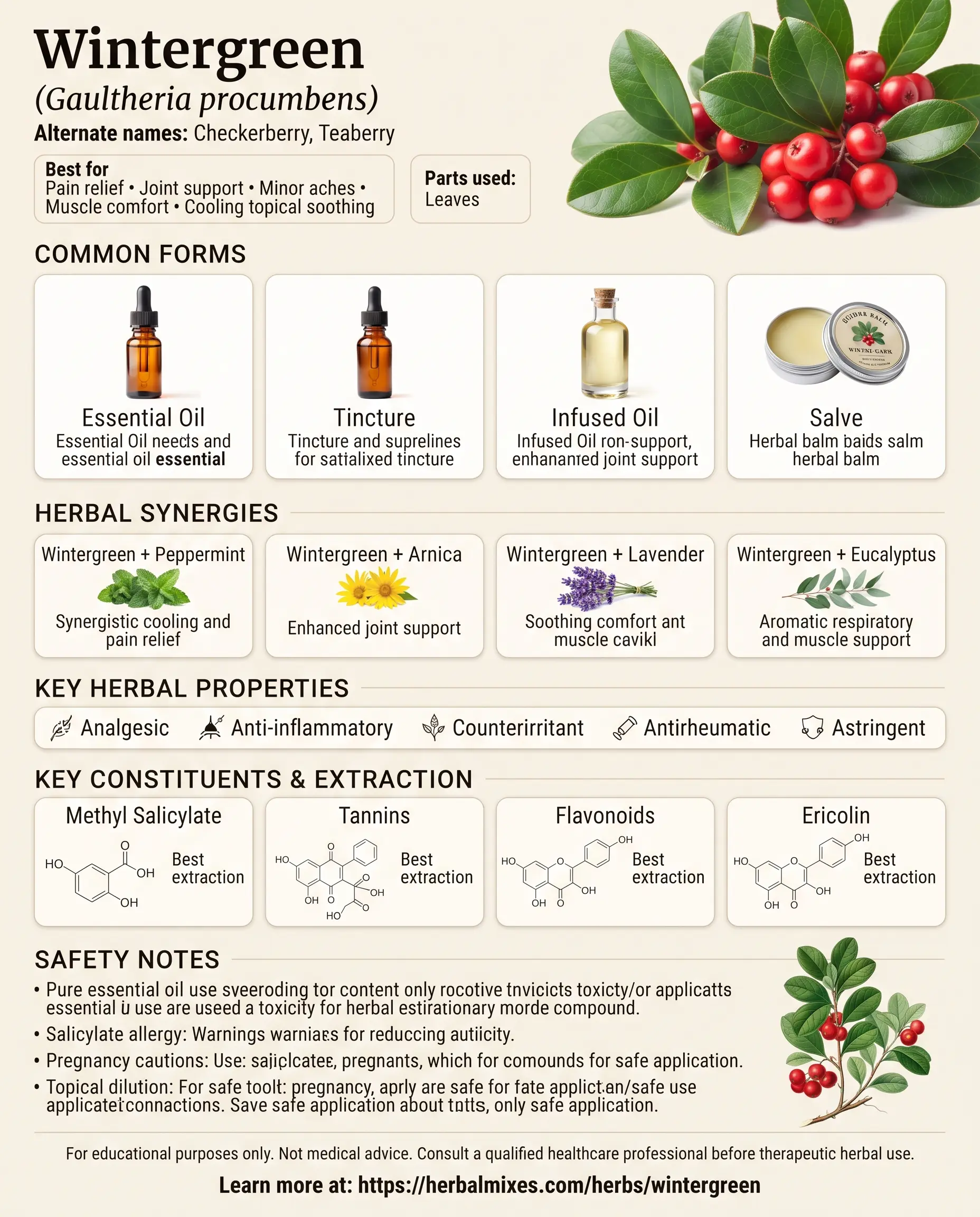
What Wintergreen Is Good For
Sore muscles — Wintergreen oil is commonly used externally in massage oils, liniments, and muscle rubs. Its main constituent, methyl salicylate, is closely related pharmacologically to other salicylates and produces topical analgesic and counterirritant effects.
Minor joint discomfort — Diluted wintergreen oil is traditionally applied to stiff or uncomfortable joints. Modern reviews support plausible anti-inflammatory activity, but direct clinical trials of Gaultheria procumbens preparations are notably lacking. (PubMed Central (PMC))
Exercise-related aches — Properly formulated topical wintergreen products may provide temporary cooling/warming sensory relief after physical activity. Because methyl salicylate can be absorbed through skin, stronger application is not necessarily better.
Inflammatory support — topical / experimental — Wintergreen leaf and essential oil contain salicylate-related compounds, polyphenols, and triterpenes with anti-inflammatory activity demonstrated mainly in laboratory and ex-vivo research. Human clinical evidence for wintergreen itself remains limited. (PubMed Central (PMC))
Aromatic respiratory comfort — Wintergreen’s intense mint-like aroma is sometimes included in inhalation blends, although it is not a primary respiratory medicinal herb and should not be inhaled in excessive concentrations.
Available Herbal Products
Buying Guides for Available Wintergreen Products
Wintergreen Oil – 100% pure steam-distilled Gaultheria procumbens leaf oil. The manufacturer provides lot-specific certificates of analysis and explicitly labels it for external/aromatherapy use rather than ingestion. Seller: NOW Foods – View NOW Wintergreen Oil → (NOW Foods)
Wintergreen Essential Oil – Pure steam-distilled Gaultheria procumbens leaf oil with published GC/MS testing. The manufacturer recommends a maximum topical dilution of 2.4% and specifically cautions against use with blood-thinning medications. Seller: Plant Therapy – View Plant Therapy Wintergreen Essential Oil → (Plant Therapy)
For wintergreen, fewer carefully chosen products are better than a long buying list. Because the essential oil is extremely rich in methyl salicylate and can be toxic if swallowed or overapplied, products with clear botanical identity, GC/MS testing, and strong safety labeling are preferable.
Herbal Synergies
Wintergreen pairs most logically with ginger, peppermint, arnica, lavender, and boswellia depending on whether the goal is muscle comfort, joint support, or post-exercise topical care.
Wintergreen + Ginger
Best for: Sore, stiff muscles
Wintergreen contributes methyl-salicylate-related topical analgesic activity, while ginger adds warming and inflammatory-modulating effects.
Best extraction: Professionally formulated topical oil or balm. Wintergreen essential oil must remain highly diluted rather than being applied neat.
Wintergreen + Peppermint
Best for: Cooling muscle and joint rubs
Wintergreen provides methyl salicylate, while peppermint contributes menthol and a cooling sensory effect.
Best extraction: Diluted topical preparation.
Combining multiple potent essential oils can increase irritation risk, so avoid improvising highly concentrated mixtures.
Wintergreen + Arnica
Best for: Temporary topical support after exertion
Wintergreen contributes counterirritant and salicylate-related effects, while arnica is traditionally used externally for bruised or overworked tissues.
Best extraction: Professionally formulated topical gel, oil, or balm.
Do not apply either ingredient to open wounds.
Wintergreen + Lavender
Best for: Mild muscle tension with a relaxing aromatic component
Wintergreen provides the stronger topical analgesic chemistry, while lavender contributes a gentler aromatic and soothing component.
Best extraction: Carefully diluted topical oil.
Wintergreen + Boswellia
Best for: Joint discomfort
Wintergreen is primarily topical and salicylate-based, while boswellia is usually taken internally as a standardized boswellic-acid extract.
Best extraction: Use them as separate preparations—a diluted wintergreen topical and a standardized boswellia extract—rather than trying to extract them together.
Herbal Properties
Analgesic supportive — topical — Methyl salicylate contributes to temporary relief of minor muscle and joint discomfort.
Anti-inflammatory — experimental / topical — Wintergreen oil and leaf constituents influence inflammatory pathways, though high-quality clinical trials of the herb itself are lacking. (PubMed Central (PMC))
Counterirritant — Topical methyl salicylate creates strong sensory stimulation that can temporarily alter perception of deeper aches.
Antioxidant — Wintergreen leaves contain polyphenols and related antioxidant compounds. (PubMed Central (PMC))
Antimicrobial — experimental — Essential oil demonstrates moderate antimicrobial activity in vitro. (PubMed Central (PMC))
Astringent — traditional leaf use — Leaf tannins and polyphenols contribute mild astringency.
Herbal Constituents
Wintergreen is chemically unusual because its essential oil is dominated overwhelmingly by methyl salicylate, while the leaves also contain salicylate glycosides, polyphenols, flavonoids, and triterpenes.
Methyl Salicylate
Found mainly in: Essential oil produced from the leaves
Methyl salicylate, commonly called oil of wintergreen, is the defining compound of wintergreen essential oil.
It is readily absorbed through skin and can produce systemic salicylate effects. This explains both its topical pain-relieving action and its significant toxicity risk.
Best extraction: Steam distillation after enzymatic liberation from leaf precursors.
This compound should not be maximized through DIY extraction or taken internally.
Gaultherin
Found mainly in: Leaves
Gaultherin is a naturally occurring methyl-salicylate glycoside found in Gaultheria species.
Enzymatic breakdown can release methyl salicylate.
Best extraction: Water and hydroalcoholic preparations can extract glycosides, but concentrated self-preparation is not recommended because salicylate exposure becomes difficult to predict.
Methyl Salicylate Glycosides
Found mainly in: Leaves
Wintergreen contains several salicylate-related glycosides that serve as precursors to the characteristic essential-oil chemistry.
Best extraction: Water or diluted alcohol, although medicinal use today generally favors standardized commercial topical products.
Quercetin Derivatives
Found mainly in: Leaves and aerial tissues
Quercetin-related flavonoids contribute antioxidant and inflammatory-modulating effects.
Best extraction: Hot water or hydroalcoholic extraction.
Proanthocyanidins
Found mainly in: Leaves
These polyphenols contribute antioxidant activity and mild astringency.
Best extraction: Hot water or water-alcohol mixtures.
Ursolic Acid
Found mainly in: Leaves
Ursolic acid is a triterpene with experimental anti-inflammatory activity.
Best extraction: Alcohol-rich or lipid-compatible extraction.
Tannins
Found mainly in: Leaves
Tannins contribute astringency and traditional tissue-toning effects.
Best extraction: Hot water.
Key Herbal Properties
Analgesic supportive — topical — Methyl salicylate contributes to temporary relief of minor muscle and joint discomfort.
Anti-inflammatory — experimental / topical — Wintergreen oil and leaf constituents influence inflammatory pathways, though high-quality clinical trials of the herb itself are lacking. (PubMed Central (PMC))
Counterirritant — Topical methyl salicylate creates strong sensory stimulation that can temporarily alter perception of deeper aches.
Antioxidant — Wintergreen leaves contain polyphenols and related antioxidant compounds. (PubMed Central (PMC))
Antimicrobial — experimental — Essential oil demonstrates moderate antimicrobial activity in vitro. (PubMed Central (PMC))
Astringent — traditional leaf use — Leaf tannins and polyphenols contribute mild astringency.





Active Compounds
Wintergreen is chemically unusual because its essential oil is dominated overwhelmingly by methyl salicylate, while the leaves also contain salicylate glycosides, polyphenols, flavonoids, and triterpenes.
Methyl Salicylate
Found mainly in: Essential oil produced from the leaves
Methyl salicylate, commonly called oil of wintergreen, is the defining compound of wintergreen essential oil.
It is readily absorbed through skin and can produce systemic salicylate effects. This explains both its topical pain-relieving action and its significant toxicity risk.
Best extraction: Steam distillation after enzymatic liberation from leaf precursors.
This compound should not be maximized through DIY extraction or taken internally.
Gaultherin
Found mainly in: Leaves
Gaultherin is a naturally occurring methyl-salicylate glycoside found in Gaultheria species.
Enzymatic breakdown can release methyl salicylate.
Best extraction: Water and hydroalcoholic preparations can extract glycosides, but concentrated self-preparation is not recommended because salicylate exposure becomes difficult to predict.
Methyl Salicylate Glycosides
Found mainly in: Leaves
Wintergreen contains several salicylate-related glycosides that serve as precursors to the characteristic essential-oil chemistry.
Best extraction: Water or diluted alcohol, although medicinal use today generally favors standardized commercial topical products.
Quercetin Derivatives
Found mainly in: Leaves and aerial tissues
Quercetin-related flavonoids contribute antioxidant and inflammatory-modulating effects.
Best extraction: Hot water or hydroalcoholic extraction.
Proanthocyanidins
Found mainly in: Leaves
These polyphenols contribute antioxidant activity and mild astringency.
Best extraction: Hot water or water-alcohol mixtures.
Ursolic Acid
Found mainly in: Leaves
Ursolic acid is a triterpene with experimental anti-inflammatory activity.
Best extraction: Alcohol-rich or lipid-compatible extraction.
Tannins
Found mainly in: Leaves
Tannins contribute astringency and traditional tissue-toning effects.
Best extraction: Hot water.
FAQ
What is wintergreen best used for?
Modern wintergreen is best suited to carefully diluted topical preparations for temporary muscle and joint comfort.
Its essential oil is too concentrated for casual internal use.
Is wintergreen the same as peppermint?
No.
Wintergreen is Gaultheria procumbens and its essential oil is dominated by methyl salicylate. Peppermint is Mentha × piperita and is dominated by menthol and menthone.
Their aromas may both seem minty, but their chemistry and safety profiles are very different.
Can wintergreen essential oil be swallowed?
No.
NOW Foods explicitly lists wintergreen among essential oils that should never be taken internally, and concentrated methyl salicylate can cause severe or fatal salicylate poisoning. (NOW Foods)
Can wintergreen oil be applied directly to skin?
It should not be used undiluted.
Plant Therapy recommends a maximum topical dilution of 2.4% and advises avoiding wintergreen in several high-risk groups. (Plant Therapy)
Is wintergreen safer because it is natural?
No.
A small bottle of concentrated wintergreen oil contains a large amount of methyl salicylate. Natural origin does not reduce its pharmacological potency or poisoning risk.
Safety & Precautions
Wintergreen essential oil deserves high-caution handling because of its extremely concentrated methyl salicylate content.
Never Swallow Wintergreen Essential Oil
Ingestion can cause rapid and severe salicylate poisoning.
Possible symptoms include:
- nausea and vomiting;
- ringing in the ears;
- dizziness;
- rapid breathing;
- sweating;
- confusion;
- metabolic disturbances;
- seizures;
- coma.
Concentrated methyl salicylate poisoning can be fatal. (PubMed)
If wintergreen oil is swallowed, contact Poison Control at 1-800-222-1222 in the United States or seek urgent medical care.
Do not induce vomiting unless instructed by a medical professional.
Blood Thinners & Aspirin
Wintergreen should generally be avoided by people taking:
- warfarin;
- aspirin;
- clopidogrel;
- apixaban;
- rivaroxaban;
- other anticoagulants or antiplatelet medicines.
Excessive topical methyl salicylate exposure has been associated with clinically important interactions and bleeding in people taking warfarin. (PubMed)
People with aspirin or salicylate allergy should also avoid wintergreen.
Children
Wintergreen essential oil should be kept completely out of reach of children.
Plant Therapy recommends complete avoidance through age 12. (Plant Therapy)
Children are particularly vulnerable to salicylate poisoning.
Viral Illness & Reye Syndrome Concern
Avoid wintergreen in children and adolescents during or shortly after viral illnesses because salicylate exposure raises concern related to Reye syndrome.
Plant Therapy specifically advises against use during or shortly after viral fever. (Plant Therapy)
Pregnancy & Breastfeeding
Avoid concentrated wintergreen essential oil during pregnancy and breastfeeding.
Plant Therapy specifically lists both as contraindications for its wintergreen oil. (Plant Therapy)
Topical Overuse
Methyl salicylate can be absorbed through the skin.
Risk increases when wintergreen is:
- applied over large areas;
- used repeatedly;
- used at high concentrations;
- applied under tight bandages;
- combined with heating pads;
- applied to damaged skin.
Do not use wintergreen oil with external heat.
Skin Reactions
Topical methyl salicylate products can cause:
- skin irritation;
- allergic contact dermatitis;
- burning;
- rarely serious allergic reactions. (PubMed)
Stop use if significant redness, blistering, swelling, or breathing difficulty develops.
Kidney, Liver & Bleeding Disorders
Avoid unsupervised wintergreen use if you have:
- kidney disease;
- significant liver disease;
- bleeding disorders;
- active stomach ulcers;
- salicylate-sensitive asthma.
These conditions may increase the risk associated with systemic salicylate exposure.
Pets
Keep concentrated wintergreen oil away from pets.
Do not apply it to cats, dogs, or other animals unless specifically directed by a veterinarian.
Anyone taking anticoagulants, aspirin, or other salicylates, or anyone who is pregnant, breastfeeding, treating a child, or managing kidney disease, bleeding disorders, ulcers, or aspirin sensitivity should avoid therapeutic wintergreen unless specifically advised by an appropriate healthcare professional.
References
- PubMed Central — Phytochemistry and Biological Profile of Gaultheria procumbens and Wintergreen Essential Oil
- PubMed — Wintergreen Review: Gaultheria procumbens
- PubMed — Potential Dangers From Topical Preparations Containing Methyl Salicylate
- NOW Foods — Wintergreen Oil
- NOW Foods — Essential Oils That Should Never Be Taken Internally
- Plant Therapy — Wintergreen Essential Oil
Disclaimer
Disclaimer: This article is for educational purposes only and is not intended to diagnose, treat, cure, or prevent any disease. Herbal products can cause side effects and interact with medications. Consult a qualified healthcare professional before using herbs therapeutically, especially if you are pregnant, breastfeeding, taking prescription medications, or managing a medical condition.